
Verwandte Artikel zu Blue Italian
Inhaltsangabe
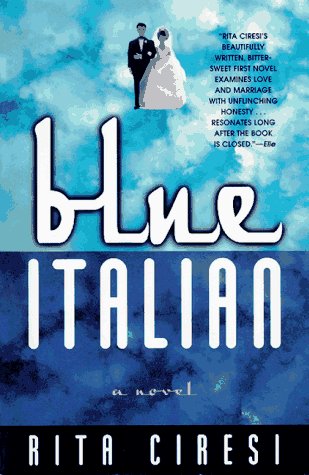
In a bittersweet debut novel, a young, wise-cracking, working-class Italian woman from Connecticut sees her dreams of perfect love fulfilled by a Jewish lawyer from New York, until he is diagnosed with a terminal illness. Reprint.
Die Inhaltsangabe kann sich auf eine andere Ausgabe dieses Titels beziehen.
Über die Autorin bzw. den Autor
Rita Ciresi is the author of Mother Rocket, which won the Flannery O'Connor Award for Short Fiction, and the novels Pink Slip and Blue Italian. She lives with her husband and daughter in Florida.
Von der hinteren Coverseite
Skillfully capturing the daily quirks of life in a boisterous, working-class ethnic family--daily assaulted by family clamor, endless courses of food, embarrassment and fierce love--"Blue Italian traces the pitfalls of the young life and three-year marriage of a wise-cracking and heart-winning heroine, Rosa Salvatore. With an ear for acid dialogue and an eye for everyday ironies, Ciresi unfolds Rosa Salvatore's tale: growing up on fantasies, guilt, and fagioli in the New Haven working-class Italian neighborhood of Pizza Beach; working her way through a local college by slinging hash, while agonizing over her thighs and aching for passion; landing a job and meeting Gary Fisher, a nice Jewish lawyer from Flushing with a great butt and angst of his own. Rosa and Gary fall in love, make love, get married, fight, make up, fight again--until Gary is diagnosed with a terminal illness, and Rosa realizes the power of her love--and the crushing force of regret.
Frank and warm, crackling with razor-sharp wit, "Blue Italian is a love story about an ill-fated couple who almost missed realizing how much they loved each other. It establishes Rita Ciresi as a writer with a unique gift for language, character, and emotion--a novelist to read, and a novelist to watch.
Aus dem Klappentext
apturing the daily quirks of life in a boisterous, working-class ethnic family--daily assaulted by family clamor, endless courses of food, embarrassment and fierce love--Blue Italian traces the pitfalls of the young life and three-year marriage of a wise-cracking and heart-winning heroine, Rosa Salvatore. With an ear for acid dialogue and an eye for everyday ironies, Ciresi unfolds Rosa Salvatore's tale: growing up on fantasies, guilt, and fagioli in the New Haven working-class Italian neighborhood of Pizza Beach; working her way through a local college by slinging hash, while agonizing over her thighs and aching for passion; landing a job and meeting Gary Fisher, a nice Jewish lawyer from Flushing with a great butt and angst of his own. Rosa and Gary fall in love, make love, get married, fight, make up, fight again--until Gary is diagnosed with a terminal illness, and Rosa realizes the power of her love--and the crushing force of regret.
Frank and warm, crackli
Auszug. © Genehmigter Nachdruck. Alle Rechte vorbehalten.
Gary Alan Fisher had cancer. He was thirty-one years old and he was going to die.
It felt like an earthquake when the doctor told him. Not that Gary had much experience with cataclysmic events. But once, when he was eleven, his parents took him on a trip out west. While visiting cousins in L.A., the Fishers went walking on the cliffs above Santa Monica Beach. Gary remembered some intense discussion between the East-Coast and West-Coast relatives about which afforded the more spectacular view-the palisades that towered above the calm Hudson River or those that overlooked the huge, green Pacific Ocean.
Then, all of a sudden, Gary felt his feet start to vibrate. The lampposts and park benches
quivered and the asphalt path shifted slightly to the right. Gary looked up at his parents. Their
mouths were moving, but he couldn't hear what they said because their voices were
overwhelmed by a low and deep rumbling that seemed to come from the center of the earth. The ground was a wave of soil, and for a moment, the cliffs seemed ready to slide into the ocean.
The earthquake was the scariest thing that had ever happened to the Fishers. But it also was oddly comforting. After the ground ceased to shake, Artie grabbed Mimi's hand, and Mimi grabbed Gary's hand, and they stood there, in the middle of the path, surprised the sun was still shining and they were all still alive.
The California cousins were amused. They called out numbers 3.5, maybe 4.0 (anything more and glass would have shattered in the condominiums across the street)-as if the earthquake(tremor, really) were a short quiz show, staged by God, to test how accurately they could recognize the different gradations on the Richter scale.
Clearly it was not the thing to be alarmed. So Gary claimed the earthquake was cool. God, it was the coolest!
Mimi's face went pale. She pinched her son on the back of his neck. In her book, there was nothing cool about dying, nothing cool about being on the verge of disappearing right off the face of the earth. Gary could have been killed-he could have been crushed to bits, like ice in a Waring blender.
The West-Coast cousins indulged in mellow laughter.
The week after they returned home to Long Island, the Fishers gave a dinner party. Drinks and unsalted cashews were served on the patio. When asked how he had enjoyed the trip, Artie immediately launched into the story of the earthquake. He pulled out a small, vibrating pillow that Mimi had given him for his birthday to help soothe his bad back and pressed the pillow against each guest's cheek. The pillow let out a low tremolo of pulsation, making the jowls of each person shiver and shake. "Now that's an earthquake," Artie said. "That's what it feels like."
"We felt like ice," Mimi kept repeating, "being crushed to bits in a Waring blender!"
"And how about you?" the guests asked Gary as they chewed on cashews and rattled their mixed drinks. "Did you like it?"
Gary watched Artie press the vibrating pillow against the heavy cheek of Itzie Katz, Gary's dentist and just about the biggest dogbreathed moron ever placed on the planet. Gary was appalled. Now he never would be able to whack off with that pillow again! His father was a fool. These dinner parties, which his mother forced him to attend, were absurd. The guests were
cretins and the conversation was inane.
Gary curled his lip and answered, "Yeah, the earthquake was cool. It felt like the earth let rip a big, killer fart."
The silence was so sustained that Gary could hear the ice cubes melting in the mixed drinks. Mimi gave Gary a murderous glare that promised some form of dire punishment and a long lecture on the inappropriateness of discussing abdominal disorders-i.e., farts while having drinks out on the patio, or, for that matter, at any other point of a dinner party. Artie looked puzzled, then laughed. His son was such a joker, a real wisenheimer! He should be a stand-up comic. He should write for Hollywood pictures. Then he could live in L.A. and be a kid for the rest of his life. Because, bar none, Artie had never seen so many adults acting like four-year-olds as he had in California.
"You should have seen Meem's cousins," Artie told his guests. "The ground was shaking like crazy and they just stood there and laughed like hyenas, as if the whole world were a Technicolor movie, and everything would come out all right in the end."
For some odd reason, Gary remembered the earthquake, and that conversation out on the patio, when the doctor told him he had cancer. As if the whole world were a Technicolor movie... he kept hearing his father say.
Gary sat in a straight-back chair opposite a light box that displayed the results of his ultrasound. Each of the five black and white images showed a different angle of his prostate gland. An ominous shadow, its position slightly shifted in each picture, darkened every screen.
The doctor was Indian. Dr. Harish Mehta. In a high, singsong voice, he described Gary's tumor as if he shared it. What we have here is....We seem to be looking at....We face surgery....Dr. Mehta's voice became higher and thinner as he continued to speak, until the sound disappeared, reminding Gary of the dog whistles he used to see advertised on the Bazooka chewing gum comics: A pitch so high it is indecipherable to the human ear!
Gary no longer heard the doctor. He felt himself freeze, then hum, as if he had covered a comb with wax paper and was playing it like a harmonica, until his lips and face and then his whole body started to vibrate. Yet this sensation did not seem to originate within himself. It came from some outside, unknown force. It was the world itself. It was the voice of the universe, playing Gary like a ventriloquist played a dummy.
Gary felt the vibration inside him for several seconds. Then it disappeared as fast as it came, and Dr. Mehta was asking him if he understood, and Gary had to say, "I was listening. Swear to God. But I didn't hear you. God, could you start all over again?"
So Dr. Mehta took his finger and pointed at the first ultrasound. And Gary, whose photographic memory had gotten him through Simon Wiesenthal Academy, Columbia, and the majority of Yale Law with straight As, was so dazed he had to ask Dr. Mehta for a piece of paper and a pencil. He sat there in his chair, staring at the first ultrasound image as if it were a world map or a periodic table of the elements, and he took notes on his own illness. He even raised his hand
when he had a question. "How do you spell that?" he asked when Dr. Mehta said prednisone. "How long is the surgery? How many stitches?" He scribbled with his pencil and then looked at the sheet of paper. He did not ask the real question nagging inside of him (Christ, why did I get this?) but only "Is it going to work?"
Dr. Mehta pulled out all his stock doctorly phrases. We have excellent chances of recovery. But no guarantees. First, surgery. And then we must have faith.
Dr. Mehta's calm, lilting tones soothed Gary. If Gary closed his eyes, he almost could imagine himself conversing with a Brahman on a hillside. Gary liked this doctor. He wanted to like him. Yes, he fervently did, because he had read somewhere, long ago, that having a good relationship with your physician was an essential ingredient for recovery from cancer or any other grave illness. He wasn't sure where the article had appeared-in some magazine he had perused while waiting to have his eyes examined--Psychology Today or American Health? Or had it been in some unlikely source, such as the Times magazine or Smithsonian?
Ah, he was sick, he was sick! His memory already was starting to fail...
„Über diesen Titel“ kann sich auf eine andere Ausgabe dieses Titels beziehen.
Suchergebnisse für Blue Italian

Beispielbild für diese ISBN
Blue Italian
Verlag:
Random House Publishing Group, 1997
ISBN 10: 0385319401
ISBN 13: 9780385319409
Gebraucht
Softcover
Anbieter: Better World Books, Mishawaka, IN, USA
Verkäuferbewertung 5 von 5 Sternen

Zustand: Good. Pages intact with minimal writing/highlighting. The binding may be loose and creased. Dust jackets/supplements are not included. Stock photo provided. Product includes identifying sticker. Better World Books: Buy Books. Do Good. Artikel-Nr. 3234434-6
Gebraucht kaufen
EUR 6,57
Versand gratis
Versand innerhalb von USA
Versand innerhalb von USA
Anzahl: 2 verfügbar
Beispielbild für diese ISBN
Blue Italian
Anbieter: World of Books (was SecondSale), Montgomery, IL, USA
Verkäuferbewertung 5 von 5 Sternen
Zustand: Acceptable. Item in good condition. Textbooks may not include supplemental items i.e. CDs, access codes etc. Artikel-Nr. 00059412914
Gebraucht kaufen
EUR 6,93
Versand gratis
Versand innerhalb von USA
Versand innerhalb von USA
Anzahl: 1 verfügbar
Beispielbild für diese ISBN
Blue Italian
Verlag:
Random House Publishing Group, 1997
ISBN 10: 0385319401
ISBN 13: 9780385319409
Gebraucht
Softcover
Anbieter: Better World Books Ltd, Dunfermline, Vereinigtes Königreich
Verkäuferbewertung 5 von 5 Sternen
Zustand: Very Good. Former library copy. Pages intact with possible writing/highlighting. Binding strong with minor wear. Dust jackets/supplements may not be included. Includes library markings. Stock photo provided. Product includes identifying sticker. Better World Books: Buy Books. Do Good. Artikel-Nr. 18285149-20
Gebraucht kaufen
EUR 5,72
EUR 5,90 Versand
Versand von Vereinigtes Königreich nach USA
Versand von Vereinigtes Königreich nach USA
Anzahl: 1 verfügbar
Beispielbild für diese ISBN
Blue Italian
Anbieter: Robinson Street Books, IOBA, Binghamton, NY, USA
Verkäuferbewertung 4 von 5 Sternen

Paperback. Zustand: Good. Prompt Shipment, shipped in Boxes, Tracking PROVIDEDGood, pages little tan, some creasing.*. Artikel-Nr. nt760dr828
Gebraucht kaufen
EUR 12,42
EUR 8,48 Versand
Versand innerhalb von USA
Versand innerhalb von USA
Anzahl: 1 verfügbar
Beispielbild für diese ISBN
Blue Italian
Anbieter: Robinson Street Books, IOBA, Binghamton, NY, USA
Verkäuferbewertung 4 von 5 Sternen
Paperback. Zustand: Very Good. Prompt Shipment, shipped in Boxes, Tracking PROVIDEDVery good, some creasing. *. Artikel-Nr. lower30kr1595
Gebraucht kaufen
EUR 12,42
EUR 8,48 Versand
Versand innerhalb von USA
Versand innerhalb von USA
Anzahl: 1 verfügbar