
Verwandte Artikel zu To Dance With the Devil: The New War on Breast Cancer
Inhaltsangabe
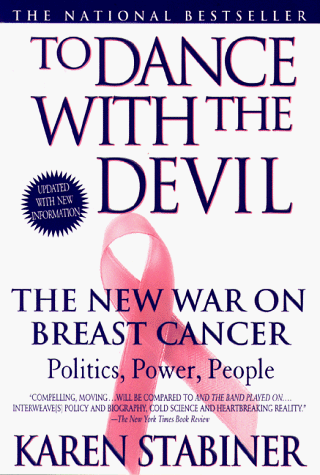
Based on more than three years of research and interviews, and weaving together the latest scientific research and public policy with stories of the human toll of the disease, this behind-the-scenes account looks at the battle against breast cancer. Reprint.
Die Inhaltsangabe kann sich auf eine andere Ausgabe dieses Titels beziehen.
Über die Autorin bzw. den Autor
Karen Stabiner, whose work has appeared in the Los Angeles Times, The New York Times, and The New Yorker, is the author of Inventing Desire, an acclaimed portrait of contemporary American advertising, among other books. She lives in Santa Monica, California, with her husband and daughter.
Aus dem Klappentext
ee years of in-depth research and scores of firsthand interviews with the nation's most innovative doctors, scientists, policymakers, and activists, To Dance with the Devil combines medical detective story with political journalism in an unprecedented behind-the-scenes account of the new war against breast cancer.
Interweaving the latest scientific findings and public policy with the gripping human stories of clinicians and patients grappling with the disease firsthand, Karen Stabiner chronicles a year at the groundbreaking UCLA Breast Center, following the progress of Dr. Susan Love, the eminent breast surgeon and author, and a number of Love's patients. From UCLA, her narrative spirals out to examine the turbulent national scene, moving from the White House and the halls of Congress to the cutting-edge labs of leading genetic researchers, from glittering charity events to bureaucratic offices where life-and-death decisions are filtered through the unforgiving lens of cost-b
Auszug. © Genehmigter Nachdruck. Alle Rechte vorbehalten.
October 1993: Washington, D.C.
It took Fran Visco two years to get into the White House. The first time she tried, in 1991, she got only as far as a guarded, locked gate where she loaded boxes containing 140,000 letters onto a conveyor belt. As the boxes were carried away she joked to her friends that they would probably ride straight through, out the back door and into an incinerator. President Bush would never see them.
In fact, no one ever acknowledged that the letters had arrived. She went home to Philadelphia to start over.
On October 18, 1993, she stood in a small room just off the East Room, talking with Health and Human Services Secretary Donna Shalala and Dr. Susan Love, director of the UCLA Breast Center and cofounder of the National Breast Cancer Coalition (NBCC), the two-and-a-half-year-old advocacy group that had twice waged a campaign for a national strategy against breast cancer. They were waiting for President Clinton and the First Lady to arrive, to accept Visco's latest offering. The boxes were piled in a lopsided pyramid at the back of a small stage in the East Room: Petitions that contained 2.6 million signatures, representing the 1.6 million women in the United States who knew they had breast cancer, and the one million who already had the disease but had not yet been diagnosed.
Visco, a forty-five-year-old corporate lawyer, was the president of the National Breast Cancer Coalition. Since May 1991 the Coalition had been fighting for research dollars and a strategy on how best to spend them. In fifteen minutes she would be seated onstage in front of all those boxes, listening to President Clinton outline a plan that was as much Fran's as anyone's.
She and Love had set out to dismantle the civilized conspiracy that had hobbled medicine's progress against breast cancer since the mid-1800s, when American and British surgeons began to define a therapeutic approach. Before that, much of what passed for treatment was based on anecdote and superstition; afterward, on often misguided heroics, as though to compensate for the clumsiness of the past.
It was not a conscious plot; not even willful disregard. It was somehow worse: layer upon layer of silence and neglect, of therapies whose use far outlasted their efficacy, and research budgets that focused almost exclusively on men's diseases. The three most potent threats to a woman's health--heart disease, breast cancer, and osteoporosis--went virtually ignored. There was not enough money to keep women from getting sick, only a desperate scramble to save them once they did.
It did not work. One third of all women who developed breast cancer eventually died of it. That had been true for fifty years--but the Coalition was determined to buy a better future. The National Institutes of Health (NIH), which conducted most of the government's health care research, had to Visco's mind embarrassed itself with paltry breast cancer budgets--$90 million in fiscal 1990, $100 million the next year, and $155 million in fiscal 1992. The Coalition had lobbied until Congress found an additional $210 million for the fiscal 1993 budget, a windfall from the peacetime Department of Defense, which had been led into the fray, kicking and screaming, by Visco and a handful of sympathetic politicians who insisted that breast cancer was a perfectly reasonable topic for army research.
Between the army's two-year program and the NIH, which had managed an $80 million increase in its own breast cancer budget for fiscal 1993, the government had allocated over $400 million in research dollars, almost triple the 1992 budget--enough to jump-start a stalled research effort, the result of too little money and too little imagination. Better still, Visco's proprietary role in the army program had won her the chance to change the way that money was spent. The government's delicate label for patients was "consumers." Fran Visco would be the first consumer to actively participate in the grant review process, which meant that she could help to steer the money away from endless treatment regimens and into more promising work on prevention or cure. The Coalition had won not just money, but authority. Patients had their foot firmly inside a door that had always been closed to them.
The East Room reception was the crowning event of National Breast Cancer Awareness Month, and Visco had organized it down to the last detail. Ronald Perelman, the billionaire owner of the Revlon Group and one of the Coalition's financial angels, had underwritten part of the petition drive, but as usual the effort had depended on volunteer labor and donated supplies, and Visco was determined to acknowledge that contribution. She did not want celebrities like Revlon models Lauren Hutton and Veronica Webb onstage, or even in the front row of the audience, because they would distract the media. She insisted that many of the seats in the East Room be awarded to "just folks" who had collected signatures. If the Coalition was to grow and sustain its effort, she needed people, lots of them, all around the country. Rewarding the volunteers was the best way to ensure that they went home and got back to work.
She knew what she wanted President Clinton to say to them. More than anything, Visco wanted him to refer to breast cancer as an epidemic. An epidemic required a solution, however long that took. If he started using the word it would be easier to get funding next year.
She knew what the resistance was. Visco had debated the linguistic point on countless radio talk shows with scientists who preferred the formal definition of the term. Breast cancer was not a true epidemic like AIDS. It had not exploded out of nowhere, nor did it spread from one person to another, nor was there as dramatic a rise in incidence. Epidemic was a literal distinction, they reminded her, not an emotional state.
Visco was always quick to reply that there was a second definition of epidemic--an ongoing, inexplicable increase in incidence--that certainly applied to breast cancer.
The more she had to explain it the angrier she got. Surely the numbers were convincing without her help: 182,000 women got breast cancer every year and 46,000 died. Between 1990 and 2000 nearly a half million women would die of the disease, the most commonly diagnosed cancer in women and the second most fatal after lung cancer. Among African-American women it was the most lethal cancer because it often was detected at a later stage. A woman's lifetime risk of developing breast cancer--the chance that she would develop the disease if she lived to be eighty-five--was one in eight, up from one in twenty when Visco was born.
Worse yet, there seemed to be nothing a woman could do to improve her odds. Cigarettes caused lung disease, and that simple causal link gave a woman an obvious tool: the best way to avoid lung cancer was to stop smoking or not start. Breast cancer had so far resisted medicine's best hunches about prevention. It claimed vegetarians, women on low-fat diets, women who were fat, women who were thin and fit--anyone.
Other ailments presented a greater statistical danger. A woman's lifetime risk of developing heart disease was one in two; adult-onset diabetes or alcoholism, one in three; a stroke, one in five; a hip fracture, one in seven. But rational fact was no consolation. Women reported that they...
„Über diesen Titel“ kann sich auf eine andere Ausgabe dieses Titels beziehen.
Suchergebnisse für To Dance With the Devil: The New War on Breast Cancer

Beispielbild für diese ISBN
The Dance with the Devil: The New War on Breast Cancer
Anbieter: World of Books (was SecondSale), Montgomery, IL, USA
Verkäuferbewertung 5 von 5 Sternen

Paperback. Zustand: Good. Artikel-Nr. 00096562259
Gebraucht kaufen
EUR 4,68
Versand gratis
Versand innerhalb von USA
Versand innerhalb von USA
Anzahl: 2 verfügbar
Beispielbild für diese ISBN
To Dance with the Devil: The New War on Breast Cancer; Politics, Power, People
Anbieter: ThriftBooks-Dallas, Dallas, TX, USA
Verkäuferbewertung 5 von 5 Sternen
Paperback. Zustand: Good. No Jacket. Pages can have notes/highlighting. Spine may show signs of wear. ~ ThriftBooks: Read More, Spend Less. Artikel-Nr. G0385312873I3N00
Gebraucht kaufen
EUR 6,54
Versand gratis
Versand innerhalb von USA
Versand innerhalb von USA
Anzahl: 1 verfügbar
Beispielbild für diese ISBN
To Dance with the Devil: The New War on Breast Cancer; Politics, Power, People
Anbieter: ThriftBooks-Dallas, Dallas, TX, USA
Verkäuferbewertung 5 von 5 Sternen
Paperback. Zustand: Very Good. No Jacket. May have limited writing in cover pages. Pages are unmarked. ~ ThriftBooks: Read More, Spend Less. Artikel-Nr. G0385312873I4N00
Gebraucht kaufen
EUR 6,54
Versand gratis
Versand innerhalb von USA
Versand innerhalb von USA
Anzahl: 1 verfügbar
Beispielbild für diese ISBN
To Dance with the Devil: The New War on Breast Cancer; Politics, Power, People
Anbieter: Wonder Book, Frederick, MD, USA
Verkäuferbewertung 5 von 5 Sternen
Zustand: Good. Good condition. A copy that has been read but remains intact. May contain markings such as bookplates, stamps, limited notes and highlighting, or a few light stains. Artikel-Nr. L09C-04262
Gebraucht kaufen
EUR 6,70
Versand gratis
Versand innerhalb von USA
Versand innerhalb von USA
Anzahl: 1 verfügbar
Beispielbild für diese ISBN
To Dance With the Devil: The New War on Breast Cancer
Anbieter: AwesomeBooks, Wallingford, Vereinigtes Königreich
Verkäuferbewertung 5 von 5 Sternen
Paperback. Zustand: Very Good. To Dance With the Devil: The New War on Breast Cancer This book is in very good condition and will be shipped within 24 hours of ordering. The cover may have some limited signs of wear but the pages are clean, intact and the spine remains undamaged. This book has clearly been well maintained and looked after thus far. Money back guarantee if you are not satisfied. See all our books here, order more than 1 book and get discounted shipping. Artikel-Nr. 7719-9780385312875
Gebraucht kaufen
EUR 105,98
EUR 4,94 Versand
Versand von Vereinigtes Königreich nach USA
Versand von Vereinigtes Königreich nach USA
Anzahl: 1 verfügbar
Beispielbild für diese ISBN
To Dance With the Devil: The New War on Breast Cancer
Anbieter: Bahamut Media, Reading, Vereinigtes Königreich
Verkäuferbewertung 4 von 5 Sternen

Paperback. Zustand: Very Good. Shipped within 24 hours from our UK warehouse. Clean, undamaged book with no damage to pages and minimal wear to the cover. Spine still tight, in very good condition. Remember if you are not happy, you are covered by our 100% money back guarantee. Artikel-Nr. 6545-9780385312875
Gebraucht kaufen
EUR 105,98
EUR 8,38 Versand
Versand von Vereinigtes Königreich nach USA
Versand von Vereinigtes Königreich nach USA
Anzahl: 1 verfügbar