
Verwandte Artikel zu Common Sense: and Other Writings (Modern Library Classics)
Inhaltsangabe
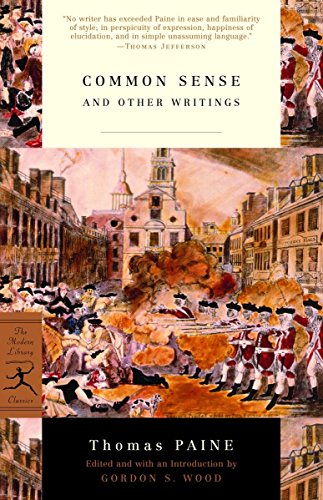
Includes the complete texts of Common Sense; Rights of Man, Part the Second; The Age of Reason (part one); Four Letters on Interesting Subjects, published anonymously and just discovered to be Paine’s work; and Letter to the Abbé Raynal, Paine’s first examination of world events; as well as selections from The American Crises
In 1776, America was a hotbed of enlightenment and revolution. Thomas Paine not only spurred his fellow Americans to action but soon came to symbolize the spirit of the Revolution. His elegantly persuasive pieces spoke to the hearts and minds of those fighting for freedom. He was later outlawed in Britain, jailed in France, and finally labeled an atheist upon his return to America.
Die Inhaltsangabe kann sich auf eine andere Ausgabe dieses Titels beziehen.
Über die Autorin bzw. den Autor
Thomas Paine was born in Norfolk, England, on January 29, 1737. He received a basic education in history, mathematics, and science, but left school at age 13 to apprentice in his father's corsetmaking shop. In 1757, he spent time at sea aboard the privateer ship King of Prussia, and later found employment as a journeyman staymaker in London. All the while, Paine continued to study on his own, influenced by the work of two leading figures of the Enlightenment, Isaac Newton and John Locke. He began writing political pamphlets, and at the urging of Benjamin Franklin, emigrated to Philadelphia in 1774 to work as an editor for The Pennsylvania Magazine. In 1776, he published Common Sense, which called for America's political freedom from England. The pamphlet sold more than 150,000 copies in three months. Paine next published The American Crisis during the Revolutionary War, inspiring George Washington to read it to his troops at Valley Forge. By the end of the Revolution, however, Paine's influence had run its course, and he fell out of political favor. He returned to Europe, where he published his treatise Rights of Man, which led to his arrest on charges of high treason. Disillusioned with life abroad, he returned to the U.S. to find himself vilifed as an agitator and atheist. He died in obscurity in New York City in 1809.
Von der hinteren Coverseite
Includes the complete texts of "Common Sense; Rights of Man, Part the Second; The Age of Reason (part one); "Four Letters on Interesting Subjects, published anonymously and just discovered to be Paine's work; and "Letter to the Abbe Raynal, Paine's first examination of world events; as well as selections from "The American Crises
In 1776, America was a hotbed of enlightenment and revolution. Thomas Paine not only spurred his fellow Americans to action but soon came to symbolize the spirit of the Revolution. His elegantly persuasive pieces spoke to the hearts and minds of those fighting for freedom. He was later outlawed in Britain, jailed in France, and finally labeled an atheist upon his return to America.
Auszug. © Genehmigter Nachdruck. Alle Rechte vorbehalten.
Introduction
Perhaps the sentiments contained in the following pages, are not yet sufficiently fashionable to procure them general favor; a long habit of not thinking a thing wrong, gives it a superficial appearance of being right, and raises at first a formidable outcry in defence of custom. But the tumult soon subsides. Time makes more converts than reason.
As a long and violent abuse of power, is generally the Means of calling the right of it in question (and in Matters too which might never have been thought of, had not the Sufferers been aggravated into the inquiry) and as the King of England hath undertaken in his own Right, to support the Parliament in what he calls Theirs, and as the good people of this country are grievously oppressed by the combination, they have an undoubted privilege to inquire into the pretensions of both, and equally to reject the usurpation of either.
In the following sheets, the author hath studiously avoided every thing which is personal among ourselves. Compliments as well as censure to individuals make no part thereof. The wise, and the worthy, need not the triumph of a pamphlet; and those whose sentiments are injudicious, or unfriendly, will cease of themselves unless too much pains are bestowed upon their conversion.
The cause of America is in a great measure the cause of all mankind. Many circumstances hath, and will arise, which are not local, but universal, and through which the principles of all Lovers of Mankind are affected, and in the Event of which, their Affections are interested. The laying a Country desolate with Fire and Sword, declaring War against the natural rights of all Mankind, and extirpating the Defenders thereof from the Face of the Earth, is the Concern of every Man to whom Nature hath given the Power of feeling; of which Class, regardless of Party Censure, is the
author.
P. S. The Publication of this new Edition hath been delayed, with a View of taking notice (had it been necessary) of any Attempt to refute the Doctrine of Independance: As no Answer hath yet appeared, it is now presumed that none will, the Time needful for getting such a Performance ready for the Public being considerably past.
Who the Author of this Production is, is wholly unnecessary to the Public, as the Object for Attention is the Doctrine itself, not the Man. Yet it may not be unnecessary to say, That he is unconnected with any Party, and under no sort of Influence public or private, but the influence of reason and principle.
Philadelphia, February 14, 1776
Of the origin and design of government in general. With concise remarks on the English constitution.
Some writers have so confounded society with government, as to leave little or no distinction between them; whereas they are not only different, but have different origins. Society is produced by our wants, and government by our wickedness; the former promotes our happiness positively by uniting our affections, the latter negatively by restraining our vices. The one encourages intercourse, the other creates distinctions. The first is a patron, the last a punisher.
Society in every state is a blessing, but government even in its best state is but a necessary evil; in its worst state an intolerable one; for when we suffer, or are exposed to the same miseries by a government, which we might expect in a country without government, our calamity is heightened by reflecting that we furnish the means by which we suffer. Government, like dress, is the badge of lost innocence;1 the palaces of kings are built on the ruins of the bowers of paradise. For were the impulses of conscience clear, uniform, and irresistably obeyed, man would need no other lawgiver; but that not being the case, he finds it necessary to surrender up a part of his property to furnish means for the protection of the rest; and this he is induced to do by the same prudence which in every other case advises him out of two evils to choose the least. Wherefore, security being the true design and end of government, it unanswerably follows that whatever form thereof appears most likely to ensure it to us, with the least expence and greatest benefit, is preferable to all others.
In order to gain a clear and just idea of the design and end of government, let us suppose a small number of persons settled in some sequestered part of the earth, unconnected with the rest, they will then represent the first peopling of any country, or of the world. In this state of natural liberty, society will be their first thought. A thousand motives will excite them thereto, the strength of one man is so unequal to his wants, and his mind so unfitted for perpetual solitude, that he is soon obliged to seek assistance and relief of another, who in his turn requires the same. Four or five united would be able to raise a tolerable dwelling in the midst of a wilderness, but one man might labour out the common period of life without accomplishing any thing; when he had felled his timber he could not remove it, nor erect it after it was removed; hunger in the mean time would urge him from his work, and every different want call him a different way. Disease, nay even misfortune would be death, for though neither might be mortal, yet either would disable him from living, and reduce him to a state in which he might rather be said to perish than to die.
Thus necessity, like a gravitating power, would soon form our newly arrived emigrants into society, the reciprocal blessings of which, would supersede, and render the obligations of law and government unnecessary while they remained perfectly just to each other; but as nothing but heaven is impregnable to vice, it will unavoidably happen, that in proportion as they surmount the first difficulties of emigration, which bound them together in a common cause, they will begin to relax in their duty and attachment to each other; and this remissness, will point out the necessity, of establishing some form of government to supply the defect of moral virtue.
Some convenient tree will afford them a State-House, under the branches of which, the whole colony may assemble to deliberate on public matters. It is more than probable that their first laws will have the title only of Regulations, and be enforced by no other penalty than public disesteem. In this first parliament every man, by natural right, will have a seat.
But as the colony increases, the public concerns will increase likewise, and the distance at which the members may be separated, will render it too inconvenient for all of them to meet on every occasion as at first, when their number was small, their habitations near, and the public concerns few and trifling. This will point out the convenience of their consenting to leave the legislative part to be managed by a select number chosen from the whole body, who are supposed to have the same concerns at stake which those have who appointed them, and who will act in the same manner as the whole body would act were they present. If the colony continue increasing, it will become necessary to augment the number of the representatives, and that the interest of every part of the colony may be attended to, it will be found best to divide the whole into convenient parts, each part sending its proper number; and that the elected might never form to themselves an interest separate from the electors, prudence will point out the propriety of having elections often; because as the elected might by that means return and mix again with the general body of the electors in a few months, their fidelity to the public will be secured by the prudent reflexion of not making a rod for themselves. And as this frequent interchange will establish a common interest with every part of the community, they will mutually and naturally support each other, and on this (not on the unmeaning name of king)...
„Über diesen Titel“ kann sich auf eine andere Ausgabe dieses Titels beziehen.
Suchergebnisse für Common Sense: and Other Writings (Modern Library Classics)

Beispielbild für diese ISBN
Common Sense : And Other Writings
Verlag:
Random House Publishing Group, 2003
ISBN 10: 0375760113
ISBN 13: 9780375760112
Gebraucht
Softcover
Anbieter: Better World Books, Mishawaka, IN, USA
Verkäuferbewertung 5 von 5 Sternen

Zustand: Very Good. Modern Lib. Pages intact with possible writing/highlighting. Binding strong with minor wear. Dust jackets/supplements may not be included. Stock photo provided. Product includes identifying sticker. Better World Books: Buy Books. Do Good. Artikel-Nr. 2296108-6
Gebraucht kaufen
EUR 8,34
Versand gratis
Versand innerhalb von USA
Versand innerhalb von USA
Anzahl: 1 verfügbar
Foto des Verkäufers
Common Sense: and Other Writings (Modern Library Classics)
Verlag:
Random House Publishing Group, 2003
ISBN 10: 0375760113
ISBN 13: 9780375760112
Gebraucht
paperback
Anbieter: WeBuyBooks, Rossendale, LANCS, Vereinigtes Königreich
Verkäuferbewertung 5 von 5 Sternen
paperback. Zustand: Good. Most items will be dispatched the same or the next working day. A copy that has been read but remains in clean condition. All of the pages are intact and the cover is intact and the spine may show signs of wear. The book may have minor markings which are not specifically mentioned. Artikel-Nr. rev6605858593
Gebraucht kaufen
EUR 8,07
EUR 6,59 Versand
Versand von Vereinigtes Königreich nach USA
Versand von Vereinigtes Königreich nach USA
Anzahl: 1 verfügbar
Beispielbild für diese ISBN
Common Sense: and Other Writings (Modern Library Classics)
Verlag:
Random House Publishing Group, 2003
ISBN 10: 0375760113
ISBN 13: 9780375760112
Gebraucht
Softcover
Anbieter: Kennys Bookshop and Art Galleries Ltd., Galway, GY, Irland
Verkäuferbewertung 5 von 5 Sternen
Zustand: Very Good. Series: Modern Library. Num Pages: 464 pages. BIC Classification: JPA. Category: (G) General (US: Trade). Dimension: 133 x 202 x 20. Weight in Grams: 282. Good clean copy with minor shelf wear. 2003. paperback. . . . . Artikel-Nr. KGS0003029
Gebraucht kaufen
EUR 9,84
EUR 9,50 Versand
Versand von Irland nach USA
Versand von Irland nach USA
Anzahl: 4 verfügbar
Beispielbild für diese ISBN
Common Sense: and Other Writings (Modern Library Classics)
Verlag:
Random House Publishing Group, 2003
ISBN 10: 0375760113
ISBN 13: 9780375760112
Gebraucht
Softcover
Anbieter: Kennys Bookstore, Olney, MD, USA
Verkäuferbewertung 5 von 5 Sternen
Zustand: Very Good. Series: Modern Library. Num Pages: 464 pages. BIC Classification: JPA. Category: (G) General (US: Trade). Dimension: 133 x 202 x 20. Weight in Grams: 282. Good clean copy with minor shelf wear. 2003. paperback. . . . . Books ship from the US and Ireland. Artikel-Nr. KGS0003029
Gebraucht kaufen
EUR 10,64
EUR 9,36 Versand
Versand innerhalb von USA
Versand innerhalb von USA
Anzahl: 4 verfügbar
Beispielbild für diese ISBN
Common Sense: and Other Writings (Modern Library Classics)
Anbieter: Revaluation Books, Exeter, Vereinigtes Königreich
Verkäuferbewertung 5 von 5 Sternen
Paperback. Zustand: Brand New. 352 pages. 8.25x5.00x0.75 inches. In Stock. Artikel-Nr. x-0375760113
Neu kaufen
EUR 16,87
EUR 11,87 Versand
Versand von Vereinigtes Königreich nach USA
Versand von Vereinigtes Königreich nach USA
Anzahl: 2 verfügbar