
Inhaltsangabe
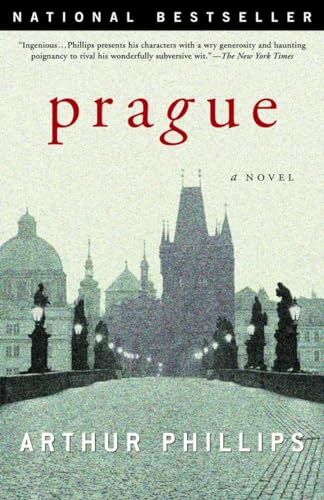
A novel of startling scope and ambition, Prague depicts an intentionally lost Lost Generation as it follows five American expats who come to Budapest in the early 1990s to seek their fortune. They harbor the vague suspicion that their counterparts in Prague have it better, but still they hope to find adventure, inspiration, a gold rush, or history in the making.
Die Inhaltsangabe kann sich auf eine andere Ausgabe dieses Titels beziehen.
Über die Autorin bzw. den Autor
Arthur Phillips is the internationally bestselling author of three New York Times Notable Books—Prague, the winner of the Los Angeles Times/Art Seidenbaum Award for First Fiction; The Song Is You; and The Tragedy of Arthur—and The Egyptologist. He lives in New York.
Von der hinteren Coverseite
A novel of startling scope and ambition, Prague depicts an intentionally lost Lost Generation as it follows five American expats who come to Budapest in the early 1990s to seek their fortune. They harbor the vague suspicion that their counterparts in Prague have it better, but still they hope to find adventure, inspiration, a gold rush, or history in the making.
Auszug. © Genehmigter Nachdruck. Alle Rechte vorbehalten.
PART ONE
FIRSTIMPRESSIONS
HE DECEPTIVELY SIMPLE RULES OF THE GAME SINCERITY, AS played late one Friday afternoon in May 1990 on the terrace of the Caf Gerbeaud in Budapest, Hungary:
1. Players (in this case, five) arrange themselves around a small caf table and impatiently await their order, haphazardly recorded by a sulky and distracted waitress with amusing boots: dollhouse cups of espresso, dense blocks of cake glazed with Art Nouveau swirls of translucent caramel, skimpy sandwiches dusted red-orange with the national spice, glass thimbles of sweet or bitter or smoky liqueurs, tumblers of bubbling water ostensibly hunted and captured from virgin springs high in the Carpathian Mountains.
2. Proceeding circularly, players make apparently sincere statements, one statement per turn. Verifiable statements of fact are inadmissible. Play proceeds accordingly for four rounds. In this case, the game would therefore consist of twenty apparently sincere statements. Interrupting competition with discursive or disruptive conversation, or auxiliary lies, is permitted and praiseworthy.
3. Of the four statements a player makes during the course of the game, only one is permitted to be “true” or “sincere.” The other three are “lies.” Players closely guard the identity of their true statements, the ability to simulate embarrassment, confusion, anger, shock, or pain being highly prized.
4. Players attempt to identify which of their opponents’ statements were true. Player A guesses which statements of players B, C, D, and E were true. Player B then does the same for players A, C, D, and E, et cetera. A scoring grid is made on a crumb-dusted cocktail napkin with a monogrammed (cmg) fountain pen.
5. Players reveal their sincere statements. A player receives one point for each of his or her lies accepted by an opponent as true and one point for each identification of an opponent’s true statement. In today’s game of five people, a perfect score would be eight: four for leading each poor sap by the nose and four more for seeing through their feeble, transparent efforts at deception.
II.
SINCERITY—A STAPLE AMONG CERTAIN CIRCLES OF YOUNG FOREIGNERS living in Budapest immediately following 1989–90’s hissing, flapping deflation of Communism—is coincidentally the much-admired invention of one of the five players in this very match, this very afternoon in May. Charles Gábor, when with people his own age, seems always to be the host, and at this small café table on this sunny patio he reigns confidently and serenely. He resembles an Art Deco picture of a 1920s dandy: long fingers, measured movements, smooth and gleaming panels of black hair, an audaciously collegiate tie, crisp pleated slacks of a favorite cotton twill, a humorously pointed nose, a sly half-smile, one eyebrow engineered for expressivity. Under the green and interlacing trees surrounding the terrace and nodding over the heads of tourists, resident foreigners, and the occasional Hungarian, Charles Gábor sits with four other Westerners, an unlikely group pieced together these past few weeks from parties and family references, friend-of-friend-of-friend happenstance, and (in one case, just now being introduced) sheer, scarcely tolerable intrusiveness—five people who, in normal life back home, would have been satisfied never to have known one another.
Five young expatriates hunch around an undersized café table: a moment of total insignificance, and not without a powerful whiff of cliché.
Unless you were one of them. Then this meaningless, overdrawn moment may (then or later) seem to be somehow the summation of both an era and your own youth, your undeniably defining afternoon (though you can hardly say that aloud without making a joke of it). Somehow this one game of Sincerity becomes the distilled recollection of a much longer series of events. It persistently rises to the surface of your memory—that afternoon when you fell in love with a person or a place or a mood, when you savored the power of fooling everyone, when you discovered some great truth about the world, when (like a baby duck glimpsing your quacking mother’s waddling rear for the first time) an indelible brand was seared into your heart, which is, of course, a finite space with limited room for searing.
Despite its insignificance, there was this moment, this hour or two, this spring afternoon blurring into evening on a café patio in a Central European capital in the opening weeks of its post-Communist era. The glasses of liqueur. The diamond dapples of light between oval, leaf-shaped shadows, like optical illusions. The trellised curve of the cast-iron fence separating the patio from its surrounding city square. The uncomfortable chair. Someday this too will represent someone’s receding, cruelly unattainable golden age.
To Charles Gábor’s right sits Mark Payton, who will eventually think of this very moment as one of the glowing, unequaled triumphs of his life. Retrospection will polish from this ambiguous, complicated afternoon all its rough edges, until Mark will be able to see nearly to its crystalline center, to its discernible seedpod of future events, to the (extremely unlikely) refraction of himself as a young and happy man, sniffing love and welcome in the spring air.
He sits at peace, a state he is lately finding harder and harder to achieve. When these five met at the Gerbeaud this afternoon, before Charles pulled out Emily Oliver’s chair for her, Mark was already discreetly securing the seat he wanted, as he always does at the half-dozen places he’s come to love in his two months in Budapest. He knows that his view, and with it his afternoon, perhaps even several days, would have been damaged if his secret wishes had been thwarted by a misseating of even forty-five degrees.
Safely placed, he can turn his head to the left and see the Café Gerbeaud itself, into its antique interior, into the very past: pastry cases, walls of mirrors and dark wood panels, red velvet seat cushions on gold-painted chairs. In daylight, the cushions are threadbare and the paint flakes, but Mark Payton doesn’t mind. A reupholsterer would steal a certain something in exchange for his handiwork. Atmospheric decay and faded glory reassure Mark, prove something. Much of Budapest—unpainted, uncleaned, unrepaired during forty-five years of Communist rule immediately following a brutal war—provides similar pleasures. For now.
Straight ahead and past his friends, Mark’s New World eye is treated to the grand, intentionally overwhelming European architecture of the nineteenth century (though it has long since lost the ability to overwhelm its native audience). For years Mark has longed to stare at such architecture, to inhale it, ingest it somehow. Unfortunately, he cannot forget that down Harmincad utca to the left, a Kempinski Hotel is slated to inflict its glass-and-steel corporate modernity on the odd, neglected asymmetry of neighboring Deák Square. But at least he can’t see the site’s unspeakable stretch marks and scars from where he sits.
Just to the right of tiny (hardly mappable) Harmincad utca stands an office building in his beloved typical-nineteenth-century Haussmann style, the sort of giant mansard-roofed beauty sprinkled all over Pest and Paris, Madrid and Milan. That its ground-floor, window-front space is occupied by the dusty and only sporadically open sales office of a second-string airline does not offend Mark’s aesthetics, because the decor of the office, plainly visible from his seat, is so absurdly 1960s East Bloc, so unintentionally and yet bittersweetly hilarious, that it...
„Über diesen Titel“ kann sich auf eine andere Ausgabe dieses Titels beziehen.
Weitere beliebte Ausgaben desselben Titels

Suchergebnisse für Prague: A Novel

Beispielbild für diese ISBN
Prague: A Novel
Verlag:
Random House Publishing Group, 2003
ISBN 10: 0375759778
ISBN 13: 9780375759772
Gebraucht
Softcover
Anbieter: World of Books (was SecondSale), Montgomery, IL, USA
Verkäuferbewertung 5 von 5 Sternen

Zustand: Good. Item in good condition. Textbooks may not include supplemental items i.e. CDs, access codes etc. Artikel-Nr. 00052377672
Gebraucht kaufen
EUR 3,39
Versand gratis
Versand innerhalb von USA
Versand innerhalb von USA
Anzahl: 14 verfügbar
Beispielbild für diese ISBN
Prague : A Novel
Verlag:
Random House Publishing Group, 2003
ISBN 10: 0375759778
ISBN 13: 9780375759772
Gebraucht
Softcover
Anbieter: Better World Books, Mishawaka, IN, USA
Verkäuferbewertung 5 von 5 Sternen
Zustand: Good. Reprint. Pages intact with minimal writing/highlighting. The binding may be loose and creased. Dust jackets/supplements are not included. Stock photo provided. Product includes identifying sticker. Better World Books: Buy Books. Do Good. Artikel-Nr. 2296602-6
Gebraucht kaufen
EUR 5,88
Versand gratis
Versand innerhalb von USA
Versand innerhalb von USA
Anzahl: 1 verfügbar
Beispielbild für diese ISBN
Prague : A Novel
Verlag:
Random House Publishing Group, 2003
ISBN 10: 0375759778
ISBN 13: 9780375759772
Gebraucht
Softcover
Anbieter: Better World Books, Mishawaka, IN, USA
Verkäuferbewertung 5 von 5 Sternen
Zustand: Very Good. Reprint. Pages intact with possible writing/highlighting. Binding strong with minor wear. Dust jackets/supplements may not be included. Stock photo provided. Product includes identifying sticker. Better World Books: Buy Books. Do Good. Artikel-Nr. 2296603-75
Gebraucht kaufen
EUR 5,88
Versand gratis
Versand innerhalb von USA
Versand innerhalb von USA
Anzahl: 1 verfügbar
Beispielbild für diese ISBN
Prague : A Novel
Verlag:
Random House Publishing Group, 2003
ISBN 10: 0375759778
ISBN 13: 9780375759772
Gebraucht
Softcover
Anbieter: Better World Books: West, Reno, NV, USA
Verkäuferbewertung 5 von 5 Sternen
Zustand: Good. Reprint. Pages intact with minimal writing/highlighting. The binding may be loose and creased. Dust jackets/supplements are not included. Stock photo provided. Product includes identifying sticker. Better World Books: Buy Books. Do Good. Artikel-Nr. 2296602-6
Gebraucht kaufen
EUR 5,88
Versand gratis
Versand innerhalb von USA
Versand innerhalb von USA
Anzahl: 1 verfügbar
Beispielbild für diese ISBN
Prague: A Novel
Verlag:
Random House Publishing Group, 2003
ISBN 10: 0375759778
ISBN 13: 9780375759772
Gebraucht
Softcover
Anbieter: Wonder Book, Frederick, MD, USA
Verkäuferbewertung 5 von 5 Sternen
Zustand: Good. Good condition. A copy that has been read but remains intact. May contain markings such as bookplates, stamps, limited notes and highlighting, or a few light stains. Artikel-Nr. V14B-04979
Gebraucht kaufen
EUR 6,89
Versand gratis
Versand innerhalb von USA
Versand innerhalb von USA
Anzahl: 1 verfügbar
Beispielbild für diese ISBN
Prague: A Novel
Verlag:
Random House Publishing Group, 2003
ISBN 10: 0375759778
ISBN 13: 9780375759772
Gebraucht
Softcover
Anbieter: Wonder Book, Frederick, MD, USA
Verkäuferbewertung 5 von 5 Sternen
Zustand: Very Good. Very Good condition. A copy that may have a few cosmetic defects. May also contain light spine creasing or a few markings such as an owner's name, short gifter's inscription or light stamp. Artikel-Nr. H04A-02552
Gebraucht kaufen
EUR 6,89
Versand gratis
Versand innerhalb von USA
Versand innerhalb von USA
Anzahl: 3 verfügbar
Beispielbild für diese ISBN
Prague: A Novel
Verlag:
Random House Publishing Group (edition Reprint), 2003
ISBN 10: 0375759778
ISBN 13: 9780375759772
Gebraucht
Paperback
Anbieter: BooksRun, Philadelphia, PA, USA
Verkäuferbewertung 5 von 5 Sternen
Paperback. Zustand: Very Good. Reprint. It's a well-cared-for item that has seen limited use. The item may show minor signs of wear. All the text is legible, with all pages included. It may have slight markings and/or highlighting. Artikel-Nr. 0375759778-11-6
Gebraucht kaufen
EUR 6,98
Versand gratis
Versand innerhalb von USA
Versand innerhalb von USA
Anzahl: 1 verfügbar
Beispielbild für diese ISBN
Prague: A Novel
Verlag:
Random House Trade Paperbacks June 2003, 2003
ISBN 10: 0375759778
ISBN 13: 9780375759772
Gebraucht
Paper Back
Anbieter: Eagle Eye Books, Decatur, GA, USA
Verkäuferbewertung 4 von 5 Sternen

Paper Back. Zustand: Used. Artikel-Nr. 903013
Gebraucht kaufen
EUR 5,39
EUR 3,49 Versand
Versand innerhalb von USA
Versand innerhalb von USA
Anzahl: 1 verfügbar
Beispielbild für diese ISBN
Prague
Verlag:
Random House Trade 30/06/2003, 2003
ISBN 10: 0375759778
ISBN 13: 9780375759772
Gebraucht
Softcover
Anbieter: AwesomeBooks, Wallingford, Vereinigtes Königreich
Verkäuferbewertung 5 von 5 Sternen
Zustand: Very Good. This book is in very good condition and will be shipped within 24 hours of ordering. The cover may have some limited signs of wear but the pages are clean, intact and the spine remains undamaged. This book has clearly been well maintained and looked after thus far. Money back guarantee if you are not satisfied. See all our books here, order more than 1 book and get discounted shipping. . Artikel-Nr. 7719-9780375759772
Gebraucht kaufen
EUR 3,19
EUR 5,82 Versand
Versand von Vereinigtes Königreich nach USA
Versand von Vereinigtes Königreich nach USA
Anzahl: 1 verfügbar
Beispielbild für diese ISBN
Prague: A Novel
Verlag:
Random House Publishing Group, 2003
ISBN 10: 0375759778
ISBN 13: 9780375759772
Gebraucht
Softcover
Anbieter: MusicMagpie, Stockport, Vereinigtes Königreich
Verkäuferbewertung 5 von 5 Sternen
Zustand: Very Good. 1755060692. 8/13/2025 4:51:32 AM. Artikel-Nr. U9780375759772
Gebraucht kaufen
EUR 3,61
EUR 6,41 Versand
Versand von Vereinigtes Königreich nach USA
Versand von Vereinigtes Königreich nach USA
Anzahl: 1 verfügbar