
Verwandte Artikel zu The Kama Sutra of Vatsyayana (Modern Library Classics)
Inhaltsangabe
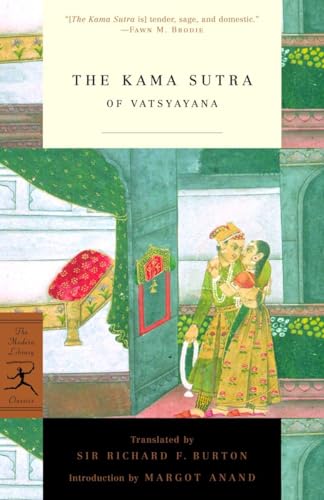
Sir Richard F. Burton’s translation of The Kama Sutra remains one of the best English interpretations of this early Indian treatise on politics, social customs, love, and intimacy. Its crisp style set a new standard for Sanskrit translation.
The Kama Sutra stands uniquely as a work of psychology, sociology, Hindu dogma, and sexology. It has been a celebrated classic of Indian literature for 1,700 years and a window for the West into the culture and mysticism of the East.
This Modern Library Paperback Classic reprints the authoritative text of Sir Richard F. Burton’s 1883 translation.
Die Inhaltsangabe kann sich auf eine andere Ausgabe dieses Titels beziehen.
Über die Autorin bzw. den Autor
Sir Richard F. Burton (1821–90) was a British explorer and writer. His translation of The Arabian Nights remains a classic.
Margot Anand, an internationally acclaimed teacher of Tantra, is the author of many bestselling books, among them Sexual Ecstasy: The Art of Orgasm and The Art of Everyday Ecstasy. She lives in California.
Von der hinteren Coverseite
Sir Richard F. Burton's translation of "The Kama Sutra remains one of the best English interpretations of this early Indian treatise on politics, social customs, love, and intimacy. Its crisp style set a new standard for Sanskrit translation.
"The Kama Sutra stands uniquely as a work of psychology, sociology, Hindu dogma, and sexology. It has been a celebrated classic of Indian literature for 1,700 years and a window for the West into the culture and mysticism of the East.
This Modern Library Paperback Classic reprints the authoritative text of Sir Richard F. Burton's 1883 translation.
Aus dem Klappentext
F. Burton s translation of The Kama Sutra remains one of the best English interpretations of this early Indian treatise on politics, social customs, love, and intimacy. Its crisp style set a new standard for Sanskrit translation.
The Kama Sutra stands uniquely as a work of psychology, sociology, Hindu dogma, and sexology. It has been a celebrated classic of Indian literature for 1,700 years and a window for the West into the culture and mysticism of the East.
This Modern Library Paperback Classic reprints the authoritative text of Sir Richard F. Burton s 1883 translation.
Auszug. © Genehmigter Nachdruck. Alle Rechte vorbehalten.
Part I
The Vatsyayana Sutra
Introductory Preface
Salutation to Dharma, Artha, and Kama
In the beginning, the Lord of Beings created men and women, and in the form of commandments in one hundred thousand chapters laid down rules for regulating their existence with regard to Dharma,* Artha,? and Kama.? Some of these commandments, namely those which treated of Dharma, were separately written by Swayanshur Manu; those that related to Artha were compiled by Brihaspati; and those that referred to Kama were expounded by Naudi, the follower of Mehadeva, in one thousand chapters.
Now these 'Kama Sutra' (Aphorisms on Love), written by Nundi in one thousand chapters, were reproduced by Shevtaketu, the son of Uddvalaka, in an abbreviated form in five hundred chapters, and this work was again similarly reproduced in an abridged form, in one hundred and fifty chapters, by Babhravya, an inheritant of the Punchala (South of Delhi) country. These one hundred and fifty chapters were then put together under seven heads or parts named severally?
1st. Sadharana (general topics).
2nd. Samprayogika (embraces, etc.).
3rd. Kanya Samprayukteka (union of males and females).
4th. Bharyadhikarika (on one's own wife).
5th. Paradarika (on the wives of other people).
6th. Vaisika (on courtezans).
7th. Aupamishadika (on the arts of seduction, tonic, medicines, etc.).
The sixth part of this last work was separately expounded by Dattaka at the request of the public women of Pataliputra (Patna), and in the same way Charayana explained the first part of it. The remaining parts, viz., the second, third, fourth, fifth, and seventh were each separately expounded by?
Suvarnanabha (second part).
Ghotakamukha (third part).
Gouardiya (fourth part).
Gouikaputra (fifth part).
Kuchumara (seventh part), respectively.
Thus the work being written in parts by different authors was almost unobtainable, and as the parts which were expounded by Dattaka and the others treated only of the particular branches of the subject to which each part related, and moreover as the original work of Babhravya was difficult to be mastered on account of its length, Vatsyayana, therefore, composed this work in a small volume as an abstract of the whole of the works of the above-named authors.
Chapter II
On the Acquisition of Dharma, Artha, and Kama
Man, the period of whose life is one hundred years, should practise Dharma, Artha, and Kama at different times and in such a manner that they may harmonize together and not clash in any way. He should acquire learning in his childhood, in his youth and middle age he should attend to Artha and Kama, and in his old age he should perform Dharma, and thus seek to gain Moksha, i.e., release from further transmigration. Or, on account of the uncertainty of life, he may practise them at times when they are enjoined to be practised. But one thing is to be noted, he should lead the life of a religious student until he finishes his education.
Dharma is obedience to the command of the Shastra or Holy Writ of the Hindoos to do certain things, such as the performance of sacrifices, which are not generally done, because they do not belong to this world, and produce no visible effect; and not to do other things, such as eating meat, which is often done because it belongs to this world, and has visible effects.
Dharma should be learnt from the Shruti (Holy Writ), and from those conversant with it.
Artha is the acquisition of arts, land, gold, cattle, wealth, equipages and friends. It is, further, the protection of what is acquired, and the increase of what is protected.
Artha should be learnt from the king's officers, and from merchants who may be versed in the ways of commerce.
Kama is the enjoyment of appropriate objects by the five senses of hearing, feeling, seeing, tasting and smelling, assisted by the mind together with the soul. The ingredient in this is a peculiar contact between the organ of sense and its object, and the consciousness of pleasure which arises from that contact is called Kama.
Kama is to be learnt from the Kama Sutra (aphorisms on love) and from the practise of citizens.
When all the three, viz., Dharma, Artha, and Kama, come together, the former is better than the one which follows it, i.e., Dharma is better than Artha, and Artha is better than Kama. But Artha should always be first practised by the king, for the livelihood of men is to be obtained from it only. Again, Kama being the occupation of public women, they should prefer it to the other two, and these are exceptions to the general rule.
Objection
Some learned men say that as Dharma is connected with things not belonging to this world, it is appropriately treated of in a book; and so also is Artha, because it is practised only by the application of proper means, and a knowledge of those means can only be obtained by study and from books. But Kama being a thing which is practised even by the brute creation, and which is to be found everywhere, does not want any work on the subject.
Answer
This is not so. Sexual intercourse being a thing dependent on man and woman requires the application of proper means by them, and those means are to be learnt from the Kama Shastra. The non-application of proper means, which we see in the brute creation, is caused by their being unrestrained, and by the females among them only being fit for sexual intercourse at certain seasons and no more, and by their intercourse not being preceded by thought of any kind.
Objection 2
The Lokayatikas* say:?Religious ordinances should not be observed, for they bear a future fruit, and at the same time it is also doubtful whether they will bear any fruit at all. What foolish person will give away that which is in his own hands into the hands of another? Moreover, it is better to have a pigeon to-day than a peacock to-morrow; and a copper coin which we have the certainty of obtaining, is better than a gold coin, the possession of which is doubtful.
Answer
It is not so. 1st. Holy Writ, which ordains the practise of Dharma, does not admit of a doubt.
2nd. Sacrifices such as those made for the destruction of enemies, or for the fall of rain, are seen to bear fruit.
3rd. The sun, moon, stars, planets and other heavenly bodies appear to work intentionally for the good of the world.
4th. The existence of this world is effected by the observance of the rules respecting the four classes? of men and their four stages of life.
5th. We see that seed is thrown into the ground with the hope of future crops.
Vatsyayana is therefore of opinion that the ordinances of religion must be obeyed.
Objection 3
Those who believe that destiny is the prime mover of all things say:?We should not exert ourselves to acquire wealth, for sometimes it is not acquired although we strive to get it, while at other times it comes to us of itself without any exertion on our part. Everything is therefore in the power of destiny, who is the lord of gain and loss, of success and defeat, of pleasure and pain. Thus we see that Bali* was raised to the throne of Indra by destiny, and was also put down by the same power, and it is destiny only that can re-instate him.
Answer
It is not right to say so. As the acquisition of every object pre-supposes at all events some exertion on the part of man, the application of proper means may be said to be the cause of gaining all our ends, and this application of proper means being thus necessary (even where a thing is destined to happen), it follows that a person who does nothing will enjoy no happiness.
Objection 4
Those who are inclined to think that Artha is the chief object to be obtained argue thus....
„Über diesen Titel“ kann sich auf eine andere Ausgabe dieses Titels beziehen.
Suchergebnisse für The Kama Sutra of Vatsyayana (Modern Library Classics)

Beispielbild für diese ISBN
The Kama Sutra of Vatsyayana M
Anbieter: World of Books (was SecondSale), Montgomery, IL, USA
Verkäuferbewertung 5 von 5 Sternen

Zustand: Acceptable. Item in acceptable condition! Textbooks may not include supplemental items i.e. CDs, access codes etc. Artikel-Nr. 00080119067
Gebraucht kaufen
EUR 5,72
Versand gratis
Versand innerhalb von USA
Versand innerhalb von USA
Anzahl: 1 verfügbar
Beispielbild für diese ISBN
The Kama Sutra of Vatsyayana
Verlag:
Random House Publishing Group, 2002
ISBN 10: 0375759247
ISBN 13: 9780375759246
Gebraucht
Paperback
Anbieter: ThriftBooks-Dallas, Dallas, TX, USA
Verkäuferbewertung 5 von 5 Sternen
Paperback. Zustand: Very Good. No Jacket. May have limited writing in cover pages. Pages are unmarked. ~ ThriftBooks: Read More, Spend Less. Artikel-Nr. G0375759247I4N00
Gebraucht kaufen
EUR 7,38
Versand gratis
Versand innerhalb von USA
Versand innerhalb von USA
Anzahl: 1 verfügbar
Beispielbild für diese ISBN
The Kama Sutra of Vatsyayana
Verlag:
Random House Publishing Group, 2002
ISBN 10: 0375759247
ISBN 13: 9780375759246
Gebraucht
Paperback
Anbieter: ThriftBooks-Dallas, Dallas, TX, USA
Verkäuferbewertung 5 von 5 Sternen
Paperback. Zustand: Good. No Jacket. Pages can have notes/highlighting. Spine may show signs of wear. ~ ThriftBooks: Read More, Spend Less. Artikel-Nr. G0375759247I3N00
Gebraucht kaufen
EUR 7,38
Versand gratis
Versand innerhalb von USA
Versand innerhalb von USA
Anzahl: 1 verfügbar
Beispielbild für diese ISBN
Kama Sutra
Anbieter: Majestic Books, Hounslow, Vereinigtes Königreich
Verkäuferbewertung 4 von 5 Sternen

Zustand: New. pp. xxxviii + 194. Artikel-Nr. 8188041
Neu kaufen
EUR 12,79
EUR 7,61 Versand
Versand von Vereinigtes Königreich nach USA
Versand von Vereinigtes Königreich nach USA
Anzahl: 1 verfügbar
Beispielbild für diese ISBN
The Kama Sutra of Vatsyayana (Modern Library Classics)
Verlag:
Random House Publishing Group, 2002
ISBN 10: 0375759247
ISBN 13: 9780375759246
Gebraucht
Soft cover
Anbieter: Joseph Burridge Books, Dagenham, Vereinigtes Königreich
Verkäuferbewertung 5 von 5 Sternen
Soft cover. Zustand: Very Good. 295 pages 22 cm. Artikel-Nr. ldp638
Gebraucht kaufen
EUR 6,03
EUR 16,39 Versand
Versand von Vereinigtes Königreich nach USA
Versand von Vereinigtes Königreich nach USA
Anzahl: 1 verfügbar
Beispielbild für diese ISBN
The Kama Sutra of Vatsyayana (Modern Library Classics)
Anbieter: Revaluation Books, Exeter, Vereinigtes Königreich
Verkäuferbewertung 5 von 5 Sternen
Paperback. Zustand: Brand New. modern lib edition. 194 pages. 8.00x5.25x0.50 inches. In Stock. Artikel-Nr. x-0375759247
Neu kaufen
EUR 20,61
EUR 11,71 Versand
Versand von Vereinigtes Königreich nach USA
Versand von Vereinigtes Königreich nach USA
Anzahl: 2 verfügbar
Beispielbild für diese ISBN
The Kama Sutra of Vatsyayana (Modern Library Classics)
Verlag:
Random House Publishing Group, 2002
ISBN 10: 0375759247
ISBN 13: 9780375759246
Neu
Softcover
Anbieter: Kennys Bookstore, Olney, MD, USA
Verkäuferbewertung 5 von 5 Sternen
Zustand: New. Series: Modern Library. Num Pages: 240 pages, illustrations. BIC Classification: VFVC. Category: (G) General (US: Trade). Dimension: 203 x 134 x 14. Weight in Grams: 192. . 2002. New edition. paperback. . . . . Books ship from the US and Ireland. Artikel-Nr. V9780375759246
Neu kaufen
EUR 25,63
EUR 9,27 Versand
Versand innerhalb von USA
Versand innerhalb von USA
Anzahl: Mehr als 20 verfügbar
Beispielbild für diese ISBN
The Kama Sutra of Vatsyayana
Verlag:
Random House Publishing Group, 2002
ISBN 10: 0375759247
ISBN 13: 9780375759246
Gebraucht
Softcover
Anbieter: Buchpark, Trebbin, Deutschland
Verkäuferbewertung 5 von 5 Sternen
Zustand: Sehr gut. Zustand: Sehr gut | Sprache: Englisch | Produktart: Bücher | Sir Richard F. Burton's translation of The Kama Sutra remains one of the best English interpretations of this early Indian treatise on politics, social customs, love, and intimacy. Its crisp style set a new standard for Sanskrit translation.The Kama Sutra stands uniquely as a work of psychology, sociology, Hindu dogma, and sexology. It has been a celebrated classic of Indian literature for 1,700 years and a window for the West into the culture and mysticism of the East. This Modern Library Paperback Classic reprints the authoritative text of Sir Richard F. Burton's 1883 translation. Artikel-Nr. 1866508/2
Gebraucht kaufen
EUR 11,12
EUR 105,00 Versand
Versand von Deutschland nach USA
Versand von Deutschland nach USA
Anzahl: 2 verfügbar