
Verwandte Artikel zu Flophouse: Life on the Bowery
Inhaltsangabe
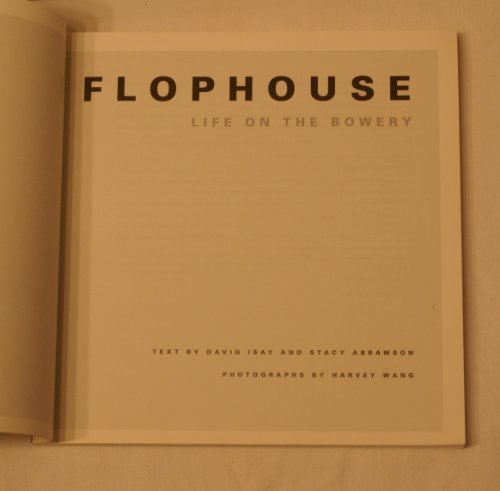
An unforgettable photographic odyssey into New York City's eight remaining flophouses in the Bowery district captures the life stories of the men, representing all backgrounds, races, and classes, who dwell in the forgotten underbelly of one of the world's great cities. Reprint. 25,000 first printing.
Die Inhaltsangabe kann sich auf eine andere Ausgabe dieses Titels beziehen.
Über die Autorin bzw. den Autor
David Isay is the executive producer of Sound Portraits Productions, an independent production company dedicated to bringing neglected American voices to a national radio audience. His radio documentary work has won almost every award in broadcasting. He lives in New York City.
Stacy Abramson is a producer at Sound Portraits. She lives in New York City.
Harvey Wang is a photographer and Emmy Award-winning filmmaker. His work includes Harvey Wang's New York and Holding On.
Auszug. © Genehmigter Nachdruck. Alle Rechte vorbehalten.
Introduction
From the end of the nineteenth century through the middle of the twentieth, the Bowery was the world's most infamous skid row. Under the shadow of the elevated Third Avenue line, the sixteen-block stretch of lower Manhattan was jammed with barber schools, bars, missions, men's clothing stores, slop joints (cheap restaurants), flophouses, and tattoo parlors. The estimates vary, but in its heyday somewhere between 25,000 and 75,000 men slept on the Bowery each night.
Today, the barber colleges are all gone. Al's, the last rummy bar on the Bowery, closed in 1993. There are no tattoo parlors, no employment agencies, no pawnshops, no burlesque houses, no secondhand stores, no El train. All that remains of the skid-row Bowery are a single mission and a handful of flops, still offering the shabbiest hotel accommodations imaginable for as little as $4.50 a night.
During the Depression, there were close to a hundred flops (the polite term is lodging house) lining the Bowery. Almost all of them were walk-ups, with a bar at the ground level and the hotel on the floors above. Up a steep flight of stairs sat the hotel's lobby-wooden chairs, a couple of benches, and some tables. Near the entrance was the cage, where the clerk sat with his ledger.
Beyond the lobby were several floors of accommodations. Guests had two choices: a cot in a tightly packed barrackslike dormitory (a little cheaper, a lot more bedbugs) or a cubicle. Smaller than a prison cell (about four-by-six feet and seven feet high), the cubicles offered nothing more than a bed, a locker, and a bare, dangling bulb. They were built in long rows, separated by narrow hallways. The walls between cubicles extended only partway to the ceiling, so each room was topped with chicken wire to discourage "lush divers" from crawling over and riffling through a dead-drunk neighbor's wallet.
The skid-row Bowery grew out of the Civil War, which created homelessness on a vast scale. Cheap hotels for returning vets opened up in what was then a New York City red-light district, and before long the Bowery became a mecca for the nation's down-and out. Seventy-five years later, the Second World War brought the street's skid-row era to a close. The Bowery's population plunged, as it always would in times of war. At the end of this war, though, returning vets were greeted by the G.I. Bill and other new social programs. Few became homeless. The flops began to empty out. By 1949, there were only 15,000 men left on the Bowery. A 1955 change in the city's housing code prohibited the construction of any new hotels with cubicle-size rooms. Bars and slop joints and employment agencies were replaced by restaurant equipment wholesalers and lighting-fixtures stores. Real estate values on the Bowery continued to rise; old flops were converted into residential lofts and office space. In 1966, there were 5,000 men left on the Bowery.
Today, about a thousand men remain in eight old flophouses: the White House, the Palace, the Sunshine, the Andrews, the Prince, the Sun, the Grand, and the Providence. The hotels are a fluke. While the rest of the skid-row Bowery was wiped clean, housing laws made it tough for hotel owners to empty the buildings. Some burned their tenants out. Some sold their hotels to a Chinese businessman, who uses his flops to house newly arrived Chinese immigrants. A couple of owners threw up their hands and decided to stick it out. The remaining flophouses on the Bowery are, at least physically, a nearly perfectly preserved remnant of old New York.
This book profiles fifty men from four of these hotels, each one a self-contained society of more than one hundred residents. Most of the flops' staffs (clerks, porters, etc.) live on the premises. Some residents go for weeks without leaving their cubicles, relying on the hotel's runners to bring them food and cigarettes. Part prison, part way station, part shelter, part psychiatric hospital, part shooting gallery, part old-age home, each hotel has a distinctive character and clientele. They are fascinating places, inhabited by the last residents of a world soon to vanish.
„Über diesen Titel“ kann sich auf eine andere Ausgabe dieses Titels beziehen.
Suchergebnisse für Flophouse: Life on the Bowery

Beispielbild für diese ISBN
Flophouse : Life on the Bowery
Verlag:
Random House, Incorporated, 2002
ISBN 10: 0375758313
ISBN 13: 9780375758317
Gebraucht
Softcover
Anbieter: Better World Books, Mishawaka, IN, USA
Verkäuferbewertung 5 von 5 Sternen

Zustand: Good. Pages intact with minimal writing/highlighting. The binding may be loose and creased. Dust jackets/supplements are not included. Stock photo provided. Product includes identifying sticker. Better World Books: Buy Books. Do Good. Artikel-Nr. 5575199-6
Gebraucht kaufen
EUR 7,24
Versand gratis
Versand innerhalb von USA
Versand innerhalb von USA
Anzahl: 2 verfügbar
Beispielbild für diese ISBN
Flophouse : Life on the Bowery
Verlag:
Random House, Incorporated, 2002
ISBN 10: 0375758313
ISBN 13: 9780375758317
Gebraucht
Softcover
Anbieter: Better World Books, Mishawaka, IN, USA
Verkäuferbewertung 5 von 5 Sternen
Zustand: Very Good. Former library copy. Pages intact with possible writing/highlighting. Binding strong with minor wear. Dust jackets/supplements may not be included. Includes library markings. Stock photo provided. Product includes identifying sticker. Better World Books: Buy Books. Do Good. Artikel-Nr. 16440902-6
Gebraucht kaufen
EUR 7,24
Versand gratis
Versand innerhalb von USA
Versand innerhalb von USA
Anzahl: 1 verfügbar
Beispielbild für diese ISBN
Flophouse: Life on the Bowery
Verlag:
Random House Trade Paperbacks, 2001
ISBN 10: 0375758313
ISBN 13: 9780375758317
Gebraucht
Paperback
Anbieter: ThriftBooks-Phoenix, Phoenix, AZ, USA
Verkäuferbewertung 5 von 5 Sternen
Paperback. Zustand: Fair. No Jacket. Readable copy. Pages may have considerable notes/highlighting. ~ ThriftBooks: Read More, Spend Less. Artikel-Nr. G0375758313I5N00
Gebraucht kaufen
EUR 7,26
Versand gratis
Versand innerhalb von USA
Versand innerhalb von USA
Anzahl: 1 verfügbar
Beispielbild für diese ISBN
Flophouse: Life on the Bowery
Verlag:
Random House Trade Paperbacks, 2001
ISBN 10: 0375758313
ISBN 13: 9780375758317
Gebraucht
Paperback
Anbieter: ThriftBooks-Atlanta, AUSTELL, GA, USA
Verkäuferbewertung 5 von 5 Sternen
Paperback. Zustand: Fair. No Jacket. Readable copy. Pages may have considerable notes/highlighting. ~ ThriftBooks: Read More, Spend Less. Artikel-Nr. G0375758313I5N00
Gebraucht kaufen
EUR 7,26
Versand gratis
Versand innerhalb von USA
Versand innerhalb von USA
Anzahl: 1 verfügbar
Beispielbild für diese ISBN
Flophouse: Life on the Bowery
Verlag:
Random House Trade Paperbacks, 2001
ISBN 10: 0375758313
ISBN 13: 9780375758317
Gebraucht
Paperback
Anbieter: ThriftBooks-Dallas, Dallas, TX, USA
Verkäuferbewertung 5 von 5 Sternen
Paperback. Zustand: Very Good. No Jacket. May have limited writing in cover pages. Pages are unmarked. ~ ThriftBooks: Read More, Spend Less. Artikel-Nr. G0375758313I4N00
Gebraucht kaufen
EUR 7,26
Versand gratis
Versand innerhalb von USA
Versand innerhalb von USA
Anzahl: 1 verfügbar
Beispielbild für diese ISBN
Flophouse: Life on the Bowery
Verlag:
Random House Trade Paperbacks, 2001
ISBN 10: 0375758313
ISBN 13: 9780375758317
Gebraucht
Paperback
Anbieter: ThriftBooks-Reno, Reno, NV, USA
Verkäuferbewertung 5 von 5 Sternen
Paperback. Zustand: Fair. No Jacket. Readable copy. Pages may have considerable notes/highlighting. ~ ThriftBooks: Read More, Spend Less. Artikel-Nr. G0375758313I5N00
Gebraucht kaufen
EUR 7,26
Versand gratis
Versand innerhalb von USA
Versand innerhalb von USA
Anzahl: 1 verfügbar
Beispielbild für diese ISBN
Flophouse: Life on the Bowery
Verlag:
Random House Trade Paperbacks, 2001
ISBN 10: 0375758313
ISBN 13: 9780375758317
Gebraucht
Paperback
Anbieter: ThriftBooks-Dallas, Dallas, TX, USA
Verkäuferbewertung 5 von 5 Sternen
Paperback. Zustand: Fair. No Jacket. Readable copy. Pages may have considerable notes/highlighting. ~ ThriftBooks: Read More, Spend Less. Artikel-Nr. G0375758313I5N00
Gebraucht kaufen
EUR 7,26
Versand gratis
Versand innerhalb von USA
Versand innerhalb von USA
Anzahl: 1 verfügbar
Beispielbild für diese ISBN
Flophouse: Life on the Bowery
Anbieter: Sell Books, Elland, YORKS, Vereinigtes Königreich
Verkäuferbewertung 5 von 5 Sternen
paperback. Zustand: Good. Our good condition books are generally good for reading but not for gifting or collecting. They could have imperfections such as creasing, fanning, inscriptions, margin notes, yellowing, staining on edge or cover or pages, bumps, scuffs, etc etc (sometimes multiple of these). It's a wide category that encompasses anything that isn't almost-new down to anything that is slightly better than poor. We would NOT recommend gifting Good books - these should be considered reading copies. Our books are dispatched from a Yorkshire former cotton mill. We list via barcode/ISBN so please note that the images are stock images and may not be the exact copy you receive, furthermore the details about edition and year might not be accurate as many publishers reuse the same ISBN for multiple editions and as we simply scan a barcode or enter an ISBN we do not check the validity of the edition data when listing. If you're looking for an exact edition please don't order (at least not without checking with us first, although we don't always have time to check). We aim to dispatch prompty, the service used will depend on order value and book size. We can ship to most countries, see our shipping policies. Payment is via Abe only. Artikel-Nr. SBAB-L-BFC01064-RAG-20241113-VG
Gebraucht kaufen
EUR 39,16
EUR 9,20 Versand
Versand von Vereinigtes Königreich nach USA
Versand von Vereinigtes Königreich nach USA
Anzahl: 1 verfügbar