
Verwandte Artikel zu The Frailty Myth: Redefining the Physical Potential...
Inhaltsangabe
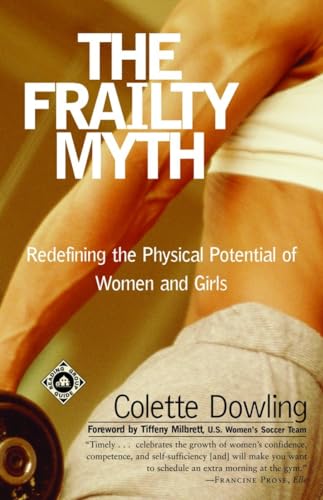
Can women be equal to men as long as men are physically stronger? And are men, in fact, stronger?
These are key questions that Colette Dowling, author of the bestselling The Cinderella Complex, raises in her provocative new book. The myth of female frailty, with its roots in nineteenth-century medicine and misogyny, has had a damaging effect on women's health, social status, and physical safety. It is Dowling's controversial thesis that women succumb to societal pressures to appear weak in order to seem more "feminine."
The Frailty Myth presents new evidence that girls are weaned from the use of their bodies even before they begin school. By adolescence, their strength and aerobic powers have started to decline unless the girls are exercising vigorously--and most aren't. By sixteen, they have already lost bone density and turned themselves into prime candidates for osteoporosis. They have also been deprived of motor stimulation that is essential for brain growth.
Yet as breakthroughs among elite women athletes grow more and more astounding, it begins to appear that strength and physical skill--for all women--is only a matter of learning and training. Men don't have a monopoly on physical prowess; when women and men are matched in size and level of training, the strength gap closes. In some areas, women are actually equipped to outperform men, due partly to differences in body structure, and partly to the newly discovered strengthening benefits of estrogen.
Drawing on extensive research in motor development, performance assessment, sports physi-ology, and endocrinology, Dowling presents an astonishing picture of the new physical woman. And she creates a powerful argument that true equality isn't possible until women learn how to stand up for themselves--physically.
Die Inhaltsangabe kann sich auf eine andere Ausgabe dieses Titels beziehen.
Über die Autorin bzw. den Autor
Colette Dowling is an internationally known writer and lecturer whose books have been translated into twenty languages. She is the author of numerous books, including Maxing Out, Red Hot Mamas, You Mean I Don't Have to Feel This Way?, and The Cinderella Complex, which has been in print since it was first published in 1981. Her articles have appeared in many magazines, including The New York Times Magazine, New York, and Harper's. She lives in Woodstock, New York.
Von der hinteren Coverseite
Can women be equal to men as long as men are physically stronger? And are men, in fact, stronger?
These are key questions that Colette Dowling, author of the bestselling "The Cinderella Complex, raises in her provocative new book. The myth of female frailty, with its roots in nineteenth-century medicine and misogyny, has had a damaging effect on women's health, social status, and physical safety. It is Dowling's controversial thesis that women succumb to societal pressures to appear weak in order to seem more "feminine."
The Frailty Myth presents new evidence that girls are weaned from the use of their bodies even before they begin school. By adolescence, their strength and aerobic powers have started to decline unless the girls are exercising vigorously--and most aren't. By sixteen, they have already lost bone density and turned themselves into prime candidates for osteoporosis. They have also been deprived of motor stimulation that is essential for brain growth.
Yet as breakthroughs among elite women athletes grow more and more astounding, it begins to appear that strength and physical skill--for all women--is only a matter of learning and training. Men don't have a monopoly on physical prowess; when women and men are matched in size and level of training, the strength gap closes. In some areas, women are actually equipped to outperform men, due partly to differences in body structure, and partly to the newly discovered strengthening benefits of estrogen.
Drawing on extensive research in motor development, performance assessment, sports physi-ology, and endocrinology, Dowling presents an astonishing picture of the new physical woman. And she creates a powerful argumentthat true equality isn't possible until women learn how to stand up for themselves--physically.
Auszug. © Genehmigter Nachdruck. Alle Rechte vorbehalten.
Chapter 1
The Frailty Myth
A hundred years ago, women were pushed backward in a very particular way. Just as they were beginning to demand education and political and economic power, they were stripped of the power of their bodies. Just as they began to get ideas about fighting for justice, they were required, with all the persuasion of a moral movement, to cultivate frailness. Nineteenth-century women were given to believe that weakness was their natural condition. It was a total gaslight job. There wasn't a plot. No single group could be held accountable. What made the concept so powerful was the influential mix-the various groups whose interests came together into a single compelling philosophy about woman's purpose on the planet. That philosophy-some scholars have dubbed it "the frailty myth"-became the rope that restrained women from developing physically, restricted them to small half movements, isolated them in rooms hidden from the sun, and threatened them with the worst of all punishments should they refuse to comply: the loss of their capacity to bear children.
The theory behind the frailty myth was this: Women could not be allowed to follow their own pursuits-physical or mental-because every ounce of energy they could generate was needed for maintaining their reproductive processes. No option was offered in this matter. In the nineteenth century female confinement was considered a social necessity. Women owed it to the next generation, and the generations thereafter, to cultivate nothing but their fertility-not mind, not artistry, and certainly not body. This became known as "the cult of true womanhood." Educators, psychologists, churchmen, and physicians-particularly obstetricians and gynecologists-were its chief proponents. Men were certain that if women weren't controlled, the very species (or "race," as they called it then) was at risk. They drummed up a role for women, an idea called "femininity," an appropriate "character," an appropriate "look"-and with all of these, they persuaded women that their reason for being was essentially heroic and thus worth giving up a lot for.
For years my image of Victorian women was narrowed by stereotypes. I had been taught that women of the late 1800s were frail, overprotected creatures who didn't have much of a life. Everything they did seemed to require undue effort. As a young woman reading about Victorian "ladies," I could only imagine trying to swim in the ocean weighed down by wet bloomers and baggy blouses. The daily struggle with corsets and merry widows, the attempt to walk, much less run, in huge skirts and hats-it seemed, to my generation, pathetic. Those women had lived their lives according to bizarre rules, and courtesies, and restraint. Rags were used for mopping up menstrual blood. Sex was a joke because Victorian men didn't know the first thing about the parts of women's bodies that give pleasure. It was hard to see how the Gay Nineties could have been all that frolicsome.
Mine was, of course, a glib view of those times. To think about actual flesh-and-blood women living in that way-to contemplate the hard, merciless doctors' couches on which they lay, trying to make sense of their ailments-would have required more emotional imagination than I possessed. I chose not to relate. It was the same way I'd distanced myself from my mother's history, thinking of her life as too strangely different from my own for us to have much in common. Hers was another time; it might as well have been another country. I wanted to be safe from my mother's rural Nebraskan history, her fifteen siblings, her diabetes-ravaged mother, the farm that failed, she and her sisters were given to believe, because there weren't enough boys to do the heavy work. Because I preferred to think that my mother and I were not quite the same under the skin-just as I viewed those strange Victorian ladies-I lived for years without knowing important things, things that would have strengthened my appreciation of my own womanhood and allowed me to see myself as belonging to a family-not only a personal family, but the historical family of my gender.
Old habits die hard. In tracing the frailty myth back to the nineteenth century, I found myself at first wanting to gloss over what I was starting to see: an inevitable connection between the women at the end of that century and women of our day-a continuum of actual physical oppression in which all of us had been kept down. I wanted to be able to name the final decades of the nineteenth century as the flowering of the frailty myth and move on. But as I began to dig further into the journals, and studies, and diaries of those women, it became clear that something fundamental to growth and development had been taken from them and that the loss was not only theirs, but ours. More and more I began to see that the frailty myth hadn't died, it had only wedged its way a little further underground. I wanted to comprehend the forces keeping women from their bodies, their physical strength and spirit.
The Frailty Myth is about the social domination of women's bodies. It is about girls' and women's restricted physical development. It is about the attempt to keep them feeling as doctors, educators, and even religious leaders have intended them to feel: physically limited. Unable to run long distances. Unable to play five sets of tennis. And even more important, unable to raise a barn or (once it was invented) fix a car. Unable to go for a walk in the woods unaccompanied. Unable to exist, in short, without the muscular heft and presumed physical assistance of the other half of the species.
For centuries women have been shackled to a perception of themselves as weak and ineffectual. This perception has been nothing less than the emotional and cognitive equivalent of having our whole bodies bound. The myth of women's frailty has been so systematically entrenched that it could fairly be called a hoax. But a hoax is a conscious deceit, while myths are believed in as truth. What propels them is complicated and invisible. The frailty myth was driven by men's repressed wish to preserve dominion. To make the myth viable, society constructed elaborate ways of keeping women cut off from their strength; of turning them into physical victims and teaching them that victimhood was all they could aspire to.
Before Frailty
Historically, strength has been encouraged in women only when the economy needs it-during wars, while the men are away, or when helping to pioneer new lands. But as feminist scholarship in the past quarter century has uncovered, women in fact lived far more complicated and demanding lives over the course of the first millennium than you might imagine if you looked at the picture of "true womanhood" to which women were restricted in the nineteenth century. It was striking to learn, when it was first published in the late 1990s, that in Paleolithic times women weren't sequestered in caves, sweeping up stone dust and suckling their infants, as male anthropologists had always suggested. That particular view of Ice Age females' physical ability was the result of certain questions not being asked, according to Olga Soffer, one of the world's leading authorities on Ice Age hunters and gatherers. Soffer's research and that of other feminist scholars in the 1990s led to the discovery that Paleolithic women were strong and physically active, and provided up to 70 percent of family nutrition. And they weren't just gathering nuts and berries. Paleolithic women hunted small animals with bows and arrows and used nets to trap larger ones. Even the children participated in these hunts. Women and children "set snares, laid spring traps, sighted game and participated in animal drives and surrounds-forms of hunting that endangered neither young...
„Über diesen Titel“ kann sich auf eine andere Ausgabe dieses Titels beziehen.
Suchergebnisse für The Frailty Myth: Redefining the Physical Potential...

Foto des Verkäufers
The Frailty Myth: Redefining the Physical Potential of Women and Girls
Verlag:
Random House Publishing Group, 2001
ISBN 10: 0375758151
ISBN 13: 9780375758157
Gebraucht
Softcover
Anbieter: Dream Books Co., Denver, CO, USA
Verkäuferbewertung 5 von 5 Sternen

Zustand: acceptable. This copy has clearly been enjoyedâ"expect noticeable shelf wear and some minor creases to the cover. Binding is strong, and all pages are legible. May contain previous library markings or stamps. Artikel-Nr. DBV.0375758151.A
Gebraucht kaufen
EUR 4,70
Versand gratis
Versand innerhalb von USA
Versand innerhalb von USA
Anzahl: 1 verfügbar
Beispielbild für diese ISBN
The Frailty Myth: Redefining the Physical Potential of Women and Girls
Verlag:
Random House Publishing Group (edition Reprint), 2001
ISBN 10: 0375758151
ISBN 13: 9780375758157
Gebraucht
Paperback
Anbieter: BooksRun, Philadelphia, PA, USA
Verkäuferbewertung 5 von 5 Sternen
Paperback. Zustand: Fair. Reprint. The item might be beaten up but readable. May contain markings or highlighting, as well as stains, bent corners, or any other major defect, but the text is not obscured in any way. Artikel-Nr. 0375758151-7-1
Gebraucht kaufen
EUR 4,80
Versand gratis
Versand innerhalb von USA
Versand innerhalb von USA
Anzahl: 1 verfügbar
Beispielbild für diese ISBN
The Frailty Myth : Redefining the Physical Potential of Women and Girls
Verlag:
Random House Publishing Group, 2001
ISBN 10: 0375758151
ISBN 13: 9780375758157
Gebraucht
Softcover
Anbieter: Better World Books, Mishawaka, IN, USA
Verkäuferbewertung 5 von 5 Sternen
Zustand: Good. 1st Trade. Former library copy. Pages intact with minimal writing/highlighting. The binding may be loose and creased. Dust jackets/supplements are not included. Includes library markings. Stock photo provided. Product includes identifying sticker. Better World Books: Buy Books. Do Good. Artikel-Nr. GRP77893766
Gebraucht kaufen
EUR 6,54
Versand gratis
Versand innerhalb von USA
Versand innerhalb von USA
Anzahl: 1 verfügbar
Beispielbild für diese ISBN
The Frailty Myth : Redefining the Physical Potential of Women and Girls
Verlag:
Random House Publishing Group, 2001
ISBN 10: 0375758151
ISBN 13: 9780375758157
Gebraucht
Softcover
Anbieter: Better World Books, Mishawaka, IN, USA
Verkäuferbewertung 5 von 5 Sternen
Zustand: Good. 1st Trade. Pages intact with minimal writing/highlighting. The binding may be loose and creased. Dust jackets/supplements are not included. Stock photo provided. Product includes identifying sticker. Better World Books: Buy Books. Do Good. Artikel-Nr. 4767170-6
Gebraucht kaufen
EUR 6,54
Versand gratis
Versand innerhalb von USA
Versand innerhalb von USA
Anzahl: 1 verfügbar
Beispielbild für diese ISBN
The Frailty Myth: Redefining the Physical Potential of Women and Girls
Verlag:
Random House Publishing Group, 2001
ISBN 10: 0375758151
ISBN 13: 9780375758157
Gebraucht
Paperback
Anbieter: ThriftBooks-Atlanta, AUSTELL, GA, USA
Verkäuferbewertung 5 von 5 Sternen
Paperback. Zustand: Good. No Jacket. Pages can have notes/highlighting. Spine may show signs of wear. ~ ThriftBooks: Read More, Spend Less. Artikel-Nr. G0375758151I3N00
Gebraucht kaufen
EUR 6,76
Versand gratis
Versand innerhalb von USA
Versand innerhalb von USA
Anzahl: 1 verfügbar
Beispielbild für diese ISBN
The Frailty Myth: Redefining the Physical Potential of Women and Girls
Verlag:
Random House Publishing Group, 2001
ISBN 10: 0375758151
ISBN 13: 9780375758157
Gebraucht
Paperback
Anbieter: ThriftBooks-Atlanta, AUSTELL, GA, USA
Verkäuferbewertung 5 von 5 Sternen
Paperback. Zustand: Fair. No Jacket. Readable copy. Pages may have considerable notes/highlighting. ~ ThriftBooks: Read More, Spend Less. Artikel-Nr. G0375758151I5N00
Gebraucht kaufen
EUR 6,76
Versand gratis
Versand innerhalb von USA
Versand innerhalb von USA
Anzahl: 1 verfügbar
Beispielbild für diese ISBN
The Frailty Myth: Redefining the Physical Potential of Women and Girls
Verlag:
Random House Publishing Group, 2001
ISBN 10: 0375758151
ISBN 13: 9780375758157
Gebraucht
Paperback
Anbieter: ThriftBooks-Dallas, Dallas, TX, USA
Verkäuferbewertung 5 von 5 Sternen
Paperback. Zustand: Very Good. No Jacket. Missing dust jacket; May have limited writing in cover pages. Pages are unmarked. ~ ThriftBooks: Read More, Spend Less. Artikel-Nr. G0375758151I4N01
Gebraucht kaufen
EUR 6,76
Versand gratis
Versand innerhalb von USA
Versand innerhalb von USA
Anzahl: 1 verfügbar
Beispielbild für diese ISBN
The Frailty Myth: Redefining the Physical Potential of Women and Girls
Verlag:
Random House Publishing Group, 2001
ISBN 10: 0375758151
ISBN 13: 9780375758157
Gebraucht
Softcover
Anbieter: Phatpocket Limited, Waltham Abbey, HERTS, Vereinigtes Königreich
Verkäuferbewertung 5 von 5 Sternen
Zustand: Good. Your purchase helps support Sri Lankan Children's Charity 'The Rainbow Centre'. Ex-library, so some stamps and wear, but in good overall condition. Our donations to The Rainbow Centre have helped provide an education and a safe haven to hundreds of children who live in appalling conditions. Artikel-Nr. Z1-B-025-02016
Gebraucht kaufen
EUR 3,79
EUR 12,52 Versand
Versand von Vereinigtes Königreich nach USA
Versand von Vereinigtes Königreich nach USA
Anzahl: 2 verfügbar
Beispielbild für diese ISBN
The Frailty Myth: Redefining the Physical Potential of Women and Girls
Anbieter: Revaluation Books, Exeter, Vereinigtes Königreich
Verkäuferbewertung 5 von 5 Sternen
Paperback. Zustand: Brand New. 1st reprint edition. 318 pages. 8.00x5.25x0.75 inches. In Stock. Artikel-Nr. x-0375758151
Neu kaufen
EUR 24,10
EUR 11,77 Versand
Versand von Vereinigtes Königreich nach USA
Versand von Vereinigtes Königreich nach USA
Anzahl: 2 verfügbar