
Verwandte Artikel zu The First Americans: In Pursuit of Archaeology's...
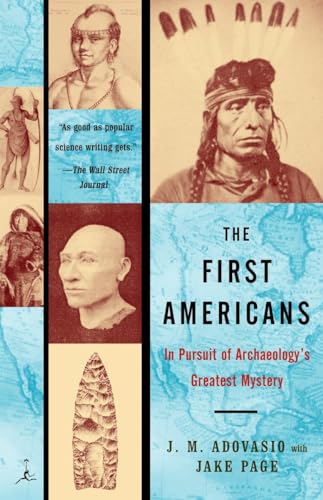
The First Americans: In Pursuit of Archaeology's Greatest Mystery (Modern Library Paperbacks) - Softcover
Inhaltsangabe
J. M. Adovasio has spent the last thirty years at the center of one of our most fiery scientific debates: Who were the first humans in the Americas, and how and when did they get there?
At its heart, The First Americans is the story of the revolution in thinking that Adovasio and his fellow archaeologists have brought about, and the firestorm it has ignited. As he writes, “The work of lifetimes has been put at risk, reputations have been damaged, an astounding amount of silliness and even profound stupidity has been taken as serious thought, and always lurking in the background of all the argumentation and gnashing of tenets has been the question of whether the field of archaeology can ever be pursued as a science.”
Die Inhaltsangabe kann sich auf eine andere Ausgabe dieses Titels beziehen.
Über die Autorin bzw. den Autor
J. M. Adovasio, Ph.D., is the founder and director of the Mercyhurst Archaeological Institute. He lives near Erie, Pennsylvania.
Jake Page is a former editor of Natural History magazine and science editor of Smithsonian magazine. He lives in Corrales, New Mexico.
Von der hinteren Coverseite
J. M. Adovasio has spent the last thirty years at the center of one of our most fiery scientific debates: Who were the first humans in the Americas, and how and when did they get there?
At its heart, "The First Americans is the story of the revolution in thinking that Adovasio and his fellow archaeologists have brought about, and the firestorm it has ignited. As he writes, "The work of lifetimes has been put at risk, reputations have been damaged, an astounding amount of silliness and even profound stupidity has been taken as serious thought, and always lurking in the background of all the argumentation and gnashing of tenets has been the question of whether the field of archaeology can ever be pursued as a science."
Auszug. © Genehmigter Nachdruck. Alle Rechte vorbehalten.
CHAPTER ONE
GLIMPSES THROUGH THE LOOKING GLASS
When Christopher Columbus first slogged ashore on October 12, 1492, on either the Caribbean island of San Salvador or Samana Cay, he was met by Arawak-speaking people who called themselves Taino and who apparently made an excellent first impression. "They are affectionate people," Columbus reported, "and without covetousness and apt for anything, which I certify." He went on to write, "I believe there is no better people or land in the world. They love their neighbors as themselves and have the sweetest speech in the world and gentle, and are always smiling." Not knowing who these seemingly happy-go-lucky folk were, Columbus imagined them to be Asians-perhaps Hindus or Spice Islanders. Yet, despite his boosterism, he was disappointed to find these natives less advanced than he expected of Asians. In fact, the Tainos were fairly sophisticated agriculturalists living in villages of a thousand or more, each with up to fifty round, conical-roofed houses of wood and thatch ringed around a plaza and presided over by a chieftain. The villages were organized into district chiefdoms; two social strata, nobles and commoners, existed; and local artisans worked in wood, ceramics, weaving, and other crafts, including gold imported from mainland South America. Even so, they were hardly what might be expected by someone who had read about Marco Polo's travels to the Orient.
Soon the neighbor-loving Tainos made it plain that their particular neighbors, known as Caribs and located to the south in what we call the Virgin Islands, were cannibals bent on wiping out the Tainos. Here we have an early version of two of the longest-running stereotypes about the native peoples of America-the noble savage and the bloodthirsty barbarian. Before many more years passed, both the Tainos and the Caribs (who were probably innocent of cannibalism) were largely extinct, victims of European diseases, the vicissitudes of Spanish enslavement, and outright murder. But untold millions of other native peoples awaited the Europeans in the New World, and once it became clear that this was not Asia, the questions soon arose: Who the hell are these people, where did they come from, and when did they get here? Even after the passage of more than five hundred years, the answers to these simple questions remain somewhat imprecise.
Early on, some Europeans wondered if the native populations of the New World were actually people-humans, as Europeans defined the word. This was in spite of the fact that by 1510 Cortés had encountered the Aztec empire and entered its capital, Tenochtitlán, a vast city grander and more beautiful, by accounts, than anything in contemporary Europe. The Spanish thus had an early realization of the breadth of cultural diversity to be found in the New World, but even the Aztecs, with their own version of high society, did not fit well into the pigeonholes of European preconceptions. And it was only a few years after the Spanish arrival that even the Aztecs and Incas were reduced to peonage, their civilizations effectively razed.
At the time, maps of much of the world outside Europe still reported that "there be monsters here," and stories abounded of creatures on distant shores who were part human, part animal. Unicorns could still appear to those whose lives had been perfectly meritorious, and as late as the next century an English adventurer, Martin Frobisher, would return from an Arctic voyage with tales of gold and with the single horn of what he believed to be a sea unicorn (an object we know as a narwhal tusk), which he presented to Queen Elizabeth. Coming upon the shores of America, one might imagine, then, that creatures with so little by way of the trappings of civilization were people, yes, but people without souls, just as animals were without souls.
Paracelsus, the brilliant sixteenth-century Swiss physician who is often thought of as the father of chemical medicine, believed that the aboriginal Americans were not "of the posterity of Adam and Eve" but had been created separately and were without souls. The matter would continue to be debated for the remainder of the century by Spanish philosophers and papal theologians. Generally speaking, the men of the Church took the most benign view of the Indians, believing that the pope's benevolent sway should be extended over the natives' lives in order to save their souls. (At the outset, Columbus commented that the Arawaks' easygoing nature made them excellent candidates for enslavement, and the Spanish colonists saw them all as little more than useful chattels.) Some theologians cited Aristotle's Politics to the effect that many people were born to be ruled over, and the Native Americans, having no "written laws, but barbaric institutions and customs," were among them-meaning that they could be enslaved or killed in order to bring them to Christ (in the afterlife). People on the ground, however, typically took an even less benign view. Amerigo Vespucci, sailing for the Portuguese, found the natives of South America to be hardly more than brutes, as well as worshipers of the Devil, given to cannibalism and other amoralities. Later, a Dominican missionary, Tomás Ortiz, perhaps by way of explaining the difficulty of his holy task, wrote the following description:
On the mainland they eat human flesh. They are more given to sodomy than any other nation. There is no justice among them. They go naked. They have no respect either for love or for virginity. They are stupid and silly. They have no respect for truth, save when it is to their advantage. . . . Most hostile to religion, dishonest, abject, and vile, in their judgements they keep no faith or law. . . . I may therefore affirm that God has never created a race more full of vice and composed without the least mixture of kindness or culture. . . . We here speak of those whom we know by experience. Especially the father, Pedro de Córdoba, who has sent me these facts in writing . . . the Indians are more stupid than asses and refuse to improve in anything.
Depressingly enough, sentiments very much like these were heard throughout the ensuing centuries, even to the present. On the other hand, the Native Americans had their early champions as well, none more vigorous and devoted than the Spanish Fray Bartolomé de Las Casas, who argued eloquently for the rights of the natives. He claimed that the pope had no temporal or coercive power over the native populations, that the gospel should be preached to them but only peacefully, and that the conquistadors' claims on the Indians' land and persons were illegal. He saw all people, including the Native Americans, as humans in various stages of cultural development and thought the natives of the New World were probably quite ancient. Las Casas had a good deal of influence on the powers back home, as did another cleric, the Dominican Bernardino de Minaya. Minaya deserted Pizarro in disgust and went to Rome to persuade Pope Paul III to issue a papal bull in 1537 that rejected the idea of Indians as mere brutes and declared them capable and desirous of embracing the Catholic faith. Not only that, the bull proclaimed, even those Native Americans who chose not to follow Christ were not to be enslaved or have their property taken. This was too much. Bristling with secular outrage, Emperor Charles ordered all copies of the bull confiscated and prevailed on the pope to rescind the bull altogether. For his efforts Minaya was thrown into jail by the head of his order.
Even as late as 1590, one sympathetic Spanish Jesuit missionary in Peru, José de Acosta, felt the need to denounce the "common opinion" that the natives of the New World were mere brutes without reason. They were barbarians-meaning non-Christian-to be sure, and...
„Über diesen Titel“ kann sich auf eine andere Ausgabe dieses Titels beziehen.
Ihre gesetzlichen Garantierechte: Alle Verbraucher:innen in der EU profitieren von mindestens 2 Jahren gesetzlichem Garantieschutz für alle in der EU verkauften Konsumgüter. Mehr erfahren
Suchergebnisse für The First Americans: In Pursuit of Archaeology's...

Beispielbild für diese ISBN
The First Americans: In Pursuit of Archaeology's Greatest Mystery
Anbieter: World of Books (was SecondSale), Montgomery, IL, USA
Verkäuferbewertung 5 von 5 Sternen

Paperback. Zustand: Fair. J. M. Adovasio has spent the last thirty years at the center of one of our most fiery scientific debates: Who were the first humans in the Americas, and how and when did they get there? At its heart, The First Americans is the story of the revolution in thinking that Adovasio and his fellow archaeologists have brought about, and the firestorm it has ignited. As he writes, The work of lifetimes has been put at risk, reputations have been damaged, an astounding amount of silliness and even profound stupidity has been taken as serious thought, and always lurking in the background of all the argumentation and gnashing of tenets has been the question of whether the field of archaeology can ever be pursued as a science. Artikel-Nr. 00106953301
Gebraucht kaufen
EUR 5,02
Versand gratis
Versand innerhalb von USA
Versand innerhalb von USA
Anzahl: 2 verfügbar
Beispielbild für diese ISBN
The First Americans: In Pursuit of Archaeology's Greatest Mystery
Anbieter: World of Books (was SecondSale), Montgomery, IL, USA
Verkäuferbewertung 5 von 5 Sternen
Paperback. Zustand: Good. J. M. Adovasio has spent the last thirty years at the center of one of our most fiery scientific debates: Who were the first humans in the Americas, and how and when did they get there? At its heart, The First Americans is the story of the revolution in thinking that Adovasio and his fellow archaeologists have brought about, and the firestorm it has ignited. As he writes, The work of lifetimes has been put at risk, reputations have been damaged, an astounding amount of silliness and even profound stupidity has been taken as serious thought, and always lurking in the background of all the argumentation and gnashing of tenets has been the question of whether the field of archaeology can ever be pursued as a science. Artikel-Nr. 00107747419
Gebraucht kaufen
EUR 5,02
Versand gratis
Versand innerhalb von USA
Versand innerhalb von USA
Anzahl: 4 verfügbar
Beispielbild für diese ISBN
The First Americans: In Pursuit of Archaeology's Greatest Mystery
Anbieter: World of Books (was SecondSale), Montgomery, IL, USA
Verkäuferbewertung 5 von 5 Sternen
Paperback. Zustand: Very Good. J. M. Adovasio has spent the last thirty years at the center of one of our most fiery scientific debates: Who were the first humans in the Americas, and how and when did they get there? At its heart, The First Americans is the story of the revolution in thinking that Adovasio and his fellow archaeologists have brought about, and the firestorm it has ignited. As he writes, The work of lifetimes has been put at risk, reputations have been damaged, an astounding amount of silliness and even profound stupidity has been taken as serious thought, and always lurking in the background of all the argumentation and gnashing of tenets has been the question of whether the field of archaeology can ever be pursued as a science. Artikel-Nr. CIN037575704XVG
Gebraucht kaufen
EUR 5,02
Versand gratis
Versand innerhalb von USA
Versand innerhalb von USA
Anzahl: 2 verfügbar
Beispielbild für diese ISBN
The First Americans: In Pursuit of Archaeology's Greatest Mystery (Modern Library Paperbacks)
Verlag:
Modern Library (edition Reprint), 2003
ISBN 10: 037575704X
ISBN 13: 9780375757044
Gebraucht
Paperback
Anbieter: BooksRun, Philadelphia, PA, USA
Verkäuferbewertung 5 von 5 Sternen
Paperback. Zustand: Very Good. Reprint. It's a well-cared-for item that has seen limited use. The item may show minor signs of wear. All the text is legible, with all pages included. It may have slight markings and/or highlighting. Artikel-Nr. 037575704X-11-1
Gebraucht kaufen
EUR 5,03
Versand gratis
Versand innerhalb von USA
Versand innerhalb von USA
Anzahl: 1 verfügbar
Beispielbild für diese ISBN
The First Americans: In Pursuit of Archaeology's Greatest Mystery
Anbieter: ThriftBooks-Atlanta, AUSTELL, GA, USA
Verkäuferbewertung 5 von 5 Sternen
Paperback. Zustand: Good. No Jacket. Pages can have notes/highlighting. Spine may show signs of wear. ~ ThriftBooks: Read More, Spend Less. Artikel-Nr. G037575704XI3N00
Gebraucht kaufen
EUR 6,35
Versand gratis
Versand innerhalb von USA
Versand innerhalb von USA
Anzahl: 1 verfügbar
Beispielbild für diese ISBN
The First Americans: In Pursuit of Archaeology's Greatest Mystery
Anbieter: ThriftBooks-Dallas, Dallas, TX, USA
Verkäuferbewertung 5 von 5 Sternen
Paperback. Zustand: Fair. No Jacket. Readable copy. Pages may have considerable notes/highlighting. ~ ThriftBooks: Read More, Spend Less. Artikel-Nr. G037575704XI5N00
Gebraucht kaufen
EUR 6,35
Versand gratis
Versand innerhalb von USA
Versand innerhalb von USA
Anzahl: 1 verfügbar
Beispielbild für diese ISBN
The First Americans: In Pursuit of Archaeology's Greatest Mystery
Anbieter: ThriftBooks-Dallas, Dallas, TX, USA
Verkäuferbewertung 5 von 5 Sternen
Paperback. Zustand: Good. No Jacket. Pages can have notes/highlighting. Spine may show signs of wear. ~ ThriftBooks: Read More, Spend Less. Artikel-Nr. G037575704XI3N00
Gebraucht kaufen
EUR 6,35
Versand gratis
Versand innerhalb von USA
Versand innerhalb von USA
Anzahl: 1 verfügbar
Beispielbild für diese ISBN
The First Americans: In Pursuit of Archaeology's Greatest Mystery (Modern Library Paperbacks)
Anbieter: Wonder Book, Frederick, MD, USA
Verkäuferbewertung 5 von 5 Sternen
Zustand: Very Good. Very Good condition. A copy that may have a few cosmetic defects. May also contain light spine creasing or a few markings such as an owner's name, short gifter's inscription or light stamp. Artikel-Nr. D04B-02317
Gebraucht kaufen
EUR 6,56
Versand gratis
Versand innerhalb von USA
Versand innerhalb von USA
Anzahl: 1 verfügbar
Beispielbild für diese ISBN
The First Americans: In Pursuit of Archaeology's Greatest Mystery (Modern Library Paperbacks)
Anbieter: Wonder Book, Frederick, MD, USA
Verkäuferbewertung 5 von 5 Sternen
Zustand: Good. Good condition. A copy that has been read but remains intact. May contain markings such as bookplates, stamps, limited notes and highlighting, or a few light stains. Artikel-Nr. K07T-00279
Gebraucht kaufen
EUR 6,56
Versand gratis
Versand innerhalb von USA
Versand innerhalb von USA
Anzahl: 1 verfügbar
Beispielbild für diese ISBN
The First Americans : In Pursuit of Archaeology's Greatest Mystery
Verlag:
Random House Publishing Group, 2003
ISBN 10: 037575704X
ISBN 13: 9780375757044
Gebraucht
Softcover
Anbieter: Better World Books, Mishawaka, IN, USA
Verkäuferbewertung 5 von 5 Sternen
Zustand: Good. Pages intact with minimal writing/highlighting. The binding may be loose and creased. Dust jackets/supplements are not included. Stock photo provided. Product includes identifying sticker. Better World Books: Buy Books. Do Good. Artikel-Nr. 4618934-6
Gebraucht kaufen
EUR 6,71
Versand gratis
Versand innerhalb von USA
Versand innerhalb von USA
Anzahl: 1 verfügbar