
Verwandte Artikel zu The Spanish Civil War: Revised Edition (Modern Library...
Inhaltsangabe
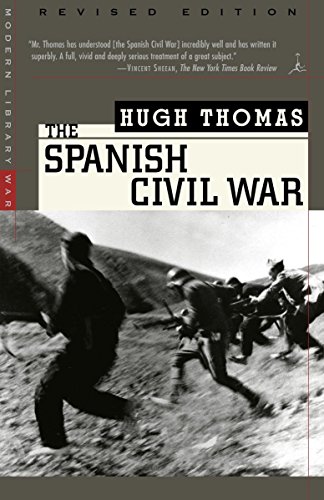
A masterpiece of the historian’s art, Hugh Thomas’s The Spanish Civil War remains the best, most engrossing narrative of one of the most emblematic and misunderstood wars of the twentieth century. Revised and updated with significant new material, including new revelations about atrocities perpetrated against civilians by both sides in this epic conflict, this "definitive work on the subject" (Richard Bernstein, The New York Times) has been given a fresh face forty years after its initial publication in 1961. In brilliant, moving detail, Thomas analyzes a devastating conflict in which the hopes, dreams, and dogmas of a century exploded onto the battlefield. Like no other account, The Spanish Civil War dramatically reassembles the events that led a European nation, in a continent on the brink of world war, to divide against itself, bringing into play the machinations of Franco and Hitler, the bloodshed of Guernica, and the deeply inspiring heroics of those who rallied to the side of democracy. Communists, anarchists, monarchists, fascists, socialists, democrats -- the various forces of the Spanish Civil War composed a fabric of the twentieth century itself, and Thomas masterfully weaves the diffuse and fascinating threads of the war together in a manner that has established the book as a genuine classic of modern history.
Die Inhaltsangabe kann sich auf eine andere Ausgabe dieses Titels beziehen.
Über die Autorin bzw. den Autor
Hugh Thomas is the author of numerous works of history, including Conquest: Montezuma, Cortés, and the Fall of Old Mexico and Cuba, or The Pursuit of Freedom. He lives in London.
Von der hinteren Coverseite
A masterpiece of the historian's art, Hugh Thomas's The Spanish Civil War remains the best, most engrossing narrative of one of the most emblematic and misunderstood wars of the twentieth century. Revised and updated with significant new material, including new revelations about atrocities perpetrated against civilians by both sides in this epic conflict, this "definitive work on the subject" (Richard Bernstein, "The New York Times) has been given a fresh face forty years after its initial publication in 1961. In brilliant, moving detail, Thomas analyzes a devastating conflict in which the hopes, dreams, and dogmas of a century exploded onto the battlefield. Like no other account, The Spanish Civil War dramatically reassembles the events that led a European nation, in a continent on the brink of world war, to divide against itself, bringing into play the machinations of Franco and Hitler, the bloodshed of Guernica, and the deeply inspiring heroics of those who rallied to the side of democracy. Communists, anarchists, monarchists, fascists, socialists, democrats -- the various forces of the Spanish Civil War composed a fabric of the twentieth century itself, and Thomas masterfully weaves the diffuse and fascinating threads of the war together in a manner that has established the book as a genuine classic of modern history.
Aus dem Klappentext
e of the historian s art, Hugh Thomas s The Spanish Civil War remains the best, most engrossing narrative of one of the most emblematic and misunderstood wars of the twentieth century. Revised and updated with significant new material, including new revelations about atrocities perpetrated against civilians by both sides in this epic conflict, this "definitive work on the subject" (Richard Bernstein, The New York Times) has been given a fresh face forty years after its initial publication in 1961. In brilliant, moving detail, Thomas analyzes a devastating conflict in which the hopes, dreams, and dogmas of a century exploded onto the battlefield. Like no other account, The Spanish Civil War dramatically reassembles the events that led a European nation, in a continent on the brink of world war, to divide against itself, bringing into play the machinations of Franco and Hitler, the bloodshed of Guernica, and the deeply inspiring heroics of tho
Auszug. © Genehmigter Nachdruck. Alle Rechte vorbehalten.
The Origins of the War
'Every Spaniard's ideal is to carry a statutory letter with a single provision, brief but imperious: "This Spaniard is entitled to do whatever he feels like doing".'
-Angel Ganivet
Prologue
The Cortes, the parliament of Spain, stands halfway up the hill leading from the Prado to the Puerta del Sol.1 Bronze lions cast from guns captured in the Moroccan Wars guard its doors. At the summit of its Corinthian columns, Justice hopefully embraces Labour on a granite pediment. On 16 June 1936 this classical building was the centre of all Spain.
Over five years had then passed since King Alfonso XIII had abandoned the Spanish throne-to avoid, as he put it (perhaps exaggerating his importance in the minds of his people), the disaster of a civil war. These had been five years of parliamentary activity. Before the King left, there had been eight years, from 1923 till 1931, when, most of the time under the amiable military dictator General Primo de Rivera, the Cortes had been deserted. Now, in June 1936, constitutional life in Spain seemed likely to be destroyed.
An anxious group of middle-class liberals were gathered on the blue government bench at the front of the semi-circular debating chamber. Honest and intelligent men, they and their followers hated violence. They admired the pleasing, democratic ways of Britain, France and America. In both this hatred and this admiration, they were, however, unusual among Spaniards of their time, isolated even among the four hundred other deputies sitting or standing around and above them, as best they could, in the crowded debating chamber.1 Yet the men of this government had a fanaticism of their own hardly typical of the practical-minded countries which they desired to reproduce in Spain.
Observe, for example, the Prime Minister, Santiago Casares Quiroga.2 A rich man from Galicia in the north-west of Spain, he had spent much of his life calling for home rule for his own poor province, although the only advantage the gallegos3 could have gained from this would have been a better rail service. Although Casares seemed to act according to liberal, Wilsonian principles formulated beyond the Pyrenees, no one could have been more Spanish. He was a passionate liberal when the rise of organized labour caused liberalism to seem as anachronistic as feudalism. Yet since there had not been in Spain a successful middle-class revolution on the model of that in France in 1789, one can hardly blame Casares and his friends for their attitude. In the early years of the republic, in 1931 and 1932, the eyes of Casares Quiroga (then minister of the interior) had appeared, to both friends and enemies, to burn in his small head like those of St Just. Now they were marked by a strange, ironic optimism, only explicable as a symptom of the tuberculosis from which he was already suffering.
The nature of the crisis in Spain was described on 16 June 1936 by Gil Robles, the sleek, fat and almost bald, but still young, leader of the Spanish Catholic party, the CEDA.4 His party was conservative, and Catholic, and it included those who wanted to restore a monarchy, as well as those who desired a christian democratic republic. Some in the CEDA, particularly in the youth movement (JAP),1 were almost fascists; and some admired Dollfuss's corporate Austria. Gil Robles was eloquent and able, but hesitant and devious. He was as hated by monarchists and fascists as he was by socialists. Yet he had created the first middle-class Spanish mass party. Now he recalled that the government had had, since the elections in February, exceptional powers, including press censorship and the suspension of constitutional guarantees. Nevertheless, during those four months, 160 churches, he said, had been burned to the ground, there had been 269 political murders, and 1,287 assaults of varying seriousness. Sixty-nine political centres had been wrecked, there had been 113 general strikes and 228 partial strikes, while 10 newspaper offices had been sacked. 'Let us not deceive ourselves!' concluded Gil Robles. 'A country can live under a monarchy or a republic, with a parliamentary or a presidential system, under communism or fascism! But it cannot live in anarchy. Now, alas, Spain is in anarchy. And we are today present at the funeral of democracy!' Angry cries broke out from all over the chamber, some in agreement, some in dissent.2
The conditions of the country and the régime were as grave as Gil Robles suggested, even if the figures seemed suspiciously precise, and even if some of the disorder caused was the work of the Right: the building of El Ideal, a right-wing newspaper in Granada, had been apparently burned by young men of the upper class and there was other provocation.3 In addition to the violence, men at both extremes of the political spectrum were being drilled for fighting, as military formations. 'All out on Sunday' was an instruction by a score of political leaders. Neither Casares Quiroga nor Gil Robles, representing groups which had been prominent in the history of the Second Republic,4 could control events. Both, indeed, were sustained in the Cortes by the votes of deputies whose aims were different from their own. The elections of the preceding February had been contested by two alliances: the Popular Front, and the National Front. Besides the liberals like Casares, the former had consisted of the large socialist party, the small communist party, and other working-class groups. Behind the socialist party there was the powerful trade union, the UGT (Unión General de Trabajadores),1 one of the best organized workers' movements in Europe. The National Front consisted not only of the CEDA, but also of monarchists, agrarians, representing the large landowners of the south and centre, and some other right-wing parties. It was the political front for all the forces of old Spain, the army, as well as of the church and the bourgeoisie.
The Popular Front had gained the day in February 1936 though, by the Spanish electoral law, their majority of seats in the Cortes was greater than their total of votes cast would have entitled them under a strict system of proportional representation. Not all the parties which had shared in the electoral alliance took part in the government. Indeed the government was composed of liberal republicans,2 while it depended for its majority upon the working-class parties. This is never a recipe for strong government. It was peculiarly unhappy in Spain
in 1936, when the latter were already in a perpetual state of revolutionary effervescence; and, apart from those who cooperated with the democratic system so far as to contest seats in the Cortes, there
remained, outside, the great army of nearly two million anarchist workers, chiefly in Andalusia or Barcelona, organized in the CNT (Confederación Nacional de Trabajo),3 and directed by a secret society, the FAI (Federación Anarquista Ibérica).4 This huge, self-absorbed and passionate movement, already throbbing like a great city at war, despised the progressive government of Casares Quiroga as much as it had in the past hated the governments of the Right. Then there was the army. Who in that early summer in Madrid had not heard rumours of plots by generals, to establish 'order' or even a military dictatorship? Indeed, after Gil Robles had finished speaking in the Cortes, a socialist deputy declared that the churches were being burned by agents provocateurs to justify just such a rebellion.
The socialists were divided. Some were reformists. Some were intellectual fabians. A few were revolutionaries. Some were dazzled by the flattery of communists, some were aghast at the recent rise of communist influence. But all could agree with the accusations levelled at the Right by their spokesmen.
When their cheering had died down,...
„Über diesen Titel“ kann sich auf eine andere Ausgabe dieses Titels beziehen.
Suchergebnisse für The Spanish Civil War: Revised Edition (Modern Library...

Beispielbild für diese ISBN
The Spanish Civil War: Revised Edition (Modern Library War)
Verlag:
Modern Library (edition Revised, Updated ed.), 2001
ISBN 10: 0375755152
ISBN 13: 9780375755156
Gebraucht
Paperback
Anbieter: BooksRun, Philadelphia, PA, USA
Verkäuferbewertung 5 von 5 Sternen

Paperback. Zustand: Very Good. Revised, Updated ed. It's a well-cared-for item that has seen limited use. The item may show minor signs of wear. All the text is legible, with all pages included. It may have slight markings and/or highlighting. Artikel-Nr. 0375755152-11-1
Gebraucht kaufen
EUR 12,77
Versand gratis
Versand innerhalb von USA
Versand innerhalb von USA
Anzahl: 1 verfügbar
Beispielbild für diese ISBN
The Spanish Civil War : Revised Edition
Verlag:
Random House Publishing Group, 2001
ISBN 10: 0375755152
ISBN 13: 9780375755156
Gebraucht
Softcover
Anbieter: Better World Books, Mishawaka, IN, USA
Verkäuferbewertung 5 von 5 Sternen
Zustand: Good. Rev Upd. Former library copy. Pages intact with minimal writing/highlighting. The binding may be loose and creased. Dust jackets/supplements are not included. Includes library markings. Stock photo provided. Product includes identifying sticker. Better World Books: Buy Books. Do Good. Artikel-Nr. 10235971-6
Gebraucht kaufen
EUR 14,17
Versand gratis
Versand innerhalb von USA
Versand innerhalb von USA
Anzahl: 1 verfügbar
Beispielbild für diese ISBN
The Spanish Civil War : Revised Edition
Verlag:
Random House Publishing Group, 2001
ISBN 10: 0375755152
ISBN 13: 9780375755156
Gebraucht
Softcover
Anbieter: Better World Books, Mishawaka, IN, USA
Verkäuferbewertung 5 von 5 Sternen
Zustand: Very Good. Rev Upd. Pages intact with possible writing/highlighting. Binding strong with minor wear. Dust jackets/supplements may not be included. Stock photo provided. Product includes identifying sticker. Better World Books: Buy Books. Do Good. Artikel-Nr. 13002536-6
Gebraucht kaufen
EUR 14,17
Versand gratis
Versand innerhalb von USA
Versand innerhalb von USA
Anzahl: 1 verfügbar
Beispielbild für diese ISBN
The Spanish Civil War: Revised Edition (Modern Library War)
Anbieter: World of Books (was SecondSale), Montgomery, IL, USA
Verkäuferbewertung 5 von 5 Sternen
Zustand: Good. Item in good condition. Textbooks may not include supplemental items i.e. CDs, access codes etc. Artikel-Nr. 00106159053
Gebraucht kaufen
EUR 15,08
Versand gratis
Versand innerhalb von USA
Versand innerhalb von USA
Anzahl: 1 verfügbar
Beispielbild für diese ISBN
The Spanish Civil War: Revised Edition (Modern Library War)
Anbieter: World of Books (was SecondSale), Montgomery, IL, USA
Verkäuferbewertung 5 von 5 Sternen
Zustand: Acceptable. Item in acceptable condition! Textbooks may not include supplemental items i.e. CDs, access codes etc. Artikel-Nr. 00110349145
Gebraucht kaufen
EUR 15,08
Versand gratis
Versand innerhalb von USA
Versand innerhalb von USA
Anzahl: 1 verfügbar
Beispielbild für diese ISBN
The Spanish Civil War: Revised Edition (Modern Library War)
Anbieter: World of Books (was SecondSale), Montgomery, IL, USA
Verkäuferbewertung 5 von 5 Sternen
Zustand: Very Good. Item in very good condition! Textbooks may not include supplemental items i.e. CDs, access codes etc. Artikel-Nr. 00110701777
Gebraucht kaufen
EUR 15,08
Versand gratis
Versand innerhalb von USA
Versand innerhalb von USA
Anzahl: 1 verfügbar
Beispielbild für diese ISBN
The Spanish Civil War: Revised Edition (Modern Library War)
Anbieter: A Squared Books (Don Dewhirst), South Lyon, MI, USA
Verkäuferbewertung 5 von 5 Sternen
paperback. Zustand: As New. New York, 2001; illustrated paper covers; minimal shelf wear; 8vo, 7 3/4" to 9 3/4" tall; interior is clean and unmarked; 1096 pages. Artikel-Nr. SKU1181432
Gebraucht kaufen
EUR 11,46
EUR 5,77 Versand
Versand innerhalb von USA
Versand innerhalb von USA
Anzahl: 1 verfügbar
Beispielbild für diese ISBN
The Spanish Civil War: Revised Edition (Modern Library War)
Anbieter: WorldofBooks, Goring-By-Sea, WS, Vereinigtes Königreich
Verkäuferbewertung 5 von 5 Sternen
Paperback. Zustand: Very Good. The book has been read, but is in excellent condition. Pages are intact and not marred by notes or highlighting. The spine remains undamaged. Artikel-Nr. GOR006020067
Gebraucht kaufen
EUR 24,24
EUR 6,59 Versand
Versand von Vereinigtes Königreich nach USA
Versand von Vereinigtes Königreich nach USA
Anzahl: 1 verfügbar
Beispielbild für diese ISBN
The Spanish Civil War: Revised Edition
Anbieter: Kennys Bookstore, Olney, MD, USA
Verkäuferbewertung 5 von 5 Sternen
Zustand: New. 2001. Paperback. . . . . . Books ship from the US and Ireland. Artikel-Nr. V9780375755156
Neu kaufen
EUR 37,33
EUR 9,33 Versand
Versand innerhalb von USA
Versand innerhalb von USA
Anzahl: 15 verfügbar
Beispielbild für diese ISBN
The Spanish Civil War: Revised Edition (Modern Library Paperbacks)
Anbieter: Revaluation Books, Exeter, Vereinigtes Königreich
Verkäuferbewertung 5 von 5 Sternen
Paperback. Zustand: Brand New. revised updated edition. 1096 pages. 8.00x5.25x1.75 inches. In Stock. Artikel-Nr. xr0375755152
Neu kaufen
EUR 32,96
EUR 14,71 Versand
Versand von Vereinigtes Königreich nach USA
Versand von Vereinigtes Königreich nach USA
Anzahl: 2 verfügbar