
Verwandte Artikel zu Pontius Pilate (Modern Library Paperbacks)
Inhaltsangabe
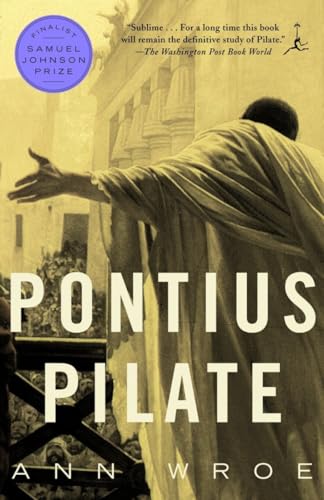
A NEW YORK TIMES NOTABLE BOOK • “Sublime . . . The definitive study of Pilate.”—The Washington Post Book World
“A masterwork . . . one of the most interesting and creative books I’ve read in a very long time.”—Ryan Holiday, #1 New York Times bestselling author of The Obstacle Is the Way
“Compelling, eloquent and vivid . . . In a superb blend of scholarship and creativity, Wroe brings this elusive yet pivotal figure to life.”—The Boston Globe
One of Esquire’s Best Biographies of All Time • Finalist for the Samuel Johnson Prize
The foil to Jesus, the defiant antihero of the Easter story, mocking, skeptical Pilate is a historical figure who haunts our imagination. For some he is a saint, for others the embodiment of human weakness, an archetypal politician willing to sacrifice one man for the sake of stability.
In this dazzlingly conceived biography, Ann Wroe brings man and myth to life. Working from classical sources, she reconstructs his origins and upbringing, his career in the military and life in Rome, his confrontation with Christ, and his long journey home. We catch glimpses of him pacing the marble floors in Caesarea, sharpening his stylus, getting dressed shortly before sunrise on the day that would seal his place in history. What were the pressures on Pilate that day? What did he really think of Jesus?
Pontius Pilate lets us see Christ's trial for the first time, in all its confusion, from the point of view of his executioner.
Die Inhaltsangabe kann sich auf eine andere Ausgabe dieses Titels beziehen.
Über die Autorin bzw. den Autor
Ann Wroe wrote her first book at the age of seven. She received her doctorate in history from Oxford University, and then joined the BBC World Service to cover the last years of communism in Europe. Since 1992 she has been the editor of the American section of The Economist; before that she was its literary editor. Her books include Lives, Lies and the Iran-Contra Affair and A Fool and His Money, an account of a scandal in a French village during the Hundred Years' War. She lives in London with her husband and three sons.
Von der hinteren Coverseite
The foil to Jesus, the defiant antihero of the Easter story, mocking, skeptical Pilate is a historical figure who haunts our imagination. For some he is a saint, for others the embodiment of human weakness, an archetypal politician willing to sacrifice one man for the sake of stability. In this dazzlingly conceived biography, a finalist for the Samuel Johnson Prize, Ann Wroe brings man and myth to life. Working from classical sources, she plunges us into the world of biblical Judaea under the reign of the erratic and licentious emperor Tiberius and lets us see the trial of Jesus, in all its confusion, from the point of view of his executioner.
Aus dem Klappentext
Jesus, the defiant antihero of the Easter story, mocking, skeptical Pilate is a historical figure who haunts our imagination. For some he is a saint, for others the embodiment of human weakness, an archetypal politician willing to sacrifice one man for the sake of stability. In this dazzlingly conceived biography, a finalist for the Samuel Johnson Prize, Ann Wroe brings man and myth to life. Working from classical sources, she plunges us into the world of biblical Judaea under the reign of the erratic and licentious emperor Tiberius and lets us see the trial of Jesus, in all its confusion, from the point of view of his executioner.
Auszug. © Genehmigter Nachdruck. Alle Rechte vorbehalten.
Chapter 5 -- The Great Equivocator
The intriguing thing about Pilate is the degree to which he tried to do the good thing rather than the bad. He commands our moral attention not because he was a bad man, but because he was so nearly a good man. One can imagine him agonising, seeing that Jesus had done nothing wrong, and wishing to release him. Just as easily, however, one can envisage Pilate's advisers telling him of the risks, warning him not to cause a riot or inflame Jewish opinion. It is a timeless parable of political life.
It is possible to view Pilate as the archetypal politician, caught on the horns of an age-old political dilemma. We know he did wrong, yet his is the struggle between what is right and what is expedient that has occurred throughout history. The Munich Agreement Of 1938 was a classic example of this, as were the debates surrounding the Great Reform Act Of 1832 and the Corn Laws. And it is not always clear, even in retrospect, what is, in truth, right. Should we do what appears principled or what is politically expedient? Do you apply a utilitarian rest or what is morally absolute?
Christianity is optimistic about the human condition, but not naive. It can identify what is good, but knows the capacity to do evil. I believe that the endless striving to do the one and avoid the other is the purpose of human existence. Through that comes progress.
—-TONY BLAIR, interview in the Sunday Telegraph, April 7, 1996
IT WAS DARK WHEN HE AWOKE. At the first cockcrow, at that time of year, the moon was often up and shining. At the second cockcrow, the gallicinium, night still hung in the silent trees. It must have been around four in the morning. A servant roused him, lighting the fire and opening the shutters to reveal the pale beginnings of the sunrise. The third legion in Syria had once adopted the local practice of saluting the rising sun; it had brought them luck in battle. The Acta Pilati imagined that Pilate, too, would have saluted it; later that day this account had him washing his hands "before the sun," the god of purification. Most later writers have liked to think that he ignored it, eyes screwed up, head aching from the fun of the night before; and that it was in this state, hungover and resentful, that he embarked on the day that was to seal his place in history.
In fact, it was not unconscionably early for him. Back in Rome it was not unusual for clients to get up and dress in the dark, in order to be the first to pay their morning respects to their patrons. Lawyers too started the court day at dawn, so that by three in the afternoon the business day would be over. Horace in one of his letters rejoiced in this arrangement: "At Rome it was long a pleasure and a habit to be up at dawn with open door, to set forth the law for clients." Others, to be sure, took a different view. Martial wrote that one of the chief delights of going to the country was that "the pale defendant will not break your sleep, and you can dream all through the morning." Bur Pilate's dreams had fled already, and the pale defendant was approaching.
There was not much dressing to be done. He had probably slept in his undertunic, as was the custom in cold weather. His shoes were by the bed; a servant put them on him and laced them. This was the first essential. To walk around barefoot was slovenly, and the marble floor was cold. He splashed his face, washed his teeth, passed water in a brass pot held by a slave, made sure his nails were clean. His official tunic with its broad purple stripe (a stripe that still smelled vaguely of shellfish dye) was put on him; a fresh toga was placed over his head and carefully arranged on his shoulders. He drank perhaps one glass of water, chewed a piece of bread. If he felt his breath was bad, he could pop in a freshening pastille; in later years, Cosmus' was the recommended brand. Then, seated in a chair by the window, he gave himself over to the attentions of his barber.
The light was still dim; too murky to see his stubble by and perhaps too bad to read if he had wanted to try. Lamps would be lit to illuminate the scene. The razor scraped across his chin, his cheeks, the nape of his neck. Water dripped in the basin. A little aromatic oil was smoothed across his hair. All this was perfectly normal, routine. Yet it was not just another day in his life. There were perhaps a hundred thousand people in the city, three times the normal population, and he was in the midst of trouble. The judgments he had to make would be easy at one level but vexed at another, when he had to consider how the crowd would react. He was keeping order like a soldier, but he had to be careful like a politician, and he was not good at this.
It was-to take one of the possible dates at random-the sixth before the Kalends of April. This was not in itself inauspicious. The unlucky days were those that immediately followed the Kalends, the Ides or the Nones; these, and some others, would be marked in his calendar with the letter N as nefastus, unlawful. On those days, in Rome, the courts could not open. Other days were partly lawful: on NP days (nefastus parte) the morning was unlawful, but if the gods were propitiated with sacrifice the afternoon could be used for court business; on EN days (endotereisi), hearings were allowed in the middle of the day. There remained the days, like this one, that were reminders of previous troubles. It is probable that the dates around Passover were already marked in his calendar with the special dots or seals proclaiming them unlucky, auspicio malo.
At such times, even an unsuperstitious man might start to look for auguries and signs: the wavering flight of birds, water spilled on a table, the left shoe put on unluckily before the right in the dark. If a man of great power were about to appear, palm trees would spring from cracks in the paving stones, put out suckers and draw wild pigeons to nest in their branches. Yellowing sprays of ilex or laurel suddenly revived. Eagles perched on the roofs of houses, or were seen flying where they had never ventured before. They fought with crows and defeated them. Some even swooped down to take food, as one had snatched a piece of bread from Augustus while he dined in a wood at the fourth milestone on the Campanian Road; after soaring to a prodigious height, it dived down again and returned it to him. Before the fall of Sejanus, crows had flocked around him and cawed as he took the auspices, and a weasel had darted through the crowd outside his house. Perhaps omens of this sort had already been spotted in Jerusalem, and Pilate, too busy, had missed them.
Even good omens had to be received correctly. A sneeze had to be greeted with "Salve!" "Good health!"-Tiberius insisted on this, even when out in his carriage. A sputtering lamp had to be calmed with a few careful drops of wine, an empty eggshell pierced or crushed as soon as the egg had been eaten. A bad omen—even one as slight as a misformed cloud, a dropped glass, a horse stumbling-called for certain precautions. To ensure your physical safety you could touch your hand to your heart, murmuring "Salvum sit, quod tango," "May what I touch be safe." You could rebuff the evil omens by saying "Longe a nobis," "Be far from us," sprinkle wine under the table, or change the rings on your right hand. If you were at dinner, you could kiss the table; at home, you could kiss the shrine of the household gods, wishing all the while for the horror to stay away.
Pilate that morning would probably have stood before the shrine anyway, with his head covered and with as many members of his household as he could gather, to pour out the wine and make the morning invocations. This was how the business day started. His statuettes of...
„Über diesen Titel“ kann sich auf eine andere Ausgabe dieses Titels beziehen.
Suchergebnisse für Pontius Pilate (Modern Library Paperbacks)

Beispielbild für diese ISBN
Pontius Pilate Modern Library
Verlag:
Random House Publishing Group, 2001
ISBN 10: 0375753974
ISBN 13: 9780375753978
Gebraucht
Softcover
Anbieter: World of Books (was SecondSale), Montgomery, IL, USA
Verkäuferbewertung 5 von 5 Sternen

Zustand: Very Good. Item in very good condition! Textbooks may not include supplemental items i.e. CDs, access codes etc. Artikel-Nr. 00107903945
Gebraucht kaufen
EUR 5,46
Versand gratis
Versand innerhalb von USA
Versand innerhalb von USA
Anzahl: 1 verfügbar
Beispielbild für diese ISBN
Pontius Pilate Modern Library
Verlag:
Random House Publishing Group, 2001
ISBN 10: 0375753974
ISBN 13: 9780375753978
Gebraucht
Softcover
Anbieter: World of Books (was SecondSale), Montgomery, IL, USA
Verkäuferbewertung 5 von 5 Sternen
Zustand: Good. Item in good condition. Textbooks may not include supplemental items i.e. CDs, access codes etc. Artikel-Nr. 00107135307
Gebraucht kaufen
EUR 5,46
Versand gratis
Versand innerhalb von USA
Versand innerhalb von USA
Anzahl: 3 verfügbar
Beispielbild für diese ISBN
Pontius Pilate Modern Library
Verlag:
Random House Publishing Group, 2001
ISBN 10: 0375753974
ISBN 13: 9780375753978
Gebraucht
Softcover
Anbieter: World of Books (was SecondSale), Montgomery, IL, USA
Verkäuferbewertung 5 von 5 Sternen
Zustand: Acceptable. Item in acceptable condition! Textbooks may not include supplemental items i.e. CDs, access codes etc. Artikel-Nr. 00108928398
Gebraucht kaufen
EUR 5,46
Versand gratis
Versand innerhalb von USA
Versand innerhalb von USA
Anzahl: 1 verfügbar
Beispielbild für diese ISBN
Pontius Pilate
Verlag:
Random House Publishing Group, 2001
ISBN 10: 0375753974
ISBN 13: 9780375753978
Gebraucht
paperback
Anbieter: Roundabout Books, Greenfield, MA, USA
Verkäuferbewertung 4 von 5 Sternen

paperback. Zustand: Near Fine. Condition Notes: Excellent, unmarked copy with little wear and tight binding. We ship in recyclable American-made mailers. 100% money-back guarantee on all orders. Artikel-Nr. 1691682
Gebraucht kaufen
EUR 13,49
Versand gratis
Versand innerhalb von USA
Versand innerhalb von USA
Anzahl: 1 verfügbar
Beispielbild für diese ISBN
Pontius Pilate
Verlag:
Random House Publishing Group, 2001
ISBN 10: 0375753974
ISBN 13: 9780375753978
Gebraucht
Softcover
Anbieter: medimops, Berlin, Deutschland
Verkäuferbewertung 5 von 5 Sternen
Zustand: good. Befriedigend/Good: Durchschnittlich erhaltenes Buch bzw. Schutzumschlag mit Gebrauchsspuren, aber vollständigen Seiten. / Describes the average WORN book or dust jacket that has all the pages present. Artikel-Nr. M00375753974-G
Gebraucht kaufen
EUR 15,28
EUR 10,00 Versand
Versand von Deutschland nach USA
Versand von Deutschland nach USA
Anzahl: 1 verfügbar
Beispielbild für diese ISBN
Pontius Pilate (Modern Library Paperbacks)
Anbieter: Kennys Bookstore, Olney, MD, USA
Verkäuferbewertung 5 von 5 Sternen
Zustand: New. 2001. Reprint. paperback. . . . . . Books ship from the US and Ireland. Artikel-Nr. V9780375753978
Neu kaufen
EUR 24,40
EUR 9,15 Versand
Versand innerhalb von USA
Versand innerhalb von USA
Anzahl: 15 verfügbar
Beispielbild für diese ISBN
Pontius Pilate: The Biography of an Invented Man
Anbieter: Revaluation Books, Exeter, Vereinigtes Königreich
Verkäuferbewertung 5 von 5 Sternen
Paperback. Zustand: Brand New. reprint edition. 432 pages. 7.75x5.00x0.75 inches. In Stock. Artikel-Nr. __0375753974
Neu kaufen
EUR 22,75
EUR 11,64 Versand
Versand von Vereinigtes Königreich nach USA
Versand von Vereinigtes Königreich nach USA
Anzahl: 1 verfügbar