
Verwandte Artikel zu The Masters: Golf, Money, and Power in Augusta, Georgia
Inhaltsangabe
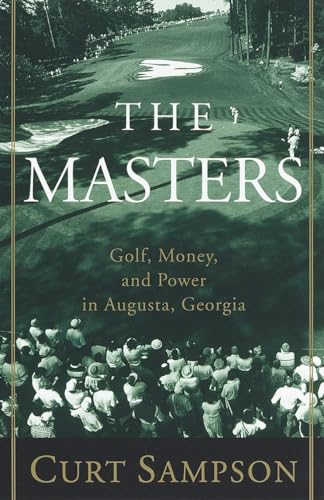
The Masters golf tournament weaves a hypnotic spell. It is the toughest ticket in sports, with black-market tickets selling for $10,000 and more. Success at Augusta National breeds legends, while failure can overshadow even the most brilliant of careers. But as Curt Sampson, author of the bestselling Hogan, reveals in The Masters, a cold heart beats behind the warm antebellum façade of this famous Augusta course. And that heart belongs to the man who killed himself on the grounds two decades ago. Club and tournament founder Clifford Roberts, a New York stockbroker, still seems to run the place from his grave. An elusive and reclusive figure, Roberts pulled the strings that made the Masters the greatest golf tournament in the world. His story—including his relationship with presidents, power brokers, and every golf champion from Bobby Jones to Arnold Palmer to Jack Nicklaus—has never been told. Until now.
The Masters is an amazing slice of history, taking us inside the presidency of Dwight D. Eisenhower, Augusta's most famous member. It is a look at how the new South coexists with the old South: the relationships between blacks and whites, between Southerners and Northerners, between rich and poor—with such characters as James Brown, the Godfather of Soul; the great boxer Beau Jack; and Frank Stranahan, the playboy golfer and the only white pro ever banned from the tournament. The Masters is a spellbinding portrait of a tournament unlike any other.
Die Inhaltsangabe kann sich auf eine andere Ausgabe dieses Titels beziehen.
Über die Autorin bzw. den Autor
Curt Sampson was a junior, amateur, and college golfer. He has written three other books: The Eternal Summer, Full Court Pressure, and Hogan.
Sampson lives in Ennis, Texas, with his wife and two children.
Von der hinteren Coverseite
The Masters golf tournament weaves a hypnotic spell. It is the toughest ticket in sports, with black-market tickets selling for $10,000 and more. Success at Augusta National breeds legends, while failure can overshadow even the most brilliant of careers. But as Curt Sampson, author of the bestselling Hogan, reveals in The Masters, a cold heart beats behind the warm antebellum faade of this famous Augusta course. And that heart belongs to the man who killed himself on the grounds two decades ago. Club and tournament founder Clifford Roberts, a New York stockbroker, still seems to run the place from his grave. An elusive and reclusive figure, Roberts pulled the strings that made the Masters the greatest golf tournament in the world. His story--including his relationship with presidents, power brokers, and every golf champion from Bobby Jones to Arnold Palmer to Jack Nicklaus--has never been told. Until now.
The Masters is an amazing slice of history, taking us inside the presidency of Dwight D. Eisenhower, Augusta's most famous member. It is a look at how the new South coexists with the old South: the relationships between blacks and whites, between Southerners and Northerners, between rich and poor--with such characters as James Brown, the Godfather of Soul; the great boxer Beau Jack; and Frank Stranahan, the playboy golfer and the only white pro ever banned from the tournament. The Masters is a spellbinding portrait of a tournament unlike any other.
Auszug. © Genehmigter Nachdruck. Alle Rechte vorbehalten.
Cliff Roberts is our Bible.
—Augusta National chairman Jackson Stephens
Echoes and anticipation filled Penn Station. The intermittent slam of dropped suitcases mingled with the hail of shouted greetings, and the nasal loudspeaker drone of announced departures added counterpoint to the music of New York City’s cavernous train terminal. But after the stock market crashed in October 1929, the railroad song was hushed. As the Great Depression deepened, people did less of anything that cost money, including travel.
Clifford Roberts stepped into this traveling buyer’s market in January 1933. As he explained to the representatives of the revenue-hungry Southern Railroad System, he required comfortable conveyance for one hundred New Yorkers to and from Augusta, Georgia. At a discount. “Business was so bad,” Roberts wrote in his history of the club, “that the railroad promised not only a special low rate, but all new Pullman equipment with two club cars for card players and two dining cars.” Roberts accepted, and the big party for the grand opening of the Augusta National Golf Club began in a railroad station in New York City.
No event in the history of the club—not even the Masters—would be more important than this first gathering.
Eighty gentlemen had joined the new club by the eve of its formal opening; remarkably, about sixty of them lived in New York. The very idea seems bizarre in retrospect: a private enclave for rich Yankees in the heart of the South, just sixty-eight years after the Civil War? But Augusta spread its arms in welcome for the National, largely because it was Bobby Jones’s club. No Southern man had been so admired since Robert Edward Lee, the heroic but defeated Confederate general in the War of Northern Aggression. Another important factor in the civic embrace had to do with empty hotel rooms. Augusta was a resort town. But Northern tourists in recent years had begun to remain seated when their trains pulled into Union Station in Augusta; they’d discovered Florida. The Depression, of course, slowed commerce even further. Thus for one hundred dollars each, Cliff Roberts’s New Yorkers—exactly one hundred of them—got three days’ accommodation at the Bon Air Vanderbilt Hotel, local transportation in Augusta, and a round-trip ticket on the luxurious magic carpet of the rails, the Pullman.
Roberts took care of everything. He wrote and distributed an itinerary, organized a bridge tournament and made up the teams, made sure there was plenty of bootleg whiskey aboard (Prohibition’s repeal was still a month away), and assigned bunks, giving the younger or more athletic travelers the uppers and the heavier or more mature gentlemen the lower beds. White-jacketed, black-skinned porters accompanied each Pullman sleeper. They made up the berths at nine or ten o’clock and helped those who needed a boost or a ladder up to the second story. The porters, living on tips, smiled a lot and called you “Mr. Smith” or “Mrs. Jones” and were customarily and carelessly called “George” in return—after George Pullman, the manufacturer of the Pullman car.
The three-foot-wide beds had curtains on one side, a window on the other, and a little hammock above, for holding wallets, jewelry, shaving gear, whatever. A sink and a toilet that flushed directly onto the tracks occupied a tiny room at the front of the car. No shower. Some found the clickety-clack sound track soothing at bedtime and nodded right off, but for most, the axiom “You can’t sleep the first night on a train” held true. The trip from New York City to Augusta took eighteen hours.
Lawyers and investment bankers predominated among the southbound one hundred. Among them were Walton Marshall, the president of the Vanderbilt Hotel chain, who had arranged the sharply reduced room rate at the Bon Air Vanderbilt in Augusta; Walt played cards with Cliff in the Two-Cent Bridge Club. Marshall also knew Bobby Jones and his father, because both liked to stay at his hotels; he had, in fact, introduced Cliff and Bob. Another important passenger, dark-haired, handsome Melvin Traylor, the president of First National Bank of Chicago, had saved Roberts’s financial bacon by warning him in 1929 of the impending crash on Wall Street. A former president of the United States Golf Association, Traylor had presented the 1928 U.S. Amateur trophy to Bobby Jones.
A third key figure on the train was Grantland Rice, America’s most-read sportswriter. Tall, bald, and fifty-two, “Granny” Rice knew everyone, and everyone knew him. In those pre-TV days, the top writers of the perspiring arts enjoyed a considerable celebrity; Rice’s name instead of the athlete’s often made the headline, as in RICE PREDICTS TENNIS UPSET. He led a now-legendary story on a Notre Dame football game with “Outlined against a blue-gray October sky, the Four Horsemen of the Apocalypse rode again.” He filled his column with similar classical allusions and with verse: “When the One Great Scorer / comes to mark against your name / he marks not that you won or lost / but how you played the game.” Rice liked to tell stories, which made him a great guy to drink with: “Hey, Grant, what’s Dempsey really like? … Have you talked to Babe Ruth lately? … What’s the story on Tilden?” Roberts wisely made Rice his assistant in organizing the grand-opening party.
He did not fit the mold of most of the other capitalist Friends of Cliff who were founding members. Rice’s connection was to the Jones family. Although they didn’t play against each other, Rice had met Bobby’s father, Big Bob (a.k.a. “the Colonel” or “Colonel Bob”), through college baseball. A good-field-no-hit shortstop, Rice majored in Greek and Latin at Vanderbilt in the Class of 1901. Big Bob, Class of 1897 at the University of Georgia, played outfield and first base. Rice did better in dead languages than Jones did in prelaw, but Big Bob was the superior athlete. Both were fraternity men and both, not coincidentally, enjoyed a cocktail. They would share quite a few over the years, cooling down after walking together in Bobby’s gallery at scores of golf tournaments. Rice’s pretty daughter Florence dated Bobby for a time, and they remained friends all their lives. Rice often featured young Bob in his nationally syndicated column, “The Sportlight.” He’d been working in New York since 1911, for the Evening Mail and later for the Herald, but the big city never took the Tennessee out of his voice.
In his memoir, The Tumult and the Shouting, Rice recalled dozens of anecdotes involving Bobby and Colonel Bob, but neither Roberts nor Augusta National got a mention. The omission seems blatant for a founding member of the club, but is understandable in the context of the privacy and secrecy that enveloped the project from the start. It would have made a good story, but Rice was not inclined to write about a vital bit of deception on the club’s first official day. Just a day after the party detrained in Augusta, Granny delivered a seemingly impromptu speech at the first meeting of the membership, an oration that decided the club’s direction from that day forward.
The train arrived at Augusta’s Union Station on Walker Street between Eighth and Ninth, a columned and ornamented edifice built at the turn of the century. White clouds billowed from under the steam engine’s eight big wheels and a prolonged metal-on-metal shriek of brakes resounded in the domed station house. Porters slowly...
„Über diesen Titel“ kann sich auf eine andere Ausgabe dieses Titels beziehen.
Weitere beliebte Ausgaben desselben Titels

Suchergebnisse für The Masters: Golf, Money, and Power in Augusta, Georgia

Foto des Verkäufers
The Masters: Golf, Money, and Power in Augusta, Georgia
Anbieter: Dream Books Co., Denver, CO, USA
Verkäuferbewertung 5 von 5 Sternen

Zustand: acceptable. This copy has clearly been enjoyedâ"expect noticeable shelf wear and some minor creases to the cover. Binding is strong, and all pages are legible. May contain previous library markings or stamps. Artikel-Nr. DBV.0375753370.A
Gebraucht kaufen
EUR 3,82
Versand gratis
Versand innerhalb von USA
Versand innerhalb von USA
Anzahl: 1 verfügbar
Beispielbild für diese ISBN
The Masters: Golf, Money, and Power in Augusta, Georgia
Anbieter: BooksRun, Philadelphia, PA, USA
Verkäuferbewertung 5 von 5 Sternen
Paperback. Zustand: Fair. The item might be beaten up but readable. May contain markings or highlighting, as well as stains, bent corners, or any other major defect, but the text is not obscured in any way. Artikel-Nr. 0375753370-7-1
Gebraucht kaufen
EUR 4,08
Versand gratis
Versand innerhalb von USA
Versand innerhalb von USA
Anzahl: 1 verfügbar
Beispielbild für diese ISBN
The Masters: Golf, Money, and Power in Augusta, Georgia
Anbieter: BooksRun, Philadelphia, PA, USA
Verkäuferbewertung 5 von 5 Sternen
Paperback. Zustand: Very Good. It's a well-cared-for item that has seen limited use. The item may show minor signs of wear. All the text is legible, with all pages included. It may have slight markings and/or highlighting. Artikel-Nr. 0375753370-11-1
Gebraucht kaufen
EUR 5,16
Versand gratis
Versand innerhalb von USA
Versand innerhalb von USA
Anzahl: 1 verfügbar
Beispielbild für diese ISBN
The Masters Golf Money and Pow
Anbieter: World of Books (was SecondSale), Montgomery, IL, USA
Verkäuferbewertung 5 von 5 Sternen
Zustand: Acceptable. Item in acceptable condition! Textbooks may not include supplemental items i.e. CDs, access codes etc. Artikel-Nr. 00108626332
Gebraucht kaufen
EUR 5,28
Versand gratis
Versand innerhalb von USA
Versand innerhalb von USA
Anzahl: 1 verfügbar
Beispielbild für diese ISBN
The Masters: Golf, Money, and Power in Augusta, Georgia
Anbieter: ThriftBooks-Phoenix, Phoenix, AZ, USA
Verkäuferbewertung 5 von 5 Sternen
Paperback. Zustand: Good. No Jacket. Pages can have notes/highlighting. Spine may show signs of wear. ~ ThriftBooks: Read More, Spend Less. Artikel-Nr. G0375753370I3N00
Gebraucht kaufen
EUR 5,72
Versand gratis
Versand innerhalb von USA
Versand innerhalb von USA
Anzahl: 2 verfügbar
Beispielbild für diese ISBN
The Masters: Golf, Money, and Power in Augusta, Georgia
Anbieter: ThriftBooks-Atlanta, AUSTELL, GA, USA
Verkäuferbewertung 5 von 5 Sternen
Paperback. Zustand: Very Good. No Jacket. May have limited writing in cover pages. Pages are unmarked. ~ ThriftBooks: Read More, Spend Less. Artikel-Nr. G0375753370I4N00
Gebraucht kaufen
EUR 5,72
Versand gratis
Versand innerhalb von USA
Versand innerhalb von USA
Anzahl: 3 verfügbar
Beispielbild für diese ISBN
The Masters: Golf, Money, and Power in Augusta, Georgia
Anbieter: ThriftBooks-Dallas, Dallas, TX, USA
Verkäuferbewertung 5 von 5 Sternen
Paperback. Zustand: Good. No Jacket. Pages can have notes/highlighting. Spine may show signs of wear. ~ ThriftBooks: Read More, Spend Less. Artikel-Nr. G0375753370I3N00
Gebraucht kaufen
EUR 5,72
Versand gratis
Versand innerhalb von USA
Versand innerhalb von USA
Anzahl: 3 verfügbar
Beispielbild für diese ISBN
The Masters: Golf, Money, and Power in Augusta, Georgia
Anbieter: ThriftBooks-Reno, Reno, NV, USA
Verkäuferbewertung 5 von 5 Sternen
Paperback. Zustand: Very Good. No Jacket. May have limited writing in cover pages. Pages are unmarked. ~ ThriftBooks: Read More, Spend Less. Artikel-Nr. G0375753370I4N00
Gebraucht kaufen
EUR 5,72
Versand gratis
Versand innerhalb von USA
Versand innerhalb von USA
Anzahl: 2 verfügbar
Beispielbild für diese ISBN
The Masters: Golf, Money, and Power in Augusta, Georgia
Anbieter: ThriftBooks-Dallas, Dallas, TX, USA
Verkäuferbewertung 5 von 5 Sternen
Paperback. Zustand: Fair. No Jacket. Readable copy. Pages may have considerable notes/highlighting. ~ ThriftBooks: Read More, Spend Less. Artikel-Nr. G0375753370I5N00
Gebraucht kaufen
EUR 5,72
Versand gratis
Versand innerhalb von USA
Versand innerhalb von USA
Anzahl: 2 verfügbar
Beispielbild für diese ISBN
The Masters: Golf, Money, and Power in Augusta, Georgia
Anbieter: ThriftBooks-Reno, Reno, NV, USA
Verkäuferbewertung 5 von 5 Sternen
Paperback. Zustand: Good. No Jacket. Pages can have notes/highlighting. Spine may show signs of wear. ~ ThriftBooks: Read More, Spend Less. Artikel-Nr. G0375753370I3N00
Gebraucht kaufen
EUR 5,72
Versand gratis
Versand innerhalb von USA
Versand innerhalb von USA
Anzahl: 3 verfügbar