
Verwandte Artikel zu Of Human Bondage (Modern Library 100 Best Novels)
Inhaltsangabe
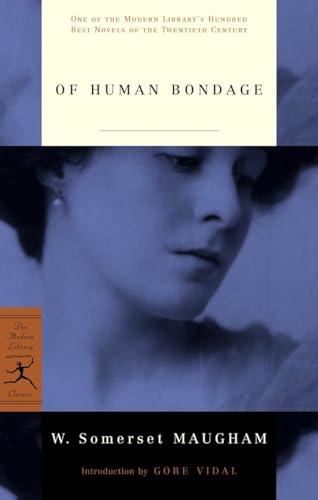
Selected by the Modern Library as one of the 100 best novels of all time
"It is very difficult for a writer of my generation, if he is honest, to pretend indifference to the work of Somerset Maugham," wrote Gore Vidal. "He was always so entirely there."
Originally published in 1915, Of Human Bondage is a potent expression of the power of sexual obsession and of modern man's yearning for freedom. This classic bildungsroman tells the story of Philip Carey, a sensitive boy born with a clubfoot who is orphaned and raised by a religious aunt and uncle. Philip yearns for adventure, and at eighteen leaves home, eventually pursuing a career as an artist in Paris. When he returns to London to study medicine, he meets the androgynous but alluring Mildred and begins a doomed love affair that will change the course of his life. There is no more powerful story of sexual infatuation, of human longing for connection and freedom.
"Here is a novel of the utmost importance," wrote Theodore Dreiser on publication. "It is a beacon of light by which the wanderer may be guided. . . . One feels as though one were sitting before a splendid Shiraz of priceless texture and intricate weave, admiring, feeling, responding sensually to its colors and tones."
With an Introduction by Gore Vidal
Commentary by Theodore Dreiser and Graham Greene
Die Inhaltsangabe kann sich auf eine andere Ausgabe dieses Titels beziehen.
Über die Autorin bzw. den Autor
William Somerset Maugham, famous as novelist, playwright and short-story writer, was born in 1874, and lived in Paris until he was ten. He was educated at King's School, Canterbury, and at Heidelberg University. He spent some time at St. Thomas' Hospital with a view to practising medicine, but the success of his first novel, Liza of Lambeth, published in 1897, won him over to letters. Of Human Bondage, the first of his masterpieces, came out in 1915, and with the publication in 1919 of The Moon and Sixpence his reputation as a novelist was established. His position as a successful playwright was being consolidated at the same time. His first play, A Man of Honour, was followed by a series of successes just before and after World War I, and his career in the theatre did not end until 1933 with Sheppey.
His fame as a short story writer began with The Trembling of a Leaf, subtitled Little Stories of the South Sea Islands, in 1921, after which he published more than ten collections. His other works include travel books such as On a Chinese Screen, and Don Fernando, essays, criticism, and the autobiographical The Summing Up and A Writer's Notebook.
In 1927, he settled in the south of France, and lived there until his death in 1965.
Von der hinteren Coverseite
It is very difficult for a writer of my generation, if he is honest, to pretend indifference to the work of Somerset Maugham," wrote Gore Vidal. "He was always so entirely there."
Originally published in 1915, Of Human Bondage is a potent expression of the power of sexual obsession and of modern man's yearning for freedom. This classic bildungsroman tells the story of Philip Carey, a sensitive boy born with a clubfoot who is orphaned and raised by a religious aunt and uncle. Philip yearns for adventure, and at eighteen leaves home, eventually pursuing a career as an artist in Paris. When he returns to London to study medicine, he meets the androgynous but alluring Mildred and begins a doomed love affair that will change the course of his life. There is no more powerful story of sexual infatuation, of human longing for connection and freedom.
"Here is a novel of the utmost importance," wrote Theodore Dreiser on publication. "It is a beacon of light by which the wanderer may be guided. . . . One feels as though one were sitting before a splendid Shiraz of priceless texture and intricate weave, admiring, feeling, responding sensually to its colors and tones."
With an Introduction by Gore Vidal
Commentary by Theodore Dreiser and Graham Greene
Auszug. © Genehmigter Nachdruck. Alle Rechte vorbehalten.
I
THE DAY broke grey and dull. The clouds hung heavily, and there was a rawness in the air that suggested snow. A woman servant came into a room in which a child was sleeping and drew the curtains. She glanced mechanically at the house opposite, a stucco house with a portico, and went to the child's bed.
'Wake up, Philip,' she said.
She pulled down the bed-clothes, took him in her arms, and carried him downstairs. He was only half awake.
'Your mother wants you,' she said.
She opened the door of a room on the floor below and took the child over to a bed in which a woman was lying. It was his mother. She stretched out her arms, and the child nestled by her side. He did not ask why he had been awakened. The woman kissed his eyes, and with thin, small hands felt the warm body through his white flannel nightgown. She pressed him closer to herself. 'Are you sleepy, darling?' she said.
Her voice was so weak that it seemed to come already from a great distance. The child did not answer, but smiled comfortably. He was very happy in the large, warm bed, with those soft arms about him. He tried to make himself smaller still as he cuddled against his mother, and he kissed her sleepily. In a moment he closed his eyes and was fast asleep. The doctor came forward and stood by the bedside.
'Oh, don't take him away yet,' she moaned.
The doctor, without answering, looked at her gravely. Knowing she would not be allowed to keep the child much longer, the woman kissed him again; and she passed her hand down his body till she came to his feet; she held the right foot in her hand and felt the five small toes; and then slowly passed her hand over the left one. She gave a sob.
'What's the matter?' said the doctor. 'You're tired.'
She shook her head, unable to speak, and the tears rolled down her cheeks. The doctor bent down.
'Let me take him.'
She was too weak to resist his wish, and she gave the child up. The doctor handed him back to his nurse.
'You'd better put him back in his own bed.'
'Very well, sir.'
The little boy, still sleeping, was taken away. His mother sobbed now broken-heartedly. 'What will happen to him, poor child?'
The monthly nurse tried to quiet her, and presently, from exhaustion, the crying ceased. The doctor walked to a table on the other side of the room, upon which, under a towel, lay the body of a still-born child. He lifted the towel and looked. He was hidden from the bed by a screen, but the woman guessed what he was doing.
'Was it a girl or a boy?' she whispered to the nurse.
'Another boy.'
The woman did not answer. In a moment the child's nurse came back. She approached the bed.
'Master Philip never woke up,' she said.
There was a pause. Then the doctor felt his patient's pulse once more.
'I don't think there's anything I can do just now,' he said. 'I'll call again after breakfast.'
'I'll show you out, sir,' said the child's nurse.
They walked downstairs in silence. In the hall the doctor stopped.
'You've sent for Mrs. Carey's brother-in-law, haven't you?'
'Yes, sir.'
'D'you know at what time he'll be here?'
'No, sir, I'm expecting a telegram.'
'What about the little boy? I should think he'd be better out of the way.'
'Miss Watkin said she'd take him, sir.'
'Who's she?'
'She's his godmother, sir. D'you think Mrs. Carey will get over it, sir?'
The doctor shook his head.
II
IT WAS a week later. Philip was sitting on the floor in the drawing-room at Miss Watkin's house in Onslow Gardens. He was an only child and used to amusing himself. The room was filled with massive furniture, and on each of the sofas were three big cushions. There was a cushion too in each armchair. All these he had taken and, with the help of the gilt rout chairs, light and easy to move, had made an elaborate cave in which he could hide himself from the Red Indians who were lurking behind the curtains. He put his ear to the floor and listened to the herd of buffaloes that raced across the prairie. Presently, hearing the door open, he held his breath so that he might not be discovered; but a violent hand pulled away a chair and the cushions fell down.
'You naughty boy, Miss Watkin will be cross with you.'
'Hulloa, Emma!' he said.
The nurse bent down and kissed him, then began to shake out the cushions, and put them back in their places.
'Am I to come home?' he asked.
'Yes, I've come to fetch you.'
'You've got a new dress on.'
It was in 1885, and she wore a bustle. Her gown was of black velvet, with tight sleeves and sloping shoulders, and the skirt had three large flounces. She wore a black bonnet with velvet strings. She hesitated. The question she had expected did not come, and so she could not give the answer she had prepared.
'Aren't you going to ask how your mamma is?' she said at length.
'Oh, I forgot. How is mamma?'
Now she was ready.
'Your mamma is quite well and happy.'
'Oh, I am glad.'
'Your mamma's gone away. You won't ever see her any more.'
Philip did not know what she meant.
'Why not?'
'Your mamma's in heaven.'
She began to cry, and Philip, though he did not quite understand, cried too. Emma was a tall, big-boned woman, with fair hair and large features. She came from Devonshire and, notwithstanding her many years of service in London, had never lost the breadth of her accent. Her tears increased her emotion, and she pressed the little boy to her heart. She felt vaguely the pity of that child deprived of the only love in the world that is quite unselfish. It seemed dreadful that he must be handed over to strangers. But in a little while she pulled herself together.
'Your Uncle William is waiting in to see you,' she said. 'Go and say good-bye to Miss Watkin, and we'll go home.'
'I don't want to say good-bye,' he answered, instinctively anxious to hide his tears.
'Very well, run upstairs and get your hat.'
He fetched it, and when he came down Emma was waiting for him in the hall. He heard the sound of voices in the study behind the dining-room. He paused. He knew that Miss Watkin and her sister were talking to friends, and it seemed to him--he was nine years old--that if he went in they would be sorry for him.
'I think I'll go and say good-bye to Miss Watkin.'
'I think you'd better,' said Emma.
'Go in and tell them I'm coming,' he said.
He wished to make the most of his opportunity. Emma knocked at the door and walked in. He heard her speak.
'Master Philip wants to say good-bye to you, miss.'
There was a sudden hush of the conversation, and Philip limped in. Henrietta Watkin was a stout woman, with a red face and dyed hair. In those days to dye the hair excited comment, and Philip had heard much gossip at home when his godmother's changed colour. She lived with an elder sister, who had resigned herself contentedly to old age. Two ladies, whom Philip did not know, were calling, and they looked at him curiously.
'My poor child,' said Miss Watkin, opening her arms.
She began to cry. Philip understood now why she had not been in to luncheon and why she wore a black dress. She could not speak.
'I've got to go home,' said Philip, at last.
He disengaged himself from Miss Watkin's arms, and she kissed him again. Then he went to her sister and bade her good-bye too. One of the strange ladies asked if she might kiss him, and he gravely gave her permission. Though crying, he keenly enjoyed the sensation he was causing; he would have been glad to stay a little longer to be made so much of, but felt they expected him to go, so he said that Emma was waiting for him. He went out of the room. Emma had gone...
„Über diesen Titel“ kann sich auf eine andere Ausgabe dieses Titels beziehen.
Suchergebnisse für Of Human Bondage (Modern Library 100 Best Novels)

Beispielbild für diese ISBN
Of Human Bondage
Anbieter: World of Books (was SecondSale), Montgomery, IL, USA
Verkäuferbewertung 5 von 5 Sternen

Paperback. Zustand: Fair. William Somerset Maugham (1874-1965) was an English playwright, novelist, and short story writer. He was one of the most popular authors of his era, and reputedly the highest paid of his profession during the 1930s. By 1914 he was famous, with 10 plays produced and 10 published novels. His masterpiece is generally agreed to be Of Human Bondage (1915), a semi-autobiographical novel that deals with the life of the main character Philip Carey, who like Maugham, was orphaned, and brought up by his pious uncle. His last major novel, The Razor's Edge, published in 1944, was a departure for him in many ways. While much of the novel takes place in Europe, its main characters are American, not British. His other works include: Liza of Lambeth (1897), Mrs Craddock (1902), A Man of Honour (1903), The Land of the Blessed Virgin (1905), The Bishop's Apron (1906), Lady Frederick (1907), The Magician (1908), Home and Beauty (1909), The Moon and Sixpence (1919), The Circle (1921), The Trembling of a Leaf (1921), and On a Chinese Screen (1922). Artikel-Nr. 00102247389
Gebraucht kaufen
EUR 5,03
Versand gratis
Versand innerhalb von USA
Versand innerhalb von USA
Anzahl: 1 verfügbar
Beispielbild für diese ISBN
Of Human Bondage
Anbieter: World of Books (was SecondSale), Montgomery, IL, USA
Verkäuferbewertung 5 von 5 Sternen
Paperback. Zustand: Good. William Somerset Maugham (1874-1965) was an English playwright, novelist, and short story writer. He was one of the most popular authors of his era, and reputedly the highest paid of his profession during the 1930s. By 1914 he was famous, with 10 plays produced and 10 published novels. His masterpiece is generally agreed to be Of Human Bondage (1915), a semi-autobiographical novel that deals with the life of the main character Philip Carey, who like Maugham, was orphaned, and brought up by his pious uncle. His last major novel, The Razor's Edge, published in 1944, was a departure for him in many ways. While much of the novel takes place in Europe, its main characters are American, not British. His other works include: Liza of Lambeth (1897), Mrs Craddock (1902), A Man of Honour (1903), The Land of the Blessed Virgin (1905), The Bishop's Apron (1906), Lady Frederick (1907), The Magician (1908), Home and Beauty (1909), The Moon and Sixpence (1919), The Circle (1921), The Trembling of a Leaf (1921), and On a Chinese Screen (1922). Artikel-Nr. CIN037575315XG
Gebraucht kaufen
EUR 5,03
Versand gratis
Versand innerhalb von USA
Versand innerhalb von USA
Anzahl: 1 verfügbar
Beispielbild für diese ISBN
Of Human Bondage (Modern Library 100 Best Novels)
Verlag:
Modern Library (edition Reprint), 1999
ISBN 10: 037575315X
ISBN 13: 9780375753152
Gebraucht
Paperback
Anbieter: BooksRun, Philadelphia, PA, USA
Verkäuferbewertung 5 von 5 Sternen
Paperback. Zustand: Fair. Reprint. The item might be beaten up but readable. May contain markings or highlighting, as well as stains, bent corners, or any other major defect, but the text is not obscured in any way. Artikel-Nr. 037575315X-7-1-13
Gebraucht kaufen
EUR 5,04
Versand gratis
Versand innerhalb von USA
Versand innerhalb von USA
Anzahl: 1 verfügbar
Beispielbild für diese ISBN
Of Human Bondage
Anbieter: ThriftBooks-Reno, Reno, NV, USA
Verkäuferbewertung 5 von 5 Sternen
Paperback. Zustand: Good. No Jacket. Pages can have notes/highlighting. Spine may show signs of wear. ~ ThriftBooks: Read More, Spend Less. Artikel-Nr. G037575315XI3N00
Gebraucht kaufen
EUR 6,13
Versand gratis
Versand innerhalb von USA
Versand innerhalb von USA
Anzahl: 1 verfügbar
Beispielbild für diese ISBN
Of Human Bondage
Anbieter: ThriftBooks-Phoenix, Phoenix, AZ, USA
Verkäuferbewertung 5 von 5 Sternen
Paperback. Zustand: Fair. No Jacket. Missing dust jacket; Readable copy. Pages may have considerable notes/highlighting. ~ ThriftBooks: Read More, Spend Less. Artikel-Nr. G037575315XI5N01
Gebraucht kaufen
EUR 6,13
Versand gratis
Versand innerhalb von USA
Versand innerhalb von USA
Anzahl: 1 verfügbar
Beispielbild für diese ISBN
Of Human Bondage
Anbieter: ThriftBooks-Dallas, Dallas, TX, USA
Verkäuferbewertung 5 von 5 Sternen
Paperback. Zustand: Fair. No Jacket. Former library book; Readable copy. Pages may have considerable notes/highlighting. ~ ThriftBooks: Read More, Spend Less. Artikel-Nr. G037575315XI5N10
Gebraucht kaufen
EUR 6,66
Versand gratis
Versand innerhalb von USA
Versand innerhalb von USA
Anzahl: 1 verfügbar
Beispielbild für diese ISBN
Of Human Bondage
Anbieter: ThriftBooks-Dallas, Dallas, TX, USA
Verkäuferbewertung 5 von 5 Sternen
Paperback. Zustand: Good. No Jacket. Pages can have notes/highlighting. Spine may show signs of wear. ~ ThriftBooks: Read More, Spend Less. Artikel-Nr. G037575315XI3N00
Gebraucht kaufen
EUR 6,67
Versand gratis
Versand innerhalb von USA
Versand innerhalb von USA
Anzahl: 1 verfügbar
Beispielbild für diese ISBN
Of Human Bondage
Anbieter: ThriftBooks-Atlanta, AUSTELL, GA, USA
Verkäuferbewertung 5 von 5 Sternen
Paperback. Zustand: Good. No Jacket. Pages can have notes/highlighting. Spine may show signs of wear. ~ ThriftBooks: Read More, Spend Less. Artikel-Nr. G037575315XI3N00
Gebraucht kaufen
EUR 6,67
Versand gratis
Versand innerhalb von USA
Versand innerhalb von USA
Anzahl: 1 verfügbar
Beispielbild für diese ISBN
Of Human Bondage
Anbieter: Magers and Quinn Booksellers, Minneapolis, MN, USA
Verkäuferbewertung 5 von 5 Sternen
paperback. Zustand: Acceptable. May have underlining, highlighting, margin notes, remainder marks, inscriptions, book plates, tears, significant wear, and/or a missing dust jacket, box, or discs. Damaged item. Artikel-Nr. 1374560
Gebraucht kaufen
EUR 6,20
EUR 3,56 Versand
Versand innerhalb von USA
Versand innerhalb von USA
Anzahl: 1 verfügbar
Beispielbild für diese ISBN
Of Human Bondage
Verlag:
Random House Publishing Group, 1999
ISBN 10: 037575315X
ISBN 13: 9780375753152
Gebraucht
Softcover
Anbieter: Better World Books, Mishawaka, IN, USA
Verkäuferbewertung 5 von 5 Sternen
Zustand: Good. Former library copy. Pages intact with minimal writing/highlighting. The binding may be loose and creased. Dust jackets/supplements are not included. Includes library markings. Stock photo provided. Product includes identifying sticker. Better World Books: Buy Books. Do Good. Artikel-Nr. 3225018-6
Gebraucht kaufen
EUR 10,38
Versand gratis
Versand innerhalb von USA
Versand innerhalb von USA
Anzahl: 1 verfügbar