
Verwandte Artikel zu The Origin of Species: By Means of Natural Selection...
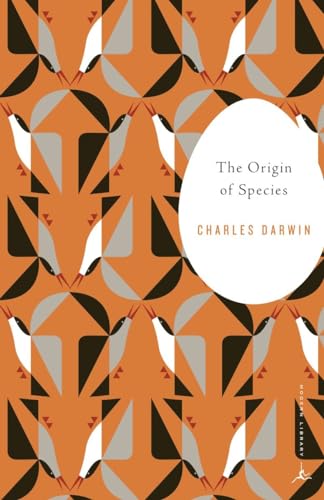
The Origin of Species: By Means of Natural Selection or the Preservation of Favored Races in the Struggle for Life (Modern Library Classics) - Softcover
Inhaltsangabe
Introduction by Edward J. Larson
Perhaps the most readable and accessible of the great works of scientific inquiry, The Origin of Species sold out its first printing on the very day it was published in 1859. Theologians quickly labeled Charles Darwin the most dangerous man in England and, as the Saturday Review noted, the uproar over the book quickly “passed beyond the bounds of the study and lecture-room into the drawing-room and the public street.” Based largely on Darwin’s experience as a naturalist while on a five-year voyage aboard H. M. S. Beagle, The Origin of Species set forth a theory of evolution and natural selection that challenged contemporary beliefs about divine providence and the immutability of species. This Modern Library edition includes a Foreword by the Pulitzer Prize–winning science historian Edward J. Larson, an introductory historical sketch, and a glossary Darwin later added to the original text.
Die Inhaltsangabe kann sich auf eine andere Ausgabe dieses Titels beziehen.
Über die Autorin bzw. den Autor
Edward J. Larson is Russell Professor of History and Talmadge Professor of Law at the University of Georgia. He is the recipient of multiple awards for teaching and writing, including the 1998 Pulitzer Prize in History for his book Summer for the Gods: The Scopes Trial and America’s Continuing Debate Over Science and Religion.
Von der hinteren Coverseite
Perhaps the most readable and accessible of the great works of scientific imagination, The Origin of Species sold out on the day it was published in 1859. Theologians quickly labeled Charles Darwin the most dangerous man in England, and, as the Saturday Review noted, the uproar over the book quickly "passed beyond the bounds of the study and lecture-room into the drawing-room and the public street." Yet, after reading it, Darwin's friend and colleague T. H. Huxley had a different reaction: "How extremely stupid not to have thought of that."
Based largely on Darwin's experience as a naturalist while on a five-year voyage aboard H.M.S. Beagle, The Origin of Species set forth a theory of evolution and natural selection that challenged contemporary beliefs about divine providence and the immutability of species. A landmark contribution to philosophical and scientific thought, this edition also includes an introductory historical sketch and a glossary Darwin later added to the original text.
Charles Darwin grew up considered, by his own account, "a very ordinary boy, rather below the common standard of intellect." A quirk of fate kept him from the career his father had deemed appropriate--that of a country parson--when a botanist recommended Darwin for an appointment as a naturalist aboard H.M.S. Beagle from 1831 to 1836. Darwin is also the author of the five-volume work Zoology of the Voyage of the Beagle (1839) and The Descent of Man (1871).
Auszug. © Genehmigter Nachdruck. Alle Rechte vorbehalten.
Chapter One
Variation Under Domestication
Causes of Variability—Effects of Habit—Correlation of Growth—Inheritance—Character of Domestic Varieties—Difficulty of distinguishing between Varieties and Species—Origin of Domestic Varieties from one or more Species—Domestic Pigeons, their Differences and Origin—Principle of Selection anciently followed, its Effects—Methodical and Unconscious Selection—Unknown Origin of our Domestic Productions—Circumstances favourable to Man's power of Selection
WHEN WE look to the individuals of the same variety or sub-variety of our older cultivated plants and animals, one of the first points which strikes us, is, that they generally differ much more from each other, than do the individuals of any one species or variety in a state of nature. When we reflect on the vast diversity of the plants and animals which have been cultivated, and which have varied during all ages under the most different climates and treatment, I think we are driven to conclude that this greater variability is simply due to our domestic productions having been raised under conditions of life not so uniform as, and somewhat different from, those to which the parent species have been exposed under nature. There is, also, I think, some probability in the view propounded by Andrew Knight, that this variability may be partly connected with excess of food. It seems pretty clear that organic beings must be exposed during several generations to the new conditions of life to cause any appreciable amount of variation; and that when the organisation has once begun to vary, it generally continues to vary for many generations. No case is on record of a variable being ceasing to be variable under cultivation. Our oldest cultivated plants, such as wheat, still often yield new varieties: our oldest domesticated animals are still capable of rapid improvement or modification.
It has been disputed at what period of life the causes of variability, whatever they may be, generally act; whether during the early or late period of development of the embryo, or at the instant of conception. Geoffroy St Hilaire's experiments show that unnatural treatment of the embryo causes monstrosities; and monstrosities cannot be separated by any clear line of distinction from mere variations. But I am strongly inclined to suspect that the most frequent cause of variability may be attributed to the male and female reproductive elements having been affected prior to the act of conception. Several reasons make me believe in this; but the chief one is the remarkable effect which confinement or cultivation has on the functions of the reproductive system; this system appearing to be far more susceptible than any other part of the organization, to the action of any change in the conditions of life. Nothing is more easy than to tame an animal, and few things more difficult than to get it to breed freely under confinement, even in the many cases when the male and female unite. How many animals there are which will not breed, though living long under not very close confinement in their native country! This is generally attributed to vitiated instincts; but how many cultivated plants display the utmost vigour, and yet rarely or never seed! In some few such cases it has been found out that very trifling changes, such as a little more or less water at some particular period of growth, will determine whether or not the plant sets a seed. I cannot here enter on the copious details which I have collected on this curious subject; but to show how singular the laws are which determine the reproduction of animals under confinement, I may just mention that carnivorous animals, even from the tropics, breed in this country pretty freely under confinement, with the exception of the plantigrades or bear family; whereas, carnivorous birds, with the rarest exceptions, hardly ever lay fertile eggs. Many exotic plants have pollen utterly worthless, in the same exact condition as in the most sterile hybrids. When, on the one hand, we see domesticated animals and plants, though often weak and sickly, yet breeding quite freely under confinement; and when, on the other hand, we see individuals, though taken young from a state of nature, perfectly tamed, long-lived, and healthy (of which I could give numerous instances), yet having their reproductive system so seriously affected by unperceived causes as to fail in acting, we need not be surprised at this system, when it does act under confinement, acting not quite regularly, and producing offspring not perfectly like their parents or variable.
Sterility has been said to be the bane of horticulture; but on this view we owe variability to the same cause which produces sterility; and variability is the source of all the choicest productions of the garden. I may add, that as some organisms will breed most freely under the most unnatural conditions (for instance, the rabbit and ferret kept in hutches), showing that their reproductive system has not been thus affected; so will some animals and plants withstand domestication or cultivation, and vary very slightly—perhaps hardly more than in a state of nature.
A long list could easily be given of 'sporting plants;' by this term gardeners mean a single bud or offset, which suddenly assumes a new and sometimes very different character from that of the rest of the plant. Such buds can be propagated by grafting, &c., and sometimes by seed. These 'sports' are extremely rare under nature, but far from rare under cultivation; and in this case we see that the treatment of the parent has affected a bud or offset, and not the ovules or pollen. But it is the opinion of most physiologists that there is no essential difference between a bud and an ovule in their earliest stages of formation; so that, in fact, 'sports' support my view, that variability may be largely attributed to the ovules or pollen, or to both, having been affected by the treatment of the parent prior to the act of conception. These cases anyhow show that variation is not necessarily connected, as some authors have supposed, with the act of generation.
Seedlings from the same fruit, and the young of the same litter, sometimes differ considerably from each other, though both the young and the parents, as Mxller has remarked, have apparently been exposed to exactly the same conditions of life; and this shows how unimportant the direct effects of the conditions of life are in comparison with the laws of reproduction, and of growth, and of inheritance; for had the action of the conditions been direct, if any of the young had varied, all would probably have varied in the same manner. To judge how much, in the case of any variation, we should attribute to the direct action of heat, moisture, light, food, &c., is most difficult: my impression is, that with animals such agencies have produced very little direct effect, though apparently more in the case of plants. Under this point of view, Mr Buckman's recent experiments on plants seem extremely valuable. When all or nearly all the individuals exposed to certain conditions are affected in the same way, the change at first appears to be directly due to such conditions; but in some cases it can be shown that quite opposite conditions produce similar changes of structure. Nevertheless some slight amount of change may, I think, be attributed to the direct action of the conditions of life—as, in some cases, increased size from amount of food, colour from particular kinds of food and from light, and perhaps the thickness of fur from climate.
Habit also has a deciding influence, as in the period of flowering with plants when transported from one climate to another. In animals it has a more marked effect; for instance, I find in the domestic duck that the bones of the wing...
„Über diesen Titel“ kann sich auf eine andere Ausgabe dieses Titels beziehen.
Suchergebnisse für The Origin of Species: By Means of Natural Selection...

Beispielbild für diese ISBN
The Origin of Species
Anbieter: World of Books (was SecondSale), Montgomery, IL, USA
Verkäuferbewertung 5 von 5 Sternen

Paperback. Zustand: Good. HarperCollins is proud to present its range of best-loved, essential classics.'How fleeting are the wishes and efforts of man how short his time and consequently how poor will his products be, compared with those accumulated by nature during whole geological periods.'Still considered one of the most important and groundbreaking works of science ever written, Darwin's eminently readable exploration of the evolutionary process challenged most of the strong beliefs of the Western world. Forced to question the idea of the Creator, mid-nineteenth century readers were faced with Darwin's theories on the laws of natural selection and the randomness of evolution, causing massive controversy at the time. However, Darwin's theories remain instrumental in providing the backbone to modern biology today. Artikel-Nr. 00095986537
Gebraucht kaufen
EUR 4,05
Versand gratis
Versand innerhalb von USA
Versand innerhalb von USA
Anzahl: 7 verfügbar
Beispielbild für diese ISBN
The Origin of Species
Anbieter: World of Books (was SecondSale), Montgomery, IL, USA
Verkäuferbewertung 5 von 5 Sternen
Paperback. Zustand: Very Good. HarperCollins is proud to present its range of best-loved, essential classics.'How fleeting are the wishes and efforts of man how short his time and consequently how poor will his products be, compared with those accumulated by nature during whole geological periods.'Still considered one of the most important and groundbreaking works of science ever written, Darwin's eminently readable exploration of the evolutionary process challenged most of the strong beliefs of the Western world. Forced to question the idea of the Creator, mid-nineteenth century readers were faced with Darwin's theories on the laws of natural selection and the randomness of evolution, causing massive controversy at the time. However, Darwin's theories remain instrumental in providing the backbone to modern biology today. Artikel-Nr. 00079423011
Gebraucht kaufen
EUR 4,05
Versand gratis
Versand innerhalb von USA
Versand innerhalb von USA
Anzahl: 11 verfügbar
Beispielbild für diese ISBN
The Origin of Species
Anbieter: World of Books (was SecondSale), Montgomery, IL, USA
Verkäuferbewertung 5 von 5 Sternen
Paperback. Zustand: Fair. HarperCollins is proud to present its range of best-loved, essential classics.'How fleeting are the wishes and efforts of man how short his time and consequently how poor will his products be, compared with those accumulated by nature during whole geological periods.'Still considered one of the most important and groundbreaking works of science ever written, Darwin's eminently readable exploration of the evolutionary process challenged most of the strong beliefs of the Western world. Forced to question the idea of the Creator, mid-nineteenth century readers were faced with Darwin's theories on the laws of natural selection and the randomness of evolution, causing massive controversy at the time. However, Darwin's theories remain instrumental in providing the backbone to modern biology today. Artikel-Nr. 00098255819
Gebraucht kaufen
EUR 4,05
Versand gratis
Versand innerhalb von USA
Versand innerhalb von USA
Anzahl: 4 verfügbar
Beispielbild für diese ISBN
The Origin of Species (Modern Library (Paperback))
Verlag:
Modern Library (edition Reprint), 1998
ISBN 10: 0375751467
ISBN 13: 9780375751462
Gebraucht
Paperback
Anbieter: BooksRun, Philadelphia, PA, USA
Verkäuferbewertung 5 von 5 Sternen
Paperback. Zustand: Fair. Reprint. The item might be beaten up but readable. May contain markings or highlighting, as well as stains, bent corners, or any other major defect, but the text is not obscured in any way. Artikel-Nr. 0375751467-7-18
Gebraucht kaufen
EUR 5,61
Versand gratis
Versand innerhalb von USA
Versand innerhalb von USA
Anzahl: 1 verfügbar
Beispielbild für diese ISBN
The Origin of Species: By Means of Natural Selection or the Preservation of Favored Races in the Struggle for Life
Anbieter: ThriftBooks-Dallas, Dallas, TX, USA
Verkäuferbewertung 5 von 5 Sternen
Paperback. Zustand: Good. No Jacket. Pages can have notes/highlighting. Spine may show signs of wear. ~ ThriftBooks: Read More, Spend Less. Artikel-Nr. G0375751467I3N00
Gebraucht kaufen
EUR 5,96
Versand gratis
Versand innerhalb von USA
Versand innerhalb von USA
Anzahl: 2 verfügbar
Beispielbild für diese ISBN
The Origin of Species: By Means of Natural Selection or the Preservation of Favored Races in the Struggle for Life
Anbieter: ThriftBooks-Reno, Reno, NV, USA
Verkäuferbewertung 5 von 5 Sternen
Paperback. Zustand: Good. No Jacket. Pages can have notes/highlighting. Spine may show signs of wear. ~ ThriftBooks: Read More, Spend Less. Artikel-Nr. G0375751467I3N00
Gebraucht kaufen
EUR 5,96
Versand gratis
Versand innerhalb von USA
Versand innerhalb von USA
Anzahl: 1 verfügbar
Beispielbild für diese ISBN
The Origin of Species: By Means of Natural Selection or the Preservation of Favored Races in the Struggle for Life
Anbieter: ThriftBooks-Atlanta, AUSTELL, GA, USA
Verkäuferbewertung 5 von 5 Sternen
Paperback. Zustand: Good. No Jacket. Pages can have notes/highlighting. Spine may show signs of wear. ~ ThriftBooks: Read More, Spend Less. Artikel-Nr. G0375751467I3N00
Gebraucht kaufen
EUR 5,96
Versand gratis
Versand innerhalb von USA
Versand innerhalb von USA
Anzahl: 2 verfügbar
Beispielbild für diese ISBN
The Origin of Species: By Means of Natural Selection or the Preservation of Favored Races in the Struggle for Life
Anbieter: ThriftBooks-Dallas, Dallas, TX, USA
Verkäuferbewertung 5 von 5 Sternen
Paperback. Zustand: Very Good. No Jacket. Former library book; May have limited writing in cover pages. Pages are unmarked. ~ ThriftBooks: Read More, Spend Less. Artikel-Nr. G0375751467I4N10
Gebraucht kaufen
EUR 5,96
Versand gratis
Versand innerhalb von USA
Versand innerhalb von USA
Anzahl: 1 verfügbar
Beispielbild für diese ISBN
The Origin of Species: By Means of Natural Selection or the Preservation of Favored Races in the Struggle for Life
Anbieter: ThriftBooks-Phoenix, Phoenix, AZ, USA
Verkäuferbewertung 5 von 5 Sternen
Paperback. Zustand: Good. No Jacket. Pages can have notes/highlighting. Spine may show signs of wear. ~ ThriftBooks: Read More, Spend Less. Artikel-Nr. G0375751467I3N00
Gebraucht kaufen
EUR 5,96
Versand gratis
Versand innerhalb von USA
Versand innerhalb von USA
Anzahl: 1 verfügbar
Beispielbild für diese ISBN
The Origin of Species (Modern Library Classics)
Anbieter: Wonder Book, Frederick, MD, USA
Verkäuferbewertung 5 von 5 Sternen
Zustand: Very Good. Very Good condition. A copy that may have a few cosmetic defects. May also contain light spine creasing or a few markings such as an owner's name, short gifter's inscription or light stamp. Artikel-Nr. C11A-05628
Gebraucht kaufen
EUR 6,63
Versand gratis
Versand innerhalb von USA
Versand innerhalb von USA
Anzahl: 3 verfügbar