
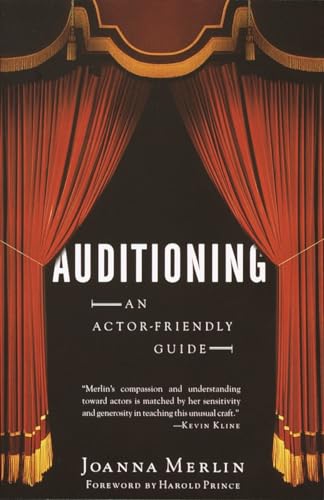
Inhaltsangabe
Theater veteran and acting teacher Joanna Merlin has written the definitive guide to auditioning for stage and screen, bringing to it a valuable dual perspective. She has spent her career on both sides of the auditioning process, both as an award-winning casting director who has worked with Harold Prince, Bernard Bertolucci, and James Ivory, and as an accomplished actor herself.
In this highly informative and accessible book, Merlin provides everything the actor needs to achieve self-confidence and artistic honesty–from the most basic practical tips to an in-depth framework for preparing a part. Filled with advice from the most esteemed people in the business, such as James Lapine, Nora Ephron, and Stephen Sondheim, and charged with tremendous wisdom and compassion, this indispensable resource will arm the reader to face an actor's greatest challenge: getting the part.
Die Inhaltsangabe kann sich auf eine andere Ausgabe dieses Titels beziehen.
Über die Autorin bzw. den Autor
Joanna Merlin was a recipient of the Casting Society of America's Artios Award for Outstanding Achievment in Dramatic Feature Film Casting for Bertolucci's The Last Emperor and for Best Musical Theatre Casting for Sondheim and Lapine's Into the Woods. As Hardol Prince's casting director, she cast the original Broadway productions of Follies, A little Night Music, Sweeney Todd, Pacific Overtures, and Evita, among others, and her film casting includes Michael Camino's Year of the Dragon and Merchant Ivory's Mr. and Mrs. Bridge.
Harold Prince is an American theatrical producer and director associated with many of the best-known American Broadway musical productions of the 20th century. Prince was born in New York, New York. He began his career as a stage manager working with director George Abbott. After a small while, he and Abbott co-produced The Pajama Game, which won Prince his first Tony. In total, Prince has won over 20 Tony Awards, more than any other person.
Von der hinteren Coverseite
Theater veteran and acting teacher Joanna Merlin has written the definitive guide to auditioning for stage and screen, bringing to it a valuable dual perspective. She has spent her career on both sides of the auditioning process, both as an award-winning casting director who has worked with Harold Prince, Bernard Bertolucci, and James Ivory, and as an accomplished actor herself.
In this highly informative and accessible book, Merlin provides everything the actor needs to achieve self-confidence and artistic honesty-from the most basic practical tips to an in-depth framework for preparing a part. Filled with advice from the most esteemed people in the business, such as James Lapine, Nora Ephron, and Stephen Sondheim, and charged with tremendous wisdom and compassion, this indispensable resource will arm the reader to face an actor's greatest challenge: getting the part.
Auszug. © Genehmigter Nachdruck. Alle Rechte vorbehalten.
Chapter I
stop self-sabotage: change the odds!
Most people go to work in the same office, store, or factory every day; they can anticipate who will be there, what the workplace will look like, how it will feel, how their colleagues will relate to them, and how much they will be paid. With any luck, they know what is expected of them and feel confident they can fulfill their assigned tasks.
An actor's life is quite different. A large part of an actor's work is auditioning. Unlike a "regular job", there is no paycheck at the end of the week. (Wouldn't that be nice?) More important, each auditioning event is unpredictable. The script may or may not be available to you in advance. You may be given a scene to read "cold," with only a few minutes to prepare. You may have to wait five minutes or many hours. There may be hundreds of other actors waiting to audition or you may be the only one. You may be auditioning in a small office or on the stage of a large theater. You may encounter one auditor or twenty. The audition atmosphere may feel welcoming or hostile. You may read the scene with someone who is a trained actor, but more likely you will read the scene with someone who is not. You may never get any feedback or know why you didn't get the job.
In a worst-case scenario, what negative effect might these circumstances, and the pressure of getting a job, have on you, the actor?
You don't prepare in a serious way because you are convinced that, since you only have a few minutes with the director, the decision will rest only on how you look, or your personal quality. (If the director thinks you're well-suited for the role, she'll direct you at the first audition, and then you'll dig in and work hard to prepare for your callback.)
You become distracted or paralyzed when confronted with your competition, and persuade yourself that everyone else is better for the role than you are.
You feel as though the entire audition is controlled by others, upon whom you are totally dependent.
You suffer a loss of confidence. You feel isolated, anxious, insecure, and negative about your talent. You know you are a better actor than you appear to be at the audition.
You are convinced that the director has already cast the role and is obliged to see you or is doing you a favor.
If the atmosphere is not overly friendly, you assume that the director has taken an instant dislike to you.
You're certain the director knows what he wants and you don't have a clue. If you make the wrong choice, you won't get the job.
Your focus is on pleasing the director, rather than on doing your work.
You believe the director is looking for a reason to reject you rather than to hire you.
The pressure to get the job either gives you too much energy, or, in an effort to deny the pressure, too little energy.
You hurry through the audition for fear of boring the director or making her fall behind schedule, so you don't take the time to experience the important moments in the script. You rush through it and virtually fly over the material rather than inhabit it.
You feel nervous; your breath is shallow; your voice becomes constricted and doesn't sound like your natural voice; your body is stiff and self-conscious.
You feel emotionally blocked, so you work technically and are unable to get in touch with your spontaneous responses.
The more important the audition, the less freedom you feel you have to "play" the scene. (When you don't care much about getting a job, you usually land it.)
You feel angry for a variety of reasons. Perhaps you didn't have much advance notice, or you've been kept waiting a long time, or your strongest competitor is in the waiting room, or the director seems hostile or unresponsive. Or you're just angry that you have to audition at all. Why don't they just offer you the job?
When you walk into the auditioning space, you feel small, fat, naked, unfocused or amateurish, or all of the above.
After the audition, you feel disappointed in yourself because you "threw away the audition." You didn't do what you feel you are capable of doing.
If you lose the job, you believe that it's because you're not as talented as the person who got it. Or you believe it's because you're not talented at all.
Does any of this sound familiar?
How can actors not feel vulnerable at auditions? It is not in the nature of actors to be thick-skinned. If actors were not sensitive human beings, how could they understand and connect and empathize with the characters they create?
So much for the worst-case scenario. By the time you finish reading this book, I hope you will know how to create a best-case scenario and stop shooting yourself in the foot.
power
Actors think the auditors have all the power in the auditioning process and they have none. After all, there is one part for which many actors must vie with one another; you don't decide who gets the part, the auditors do. You don't know what they are looking for; they do and won't tell you. You have to prove to them that you're talented, and overcome their hostile skepticism and disbelief that you're right for the role. Until then, you're just another actor. "Thank you. Next!" You're gone and forgotten, their victim.
The actor's misperception of the auditioning process can be crippling. Apart from disabling yourself in all of the ways suggested at the beginning of this chapter, you abdicate your own power. The more power you attribute to the auditors, the less you have. The truth is that, without the vision and talent of the actor, the auditors are powerless, they can't do their work. You are the key to their power. Every director has high hopes that the next actor who walks through the door--YOU--will be the one for the part. Far from eagerly anticipating the actor's abject failure, the auditors' fondest hope is that you will give a superb audition so they can cast the role and go home.
When you shed the image of yourself as victim, you can embrace the conviction that you do have the power to affect the casting choice. Your power is your individual creativity and your ability to deliver a well-prepared, lively audition that reveals your potential for playing the role. Auditors depend on the actors who audition to shape their view of the role to be cast. That's why actors get cast, not because they fit into a cookie-cutter mold the director has in mind.
Once you realize that there is a balance of power between the actor and director, you might start looking forward to the next audition.
resistance: rejection
Many actors resist the auditioning process without realizing it. Resistance comes in many forms. You don't find the time to pick up the script well in advance of the audition. You had a very important engagement the night before the audition and didn't start working on the script till midnight. You're certain you're not what "they" are looking for, or you decide you really don't want the job, so why invest time and energy?
Or you did make the investment. You prepared, you put yourself out there creatively and emotionally, took risks, and the auditors didn't respond. There was no feedback and you didn't get the job. You feel defeated. You don't want to put yourself into that vulnerable place again, so at the next audition you shut down. You work technically and hold back any emotional commitment. We all know where that leads, or doesn't.
The major reason actors resist preparing properly for auditions is the fear of rejection. If you don't invest yourself in the audition, then you won't be so disappointed if you don't get the job. When you don't succeed, you won't feel like a loser because, after all, you didn't really try. That is a self-protective choice....
„Über diesen Titel“ kann sich auf eine andere Ausgabe dieses Titels beziehen.
Suchergebnisse für Auditioning: An Actor-Friendly Guide

Beispielbild für diese ISBN
Auditioning: An Actor-Friendly
Anbieter: World of Books (was SecondSale), Montgomery, IL, USA
Verkäuferbewertung 5 von 5 Sternen

Zustand: Good. Item in good condition. Textbooks may not include supplemental items i.e. CDs, access codes etc. Artikel-Nr. 00067488703
Gebraucht kaufen
EUR 3,47
Versand gratis
Versand innerhalb von USA
Versand innerhalb von USA
Anzahl: 10 verfügbar
Beispielbild für diese ISBN
Auditioning: An Actor-Friendly Guide
Verlag:
Knopf Doubleday Publishing Group, 2001
ISBN 10: 0375725377
ISBN 13: 9780375725371
Gebraucht
Softcover
Anbieter: World of Books (was SecondSale), Montgomery, IL, USA
Verkäuferbewertung 5 von 5 Sternen
Zustand: Very Good. Item in very good condition! Textbooks may not include supplemental items i.e. CDs, access codes etc. Artikel-Nr. 00106112148
Gebraucht kaufen
EUR 3,64
Versand gratis
Versand innerhalb von USA
Versand innerhalb von USA
Anzahl: 1 verfügbar
Beispielbild für diese ISBN
Auditioning: An Actor-Friendly Guide
Verlag:
Knopf Doubleday Publishing Group, 2001
ISBN 10: 0375725377
ISBN 13: 9780375725371
Gebraucht
Softcover
Anbieter: World of Books (was SecondSale), Montgomery, IL, USA
Verkäuferbewertung 5 von 5 Sternen
Zustand: Good. Item in good condition. Textbooks may not include supplemental items i.e. CDs, access codes etc. Artikel-Nr. 00068106391
Gebraucht kaufen
EUR 3,64
Versand gratis
Versand innerhalb von USA
Versand innerhalb von USA
Anzahl: 19 verfügbar
Beispielbild für diese ISBN
Auditioning: An Actor-Friendly Guide
Verlag:
Knopf Doubleday Publishing Group, 2001
ISBN 10: 0375725377
ISBN 13: 9780375725371
Gebraucht
Softcover
Anbieter: World of Books (was SecondSale), Montgomery, IL, USA
Verkäuferbewertung 5 von 5 Sternen
Zustand: Good. Good condition ex-library book with usual library markings and stickers. Artikel-Nr. 00103897782
Gebraucht kaufen
EUR 3,76
Versand gratis
Versand innerhalb von USA
Versand innerhalb von USA
Anzahl: 1 verfügbar
Beispielbild für diese ISBN
Auditioning: An Actor-Friendly Guide
ISBN 10: 0375725377
ISBN 13: 9780375725371
Gebraucht
Paperback
Anbieter: BooksRun, Philadelphia, PA, USA
Verkäuferbewertung 5 von 5 Sternen
Paperback. Zustand: Fair. 1st Vintage Books ed. The item might be beaten up but readable. May contain markings or highlighting, as well as stains, bent corners, or any other major defect, but the text is not obscured in any way. Artikel-Nr. 0375725377-7-1
Gebraucht kaufen
EUR 4,45
Versand gratis
Versand innerhalb von USA
Versand innerhalb von USA
Anzahl: 1 verfügbar
Beispielbild für diese ISBN
Auditioning: An Actor-Friendly Guide
Verlag:
Knopf Doubleday Publishing Group, 2001
ISBN 10: 0375725377
ISBN 13: 9780375725371
Gebraucht
Paperback
Anbieter: ThriftBooks-Phoenix, Phoenix, AZ, USA
Verkäuferbewertung 5 von 5 Sternen
Paperback. Zustand: Very Good. No Jacket. May have limited writing in cover pages. Pages are unmarked. ~ ThriftBooks: Read More, Spend Less. Artikel-Nr. G0375725377I4N00
Gebraucht kaufen
EUR 5,84
Versand gratis
Versand innerhalb von USA
Versand innerhalb von USA
Anzahl: 1 verfügbar
Beispielbild für diese ISBN
Auditioning: An Actor-Friendly Guide
Verlag:
Knopf Doubleday Publishing Group, 2001
ISBN 10: 0375725377
ISBN 13: 9780375725371
Gebraucht
Paperback
Anbieter: ThriftBooks-Dallas, Dallas, TX, USA
Verkäuferbewertung 5 von 5 Sternen
Paperback. Zustand: Very Good. No Jacket. Former library book; May have limited writing in cover pages. Pages are unmarked. ~ ThriftBooks: Read More, Spend Less. Artikel-Nr. G0375725377I4N10
Gebraucht kaufen
EUR 5,84
Versand gratis
Versand innerhalb von USA
Versand innerhalb von USA
Anzahl: 1 verfügbar
Beispielbild für diese ISBN
Auditioning: An Actor-Friendly Guide
Verlag:
Knopf Doubleday Publishing Group, 2001
ISBN 10: 0375725377
ISBN 13: 9780375725371
Gebraucht
Paperback
Anbieter: ThriftBooks-Dallas, Dallas, TX, USA
Verkäuferbewertung 5 von 5 Sternen
Paperback. Zustand: Very Good. No Jacket. May have limited writing in cover pages. Pages are unmarked. ~ ThriftBooks: Read More, Spend Less. Artikel-Nr. G0375725377I4N00
Gebraucht kaufen
EUR 5,84
Versand gratis
Versand innerhalb von USA
Versand innerhalb von USA
Anzahl: 1 verfügbar
Beispielbild für diese ISBN
Auditioning : An Actor-Friendly Guide
Verlag:
Knopf Doubleday Publishing Group, 2001
ISBN 10: 0375725377
ISBN 13: 9780375725371
Gebraucht
Softcover
Anbieter: Better World Books, Mishawaka, IN, USA
Verkäuferbewertung 5 von 5 Sternen
Zustand: Good. auditioning Edition. Former library copy. Pages intact with minimal writing/highlighting. The binding may be loose and creased. Dust jackets/supplements are not included. Includes library markings. Stock photo provided. Product includes identifying sticker. Better World Books: Buy Books. Do Good. Artikel-Nr. GRP95820537
Gebraucht kaufen
EUR 5,88
Versand gratis
Versand innerhalb von USA
Versand innerhalb von USA
Anzahl: 2 verfügbar
Beispielbild für diese ISBN
Auditioning : An Actor-Friendly Guide
Verlag:
Knopf Doubleday Publishing Group, 2001
ISBN 10: 0375725377
ISBN 13: 9780375725371
Gebraucht
Softcover
Anbieter: Better World Books: West, Reno, NV, USA
Verkäuferbewertung 5 von 5 Sternen
Zustand: Good. auditioning Edition. Pages intact with minimal writing/highlighting. The binding may be loose and creased. Dust jackets/supplements are not included. Stock photo provided. Product includes identifying sticker. Better World Books: Buy Books. Do Good. Artikel-Nr. 471361-6
Gebraucht kaufen
EUR 6,06
Versand gratis
Versand innerhalb von USA
Versand innerhalb von USA
Anzahl: 1 verfügbar