
Verwandte Artikel zu Paperboy: Confessions of a Future Engineer
Inhaltsangabe
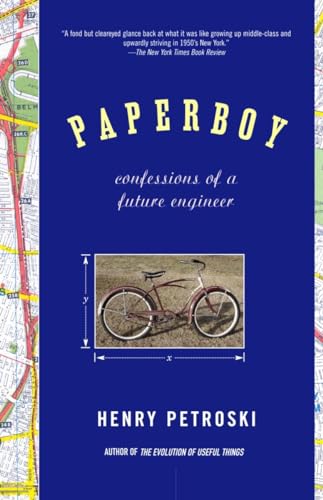
Anyone wondering what sort of experience prepares one for a future as an engineer may be surprised to learn that it includes delivering newspapers. But as Henry Petroski recounts his youth in 1950s Queens, New York–a borough of handball games and inexplicably numbered streets–he winningly shows how his after-school job amounted to a prep course in practical engineering.
Petroksi’s paper was The Long Island Press, whose headlines ran to COP SAVES OLD WOMAN FROM THUG and DiMAG SAYS BUMS CAN’T WIN SERIES. Folding it into a tube suitable for throwing was an exercise in post-Euclidean geometry. Maintaining a Schwinn revealed volumes about mechanics. Reading Paperboy, we also learn about the hazing rituals of its namesakes, the aesthetics of kitchen appliances, and the delicate art of penny-pitching. With gratifying reflections on these and other lessons of a bygone era–lessons about diligence, labor, and community-mindedness–Paperboy is a piece of Americana to cherish and reread.
Die Inhaltsangabe kann sich auf eine andere Ausgabe dieses Titels beziehen.
Über die Autorin bzw. den Autor
Henry Petroski is the Aleksandar S. Vesic Professor of Civil Engineering and a professor of history at Duke University. He is the author of nine previous books.
Aus dem Klappentext
ring what sort of experience prepares one for a future as an engineer may be surprised to learn that it includes delivering newspapers. But as Henry Petroski recounts his youth in 1950s Queens, New Yorka borough of handball games and inexplicably numbered streetshe winningly shows how his after-school job amounted to a prep course in practical engineering.
Petroksis paper was The Long Island Press, whose headlines ran to COP SAVES OLD WOMAN FROM THUG and DiMAG SAYS BUMS CANT WIN SERIES. Folding it into a tube suitable for throwing was an exercise in post-Euclidean geometry. Maintaining a Schwinn revealed volumes about mechanics. Reading Paperboy, we also learn about the hazing rituals of its namesakes, the aesthetics of kitchen appliances, and the delicate art of penny-pitching. With gratifying reflections on these and other lessons of a bygone eralessons about diligence, labor, and community-mindedness<
Auszug. © Genehmigter Nachdruck. Alle Rechte vorbehalten.
Chapter 1
All You Need Is a Bike
On my twelfth birthday, our family moved from the city that we knew to the suburbs that we did not. We traded a world of curbs, sidewalks, and stoops for one of driveways, lawns, and porches. But the city savvy developed on the streets of Brooklyn would not be enough to comprehend all at once the backyards and basements of Queens, especially for a young boy. I would have to learn a new geography, a new language, and a new way to behave and occupy myself. It wouldn't happen all at once, and in the process I would become a young businessman and lay the foundations for becoming an engineer, all in an era when technology was growing increasingly attractive, important, and humbling to me and to the country.
On the drive from the old to the new house, my father repeated what he had been saying for weeks: that we were moving up in the world. We were leaving behind an icebox for a refrigerator, a bathtub for a shower, a party line for a private phone, the subway and trolleys for buses and a car. I kept waiting for him to say "and a tricycle for a bicycle," but the words never came. How could I expect him and my mother to worry about my single birthday wish with all the other things on their minds? We had lived among boxes for the last week or two, and our meals had become increasingly bizarre as we cleaned out the cupboard and emptied the icebox. Last night we had had only vegetables: green peas, creamed corn, and diced beets. Dessert was tapioca pudding. This morning, we had all sat cross-legged on the bare kitchen floor around the coffee ring my father had brought home last evening, the only fresh food we had had for days. After I listened to a spirited rendition of "Happy Birthday, Dear Henry," I halfheartedly blew out the twelve mismatched candles on the cake that we ate with the last quart of milk from the icebox. My present that year would be moving into our new house, I guessed. My wish would remain unfulfilled.
I rode silently with my siblings in the backseat of the car, all of us cradling something special in our laps. My brother, Bill, held his dog, Blackie, and a box of caps for the guns he wore in holsters at his side. (My brother's given name was William, but we always called him Billy or Bill.) My sister, Marianne, whom we called Mary, cradled in the frills of her party dress what must have been a dozen dolls. Skippy, our other dog, lay at my feet as I opened and closed a birthday card from which a clown popped up to taunt me. It was winter, and last week's snow had all but disappeared, save for the dirty piles in the shade of the parkway's retaining wall. I daydreamed of Skippy pulling me in a dogsled, away from my family and their set ways. But without my own ways or means or wheels, I was still very much dependent upon them. A bicycle, I knew, would take me a long way toward my goal, but in the rush of the move it looked like my birthday was going to pass without any presents.
None of us children had yet seen the place our parents had bought. Like our house in Brooklyn, the new one had been purchased from a couple whom my father knew from his days as a bachelor. He was not an adventurous man, and so he reacted to offers rather than made them. When his old landlords suggested that he buy a house from them, he agreed, even to their price. Had they not moved ever upward by capitalizing on the appreciation of their real estate holdings, my father might never have taken the initiative to buy a house like this himself. We were grateful he was sentimental and kept in touch with old landlords. It enabled us to move from a row house to a tract house.
I came out of my daydreams on what seemed a street of extraordinary beauty, which our father said was ours. Though the trees lining it were bare of leaves, their branches arched over it as the ceiling did in St. Patrick's Cathedral, which we had visited once after a Thanksgiving Day Parade. The trees were planted as regularly among the driveways as the columns in St. Pat's were among the pews. The houses were set way back from the street, like side altars from the nave. There was a privacy that we had not known on our treeless street in Brooklyn. Except in winter, it was difficult to see the houses for the trees.
Many of the houses on our new street had exposed front yards whose lawns ran to the sidewalk, but the grass in front of ours and of several of our closest neighbors was hidden behind thick hedges. The walkway to our front door was flanked by two enormous blue spruce trees, which concealed the entrance from everyone but those who approached it head-on. The house was not vulnerable to strangers; it was a fortress within which we could retreat.
The house's distinctive style of a red-brick bottom and a brown-and-white timber-and-stucco top was English Tudor, we were told. In fact, it shared an elevation and a floor plan with virtually all of the neighboring houses. Their individuality came mostly in how the second story was wrapped. Some were shingled and some were sheathed in clapboards, with the color of the shingles or siding often providing the house's main distinguishing feature. The area today is described as "a rather homogeneous semisuburban district, largely made up of conservatively styled brick homes." On our street there was little brick above the first floor, as if the material were too heavy for the builders to carry up to the second.
My father had parked the car at the curb, and we stood for a moment at the front gate, my sister's hand on its unfamiliar mechanism. We were caught between awe and adventure. The dogs could run free, my mother told us, and we let them go. We stood mesmerized by the tableau. Before us was not a sinuous yellow-brick road, but a gray concrete walkway running straight as an arrow between the spruces to the front door. The house loomed also above some shrubs, seeming to dare them to try to overtake it, which they almost would in time. If this was not exactly a castle, it was our home, and we were all anxious to explore it. I showed Marianne how the latch on the gate worked, and swung it open.
We passed single-file between the trees, Mary showing her exuberance by running ahead. Billy advanced with his hands on his
six-shooters, looking from side to side. I moved at a pouty pace, resigned to walk instead of ride a bike for the rest of my life. My mother looked over my head, something she would not be able to do in another year, and my father lingered by the gate, closing it behind him and looking up at the trees.
As we approached the porch, which I would try to but never fully succeed in calling that, I saw several newspapers folded in a curious way sitting under the bushes beside the stoop. They were recognizable to me as papers only by their columns of type and bold headlines. In shape they resembled the makeshift flyswatters my father fashioned in the summer out of the papers he brought home from work in the evening, but these did not need a strong hand to hold them together. They had been soaked by rain and looked heavy, like wrung-out wash ready to be hung on a clothesline. I pointed out the litter to my father, and he commented that it looked like several days of the local paper, which the previous owners must have forgotten to stop delivery on. When the paperboy came to collect later that afternoon, my father paid him for the week but told him we did not want the paper delivered anymore.
It must have been easy for the paperboy to miss the porch, I thought, for it was much smaller than our stoop in Brooklyn. But there was little need for it to be larger, for it would be used only by the rare solicitor and the even rarer guest. It certainly would not be used by roomers my parents had inherited with the rooming house we had just left behind in Brooklyn. They had paid the second mortgage, my father...
„Über diesen Titel“ kann sich auf eine andere Ausgabe dieses Titels beziehen.
Suchergebnisse für Paperboy: Confessions of a Future Engineer

Beispielbild für diese ISBN
Paperboy: Confessions of a Future Engineer
Verlag:
Vintage (edition Reprint), 2003
ISBN 10: 0375718982
ISBN 13: 9780375718984
Gebraucht
Paperback
Anbieter: BooksRun, Philadelphia, PA, USA
Verkäuferbewertung 5 von 5 Sternen

Paperback. Zustand: Very Good. Reprint. It's a well-cared-for item that has seen limited use. The item may show minor signs of wear. All the text is legible, with all pages included. It may have slight markings and/or highlighting. Artikel-Nr. 0375718982-11-1
Gebraucht kaufen
EUR 5,70
Versand gratis
Versand innerhalb von USA
Versand innerhalb von USA
Anzahl: 1 verfügbar
Beispielbild für diese ISBN
Paperboy : Confessions of a Future Engineer
Verlag:
Knopf Doubleday Publishing Group, 2003
ISBN 10: 0375718982
ISBN 13: 9780375718984
Gebraucht
Softcover
Anbieter: Better World Books, Mishawaka, IN, USA
Verkäuferbewertung 5 von 5 Sternen
Zustand: Good. Reprint. Pages intact with minimal writing/highlighting. The binding may be loose and creased. Dust jackets/supplements are not included. Stock photo provided. Product includes identifying sticker. Better World Books: Buy Books. Do Good. Artikel-Nr. 16440714-6
Gebraucht kaufen
EUR 6,47
Versand gratis
Versand innerhalb von USA
Versand innerhalb von USA
Anzahl: 2 verfügbar
Beispielbild für diese ISBN
Paperboy: Confessions of a Future Engineer
Anbieter: ThriftBooks-Atlanta, AUSTELL, GA, USA
Verkäuferbewertung 5 von 5 Sternen
Paperback. Zustand: Good. No Jacket. Pages can have notes/highlighting. Spine may show signs of wear. ~ ThriftBooks: Read More, Spend Less. Artikel-Nr. G0375718982I3N00
Gebraucht kaufen
EUR 7,13
Versand gratis
Versand innerhalb von USA
Versand innerhalb von USA
Anzahl: 1 verfügbar
Beispielbild für diese ISBN
Paperboy: Confessions of a Future Engineer
Anbieter: ThriftBooks-Atlanta, AUSTELL, GA, USA
Verkäuferbewertung 5 von 5 Sternen
Paperback. Zustand: Very Good. No Jacket. Former library book; May have limited writing in cover pages. Pages are unmarked. ~ ThriftBooks: Read More, Spend Less. Artikel-Nr. G0375718982I4N10
Gebraucht kaufen
EUR 7,13
Versand gratis
Versand innerhalb von USA
Versand innerhalb von USA
Anzahl: 1 verfügbar
Beispielbild für diese ISBN
Paperboy: Confessions of a Future Engineer
Anbieter: Powell's Bookstores Chicago, ABAA, Chicago, IL, USA
Verkäuferbewertung 5 von 5 Sternen
Paperback. Zustand: Used-Very Good. Pbk. Some shelf-wear. Else clean copy. Artikel-Nr. 1824281
Gebraucht kaufen
EUR 8,15
EUR 4,39 Versand
Versand innerhalb von USA
Versand innerhalb von USA
Anzahl: 1 verfügbar