
Verwandte Artikel zu The Crazed (Vintage International)
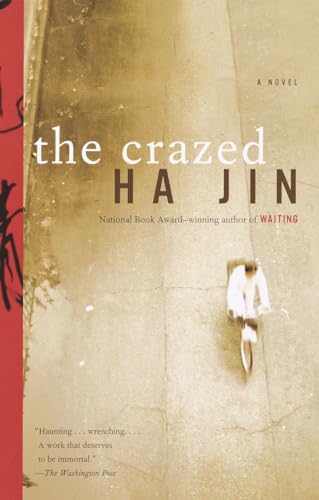
Inhaltsangabe
A New York Times Notable Book
A Washington Post, Los Angeles times, and San Jose Mercury News Best Book of the Year
Ha Jin’s seismically powerful new novel is at once an unblinking look into the bell jar of communist Chinese society and a portrait of the eternal compromises and deceptions of the human state. When the venerable professor Yang, a teacher of literature at a provincial university, has a stroke, his student Jian Wan is assigned to care for him. Since the dutiful Jian plans to marry his mentor’s beautiful, icy daughter, the job requires delicacy. Just how much delicacy becomes clear when Yang begins to rave.
Are these just the outpourings of a broken mind, or is Yang speaking the truth—about his family, his colleagues, and his life’s work? And will bearing witness to the truth end up breaking poor Jian’s heart? Combining warmth and intimacy with an unsparing social vision, The Crazed is Ha Jin’s most enthralling book to date.
Die Inhaltsangabe kann sich auf eine andere Ausgabe dieses Titels beziehen.
Über die Autorin bzw. den Autor
Ha Jin left his native China in 1985 to attend Brandeis University. He is the author of the internationally bestselling novel Waiting, which won the PEN/Faulkner Award and the National Book Award, and War Trash, which won the PEN/Faulkner Award for Fiction, and was a Finalist for the Pulitzer Prize and the Kiriyama Pacific Rim Book Prize; the story collections The Bridegroom, which won the Asian American Literary Award, Under the Red Flag, which won the Flannery O’Connor Award for Short Fiction, and Ocean of Words, which won the PEN/Hemingway Award; the novels The Crazed and In the Pond; and three books of poetry. His latest novel, A Free Life is his first novel set in the United States. He lives in the Boston area and is a professor of English at Boston University.
War Trash, The Crazed, The Bridegroom, Waiting, In the Pond, and Ocean of Words are available in paperback from Vintage Books.
Von der hinteren Coverseite
A New York Times Notable Book
A Washington Post, Los Angeles times, and San Jose Mercury News Best Book of the Year
Ha Jin’s seismically powerful new novel is at once an unblinking look into the bell jar of communist Chinese society and a portrait of the eternal compromises and deceptions of the human state. When the venerable professor Yang, a teacher of literature at a provincial university, has a stroke, his student Jian Wan is assigned to care for him. Since the dutiful Jian plans to marry his mentor’s beautiful, icy daughter, the job requires delicacy. Just how much delicacy becomes clear when Yang begins to rave.
Are these just the outpourings of a broken mind, or is Yang speaking the truth—about his family, his colleagues, and his life’s work? And will bearing witness to the truth end up breaking poor Jian’s heart? Combining warmth and intimacy with an unsparing social vision, The Crazed is Ha Jin’s most enthralling book to date.
Auszug. © Genehmigter Nachdruck. Alle Rechte vorbehalten.
1
Everybody was surprised when Professor Yang suffered a stroke in the spring of 1989. He had always been in good
health, and his colleagues used to envy his energy and productiveness--he had published more than any of them and had
been a mainstay of the Literature Department, directing its M.A. program, editing a biannual journal, and teaching a full
load. Now even the undergraduates were talking about his collapse, and some of them would have gone to the hospital if
Secretary Peng had not announced that Mr. Yang, under intensive care, was in no condition to see visitors.
His stroke unsettled me, because I was engaged to his daughter, Meimei, and under his guidance I had been studying for
the Ph.D. entrance exams for the classical literature program at Beijing University. I hoped to enroll there so that I could
join my fianceé in the capital, where we planned to build our nest. Mr. Yang's hospitalization disrupted my work, and for
a whole week I hadn't sat down to my books, having to go see him every day. I was anxious--without thorough
preparation I couldn't possibly do well in the exams.
Just now, Ying Peng, the Party secretary of our department, had called me to her office. On her desk an electric fan was
whirring back and forth to blow out the odor of dichlorvos sprayed in the room to kill fleas. Her gray bangs were
fluttering as she described to me my job, which was to attend my teacher in the afternoons from now on. Besides me, my
fellow graduate student Banping Fang would look after Mr. Yang too; he was to take care of the mornings.
"Well, Jian Wan," Ying Peng said to me with a tight smile, "you're the only family Professor Yang has here. It's time for
you to help him. The hospital can't provide him with nursing care during the day, so we have to send some people there."
She lifted her tall teacup and took a gulp. Like a man, she drank black tea and smoked cheap cigarettes.
"Do you think he'll stay in the hospital for long?" I asked her.
"I've no idea."
"How long should I look after him?"
"Till we find somebody to replace you."
By "somebody" she meant a person the department might hire as a nurse's aide. Although annoyed by the way she
assigned me the job, I said nothing. To some extent I was glad for the assignment, without which I would in any case go
to the hospital every day.
After lunch, when my two roommates, Mantao and Huran, were napping, I went to the bicycle shed located between two
long dormitory houses. Unlike the female students, who had recently all moved into the new dorm building inside the
university, most of the male students still lived in the one-story houses near the front entrance to the campus. I pulled out
my Phoenix bicycle and set off for Central Hospital.
The hospital was in downtown Shanning, and it took me more than twenty minutes to get there. Though it wasn't
summer yet, the air was sweltering, filled with the smell of burning fat and stewed radish. On the balconies of the
apartment buildings along the street, lines of laundry were flapping languidly--sheets, blouses, pajamas, towels, tank tops,
sweat suits. As I passed by a construction site, a loudspeaker mounted on a telephone pole was broadcasting a soccer
game; the commentator sounded sleepy despite the intermittent surges of shouts from the fans. All the workers at the site
were resting inside the building caged by bamboo scaffolding. The skeletonlike cranes and the drumlike mixers were
motionless. Three shovels stood on a huge pile of sand, beyond which a large yellow board displayed the giant words in
red paint: AIM HIGH, GO ALL OUT. I felt the back of my shirt dampen with sweat.
Mrs. Yang had gone to Tibet on a veterinary team for a year. Our department had written to her about her husband's
stroke, but she wouldn't be able to come home immediately. Tibet was too far away. She'd have to switch buses and
trains constantly--it would take her more than a week to return. In my letter to my fianceé, Meimei, who was in Beijing
cramming for the exams for a medical graduate program, I described her father's condition and assured her that I would
take good care of him and that she mustn't be worried too much. I told her not to rush back since there was no magic
cure for a stroke.
To be honest, I felt obligated to attend my teacher. Even without my engagement to his daughter, I'd have done it
willingly, just out of gratitude and respect. For almost two years he had taught me individually, discussing classical
poetry and poetics with me almost every Saturday afternoon, selecting books for me to read, directing my master's thesis,
and correcting my papers for publication. He was the best teacher I'd ever had, knowledgeable about the field of poetics
and devoted to his students. Some of my fellow graduate students felt uncomfortable having him as their adviser. "He's
too demanding," they would say. But I enjoyed working with him. I didn't even mind some of them calling me Mr.
Yang, Jr.; in a way, I was his disciple.
Mr. Yang was sleeping as I stepped into the sickroom. He was shorn of the IV apparatus affixed to him in intensive care.
The room was a makeshift place, quite large for one bed, but dusky and rather damp. Its square window looked south
onto a mountain of anthracite in the backyard of the hospital. Beyond the coal pile, a pair of concrete smokestacks
spewed whitish fumes and a few aspen crowns swayed indolently. The backyard suggested a factory--more exactly, a
power plant; even the air here looked grayish. By contrast, the front yard resembled a garden or a park, planted with
holly bushes, drooping willows, sycamores, and flowers, including roses, azaleas, geraniums, and fringed irises. There
was even an oval pond, built of bricks and rocks, abounding in fantailed goldfish. White-robed doctors and nurses
strolled through the flowers and trees as if they had nothing urgent to do.
Shabby as Mr. Yang's room was, having it was a rare privilege; few patients could have a sickroom solely to themselves.
If my father, who was a carpenter on a tree farm in the Northeast, had a stroke, he would be lucky if they gave him a bed
in a room shared by a dozen people. Actually Mr. Yang had lain unconscious in a place like that for three days before he
was moved here. With infinite pull, Secretary Peng had succeeded in convincing the hospital officials that Mr. Yang was
an eminent scholar (though he wasn't a full professor yet) whom our country planned to protect as a national treasure, so
they ought to give him a private room.
Mr. Yang stirred a little and opened his mouth, which had become flabby since the stroke. He looked a few years older
than the previous month; a network of wrinkles had grown into his face. His gray hair was unkempt and a bit shiny,
revealing his whitish scalp. Eyes shut, he went on licking his upper lip and murmured something I couldn't quite hear.
Sitting on a large wicker chair close to the door, I was about to take out a book from my shoulder bag when Mr. Yang
opened his eyes and looked around vacantly. I followed his gaze and noticed that the wallpaper had almost lost its
original pink. His eyes, cloudy with a web of reddish veins, moved toward the center of the low ceiling, stopped for a
moment at the lightbulb held by a frayed wire, then fell on the stack of Japanese vocabulary cards on my lap.
"Help me sit up, Jian," he said softly.
I went over, lifted his shoulders, and put behind him two pillows stuffed with fluffy cotton so that he could sit
comfortably. "Do you feel...
„Über diesen Titel“ kann sich auf eine andere Ausgabe dieses Titels beziehen.
Suchergebnisse für The Crazed (Vintage International)

Beispielbild für diese ISBN
The Crazed
Anbieter: World of Books (was SecondSale), Montgomery, IL, USA
Verkäuferbewertung 5 von 5 Sternen

Paperback. Zustand: Good. A New York Times Notable Book A Washington Post, Los Angeles times, and San Jose Mercury News Best Book of the Year Ha Jin's seismically powerful new novel is at once an unblinking look into the bell jar of communist Chinese society and a portrait of the eternal compromises and deceptions of the human state. When the venerable professor Yang, a teacher of literature at a provincial university, has a stroke, his student Jian Wan is assigned to care for him. Since the dutiful Jian plans to marry his mentor's beautiful, icy daughter, the job requires delicacy. Just how much delicacy becomes clear when Yang begins to rave. Are these just the outpourings of a broken mind, or is Yang speaking the truth--about his family, his colleagues, and his life's work? And will bearing witness to the truth end up breaking poor Jian's heart? Combining warmth and intimacy with an unsparing social vision, The Crazed is Ha Jin's most enthralling book to date. Artikel-Nr. 00099712888
Gebraucht kaufen
EUR 4,51
Versand gratis
Versand innerhalb von USA
Versand innerhalb von USA
Anzahl: 2 verfügbar
Beispielbild für diese ISBN
The Crazed
Anbieter: ThriftBooks-Atlanta, AUSTELL, GA, USA
Verkäuferbewertung 5 von 5 Sternen
Paperback. Zustand: Very Good. No Jacket. May have limited writing in cover pages. Pages are unmarked. ~ ThriftBooks: Read More, Spend Less. Artikel-Nr. G0375714111I4N00
Gebraucht kaufen
EUR 5,98
Versand gratis
Versand innerhalb von USA
Versand innerhalb von USA
Anzahl: 1 verfügbar
Beispielbild für diese ISBN
The Crazed
Anbieter: ThriftBooks-Dallas, Dallas, TX, USA
Verkäuferbewertung 5 von 5 Sternen
Paperback. Zustand: Very Good. No Jacket. May have limited writing in cover pages. Pages are unmarked. ~ ThriftBooks: Read More, Spend Less. Artikel-Nr. G0375714111I4N00
Gebraucht kaufen
EUR 5,98
Versand gratis
Versand innerhalb von USA
Versand innerhalb von USA
Anzahl: 1 verfügbar
Beispielbild für diese ISBN
The Crazed
Anbieter: ThriftBooks-Dallas, Dallas, TX, USA
Verkäuferbewertung 5 von 5 Sternen
Paperback. Zustand: Very Good. No Jacket. Former library book; May have limited writing in cover pages. Pages are unmarked. ~ ThriftBooks: Read More, Spend Less. Artikel-Nr. G0375714111I4N10
Gebraucht kaufen
EUR 5,98
Versand gratis
Versand innerhalb von USA
Versand innerhalb von USA
Anzahl: 1 verfügbar
Beispielbild für diese ISBN
The Crazed
Verlag:
Knopf Doubleday Publishing Group, 2004
ISBN 10: 0375714111
ISBN 13: 9780375714115
Gebraucht
Softcover
Anbieter: Wonder Book, Frederick, MD, USA
Verkäuferbewertung 5 von 5 Sternen
Zustand: Good. Good condition. A copy that has been read but remains intact. May contain markings such as bookplates, stamps, limited notes and highlighting, or a few light stains. Artikel-Nr. E15N-02331
Gebraucht kaufen
EUR 6,41
Versand gratis
Versand innerhalb von USA
Versand innerhalb von USA
Anzahl: 2 verfügbar
Beispielbild für diese ISBN
The Crazed
Verlag:
Knopf Doubleday Publishing Group, 2004
ISBN 10: 0375714111
ISBN 13: 9780375714115
Gebraucht
Softcover
Anbieter: Wonder Book, Frederick, MD, USA
Verkäuferbewertung 5 von 5 Sternen
Zustand: As New. Like New condition. A near perfect copy that may have very minor cosmetic defects. Artikel-Nr. Q12H-01059
Gebraucht kaufen
EUR 6,41
Versand gratis
Versand innerhalb von USA
Versand innerhalb von USA
Anzahl: 1 verfügbar
Beispielbild für diese ISBN
The Crazed
Verlag:
Knopf Doubleday Publishing Group, 2004
ISBN 10: 0375714111
ISBN 13: 9780375714115
Gebraucht
Softcover
Anbieter: Better World Books: West, Reno, NV, USA
Verkäuferbewertung 5 von 5 Sternen
Zustand: Very Good. Pages intact with possible writing/highlighting. Binding strong with minor wear. Dust jackets/supplements may not be included. Stock photo provided. Product includes identifying sticker. Better World Books: Buy Books. Do Good. Artikel-Nr. 4183233-6
Gebraucht kaufen
EUR 6,56
Versand gratis
Versand innerhalb von USA
Versand innerhalb von USA
Anzahl: 1 verfügbar
Beispielbild für diese ISBN
The Crazed
Verlag:
Knopf Doubleday Publishing Group, 2004
ISBN 10: 0375714111
ISBN 13: 9780375714115
Gebraucht
Softcover
Anbieter: Better World Books, Mishawaka, IN, USA
Verkäuferbewertung 5 von 5 Sternen
Zustand: Good. Pages intact with minimal writing/highlighting. The binding may be loose and creased. Dust jackets/supplements are not included. Stock photo provided. Product includes identifying sticker. Better World Books: Buy Books. Do Good. Artikel-Nr. 472204-6
Gebraucht kaufen
EUR 6,56
Versand gratis
Versand innerhalb von USA
Versand innerhalb von USA
Anzahl: 1 verfügbar
Beispielbild für diese ISBN
The Crazed
Verlag:
Knopf Doubleday Publishing Group, 2004
ISBN 10: 0375714111
ISBN 13: 9780375714115
Gebraucht
paperback
Anbieter: Roundabout Books, Greenfield, MA, USA
Verkäuferbewertung 4 von 5 Sternen

paperback. Zustand: Good. Condition Notes: Moderate edge wear. Binding good. May have marking in text. We sometimes source from libraries. We ship in recyclable American-made mailers. 100% money-back guarantee on all orders. Artikel-Nr. 1771562
Gebraucht kaufen
EUR 8,54
Versand gratis
Versand innerhalb von USA
Versand innerhalb von USA
Anzahl: 1 verfügbar
Foto des Verkäufers
The Crazed (Vintage International)
Anbieter: WeBuyBooks, Rossendale, LANCS, Vereinigtes Königreich
Verkäuferbewertung 5 von 5 Sternen
paperback. Zustand: Very Good. Most items will be dispatched the same or the next working day. A copy that has been read, but is in excellent condition. Pages are intact and not marred by notes or highlighting. The spine remains undamaged. Artikel-Nr. rev9360365531
Gebraucht kaufen
EUR 2,98
EUR 6,88 Versand
Versand von Vereinigtes Königreich nach USA
Versand von Vereinigtes Königreich nach USA
Anzahl: 1 verfügbar