
Verwandte Artikel zu Yosl Rakover Talks to God: Winner of the Jewish National...
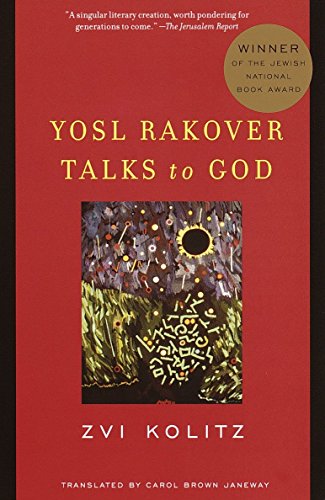
Yosl Rakover Talks to God: Winner of the Jewish National Book Award (Vintage International) - Softcover
Inhaltsangabe
There are two stories here. One is the now legendary tale of a defiant Jew's refusal to abandon God, even in the face of the greatest suffering the world has known, a testament of faith that has taken on an unpredictable and fascinating life of its own and has often been thought to be a direct testament from the Holocaust.
The parallel story is that of Zvi Kolitz, the true author, whose connection to Yosl Rakover has been obscured over the fifty years since its original appearance. German journalist Paul Badde tells how a young man came to write this classic response to evil, and then was nearly written out of its history. With brief commentaries by French philosopher Emmanuel Levinas and Leon Wieseltier, author of Kaddish, this edition presents a religious classic and the very human story behind it.
Die Inhaltsangabe kann sich auf eine andere Ausgabe dieses Titels beziehen.
Über die Autorin bzw. den Autor
Zvi Kolitz lives in New York City.
Translated from the German by Carol Brown Janeway.
Von der hinteren Coverseite
There are two stories here. One is the now legendary tale of a defiant Jew's refusal to abandon God, even in the face of the greatest suffering the world has known, a testament of faith that has taken on an unpredictable and fascinating life of its own and has often been thought to be a direct testament from the Holocaust.
The parallel story is that of Zvi Kolitz, the true author, whose connection to Yosl Rakover has been obscured over the fifty years since its original appearance. German journalist Paul Badde tells how a young man came to write this classic response to evil, and then was nearly written out of its history. With brief commentaries by French philosopher Emmanuel Levinas and Leon Wieseltier, author of Kaddish, this edition presents a religious classic and the very human story behind it.
Aus dem Klappentext
o stories here. One is the now legendary tale of a defiant Jew's refusal to abandon God, even in the face of the greatest suffering the world has known, a testament of faith that has taken on an unpredictable and fascinating life of its own and has often been thought to be a direct testament from the Holocaust.
The parallel story is that of Zvi Kolitz, the true author, whose connection to Yosl Rakover has been obscured over the fifty years since its original appearance. German journalist Paul Badde tells how a young man came to write this classic response to evil, and then was nearly written out of its history. With brief commentaries by French philosopher Emmanuel Levinas and Leon Wieseltier, author of Kaddish, this edition presents a religious classic and the very human story behind it.
Auszug. © Genehmigter Nachdruck. Alle Rechte vorbehalten.
In one of the ruins of the Warsaw Ghetto, preserved in a little bottle and concealed amongst heaps of charred stone and human bones, the following testament was found, written in the last hours of the ghetto by a Jew named Yosl Rakover.
Warsaw, 28 April 1943
I, Yosl, son of David Rakover of Tarnopol, a follower of the Rabbi of Ger and descendant of the righteous, learned, and holy ones of the families Rakover and Maysels, am writing these lines as the houses of the Warsaw Ghetto are in flames, and the house I am in is one of the last that has not yet caught fire. For several hours now we have been under raging artillery fire and all around me walls are exploding and shattering in the hail of shells. It will not be long before this house I'm in, like almost all the houses in the ghetto, will become the grave of its inhabitants and defenders.
Fiery red bolts of sunlight piercing through the little half-walled-up window in my room, out of which we've been shooting at the enemy day and night, tell me that it must be almost evening, just before sundown. The sun probably has no idea how little I regret that I shall never see it again.
A strange thing has happened to us: all our ideas and feelings have changed. Death, quick death that comes in an instant, is to us a deliverer, a liberator who breaks our chains. The animals of the forest seem so dear and precious to me that it pains my heart to hear the criminals who are now masters of Europe likened to them. It is not true that there is something of the animal in Hitler. He is -- I am utterly convinced of it -- a typical child of modern man. Mankind has borne him and raised him and he is the direct, unfeigned expression of mankind's innermost, deepest-hidden urges.
In a forest where I was hiding, I met a dog one night, a sick, starving, crazed dog, his tail between his legs. Immediately we felt our common situation, for no dog's situation is a whit better than our own. He rubbed up against me, buried his head in my lap, and licked my hands. I don't know if I have ever wept the way I wept that night; I wrapped myself around his neck and cried like a child. If I stress the fact that I envied the animals then, no one should be surprised. But what I felt back then was more than envy; it was shame. I was ashamed be-fore the dog, for being not a dog but a man. That is how it is, and such is the spiritual condition we have reached: life is a calamity -- death, a liberator -- man, a plague -- beast, an ideal -- day, an abomination -- night, a comfort.
Millions of people in the great, wide world, in love with the day, the sun, and the light, neither know nor have the slightest intimation of the darkness and calamity the sun brings us. The criminals have made of it an instrument in their hands; they have used the sun as a searchlight to reveal the footprints of the fugitives trying to escape them. When I hid myself in the forests with my wife and my children -- there were six of them then -- it was the night, only the night, that concealed us in her heart. The day delivered us to our pursuers, who were hunting our souls. How can I ever forget the day of that German firestorm that raged over thousands of refugees on the road from Grodno to Warsaw? Their planes rose in the early dawn with the sun, and all day long they slaughtered us unceasingly. In this massacre that came down from the skies my wife died with our youngest child, seven months old, in her arms, and two of my surviving five children vanished that same day without a trace. David and Jehuda were their names, the one was four years old, the other six.
When the sun went down the handful of survivors moved on again toward Warsaw. But I combed through the woods and fields with my three remaining children, searching for the other two on the slaughterground. "David! -- Jehuda!" -- all night long our cries slashed like knives through the deadly silence that surrounded us, and all that answered us from the woods was an echo, helpless, heartrending, suffering as we suffered, a distant voice of lamentation. I never saw the two boys again, and I was told in a dream not to worry over them any more: they were in the hands of the Lord of Heaven and Earth. My other three children died in the Warsaw Ghetto within a year.
Rachel, my little daughter, ten years old, had heard that there were scraps of bread to be found in the city garbage cans on the other side of the walls of the ghetto. The ghetto was starving, and the starving lay like rags in the streets. People were prepared to die any death, but not death by starvation. This is probably because in a time when systematic persecution gradually destroys every other human need, the will to eat is the last one that endures, even in the presence of a longing for death. I was told of a Jew, half-starved, who said to someone, "Ah, how happy I would be to die if one last time I could sit down to a meal like a mentsh!"
Rachel had said nothing to me about her plan to steal out of the ghetto -- a crime that carried the death penalty. She went off on her dangerous journey with a friend, another girl of the same age.
In the dark of night she left home and at dawn she was discovered with her little friend outside the gates of the ghetto. The Nazi sentries and dozens of their Polish helpers immediately went in pursuit of the Jewish children who had dared to hunt in the garbage for a lump of bread so as not to die of hunger. People who had experienced this human hunt at first hand could not believe what they were seeing. Even for the ghetto this was new. You might have thought that dangerous escaped criminals were being chased as this terrifying pack ran amok after the two half-starved ten-year-old children. They couldn't keep up this race for long before one of them, my daughter, having expended the last of her strength, collapsed on the ground in exhaustion. The Nazis drove holes through her skull. The other girl escaped their clutches, but she died two weeks later. She had lost her mind.
Jacob, our fifth child, a boy of thirteen, died of tuberculosis on the day of his bar mitzvah. His death was a release for him. The last child, my daughter Eva, lost her life at the age of fifteen in a "roundup of children" that began at sunrise on the final Rosh Hashanah and lasted till sundown.
On that first day of the New Year, hundreds of Jewish families lost their children before evening came.
Now my hour has come, and like Job I can say of myself -- naked shall I return unto the earth, naked as the day I was born. My years are forty-three, and when I look back on the years that have gone by, I can say with certainty -- insofar as any man may be certain of himself -- that I have lived an honorable life. My heart has been filled with the love of God. I have been blessed with success, but the success never went to my head. My portion was ample. But though it was mine, I treated it not as mine: following the counsel of my rabbi, I considered my possessions to have no possessor. Should they lure someone to take some part of them, this should not be counted as theft, but as though that person had taken unclaimed goods. My house stood open for all who were needy, and I was happy when I was given the opportunity to perform a good deed for others. I served God with devotion, and my only petition of Him was that He allow me to serve Him "with all my heart and with all my soul and with all my strength."
I cannot say, after all I have lived through, that my relation to God is unchanged. But with absolute certainty I can say that my faith in Him has not altered by a hairsbreadth. In earlier times, when my life was good, my relation to Him was as if to one who gave me gifts without end, and to whom I was therefore always somewhat in debt. Now my relation to Him is as to one who is also in my debt -- greatly in...
„Über diesen Titel“ kann sich auf eine andere Ausgabe dieses Titels beziehen.
Suchergebnisse für Yosl Rakover Talks to God: Winner of the Jewish National...

Beispielbild für diese ISBN
Yosl Rakover Talks to God
Anbieter: World of Books (was SecondSale), Montgomery, IL, USA
Verkäuferbewertung 5 von 5 Sternen

Paperback. Zustand: Very Good. Winner of the Jewish National Book Award There are two stories here. One is the now legendary tale of a defiant Jew's refusal to abandon God, even in the face of the greatest suffering the world has known, a testament of faith that has taken on an unpredictable and fascinating life of its own and has often been thought to be a direct testament from the Holocaust. The parallel story is that of Zvi Kolitz, the true author, whose connection to Yosl Rakover has been obscured over the fifty years since its original appearance. German journalist Paul Badde tells how a young man came to write this classic response to evil, and then was nearly written out of its history. With brief commentaries by French philosopher Emmanuel Levinas and Leon Wieseltier, author of Kaddish, this edition presents a religious classic and the very human story behind it. Artikel-Nr. 00102719217
Gebraucht kaufen
EUR 3,94
Versand gratis
Versand innerhalb von USA
Versand innerhalb von USA
Anzahl: 1 verfügbar
Beispielbild für diese ISBN
Yosl Rakover Talks to God
Anbieter: World of Books (was SecondSale), Montgomery, IL, USA
Verkäuferbewertung 5 von 5 Sternen
Paperback. Zustand: Good. Winner of the Jewish National Book Award There are two stories here. One is the now legendary tale of a defiant Jew's refusal to abandon God, even in the face of the greatest suffering the world has known, a testament of faith that has taken on an unpredictable and fascinating life of its own and has often been thought to be a direct testament from the Holocaust. The parallel story is that of Zvi Kolitz, the true author, whose connection to Yosl Rakover has been obscured over the fifty years since its original appearance. German journalist Paul Badde tells how a young man came to write this classic response to evil, and then was nearly written out of its history. With brief commentaries by French philosopher Emmanuel Levinas and Leon Wieseltier, author of Kaddish, this edition presents a religious classic and the very human story behind it. Artikel-Nr. 00105180274
Gebraucht kaufen
EUR 3,94
Versand gratis
Versand innerhalb von USA
Versand innerhalb von USA
Anzahl: 1 verfügbar
Foto des Verkäufers
Yosl Rakover Talks to God: Winner of the Jewish National Book Award (Vintage International)
Verlag:
Knopf Doubleday Publishing Group, 2000
ISBN 10: 0375708405
ISBN 13: 9780375708404
Gebraucht
Softcover
Anbieter: Dream Books Co., Denver, CO, USA
Verkäuferbewertung 5 von 5 Sternen
Zustand: good. Gently used with minimal wear on the corners and cover. A few pages may contain light highlighting or writing, but the text remains fully legible. Dust jacket may be missing, and supplemental materials like CDs or codes may not be included. May be ex-library with library markings. Ships promptly! Artikel-Nr. DBV.0375708405.G
Gebraucht kaufen
EUR 3,95
Versand gratis
Versand innerhalb von USA
Versand innerhalb von USA
Anzahl: 1 verfügbar
Beispielbild für diese ISBN
Yosl Rakover Talks to God: Winner of the Jewish National Book Award
ISBN 10: 0375708405
ISBN 13: 9780375708404
Gebraucht
Paperback
Anbieter: BooksRun, Philadelphia, PA, USA
Verkäuferbewertung 5 von 5 Sternen
Paperback. Zustand: Very Good. First Vintage Intern. It's a well-cared-for item that has seen limited use. The item may show minor signs of wear. All the text is legible, with all pages included. It may have slight markings and/or highlighting. Artikel-Nr. 0375708405-11-1
Gebraucht kaufen
EUR 4,66
Versand gratis
Versand innerhalb von USA
Versand innerhalb von USA
Anzahl: 1 verfügbar
Beispielbild für diese ISBN
Yosl Rakover Talks to God
Verlag:
Knopf Doubleday Publishing Group, 2000
ISBN 10: 0375708405
ISBN 13: 9780375708404
Gebraucht
Softcover
Anbieter: Wonder Book, Frederick, MD, USA
Verkäuferbewertung 5 von 5 Sternen
Zustand: Very Good. Very Good condition. A copy that may have a few cosmetic defects. May also contain light spine creasing or a few markings such as an owner's name, short gifter's inscription or light stamp. Artikel-Nr. M09B-02616
Gebraucht kaufen
EUR 6,40
Versand gratis
Versand innerhalb von USA
Versand innerhalb von USA
Anzahl: 1 verfügbar
Beispielbild für diese ISBN
Yosl Rakover Talks to God : Winner of the Jewish National Book Award
Verlag:
Knopf Doubleday Publishing Group, 2000
ISBN 10: 0375708405
ISBN 13: 9780375708404
Gebraucht
Softcover
Anbieter: Better World Books, Mishawaka, IN, USA
Verkäuferbewertung 5 von 5 Sternen
Zustand: Good. Former library copy. Pages intact with minimal writing/highlighting. The binding may be loose and creased. Dust jackets/supplements are not included. Includes library markings. Stock photo provided. Product includes identifying sticker. Better World Books: Buy Books. Do Good. Artikel-Nr. 5403965-75
Gebraucht kaufen
EUR 6,54
Versand gratis
Versand innerhalb von USA
Versand innerhalb von USA
Anzahl: 1 verfügbar
Beispielbild für diese ISBN
Yosl Rakover Talks to God : Winner of the Jewish National Book Award
Verlag:
Knopf Doubleday Publishing Group, 2000
ISBN 10: 0375708405
ISBN 13: 9780375708404
Gebraucht
Softcover
Anbieter: Better World Books, Mishawaka, IN, USA
Verkäuferbewertung 5 von 5 Sternen
Zustand: Very Good. Pages intact with possible writing/highlighting. Binding strong with minor wear. Dust jackets/supplements may not be included. Stock photo provided. Product includes identifying sticker. Better World Books: Buy Books. Do Good. Artikel-Nr. 3224348-6
Gebraucht kaufen
EUR 6,54
Versand gratis
Versand innerhalb von USA
Versand innerhalb von USA
Anzahl: 1 verfügbar
Beispielbild für diese ISBN
Yosl Rakover Talks to God
Anbieter: Revaluation Books, Exeter, Vereinigtes Königreich
Verkäuferbewertung 5 von 5 Sternen
Paperback. Zustand: Brand New. 112 pages. 8.00x5.50x0.50 inches. In Stock. Artikel-Nr. x-0375708405
Neu kaufen
EUR 16,48
EUR 11,77 Versand
Versand von Vereinigtes Königreich nach USA
Versand von Vereinigtes Königreich nach USA
Anzahl: 2 verfügbar
Beispielbild für diese ISBN
Yosl Rakover Talks to God (Vintage International)
Anbieter: Majestic Books, Hounslow, Vereinigtes Königreich
Verkäuferbewertung 4 von 5 Sternen

Zustand: New. pp. 114. Artikel-Nr. 8191274
Neu kaufen
EUR 23,81
EUR 7,65 Versand
Versand von Vereinigtes Königreich nach USA
Versand von Vereinigtes Königreich nach USA
Anzahl: 1 verfügbar