
Inhaltsangabe
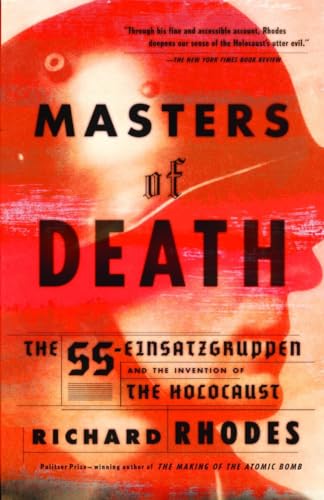
In Masters of Death, Pulitzer Prize-winning author Rhodes gives full weight, for the first time, to the Einsatzgruppen’s role in the Holocaust. These “special task forces,” organized by Heinrich Himmler to follow the German army as it advanced into eastern Poland and Russia, were the agents of the first phase of the Final Solution. They murdered more than 1.5 million men, women, and children between 1941 and 1943, often by shooting them into killing pits, as at Babi Yar.
These massive crimes have been generally overlooked or underestimated by Holocaust historians, who have focused on the gas chambers. In this painstaking account, Pulitzer Prize-winning author Richard Rhodes profiles the eastern campaign’s architects as well as its “ordinary” soldiers and policemen, and helps us understand how such men were conditioned to carry out mass murder. Marshaling a vast array of documents and the testimony of perpetrators and survivors, this book is an essential contribution to our understanding of the Holocaust and World War II.
Die Inhaltsangabe kann sich auf eine andere Ausgabe dieses Titels beziehen.
Über die Autorin bzw. den Autor
Richard Rhodes is the author or editor of twentytwo books, most recently the author of The Twilight of the Bomb, the last volume in a quartet about nuclear history. The first, The Making of the Atomic Bomb, won the Pulitzer Prize, a National Book Award, and a National Book Critics Circle Award. He has received numerous fellowships for research and writing, including grants from the Ford Foundation, the Guggenheim Foundation, the MacArthur Foundation and the Alfred P. Sloan Foundation. He has been a visiting scholar at Harvard and MIT and a host and correspondent for documentaries on public television's Frontline and American Experience series. An affiliate of the Center for International Security and Cooperation at Stanford University, he lectures frequently to audiences in the United States and abroad.
Von der hinteren Coverseite
In Masters of Death," Rhodes gives full weight, for the first time, to the Einsatzgruppen's role in the Holocaust. These "special task forces," organized by Heinrich Himmler to follow the German army as it advanced into eastern Poland and Russia, were the agents of the first phase of the Final Solution. They murdered more than 1.5 million men, women, and children between 1941 and 1943, often by shooting them into killing pits, as at Babi Yar.
These massive crimes have been generally overlooked or underestimated by Holocaust historians, who have focused on the gas chambers. In this painstaking account, Pulitzer Prize-winning author Richard Rhodes profiles the eastern campaign's architects as well as its "ordinary" soldiers and policemen, and helps us understand how such men were conditioned to carry out mass murder. Marshaling a vast array of documents and the testimony of perpetrators and survivors, this book is an essential contribution to our understanding of the Holocaust and World War II.
Auszug. © Genehmigter Nachdruck. Alle Rechte vorbehalten.
one
Eastward from Pretzsch
In the spring of 1941 a police academy in Pretzsch, a town on the Elbe River about fifty miles southwest of Berlin, became the site of a sinister assembly. Several thousand men from the ranks of the SS-the Nazi Party's Schutzstaffel, or defense echelon, a police and security service that answered directly to Adolf Hitler and operated outside the constraints of German law-were ordered to report to Pretzsch for training and assignment. They were not told what their assignment would be, but their commonalities offered a clue: many of them had served in SS detachments in Poland, which Germany had invaded and occupied in 1939, and preference was given to men who spoke Russian.
Assignment to Pretzsch emptied the SS leadership school in Berlin-Charlottenburg and depleted the professional examination course of an SS criminal division. It drew in lower- and middle-ranking officers of the Security Police (the Gestapo and the criminal police), some of them passed on gratefully by their home regiments because they were considered too wild. The Waffen-SS, the small but growing SS army, contributed enlisted men. High-ranking bureaucrats within the shadowy Reich Security Main Office,* an internal SS security agency, were posted to Pretzsch as well. They had been handpicked for leadership positions by Obergruppenführer Reinhard Heydrich, the head of the RSHA and the second most powerful man in the SS, and his superior Heinrich Himmler, the Reichsführer-SS. Most of these handpicked leaders were lawyers, and a few were physicians or educators; most had earned doctoral degrees. Among the more exotic specimens were Otto Ohlendorf, a handsome but argumentative young economist who had fallen into disfavor with Himmler; Paul Blobel, a rawboned, highstrung, frequently drunken architect; Arthur Nebe, a former vice squad detective and Gestapo head who had enthusiastically volunteered; and Karl Jäger, a brutal fifty-three-year-old secret police commander. A reserve battalion of the regular German Order Police (uniformed urban, rural and municipal police) completed the Pretzsch roster.
Soon the men learned that they would be assigned to an Einsatzgruppe-a task force. Einsatz units-groups and commandos-had followed the German army into Austria, Czechoslovakia and Poland when Germany had invaded those countries successively in 1938 and 1939. Einsatzgruppen secured occupied territories in advance of civilian administrators. They confiscated weapons and gathered incriminating documents, tracked down and arrested people the SS considered politically unreliable-and systematically murdered the occupied country's political, educational, religious and intellectual leadership. Since Germany had concluded a nonaggression pact with the Soviet Union in August 1939, many of the candidates at Pretzsch assumed they would be assigned to follow the Wehrmacht into England. Some of them had previously trained to just that end.
By the spring of 1941, Poland had already been decapitated. Albert Speer, Hitler's architect and later his munitions and armament minister, remembered that on the night of 21 August 1939, when news of Josef Stalin's agreement to the nonaggression pact had settled Hitler's decision to invade Poland, the Führer and his entourage had drifted out onto the terrace of his mountain retreat on the Obersalzberg to watch a rare display of Northern Lights vermilioning the mountain across the valley. "The last act of Götterdämmerung could not have been more effectively staged," Speer writes. "The same red light bathed our faces and our hands. The display produced a curiously pensive mood among us. Abruptly turning to one of his military adjutants, Hitler said: 'Looks like a great deal of blood. This time we won't bring it off without violence.' "
The next day the Führer belabored the generals and field marshals of the Wehrmacht for hours with an impassioned harangue. He told them Germany needed room to expand and as a buffer against the Russians. Therefore he meant not merely to occupy Poland but also to destroy it; in its place a new German eastern frontier would arise. "The idea of treating war as anything other than the harshest means of settling questions of very existence is ridiculous," he challenged the army commanders. "Every war costs blood, and the smell of blood arouses in man all the instincts which have lain within us since the beginning of the world: deeds of violence, the intoxication of murder, and many other things. Everything else is empty babble. A humane war exists only in bloodless brains." A field marshal who attended the conference reported Hitler warning them "that he would proceed against the Poles after the end of the campaign with relentless vigor. Things would happen which would not be to the taste of the German generals." The field marshal understood the warning to mean "the destruction of the Polish intelligentsia, in particular the priesthood, by the SS."
When Germany had attacked Poland on 1 September 1939, beginning the Second World War in Europe, five Einsatzgruppen that Heydrich had organized followed behind the five invading Wehrmacht armies, each group subdivided into four Einsatzkommandos of 100 to 150 men. These advance cadres were augmented with Order Police battalions, Totenkopf* concentration-camp guard regiments and Waffen-SS, producing a combined SS force approaching twenty thousand men. The commander of one of the Polish Einsatzgruppen in 1939, Bruno Streckenbach, would become the head of SS personnel responsible for recruiting the new Einsatzgruppen forming at Pretzsch in May 1941.
Himmler's SS was famously thorough. Heydrich, a tall, horse-faced, sneering former naval officer whom even his own subordinates called "the blond beast," had started his career organizing elaborate card indexes on Nazi Party enemies, a system Hitler had instituted in the early days of the party to keep tabs on his own supporters. If the Einsatzgruppen in Poland followed standard SS practice, the lists Heydrich's staff compiled of Polish enemies would serve them well. An SS officer on a later mission to the Caucasus describes how the system worked:
As a group leader I was sent supplementary documentation. By far the most valuable was a slim little book, part of a limited, numbered edition, which I never let out of my sight. The typeface was tiny, I remember, and the paper was extra thin, in order to pack the most information into the smallest possible space. . . . It consisted of a series of lists, including the names of every active member of the Communist party in the Caucasus, all the nonparty intelligentsia, and listings of scholars, teachers, writers and journalists, priests, public officials, upwardly mobile peasants, and the most prominent industrialists and bankers. [It contained] addresses and telephone numbers. . . . And that wasn't all. There were additional listings of relatives and friends, in case any subversive scum tried to hide, plus physical descriptions, and in some cases photographs. You can imagine what the size of that book would have been if it had been printed normally.
All these categories of people in Poland, and the Polish nobility as well, were marked for murder. During the first weeks after the invasion, while the Wehrmacht still controlled the occupied areas, a historian of the Polish experience summarizes, "531 towns and villages were burned; the provinces of Lodz and Warsaw suffered the heaviest losses. Various branches of the army and police [i.e., Himmler's legions] carried out 714 [mass] executions, which took the lives of 16,376 people, most of whom were Polish Christians. The Wehrmacht committed approximately 60 percent of these crimes, with the police responsible for the remainder." The historian cites...
„Über diesen Titel“ kann sich auf eine andere Ausgabe dieses Titels beziehen.
Weitere beliebte Ausgaben desselben Titels

Suchergebnisse für Masters of Death: The SS-Einsatzgruppen and the Invention...

Beispielbild für diese ISBN
Masters of Death: The SS-Einsatzgruppen and the Invention of the Holocaust
Anbieter: Wonder Book, Frederick, MD, USA
Verkäuferbewertung 5 von 5 Sternen

Zustand: Good. Good condition. A copy that has been read but remains intact. May contain markings such as bookplates, stamps, limited notes and highlighting, or a few light stains. Artikel-Nr. I13A-02867
Gebraucht kaufen
EUR 6,88
Versand gratis
Versand innerhalb von USA
Versand innerhalb von USA
Anzahl: 1 verfügbar
Beispielbild für diese ISBN
Masters of Death: The SS-Einsatzgruppen and the Invention of the Holocaust
Anbieter: Wonder Book, Frederick, MD, USA
Verkäuferbewertung 5 von 5 Sternen
Zustand: Very Good. Very Good condition. A copy that may have a few cosmetic defects. May also contain light spine creasing or a few markings such as an owner's name, short gifter's inscription or light stamp. Artikel-Nr. V03B-03534
Gebraucht kaufen
EUR 6,88
Versand gratis
Versand innerhalb von USA
Versand innerhalb von USA
Anzahl: 1 verfügbar
Beispielbild für diese ISBN
Masters of Death : The SS-Einsatzgruppen and the Invention of the Holocaust
Verlag:
Knopf Doubleday Publishing Group, 2003
ISBN 10: 0375708227
ISBN 13: 9780375708220
Gebraucht
Softcover
Anbieter: Better World Books, Mishawaka, IN, USA
Verkäuferbewertung 5 von 5 Sternen
Zustand: Good. Pages intact with minimal writing/highlighting. The binding may be loose and creased. Dust jackets/supplements are not included. Stock photo provided. Product includes identifying sticker. Better World Books: Buy Books. Do Good. Artikel-Nr. 4265275-6
Gebraucht kaufen
EUR 9,59
Versand gratis
Versand innerhalb von USA
Versand innerhalb von USA
Anzahl: 1 verfügbar
Beispielbild für diese ISBN
Masters of Death : The SS-Einsatzgruppen and the Invention of the Holocaust
Verlag:
Knopf Doubleday Publishing Group, 2003
ISBN 10: 0375708227
ISBN 13: 9780375708220
Gebraucht
Softcover
Anbieter: Better World Books, Mishawaka, IN, USA
Verkäuferbewertung 5 von 5 Sternen
Zustand: Very Good. Pages intact with possible writing/highlighting. Binding strong with minor wear. Dust jackets/supplements may not be included. Stock photo provided. Product includes identifying sticker. Better World Books: Buy Books. Do Good. Artikel-Nr. 4037184-6
Gebraucht kaufen
EUR 9,59
Versand gratis
Versand innerhalb von USA
Versand innerhalb von USA
Anzahl: 1 verfügbar
Beispielbild für diese ISBN
Masters of Death
Anbieter: PBShop.store US, Wood Dale, IL, USA
Verkäuferbewertung 5 von 5 Sternen
PAP. Zustand: New. New Book. Shipped from UK. Established seller since 2000. Artikel-Nr. WB-9780375708220
Foto des Verkäufers
Masters of Death: The SS-Einsatzgruppen and the Invention of the Holocaust
Verlag:
Vintage Books, 2003
ISBN 10: 0375708227
ISBN 13: 9780375708220
Gebraucht
Paperback
Erstausgabe
Anbieter: Southampton Books, Sag Harbor, NY, USA
Verkäuferbewertung 5 von 5 Sternen
Paperback. Zustand: Like New. First Edition. First Edition, Third Printing. Not price-clipped. Published by Vintage Books, 2002. Octavo. Paperback. Book is like new. 100% positive feedback. 30 day money back guarantee. NEXT DAY SHIPPING! Excellent customer service. Please email with any questions. All books packed carefully and ship with free delivery confirmation/tracking. All books come with free bookmarks. Ships from Sag Harbor, New York. Artikel-Nr. 336257
Gebraucht kaufen
EUR 17,98
EUR 3,48 Versand
Versand innerhalb von USA
Versand innerhalb von USA
Anzahl: 1 verfügbar
Beispielbild für diese ISBN
Masters of Death: The SS-Einsatzgruppen and the Invention of the Holocaust
Anbieter: WorldofBooks, Goring-By-Sea, WS, Vereinigtes Königreich
Verkäuferbewertung 5 von 5 Sternen
Paperback. Zustand: Very Good. The book has been read, but is in excellent condition. Pages are intact and not marred by notes or highlighting. The spine remains undamaged. Artikel-Nr. GOR001781686
Gebraucht kaufen
EUR 15,69
EUR 6,45 Versand
Versand von Vereinigtes Königreich nach USA
Versand von Vereinigtes Königreich nach USA
Anzahl: 1 verfügbar
Beispielbild für diese ISBN
Masters of Death: The Ss-Einsatzgruppen and the Invention of the Holocaust
Anbieter: Revaluation Books, Exeter, Vereinigtes Königreich
Verkäuferbewertung 5 von 5 Sternen
Paperback. Zustand: Brand New. reprint edition. 368 pages. 8.00x5.00x0.75 inches. In Stock. Artikel-Nr. __0375708227
Neu kaufen
EUR 20,73
EUR 11,52 Versand
Versand von Vereinigtes Königreich nach USA
Versand von Vereinigtes Königreich nach USA
Anzahl: 1 verfügbar
Beispielbild für diese ISBN
Masters of Death: The Ss-Einsatzgruppen and the Invention of the Holocaust
Anbieter: Revaluation Books, Exeter, Vereinigtes Königreich
Verkäuferbewertung 5 von 5 Sternen
Paperback. Zustand: Brand New. reprint edition. 368 pages. 8.00x5.00x0.75 inches. In Stock. Artikel-Nr. x-0375708227
Neu kaufen
EUR 21,36
EUR 11,52 Versand
Versand von Vereinigtes Königreich nach USA
Versand von Vereinigtes Königreich nach USA
Anzahl: 1 verfügbar
Beispielbild für diese ISBN
Masters of Death: The SS-Einsatzgruppen and the Invention of the Holocaust
Anbieter: Kennys Bookstore, Olney, MD, USA
Verkäuferbewertung 5 von 5 Sternen
Zustand: New. 2003. Illustrated. Paperback. . . . . . Books ship from the US and Ireland. Artikel-Nr. V9780375708220
Neu kaufen
EUR 25,15
EUR 9,16 Versand
Versand innerhalb von USA
Versand innerhalb von USA
Anzahl: 1 verfügbar