
Verwandte Artikel zu Niccolo Rising: Book One of the House of Niccolo (House...
Niccolo Rising: Book One of the House of Niccolo (House of Niccolo Series, Band 1) - Softcover
Buch 1 von 8: House of Niccolo Series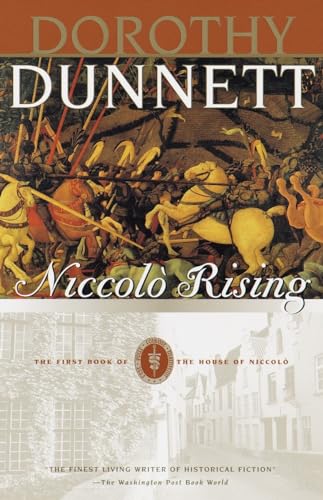
Inhaltsangabe
In this first book of The House of Niccolò series, the author of the Lymond Chronicles introduces a new hero, Nicholas vander Poele of Bruges, the good-natured dyer's apprentice who schemes and swashbuckles his way to the helm of a mercantile empire.
With the bravura storytelling and pungent authenticity of detail she brought to her acclaimed Lymond Chronicles, Dorothy Dunnett, grande dame of the historical novel, presents The House of Niccolò series. The time is the 15th century, when intrepid merchants became the new knighthood of Europe. Among them, none is bolder or more cunning than Nicholas vander Poele of Bruges.
Niccolò Rising, Book One of the series, finds us in Bruges, 1460. Jousting is the genteel pastime, and successful merchants are, of necessity, polyglot. Street smart, brilliant at figures, adept at the subtleties of diplomacy and the well-timed untruth, Dunnett's hero rises from wastrel to prodigy in a breathless adventure that wins him the hand of the strongest woman in Bruges and the hatred of two powerful enemies. From a riotous and potentially murderous carnival in Flanders, to an avalanche in the Alps and a pitched battle on the outskirts of Naples, Niccolò Rising combines history, adventure, and high romance in the tradition stretching from Alexandre Dumas to Mary Renault.
Die Inhaltsangabe kann sich auf eine andere Ausgabe dieses Titels beziehen.
Über die Autorin bzw. den Autor
Dorothy Dunnett was born in 1923 in Dunfermline, Fife, Scotland. Her time at Gillespie's High School for Girls overlapped with that of the novelist Muriel Spark. From 1940-1955, she worked for the Civil Service as a press officer. In 1946, she married Alastair Dunnett, later editor of The Scotsman.
Dunnett started writing in the late 1950s. Her first novel, The Game of Kings, was published in the United States in 1961, and in the United Kingdom the year after. She published 22 books in total, including the six-part Lymond Chronicles and the eight-part Niccolo Series, and co-authored another volume with her husband. Also an accomplished professional portrait painter, Dunnett exhibited at the Royal Scottish Academy on many occasions and had portraits commissioned by a number of prominent public figures in Scotland.
She also led a busy life in public service, as a member of the Board of Trustees of the National Library of Scotland, a Trustee of the Scottish National War Memorial, and Director of the Edinburgh Book Festival. She served on numerous cultural committees, and was a Fellow of the Royal Society of Arts. In 1992 she was awarded the Office of the British Empire for services to literature. She died on November 9, 2001, at the age of 78.
Von der hinteren Coverseite
With the bravura storytelling and pungent authenticity of detail she brought to her acclaimed Lymond Chronicles, Dorothy Dunnett, grande dame of the historical novel, presents The House of Niccolo series. The time is the 15th century, when intrepid merchants became the new knighthood of Europe. Among them, none is bolder or more cunning than Nicholas vander Poele of Bruges, the good-natured dyer's apprentice who schemes and swashbuckles his way to the helm of a mercantile empire.
Niccolo Rising, Book One of the series, finds us in Bruges, 1460. Jousting is the genteel pastime, and successful merchants are, of necessity, polyglot. Street smart, brilliant at figures, adept at the subtleties of diplomacy and the well-timed untruth, Dunnett's hero rises from wastrel to prodigy in a breathless adventure that wins him the hand of the strongest woman in Bruges and the hatred of two powerful enemies. From a riotous and potentially murderous carnival in Flanders, to an avalanche in the Alps and a pitched battle on the outskirts of Naples, Niccolo Rising combines history, adventure, and high romance in the tradition stretching from Alexandre Dumas to Mary Renault.
Auszug. © Genehmigter Nachdruck. Alle Rechte vorbehalten.
Chapter 1
From Venice to Cathay, from Seville to the Gold Coast of Africa, men anchored their ships and opened their ledgers and weighed one thing against another as if nothing would ever change. Or as if there existed no sort of fool, of either sex, who might one day treat trade (trade!) as an amusement.
It began mildly enough, the awkward chain of events that was to upset the bankers so much. It began with sea, and September sunlight, and three young men lying stripped to their doublets in the Duke of Burgundy's bath.
Of the three, Claes and Felix were watching the canal bank for girls. Julius, his instincts blunted by an extra decade, was content to sink back, agreeably fortified, and forget he was anyone's tutor. A good astrologer would have told him to get out at once.
The sun warmed the bath, and the water bore it along on the last stage of its meandering journey. From the leadfounder's in England it had crossed the narrow sea to the Low Countries in a serviceable wind-battered caravel. It had been unloaded with some trouble in the crowded harbour at Sluys, and strapped with some trouble athwart a canal boat with a scratch crew of oarsmen.
And now, here it was. Lumped with cherubs: a bath for the noble Philip, Duke of Burgundy, Count of Flanders, Margrave of the Holy Roman Empire and all the rest of his high-yielding honours. A communal bathing-basin now on its way to the Duke's occasional residence in the merchant city of Bruges. And working their passage inside it, Julius, Felix and Claes.
For the moment, there was nothing to do. In the peace, a wave of philosophy overcame Julius. "What," he said, "is happiness?" He opened his eyes.
"A new hound," said Felix, who was seventeen. His crossbow lay on the points of his pelvis and his ratlike nose was red with the sun. "The kind with big ears."
Julius curled a lip, without malice. So much for Felix. He turned his gaze towards Claes, who was eighteen and built like an oak tree with dimples.
"A new girl," offered Claes. He jerked open the wine flask, gripping the neck like the hock of a stallion. "The kind with . . ."
"That's enough," Julius said. Philosophy was wasted on both of them. Everything was wasted on Claes. Julius was sometimes glad that civilization had reached the advanced stage it had, so that it could stand up to Claes. The Greeks would have gone back to tents.
Claes looked at him, pained. He said, "I've only had-" Beside him, young Felix was grinning.
Julius said, "Drink! Drink! I said that's enough about girls. Forget I said anything."
"All right," said Claes, surprised. He drank. He inhaled. His nostrils were indigo blue. He said, "This is nice."
Julius refrained from agreeing. A dyeshop apprentice would find any change nice. Felix (his charge, his employer's son, his daily burden) had enjoyed the day's rabbiting, but didn't deserve to. Only he, Julius, had left his cares in the dyeshop and had a right, for one day, to indulge himself.
The canal banks glided past. The lightermen bickered companionably and dropped into snatches of song as they paddled. The sunwarmed cherubim lodged three indolent heads, cheek by jowl round the bath-rim. Julius found the wine flask in his hand, and eclipsed the whole sun with its bottom. A conscientious youth, yet with a troublesome lightness of character. So they had assessed him, while he was earning his scroll at Bologna.
God take all law schools and dispose of them. This is Flanders, not Italy. You volunteer to unload a bath from a ship. You accept a lift in the bath back to your place of residence and employment. You close your eyes the better to ponder. Where is the lightness in that? Julius, notary to the Charetty family, closed his eyes. Almost at once, so it seemed, he endured a nasty blow to his ribs. Half-awake, he flung out a fist in return. He hit something.
"Hey!" said Felix and, his face flushed, made to kick him again.
Julius rolled over, escaping the foot. The sound of rushing water told him why Felix had wakened him. They were approaching the lock.
Felix's voice was continuing, monumentally resonant because of the bath. "You've knocked my hat off," boomed Felix. "You've broken the feather."
The lightermen, steering up to the lock, glanced round appreciatively, and so did Claes, who had got up to help them. The truth was, it was hard to hit Felix and avoid hitting his headgear. This one had a peak and a long pointed brim like a paper boat. Its osprey feather curled, broken-backed, on the rabbit-bag. Where the hat had been, Felix's brown hair was sweaty and flat, and his curls had sagged into corkscrews. He looked furious.
Claes said, "You said you were tired of the feather. It's time for the beer, Meester Julius."
Claes had been with the Charetty since he was ten, and being a family by-blow, he got to speak that way to Felix. Through the years Claes had become not only an apprentice but a kind of servant-companion to the Charetty heir. Felix tried to batter Claes regularly but mostly put up with him. Felix's mother, thankful for peace, let Claes off his dyeshop duties whenever Felix demanded it. Julius, equally thankful, hoped that Claes' spasmodic apprenticeship would last long enough to see Felix into maturity, if not old age and burial.
Julius, an easy-going sort of man, had nothing much against jonk-heere Felix. He could control him. Claes, of course, had no writ to control anyone, which was why he got beaten so freely. It made him very helpful. Julius watched Claes give a last shove with his oar, put it down, and then walk round the end of the boat and hand Felix his hat. All anyone remembered of Claes were his size and the dents in his cheeks and his helpfulness. And that nothing female under twenty was safe from his endeavours.
Julius could see his mouth opening and shutting outside the bath, and hear Felix booming back from within. Julius didn't join the discussion, which was on the usual subject. Of course, he liked watching a good-looking woman. He had his share of vanity. He knew his sort of looks drew attention. He had had to extract himself more than once from some developing situation with a client's young wife. It was not, either, that he contemplated taking Holy Orders, or not up to the present. But if a good chance came along, a man ought to be ready. He was moderate. He didn't raven, like Claes; or yearn like poor Felix when brought to sail the canalised river between Sluys and Damme, passing three miles of ankles and a handful of knees, if you were lucky.
Accessible ankles, what's more. You didn't find grand ladies with steeple headdresses and shaved brows and pearls on their slippers among the quays and sheds and warehouses and pens and tie-posts of the two ports of Bruges. You got pertly laundered white caps and slyly hitched work-gowns: enough of them to please even Claes, Julius thought. The liveliest girls called down to one youth or the other. Men sang out too, and boys ran alongside, keeping up with the rowers. One tossed a pebble into the bath, and it chimed like the tongue of a church bell. The tongue of the thrower soon drowned it, as his father hurriedly thrashed him. Even from Brussels, or Dijon, or Lille, Duke Philip could hear things.
Claes stayed on his feet beside Felix. Felix was signalling masterfully with his hat, from which Claes had adopted the feather. Three feet long, it waved from his thatch like a fishing line. On the other side of the boat, Julius helped throw up the ropes at the sealock, and heaved up the statutory can of Bruges beer to the lock-keeper.
The man looked at him twice before naming him. Without the gown he wasn't Meester Julius the notary;...
„Über diesen Titel“ kann sich auf eine andere Ausgabe dieses Titels beziehen.
Suchergebnisse für Niccolo Rising: Book One of the House of Niccolo (House...

Beispielbild für diese ISBN
Niccolo Rising: Book One of the House of Niccolo
Anbieter: World of Books (was SecondSale), Montgomery, IL, USA
Verkäuferbewertung 5 von 5 Sternen

Paperback. Zustand: Good. In this first book of The House of Niccolò series, the author of the Lymond Chronicles introduces a new hero, Nicholas vander Poele of Bruges, the good-natured dyer's apprentice who schemes and swashbuckles his way to the helm of a mercantile empire. With the bravura storytelling and pungent authenticity of detail she brought to her acclaimed Lymond Chronicles, Dorothy Dunnett, grande dame of the historical novel, presents The House of Niccolò series. The time is the 15th century, when intrepid merchants became the new knighthood of Europe. Among them, none is bolder or more cunning than Nicholas vander Poele of Bruges. Niccolò Rising, Book One of the series, finds us in Bruges, 1460. Jousting is the genteel pastime, and successful merchants are, of necessity, polyglot. Street smart, brilliant at figures, adept at the subtleties of diplomacy and the well-timed untruth, Dunnett's hero rises from wastrel to prodigy in a breathless adventure that wins him the hand of the strongest woman in Bruges and the hatred of two powerful enemies. From a riotous and potentially murderous carnival in Flanders, to an avalanche in the Alps and a pitched battle on the outskirts of Naples, Niccolò Rising combines history, adventure, and high romance in the tradition stretching from Alexandre Dumas to Mary Renault. Artikel-Nr. 00099513968
Gebraucht kaufen
EUR 5,27
Versand gratis
Versand innerhalb von USA
Versand innerhalb von USA
Anzahl: 14 verfügbar
Beispielbild für diese ISBN
Niccolo Rising: Book One of the House of Niccolo
Anbieter: World of Books (was SecondSale), Montgomery, IL, USA
Verkäuferbewertung 5 von 5 Sternen
Paperback. Zustand: Fair. In this first book of The House of Niccolò series, the author of the Lymond Chronicles introduces a new hero, Nicholas vander Poele of Bruges, the good-natured dyer's apprentice who schemes and swashbuckles his way to the helm of a mercantile empire. With the bravura storytelling and pungent authenticity of detail she brought to her acclaimed Lymond Chronicles, Dorothy Dunnett, grande dame of the historical novel, presents The House of Niccolò series. The time is the 15th century, when intrepid merchants became the new knighthood of Europe. Among them, none is bolder or more cunning than Nicholas vander Poele of Bruges. Niccolò Rising, Book One of the series, finds us in Bruges, 1460. Jousting is the genteel pastime, and successful merchants are, of necessity, polyglot. Street smart, brilliant at figures, adept at the subtleties of diplomacy and the well-timed untruth, Dunnett's hero rises from wastrel to prodigy in a breathless adventure that wins him the hand of the strongest woman in Bruges and the hatred of two powerful enemies. From a riotous and potentially murderous carnival in Flanders, to an avalanche in the Alps and a pitched battle on the outskirts of Naples, Niccolò Rising combines history, adventure, and high romance in the tradition stretching from Alexandre Dumas to Mary Renault. Artikel-Nr. 00094335032
Gebraucht kaufen
EUR 5,27
Versand gratis
Versand innerhalb von USA
Versand innerhalb von USA
Anzahl: 6 verfügbar
Beispielbild für diese ISBN
Niccolo Rising: Book One of the House of Niccolo
Verlag:
Knopf Doubleday Publishing Group, 1999
ISBN 10: 0375704779
ISBN 13: 9780375704772
Gebraucht
Paperback
Anbieter: ThriftBooks-Atlanta, AUSTELL, GA, USA
Verkäuferbewertung 5 von 5 Sternen
Paperback. Zustand: Good. No Jacket. Former library book; Pages can have notes/highlighting. Spine may show signs of wear. ~ ThriftBooks: Read More, Spend Less. Artikel-Nr. G0375704779I3N10
Gebraucht kaufen
EUR 5,96
Versand gratis
Versand innerhalb von USA
Versand innerhalb von USA
Anzahl: 1 verfügbar
Beispielbild für diese ISBN
Niccolo Rising: Book One of the House of Niccolo
Verlag:
Knopf Doubleday Publishing Group, 1999
ISBN 10: 0375704779
ISBN 13: 9780375704772
Gebraucht
Paperback
Anbieter: ThriftBooks-Dallas, Dallas, TX, USA
Verkäuferbewertung 5 von 5 Sternen
Paperback. Zustand: Good. No Jacket. Pages can have notes/highlighting. Spine may show signs of wear. ~ ThriftBooks: Read More, Spend Less. Artikel-Nr. G0375704779I3N00
Gebraucht kaufen
EUR 5,96
Versand gratis
Versand innerhalb von USA
Versand innerhalb von USA
Anzahl: 2 verfügbar
Beispielbild für diese ISBN
Niccolo Rising: Book One of the House of Niccolo
Verlag:
Knopf Doubleday Publishing Group, 1999
ISBN 10: 0375704779
ISBN 13: 9780375704772
Gebraucht
Paperback
Anbieter: ThriftBooks-Dallas, Dallas, TX, USA
Verkäuferbewertung 5 von 5 Sternen
Paperback. Zustand: Good. No Jacket. Former library book; Pages can have notes/highlighting. Spine may show signs of wear. ~ ThriftBooks: Read More, Spend Less. Artikel-Nr. G0375704779I3N10
Gebraucht kaufen
EUR 5,96
Versand gratis
Versand innerhalb von USA
Versand innerhalb von USA
Anzahl: 1 verfügbar
Beispielbild für diese ISBN
Niccolo Rising: Book One of the House of Niccolo
Verlag:
Knopf Doubleday Publishing Group, 1999
ISBN 10: 0375704779
ISBN 13: 9780375704772
Gebraucht
Paperback
Anbieter: ThriftBooks-Atlanta, AUSTELL, GA, USA
Verkäuferbewertung 5 von 5 Sternen
Paperback. Zustand: Good. No Jacket. Pages can have notes/highlighting. Spine may show signs of wear. ~ ThriftBooks: Read More, Spend Less. Artikel-Nr. G0375704779I3N00
Gebraucht kaufen
EUR 5,96
Versand gratis
Versand innerhalb von USA
Versand innerhalb von USA
Anzahl: 1 verfügbar
Beispielbild für diese ISBN
Niccolo Rising: Book One of the House of Niccolo
Verlag:
Knopf Doubleday Publishing Group, 1999
ISBN 10: 0375704779
ISBN 13: 9780375704772
Gebraucht
Paperback
Anbieter: ThriftBooks-Reno, Reno, NV, USA
Verkäuferbewertung 5 von 5 Sternen
Paperback. Zustand: Good. No Jacket. Former library book; Pages can have notes/highlighting. Spine may show signs of wear. ~ ThriftBooks: Read More, Spend Less. Artikel-Nr. G0375704779I3N10
Gebraucht kaufen
EUR 6,07
Versand gratis
Versand innerhalb von USA
Versand innerhalb von USA
Anzahl: 1 verfügbar
Beispielbild für diese ISBN
Niccolo Rising: Book One of the House of Niccolo
Verlag:
Knopf Doubleday Publishing Group, 1999
ISBN 10: 0375704779
ISBN 13: 9780375704772
Gebraucht
Paperback
Anbieter: ThriftBooks-Phoenix, Phoenix, AZ, USA
Verkäuferbewertung 5 von 5 Sternen
Paperback. Zustand: Good. No Jacket. Pages can have notes/highlighting. Spine may show signs of wear. ~ ThriftBooks: Read More, Spend Less. Artikel-Nr. G0375704779I3N00
Gebraucht kaufen
EUR 6,07
Versand gratis
Versand innerhalb von USA
Versand innerhalb von USA
Anzahl: 1 verfügbar
Beispielbild für diese ISBN
Niccolo Rising: Book One of the House of Niccolo
Verlag:
Knopf Doubleday Publishing Group, 1999
ISBN 10: 0375704779
ISBN 13: 9780375704772
Gebraucht
Paperback
Anbieter: ThriftBooks-Reno, Reno, NV, USA
Verkäuferbewertung 5 von 5 Sternen
Paperback. Zustand: Good. No Jacket. Pages can have notes/highlighting. Spine may show signs of wear. ~ ThriftBooks: Read More, Spend Less. Artikel-Nr. G0375704779I3N00
Gebraucht kaufen
EUR 6,07
Versand gratis
Versand innerhalb von USA
Versand innerhalb von USA
Anzahl: 1 verfügbar
Beispielbild für diese ISBN
Niccol� Rising: The First Book of The House of Niccol�
Verlag:
Knopf Doubleday Publishing Group, 1999
ISBN 10: 0375704779
ISBN 13: 9780375704772
Gebraucht
Softcover
Anbieter: Wonder Book, Frederick, MD, USA
Verkäuferbewertung 5 von 5 Sternen
Zustand: Good. Good condition. A copy that has been read but remains intact. May contain markings such as bookplates, stamps, limited notes and highlighting, or a few light stains. Artikel-Nr. E01A-02871
Gebraucht kaufen
EUR 6,43
Versand gratis
Versand innerhalb von USA
Versand innerhalb von USA
Anzahl: 5 verfügbar