
Verwandte Artikel zu Trumpet: A Novel (Vintage Contemporaries)
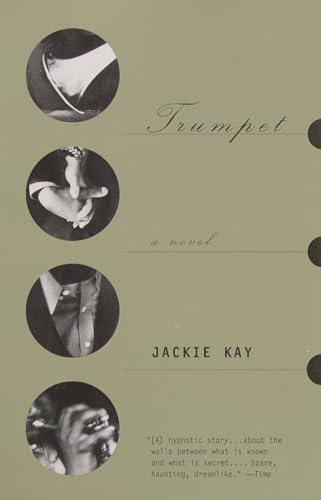
Inhaltsangabe
"Supremely humane.... Kay leaves us with a broad landscape of sweet tolerance and familial love." —The New York Times Book Review
In her starkly beautiful and wholly unexpected tale, Jackie Kay delves into the most intimate workings of the human heart and mind and offers a triumphant tale of loving deception and lasting devotion.
The death of legendary jazz trumpeter Joss Moody exposes an extraordinary secret, one that enrages his adopted son, Colman, leading him to collude with a tabloid journalist. Besieged by the press, his widow Millie flees to a remote Scottish village, where she seeks solace in memories of their marriage. The reminiscences of those who knew Joss Moody render a moving portrait of a shared life founded on an intricate lie, one that preserved a rare, unconditional love.
Die Inhaltsangabe kann sich auf eine andere Ausgabe dieses Titels beziehen.
Über die Autorin bzw. den Autor
Jackie Kay was born and raised in Scotland. She is the author of four collections of poetry: Other Lovers (winner of the Somerset Maugham Award), The Adoption Papers, Off Colour, and Life Mask; almost all of which were collected in Darling: New & Selected Poems. She lives in England.
Von der hinteren Coverseite
Winner of the 1998 Guardian Fiction Prize, Jackie Kay's captivating novel delves into the inner workings of the human heart to reveal an unforgettable story about love, loss, and identity.
The music of legendary jazz trumpeter Joss Moody touched the souls of all who listened. But his death, exposes an extraordinary secret, one that he shared in life only with his beloved wife, Millie. When their adopted son, Colman, learns the truth about his father, his rage compels him to collude with a tabloid journalist. Besieged by the press and overwhelmed with grief, Millie secludes herself in their remote seaside home. There, she seeks solace in treasured memories of her fiercely private marriage, while Colman searches for answers that can resolve his resentment and confusion. The reminiscences of those who knew Joss Moody render a complex and moving portrait of two people whose shared life was founded on an intricate lie that preserved their family, and their rare, unconditional love.
Starkly beautiful, emotionally charged, and wholly unexpected, Trumpet delves into the most intimate workings of the human heart and mind. It is a bravura performance and a mesmerizing debut.
Aus dem Klappentext
"Supremely humane.... Kay leaves us with a broad landscape of sweet tolerance and familial love."--"The New York Times Book Review
In her starkly beautiful and wholly unexpected tale, Jackie Kay delves into the most intimate workings of the human heart and mind and offers a triumphant tale of loving deception and lasting devotion.
The death of legendary jazz trumpeter Joss Moody exposes an extraordinary secret, one that enrages his adopted son, Colman, leading him to collude with a tabloid journalist. Besieged by the press, his widow Millie flees to a remote Scottish village, where she seeks solace in memories of their marriage. The reminiscences of those who knew Joss Moody render a moving portrait of a shared life founded on an intricate lie, one that preserved a rare, unconditional love.
Auszug. © Genehmigter Nachdruck. Alle Rechte vorbehalten.
I pull back the curtain an inch and see their heads bent together. I have no idea how long they have been there. It is getting dark. I keep expecting them to vanish; then I would know that they were all in my mind. I would know that I imagined them just as surely as I imagined my life. But they are still there, wearing real clothes, looking as conspicuous as they please. Each time I look at the photographs in the papers, I look unreal. I look unlike the memory of myself. I feel strange now. It used to be such a certain thing, just being myself. It was so easy, so painless.
I have to get back to our den, and hide myself away from it all. Animals are luckier; they can bury their heads in sand, hide their heads under their coats, pretend they have no head at all. I feel pain in the exact place Joss complained of for months. A stabbing pain on my left side. We couldn't die of the same thing?
There's a film I watched once, Double Indemnity, where the guy is telling his story into a tape, dying and breathless. I feel like him. I haven't killed anyone. I haven't done anything wrong. If I was going to make a tape, I'd make it for Colman.
I crept out of my house in the middle of the night with a thief's racing heart. Nobody watching. I drove into dawn. Relief as I crossed the border into Scotland. I let down the windows to sniff the different air. I am exhausted. Every morning for the past ten days, someone has been waiting outside my house with cameras and questions. I have seen the most awful looking pictures of myself in the newspapers looking deranged and shocked. Of course you are going to look demented if some hack hides behind your hedge, snaps and flashes the moment you appear. How else are you going to look?
Even here now the sound of cameras, like the assault of a machine-gun, is still playing inside my head. I can't get the noise to go no matter what I do. I hear it over music, over the sound of a tap running, over the kettle's whistle -- the cameras' rapid bullets. Their fingers on the triggers, they don't take them off till they finish the film, till I've been shot over and over again. They stop for the briefest of frantic seconds, reload the cartridge and then start up again. What can they want with all those pictures? With every snap and flash and whirr, I felt myself, the core of myself, being eaten away. My soul. I met a man once who wouldn't let me take his picture with Joss. He said it would be stealing his soul. I remember thinking, how ridiculous, a soul cannot be stolen. Strange how things like that stay with you as if life is waiting for a chance to prove you wrong. Joss's soul has gone and mine has been stolen. It is as simple and as true as that.
Once, I came out of my house and at least ten of them were waiting, two days after Joss's funeral. I was still in a daze. I didn't react quickly enough. I couldn't find cover. I couldn't hide. They took me walking towards my car, entering my car, wild behind the steering wheel. I looked like an actress in an old black and white movie who has just bumped off her husband and is escaping. The wipers on, the rain on the wind screen, my face, crazy, at the wheel. The blinding white light, flashing and illuminating me. I could barely see to drive off. Of course, the minute I am placed in front of that raging white light, I am not myself any longer. I am no more myself than a rabbit is itself trapped in front of glaring headlights. The rabbit freezes and what you see most on the road is fear itself, not a furry rabbit, fear flashed up before you for a second until your brakes screech to a halt. I have stared at the woman who was captured by the light for ages and ages to try to find myself in her. I have never seen my own fear. Most people don't get a chance to see what they look like terrified. If I had died they would have continued shooting, one shot after another. They would have taken me dead. The next day I was splattered all over the papers again, more lies, more lurid headlines.
I had to get away. So I drove here. I've been here a million times and never noticed that left turn at Kepper. I threw a bag together and chucked it in the boot and took off. I've no idea how long it took me to get here. Time feels as if it is on the other side of me now, way over, out across the sea, like another country. I don't live inside it any more and it doesn't rule me.
I have a fire going. It is working itself up into a state of survival. The only noise inside here. Dry cackle, sputtering and spitting. It sounds possessed. It seems a strange fickle, flickering company to begin with, as if at any moment it might just die out, the flames pale and uncertain, but after a while it has transformed into my loyal, dependable friend. I sit here like this for an age admiring the full colours, looking right into the wild soul of the fire to try to find myself. I can see Joss bending down to light the fire, making his base with newspapers rolled and then tied to precision, then kindling. 'There's quite an art to building a fire,' he says, lighting it, smug, satisfied.
Colman is the only one who knows I am here. I left him a message on his machine. I think I didn't say much except that I was going to Torr. He can get hold of me if he wants, though I doubt he will. I don't know if he'll ever speak to me again. Bruce, the butcher, would always take a message. I won't hold my breath.
From the small sitting-room window, way down below, I can see the waves in the damaged light, lashing out at the rocks. My eyes follow the waves backwards out to where the sea is suddenly deep. It seems as if Joss has been dead for the longest time now. Every day feels like a week. I am awake for much of the time, staring out into the dark or the day; it doesn't make much difference.
My hand was shaking when I lit the fire. That's how absurd I've become. I can't even light a tiny cottage fire without shaking. It might be the beginning. Animals do that, don't they, when one goes first, the other follows later, often of the very same thing. I don't know what is real and what is not, whether the pain in my side is real or imagined. The terrible thing about pain is that it doesn't matter, it still hurts. It hurts like hell.
They will never find me here. Torr is off the beaten track. We never mentioned the existence of this place to any of the media through the years. We kept it private. Colman is the only one and he won't be speaking to any of them. He told me he was too ashamed to go out. I never imagined that people could make such a fuss. I know now why they call reporters hounds. I feel hounded, hunted. Pity the fox.
Joss's holiday clothes are all here. Colman's model aeroplanes, fishing rods, old green bottles dug up from the sea. Colman's little antique collection. His coins. Joss's records. A box of his mild cigars. Everything that mattered to us, we celebrated here. When we first adopted Colman we brought him here, not long after. We chose his name here too. Joss and I nearly divorced when it came to naming Colman. Joss wanted Miles; I wanted Campbell. Joss wanted Louis; I wanted Alastair. Joss wanted a jazz or a blues name. What about Jelly Roll, I laughed. Or Howling Wolf, Bird, Muggsy, Fats, Leadbelly. I was bent over double: Pee Wee. Joss slapped me across my face. 'That's enough,' he said. 'White people always laugh at black names.' I rubbed my cheek. I couldn't believe it. I just gave him a look until I saw the first bloom of shame appear on his. We gave up on names and went to bed. Sex is always better if you argue before. After, we compromised on Colman spelt the Irish way and not like Coleman Hawkins. That way we could get an Irish name and a jazz name rolled into one. Colman comes from the Latin meaning dove, I told Joss, pleased with myself. 'Is that right?' he said. 'Well, I hope to Christ he brings us peace.'
I must go...
„Über diesen Titel“ kann sich auf eine andere Ausgabe dieses Titels beziehen.
Weitere beliebte Ausgaben desselben Titels

Suchergebnisse für Trumpet: A Novel (Vintage Contemporaries)

Beispielbild für diese ISBN
Trumpet: A Novel
Anbieter: World of Books (was SecondSale), Montgomery, IL, USA
Verkäuferbewertung 5 von 5 Sternen

Zustand: Very Good. Item in very good condition! Textbooks may not include supplemental items i.e. CDs, access codes etc. Artikel-Nr. 00102458561
Gebraucht kaufen
EUR 3,93
Versand gratis
Versand innerhalb von USA
Versand innerhalb von USA
Anzahl: 1 verfügbar
Beispielbild für diese ISBN
Trumpet: A Novel
Anbieter: World of Books (was SecondSale), Montgomery, IL, USA
Verkäuferbewertung 5 von 5 Sternen
Zustand: Good. Item in good condition. Textbooks may not include supplemental items i.e. CDs, access codes etc. Artikel-Nr. 00098976009
Gebraucht kaufen
EUR 3,93
Versand gratis
Versand innerhalb von USA
Versand innerhalb von USA
Anzahl: 7 verfügbar
Beispielbild für diese ISBN
Trumpet: A Novel
Anbieter: World of Books (was SecondSale), Montgomery, IL, USA
Verkäuferbewertung 5 von 5 Sternen
Zustand: Good. Item in good condition and has highlighting/writing on text. Used texts may not contain supplemental items such as CDs, info-trac etc. Artikel-Nr. 00099117415
Gebraucht kaufen
EUR 4,41
Versand gratis
Versand innerhalb von USA
Versand innerhalb von USA
Anzahl: 3 verfügbar
Beispielbild für diese ISBN
Trumpet
Anbieter: ThriftBooks-Phoenix, Phoenix, AZ, USA
Verkäuferbewertung 5 von 5 Sternen
Paperback. Zustand: Fair. No Jacket. Readable copy. Pages may have considerable notes/highlighting. ~ ThriftBooks: Read More, Spend Less. Artikel-Nr. G0375704639I5N00
Gebraucht kaufen
EUR 5,83
Versand gratis
Versand innerhalb von USA
Versand innerhalb von USA
Anzahl: 1 verfügbar
Beispielbild für diese ISBN
Trumpet
Anbieter: ThriftBooks-Phoenix, Phoenix, AZ, USA
Verkäuferbewertung 5 von 5 Sternen
Paperback. Zustand: Good. No Jacket. Pages can have notes/highlighting. Spine may show signs of wear. ~ ThriftBooks: Read More, Spend Less. Artikel-Nr. G0375704639I3N00
Gebraucht kaufen
EUR 5,83
Versand gratis
Versand innerhalb von USA
Versand innerhalb von USA
Anzahl: 3 verfügbar
Beispielbild für diese ISBN
Trumpet
Anbieter: ThriftBooks-Reno, Reno, NV, USA
Verkäuferbewertung 5 von 5 Sternen
Paperback. Zustand: Good. No Jacket. Pages can have notes/highlighting. Spine may show signs of wear. ~ ThriftBooks: Read More, Spend Less. Artikel-Nr. G0375704639I3N00
Gebraucht kaufen
EUR 5,83
Versand gratis
Versand innerhalb von USA
Versand innerhalb von USA
Anzahl: 3 verfügbar
Beispielbild für diese ISBN
Trumpet
Anbieter: ThriftBooks-Reno, Reno, NV, USA
Verkäuferbewertung 5 von 5 Sternen
Paperback. Zustand: Fair. No Jacket. Readable copy. Pages may have considerable notes/highlighting. ~ ThriftBooks: Read More, Spend Less. Artikel-Nr. G0375704639I5N00
Gebraucht kaufen
EUR 5,83
Versand gratis
Versand innerhalb von USA
Versand innerhalb von USA
Anzahl: 1 verfügbar
Beispielbild für diese ISBN
Trumpet
Anbieter: ThriftBooks-Atlanta, AUSTELL, GA, USA
Verkäuferbewertung 5 von 5 Sternen
Paperback. Zustand: Fair. No Jacket. Missing dust jacket; Readable copy. Pages may have considerable notes/highlighting. ~ ThriftBooks: Read More, Spend Less. Artikel-Nr. G0375704639I5N01
Gebraucht kaufen
EUR 5,87
Versand gratis
Versand innerhalb von USA
Versand innerhalb von USA
Anzahl: 1 verfügbar
Beispielbild für diese ISBN
Trumpet
Anbieter: ThriftBooks-Dallas, Dallas, TX, USA
Verkäuferbewertung 5 von 5 Sternen
Paperback. Zustand: Good. No Jacket. Pages can have notes/highlighting. Spine may show signs of wear. ~ ThriftBooks: Read More, Spend Less. Artikel-Nr. G0375704639I3N00
Gebraucht kaufen
EUR 5,87
Versand gratis
Versand innerhalb von USA
Versand innerhalb von USA
Anzahl: 3 verfügbar
Beispielbild für diese ISBN
Trumpet
Anbieter: ThriftBooks-Atlanta, AUSTELL, GA, USA
Verkäuferbewertung 5 von 5 Sternen
Paperback. Zustand: Fair. No Jacket. Readable copy. Pages may have considerable notes/highlighting. ~ ThriftBooks: Read More, Spend Less. Artikel-Nr. G0375704639I5N00
Gebraucht kaufen
EUR 5,87
Versand gratis
Versand innerhalb von USA
Versand innerhalb von USA
Anzahl: 1 verfügbar