
Verwandte Artikel zu Human Traces (Vintage International)
Inhaltsangabe
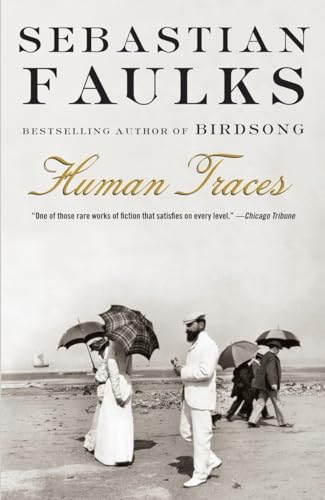
Sixteen-year-old Jacques Rebière is living a humble life in rural France, studying butterflies and frogs by candlelight in his bedroom. Across the Channel, in England, the playful Thomas Midwinter, also sixteen, is enjoying a life of ease-and is resigned to follow his father's wishes and pursue a career in medicine. A fateful seaside meeting four years later sets the two young men on a profound course of friendship and discovery; they will become pioneers in the burgeoning field of psychiatry. But when a female patient at the doctors' Austrian sanatorium becomes dangerously ill, the two men's conflicting diagnosis threatens to divide them--and to undermine all their professional achievements. From the bestselling author of Birdsong comes this masterful novel that ventures to answer challenging questions of consciousness and science, and what it means to be human.
Die Inhaltsangabe kann sich auf eine andere Ausgabe dieses Titels beziehen.
Über die Autorin bzw. den Autor
Sebastian Faulks's six previous novels include Birdsong (1993), Charlotte Gray (2000), The Girl at the Lion d'Or (1989) and On Green Dolphin Street (2001). He is also the author of a biographical study, The Fatal Englishman (1996). He lives in London, is married and has two sons and a daughter.
Auszug. © Genehmigter Nachdruck. Alle Rechte vorbehalten.
IAn evening mist, salted by the western sea, was gathering on the low hills--reed-spattered rises running up from the rocks then back into the gorse- and bracken-covered country--and on to the roads that joined the villages, where lamps and candles flickered behind the shutters of the gray stone houses. It was poor country--so poor, remarked the Cure, who had recently arrived from Angers, that the stones of the shore called out for God's mercy. With the mist came sputtering rain, made invisible by the extinguished light, as it exploded like flung gravel at the windows, while stronger gusts made the shivering pine trees shed their needles on the dark, sanded earth.Jacques Rebiere listened to the sounds from outside as he looked through the window of his bedroom; for a moment, a dim moon allowed him to see clouds foaming in the darkness. The weather reminded him, often, that it was not just he, at sixteen years old, who was young, but all mankind: a species that took infant steps on the drifts and faults of the earth.Between the ends of his dirtied fingers, Jacques held a small blade which, over the course of several days, he had whetted to surgical sharpness. He pulled a candle closer. From downstairs he could hear the sound of his father's voice in reluctant negotiation.The house was at the top of a narrow street that ran off the main square of Saint Agnes. Behind it, the village ended and there were thick woods--Monsieur Rebiere's own property--where Jacques was meant to trap birds and rabbits and prevent other villagers from doing likewise. The garden had an orchard of pear and apple trees whose fruits were collected and set to keep in one of the outbuildings. Rebiere's was a house of many stores: of sheds with beaten earth underfoot and slatted wooden shelves; of brick-floored cellars with stone bins on which the cobwebs closed the access to the bottles; of barred pantry and latched larder with trays of nuts and preserved fruits. The keys were on a ring in the pocket of Rebiere's waistcoat. Although born no more than sixty years earlier, he was known as "old Rebiere," perhaps for the arthritic movement of his knees, when he heaved himself up from his chair and straightened the joints beneath his breeches. He preferred to do business standing up; it gave the transaction a temporary air, helping to convince the other party that bargaining time was short.Old Rebiere was a forester who worked as the agent for a landowner from Lorient. Over the years he had done some business on his own account, acquiring some parcels of land, three cottages that the heirs did not want to keep, some fields and woodland. Most of his work was no more than that of bailiff or rent collector, but he liked to try to negotiate private deals with a view to becoming a businessman in his own right. Born in the year after Waterloo, he had lived under a republic, three kings and an emperor; twice mayor of the local town, he had found it made little difference which government was in Paris, since so few edicts devolved from the distant center to his own Breton world.The parlor of the house had smoke-stained wooden paneling and a white stone chimneypiece decorated with the carved head of a wild boar. A small fire was smoldering in the grate as Rebiere attempted to conclude his meeting with the notary who had come to see him. He never invited guests into his study but preferred to speak to them in this public room, as though he might later need witnesses to what had passed between them. His second wife sat in her accustomed chair by the door, sewing and listening. Rebiere's tactic was to say as little as possible; he had found that silence, accompanied by pained inhalation, often induced nervousness in the other side. His contributions, when they were unavoidable, were delivered in a reluctant murmur, melancholy, full of weariness at a world that had obliged him to agree terms so self-wounding."I am not a peasant," he told his son. "I am not one of those men you see portrayed at the theater in Paris, who buries his gold in a sock and never buys a bonnet for his wife. I am a businessman who understands the modern world."From upstairs, Jacques could still hear his father's business murmur. It was true that he was not a peasant, though his parents had been; true too, that he was not the miser of the popular imagination, though partly because the amount of gold he had to hoard was not great enough: forty years of dealing had brought him a modest return, and perhaps, thought Jacques, this was why his father had forbidden him to study any further. From the age of thirteen, he had been set to work, looking after the properties, mending roofs and fences, clearing trees while his father traveled to Quimper and Vannes to cultivate new acquaintances.Jacques looked back to his table, not wanting to waste the light of the wax candle he had begged from Tante Mathilde in place of the dingy ox-tallow which was all his father would allow him. He took the blade and began, very carefully, to make a shallow incision in the neck of a frog he had pinned, through its splayed feet, to the untreated wood. He had never attempted the operation before and was anxious not to damage what lay beneath the green skin, moist from the saline in which he had kept it. The frog was on its front, and Jacques's blade traveled smoothly up over the top of its head and stopped between the bulging eyes. He then cut two semicircular flaps to join at the nape of the neck and pushed back the pouches of peeled skin, with their pearls of eyes. Beneath his delicate touch he could see now that there was little in the way of protection for the exposed brain. He took out a magnifying glass.What is a frog's fury? he thought, as he gazed at the tiny thinking organ his knife had exposed. It was beautiful. What does it feel for its spawn or its mate or the flash of water over its skin? The brain of an amphibian is a poor thing, the Cure had warned him; he promised that soon he would acquire the head of a cow from the slaughterhouse, and then they would have a more instructive time. Yet Jacques was happy with his frog's brain. From the side of the table he took two copper wires attached at the other end to a brass rod that ran through a cork which was in turn used to seal a glass bottle coated inside and out with foil."Jacques! Jacques! It's time for dinner. Come to the table!"It was Tante Mathilde's voice; clearly Jacques had not heard the notary depart. He set down the electrodes and blew out the candle, then crossed the landing to the top of the almost-vertical wooden staircase and groped his way down by the familiar indentations of the plaster wall. His grandmother came into the parlor carrying a tureen of soup, which she placed on the table. Rebiere and his wife, known to Jacques as Tante Mathilde, were already sitting down. Rebiere drummed his knife impatiently on the wood while Grand-mÂ?re ladled the soup out with her shaking hand."Take a bowl out to . . ." Rebiere jerked his head in the direction of the door."Wait," said Grand-mere. "There's some rabbit, too."Rebiere rolled his eyes with impatience as the old woman went out to the scullery again and returned with a second bowl that she handed to Jacques. He carried both dishes carefully to the door and took a lantern to light his way out into the darkness, watching his feet on the shiny cobbles of the yard. At the stable, he set down the food and pulled back the top half of the door; he peered in by the light of the flame and felt his nostrils fill with a familiar sensation."Olivier? Are you there? I've brought dinner. There's no bread again, but there's soup and some rabbit. Olivier?"There was a sudden noise from the horse, like the rumbling clatter of a laden table being overturned, as she shifted in the stall."Olivier? Please. It's raining. Where are you?"Wary of the horse, who...
„Über diesen Titel“ kann sich auf eine andere Ausgabe dieses Titels beziehen.
Suchergebnisse für Human Traces (Vintage International)

Beispielbild für diese ISBN
Human Traces
Anbieter: World of Books (was SecondSale), Montgomery, IL, USA
Verkäuferbewertung 5 von 5 Sternen

Paperback. Zustand: Good. Sixteen-year-old Jacques Rebière is living a humble life in rural France, studying butterflies and frogs by candlelight in his bedroom. Across the Channel, in England, the playful Thomas Midwinter, also sixteen, is enjoying a life of ease-and is resigned to follow his father's wishes and pursue a career in medicine. A fateful seaside meeting four years later sets the two young men on a profound course of friendship and discovery; they will become pioneers in the burgeoning field of psychiatry. But when a female patient at the doctors' Austrian sanatorium becomes dangerously ill, the two men's conflicting diagnosis threatens to divide them--and to undermine all their professional achievements. From the bestselling author of Birdsong comes this masterful novel that ventures to answer challenging questions of consciousness and science, and what it means to be human. Artikel-Nr. 00102994497
Gebraucht kaufen
EUR 3,87
Versand gratis
Versand innerhalb von USA
Versand innerhalb von USA
Anzahl: 1 verfügbar
Beispielbild für diese ISBN
Human Traces (Vintage International)
Verlag:
Knopf Doubleday Publishing Group (edition Reprint), 2008
ISBN 10: 0375704574
ISBN 13: 9780375704574
Gebraucht
Paperback
Anbieter: BooksRun, Philadelphia, PA, USA
Verkäuferbewertung 5 von 5 Sternen
Paperback. Zustand: Very Good. Reprint. It's a well-cared-for item that has seen limited use. The item may show minor signs of wear. All the text is legible, with all pages included. It may have slight markings and/or highlighting. Artikel-Nr. 0375704574-11-1
Gebraucht kaufen
EUR 4,73
Versand gratis
Versand innerhalb von USA
Versand innerhalb von USA
Anzahl: 1 verfügbar
Beispielbild für diese ISBN
Human Traces (Vintage International)
Verlag:
Knopf Doubleday Publishing Group, 2008
ISBN 10: 0375704574
ISBN 13: 9780375704574
Gebraucht
Softcover
Anbieter: Wonder Book, Frederick, MD, USA
Verkäuferbewertung 5 von 5 Sternen
Zustand: Good. Good condition. A copy that has been read but remains intact. May contain markings such as bookplates, stamps, limited notes and highlighting, or a few light stains. Artikel-Nr. M05G-01452
Gebraucht kaufen
EUR 6,62
Versand gratis
Versand innerhalb von USA
Versand innerhalb von USA
Anzahl: 1 verfügbar
Beispielbild für diese ISBN
Human Traces
Verlag:
Knopf Doubleday Publishing Group, 2008
ISBN 10: 0375704574
ISBN 13: 9780375704574
Gebraucht
Paperback
Anbieter: ThriftBooks-Phoenix, Phoenix, AZ, USA
Verkäuferbewertung 5 von 5 Sternen
Paperback. Zustand: Good. No Jacket. Pages can have notes/highlighting. Spine may show signs of wear. ~ ThriftBooks: Read More, Spend Less. Artikel-Nr. G0375704574I3N00
Gebraucht kaufen
EUR 6,63
Versand gratis
Versand innerhalb von USA
Versand innerhalb von USA
Anzahl: 1 verfügbar
Beispielbild für diese ISBN
Human Traces
Verlag:
Knopf Doubleday Publishing Group, 2008
ISBN 10: 0375704574
ISBN 13: 9780375704574
Gebraucht
Paperback
Anbieter: ThriftBooks-Atlanta, AUSTELL, GA, USA
Verkäuferbewertung 5 von 5 Sternen
Paperback. Zustand: Good. No Jacket. Pages can have notes/highlighting. Spine may show signs of wear. ~ ThriftBooks: Read More, Spend Less. Artikel-Nr. G0375704574I3N00
Gebraucht kaufen
EUR 6,63
Versand gratis
Versand innerhalb von USA
Versand innerhalb von USA
Anzahl: 1 verfügbar
Beispielbild für diese ISBN
Human Traces
Verlag:
Knopf Doubleday Publishing Group, 2008
ISBN 10: 0375704574
ISBN 13: 9780375704574
Gebraucht
Paperback
Anbieter: ThriftBooks-Reno, Reno, NV, USA
Verkäuferbewertung 5 von 5 Sternen
Paperback. Zustand: Good. No Jacket. Pages can have notes/highlighting. Spine may show signs of wear. ~ ThriftBooks: Read More, Spend Less. Artikel-Nr. G0375704574I3N00
Gebraucht kaufen
EUR 6,63
Versand gratis
Versand innerhalb von USA
Versand innerhalb von USA
Anzahl: 1 verfügbar
Beispielbild für diese ISBN
Human Traces
Verlag:
Knopf Doubleday Publishing Group, 2008
ISBN 10: 0375704574
ISBN 13: 9780375704574
Gebraucht
Paperback
Anbieter: ThriftBooks-Dallas, Dallas, TX, USA
Verkäuferbewertung 5 von 5 Sternen
Paperback. Zustand: Very Good. No Jacket. May have limited writing in cover pages. Pages are unmarked. ~ ThriftBooks: Read More, Spend Less. Artikel-Nr. G0375704574I4N00
Gebraucht kaufen
EUR 6,63
Versand gratis
Versand innerhalb von USA
Versand innerhalb von USA
Anzahl: 1 verfügbar
Beispielbild für diese ISBN
Human Traces
Verlag:
Knopf Doubleday Publishing Group, 2008
ISBN 10: 0375704574
ISBN 13: 9780375704574
Gebraucht
Paperback
Anbieter: ThriftBooks-Dallas, Dallas, TX, USA
Verkäuferbewertung 5 von 5 Sternen
Paperback. Zustand: Good. No Jacket. Pages can have notes/highlighting. Spine may show signs of wear. ~ ThriftBooks: Read More, Spend Less. Artikel-Nr. G0375704574I3N00
Gebraucht kaufen
EUR 6,63
Versand gratis
Versand innerhalb von USA
Versand innerhalb von USA
Anzahl: 1 verfügbar
Beispielbild für diese ISBN
Human Traces
Verlag:
Knopf Doubleday Publishing Group, 2008
ISBN 10: 0375704574
ISBN 13: 9780375704574
Gebraucht
Softcover
Anbieter: Better World Books, Mishawaka, IN, USA
Verkäuferbewertung 5 von 5 Sternen
Zustand: Very Good. Pages intact with possible writing/highlighting. Binding strong with minor wear. Dust jackets/supplements may not be included. Stock photo provided. Product includes identifying sticker. Better World Books: Buy Books. Do Good. Artikel-Nr. 9580886-75
Gebraucht kaufen
EUR 6,74
Versand gratis
Versand innerhalb von USA
Versand innerhalb von USA
Anzahl: 1 verfügbar
Beispielbild für diese ISBN
Human Traces
Verlag:
Knopf Doubleday Publishing Group, 2008
ISBN 10: 0375704574
ISBN 13: 9780375704574
Gebraucht
Softcover
Anbieter: Better World Books, Mishawaka, IN, USA
Verkäuferbewertung 5 von 5 Sternen
Zustand: Good. Pages intact with minimal writing/highlighting. The binding may be loose and creased. Dust jackets/supplements are not included. Stock photo provided. Product includes identifying sticker. Better World Books: Buy Books. Do Good. Artikel-Nr. 2295006-6
Gebraucht kaufen
EUR 6,74
Versand gratis
Versand innerhalb von USA
Versand innerhalb von USA
Anzahl: 1 verfügbar