
Verwandte Artikel zu Straight Man: A Novel (Vintage Contemporaries)
Inhaltsangabe
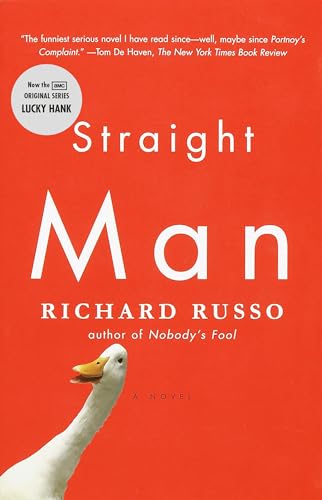
Hilarious and true-to-life, witty, compassionate, and impossible to put down, Straight Man follows Hank Devereaux through one very bad week in this novel from the Pulitzer Prize-winning author of Empire Falls. • Now the AMC Original Series Lucky Hank.
William Henry Devereaux, Jr., is the reluctant chairman of the English department of a badly underfunded college in the Pennsylvania rust belt. Devereaux's reluctance is partly rooted in his character—he is a born anarchist—and partly in the fact that his department is more savagely divided than the Balkans.
In the course of a single week, Devereaux will have his nose mangled by an angry colleague, imagine his wife is having an affair with his dean, wonder if a curvaceous adjunct is trying to seduce him with peach pits, and threaten to execute a goose on local television. All this while coming to terms with his philandering father, the dereliction of his youthful promise, and the ominous failure of certain vital body functions. In short, Straight Man is classic Russo—side-splitting, poignant, compassionate, and unforgettable.
Look for Richard Russo's new book, Somebody's Fool, coming soon.
Die Inhaltsangabe kann sich auf eine andere Ausgabe dieses Titels beziehen.
Über die Autorin bzw. den Autor
RICHARD RUSSO is the author of eight novels; two collections of stories; and Elsewhere, a memoir. In 2002 he received the Pulitzer Prize for Empire Falls, which like Nobody’s Fool was adapted to film, in a multiple-award-winning HBO miniseries.
Von der hinteren Coverseite
In this uproarious new novel, Richard Russo performs his characteristic high-wire walk between hilarity and heartbreak. Russo's protagonist is William Henry Devereaux, Jr., the reluctant chairman of the English department of a badly underfunded college in the Pennsylvania rust belt. Devereaux's reluctance is partly rooted in his character--he is a born anarchist-- and partly in the fact that his department is more savagely divided than the Balkans.
In the course of a single week, Devereaux will have his nose mangled by an angry colleague, imagine his wife is having an affair with his dean, wonder if a curvaceous adjunct is trying to seduce him with peach pits, and threaten to execute a goose on local television. All this while coming to terms with his philandering father, the dereliction of his youthful promise, and the ominous failure of certain vital body functions. in short, Straight Man is classic Russo--side-splitting and true-to-life, witty, compassionate, and impossible to put down.
Auszug. © Genehmigter Nachdruck. Alle Rechte vorbehalten.
Chapter I
When my nose finally stops bleeding and I've disposed of the bloody paper towels, Teddy Barnes insists on driving me home in his ancient Honda Civic, a car that refuses to die and that Teddy, cheap as he is, refuses to trade in. June, his wife, whose sense of self-worth is not easily tilted, drives a new Saab. "That seat goes back," Teddy says, observing that my knees are practically under my chin.
When we stop at an intersection for oncoming traffic, I run my fingers along the side of the seat, looking for the release. "It does, huh?"
"It's supposed to," he says, sounding academic, helpless.
I know it's supposed to, but I give up trying to make it, preferring the illusion of suffering. I'm not a guilt provoker by nature, but I can play that role. I release a theatrical sigh intended to convey that this is nonsense, that my long legs could be stretched out comfortably beneath the wheel of my own Lincoln, a car as ancient as Teddy's Civic, but built on a scale more suitable to the long-legged William Henry Devereauxs of the world, two of whom, my father and me, remain above ground.
Teddy is an insanely cautious driver, unwilling to goose his little Civic into a left turn in front of oncoming traffic. "The cars are spaced just wrong. I can't help it," he explains when he sees me grinning at him. Teddy's my age, forty-nine, and though his features are more boyish, he too is beginning to show signs of age. Never robust, his chest seems to have become more concave, which emphasizes his small paunch. His hands are delicate, almost feminine, hairless. His skinny legs appear lost in his trousers. It occurs to me as I study him that Teddy would have a hard time starting over-that is, learning how unfamiliar things work, competing, finding a mate. The business of young men. "Why would I have to start over?" he wants to know, a frightened expression deepening the lines around the corners of his eyes.
Apparently, to judge from the way he's looking at me now, I have spoken my thought out loud, though I wasn't aware of doing so. "Don't you ever wish you could?"
"Could what?" he says, his attention diverted. Having spied a break in the oncoming traffic, he takes his foot off the brake and leans forward, his foot poised over but not touching the gas pedal, only to conclude that the gap between the cars isn't as big as he thought, settling back into his seat with a frustrated sigh.
Something about this gesture causes me to wonder if a rumor I've been hearing about Teddy's wife, June-that she's involved with a junior faculty member in our department-just might be true. I haven't given it much credence until now because Teddy and June have such a perfect symbiotic relationship. In the English department they are known as Fred and Ginger for the grace with which they move together, without a hint of passion, toward a single, shared destination. In an atmosphere of distrust and suspicion and retribution, two people working together represent a power base, and no one has understood this sad academic truth better than Teddy and June. It's hard to imagine either of them risking it. On the other hand, it must be hard to be married to a man like Teddy, who's always leaning forward in anticipation, foot poised above the gas pedal, but too cautious to stomp.
We are on Church Street, which parallels the railyard that divides the city of Railton into two dingy, equally unattractive halves. This is the broadest section of the yard, some twenty sets of tracks wide, and most of those tracks are occupied by a rusty boxcar or two. A century ago the entire yard would have been full, the city of Railton itself thriving, its citizens looking forward to a secure future. No longer. On Church Street, where we remain idling in the left-turn lane, there is no longer a single church, though there were once, I'm told, half a dozen. The last of them, a decrepit red brick affair, long condemned and boarded up, was razed last year after some kids broke in and fell through the floor. The large parcel of land it perched on now sits empty. It's the fact that there are so many empty, littered spaces in Railton, like the windblown expanses between the boxcars in the railyard, that challenges hope. Within sight of where we sit waiting to turn onto Pleasant Street, a man named William Cherry, a lifelong Conrail employee, has recently taken his life by lying down on the track in the middle of the night. At first the speculation was that he was one of the men laid off the previous week, but the opposite turned out to be true. He had in fact lust retired with his pension and full benefits. On television his less fortunate neighbors couldn't understand it. He had it made, they said.
When it's safe, when all the oncoming traffic has passed, Teddy turns onto Pleasant, the most unpleasant of Railton streets. Lined on both sides with shabby one- and two-story office fronts, Pleasant Street is too steep to climb in winter when there's snow. Now, in early April, I suspect it may be too steep for Teddy's Civic, which is whirring heroically in its lower gears and going all of fifteen miles an hour. There's a plateau and a traffic light halfway up, and when we stop, I say, "Should I get out and push?"
"It's just cold," Teddy tells me. "Really. We're fine."
No doubt he's right. We will make it. Why this fact should be so discouraging is what I'd like to know. I can't help wondering if William Cherry also feared things would work out if he didn't do something drastic to prevent them.
"I think I can, I think I can, I think I can," I chant, as the light changes and Teddy urges forward the Little Civic That Could. A few months ago I foolishly tried to climb this same hill in a light snow. It was nearly midnight, and I was heading home from the campus and hadn't wanted to go the long way, which added ten minutes. During the long Pennsylvania winters, curbside parking is not allowed at night, so the street had a deserted, ominous feel. Mine was the only car on the five-block incline, and I made it without incident to this very plateau where Teddy and I have now stopped. The office of my insurance agent was on the corner, and I remember wishing he was there to see me do something so reckless in a car he was insuring. When the light changed, my tires spun, then caught, and I labored up the last two blocks. I couldn't have been more than ten yards from the crest of the hill when I felt the tires begin to spin and the rear end to drift. When the car stalled and I realized the brake exerted no meaningful influence, I sat back and became a witness to my own folly. With the engine dead and the snow muffling all other sounds, I found myself in a silent ballet as I slalomed gracefully down the hill, backward as far as the landing where it appeared that I would stop, right in front of my insurance agent's, but then I slipped over the edge and spun down the last three blocks, rebounding off curbs like the cue ball in a game of bumper pool, finally coming to rest at the entrance to the railyard, having suffered a loss of equilibrium but otherwise unscathed. A friend, Bodie Pie, who lives in a second-floor flat near the bottom of the hill and claims to have witnessed my balletic descent, swears she heard me laughing maniacally, but I don't remember that. The only emotion I recall is similar to the one I feel now, with Teddy on this same hill. That is, a certain sense of disappointment about such drama resulting in so little consequence. Teddy is sure we'll make it, and so am I. We have tenure, the two of us.
Once out of town, the rejuvenated Civic rushes along the two-lane blacktop like a cartoon car with a big, loopy smile (I knew I could, I knew I could), the Pennsylvania countryside hurtling by. Most of the trees...
„Über diesen Titel“ kann sich auf eine andere Ausgabe dieses Titels beziehen.
Suchergebnisse für Straight Man: A Novel (Vintage Contemporaries)

Beispielbild für diese ISBN
Straight Man: A Novel
Anbieter: World of Books (was SecondSale), Montgomery, IL, USA
Verkäuferbewertung 5 von 5 Sternen

Paperback. Zustand: Fair. Hilarious and true-to-life, witty, compassionate, and impossible to put down, Straight Man follows Hank Devereaux through one very bad week in this novel from the Pulitzer Prize-winning author of Empire Falls. * Now the AMC Original Series Lucky Hank. William Henry Devereaux, Jr., is the reluctant chairman of the English department of a badly underfunded college in the Pennsylvania rust belt. Devereaux's reluctance is partly rooted in his character--he is a born anarchist--and partly in the fact that his department is more savagely divided than the Balkans. In the course of a single week, Devereaux will have his nose mangled by an angry colleague, imagine his wife is having an affair with his dean, wonder if a curvaceous adjunct is trying to seduce him with peach pits, and threaten to execute a goose on local television. All this while coming to terms with his philandering father, the dereliction of his youthful promise, and the ominous failure of certain vital body functions. In short, Straight Man is classic Russo--side-splitting, poignant, compassionate, and unforgettable. Look for Richard Russo's new book, Somebody's Fool, coming soon. Artikel-Nr. 00066234274
Gebraucht kaufen
EUR 3,68
Versand gratis
Versand innerhalb von USA
Versand innerhalb von USA
Anzahl: Mehr als 20 verfügbar
Beispielbild für diese ISBN
Straight Man: A Novel
Anbieter: World of Books (was SecondSale), Montgomery, IL, USA
Verkäuferbewertung 5 von 5 Sternen
Paperback. Zustand: Good. Hilarious and true-to-life, witty, compassionate, and impossible to put down, Straight Man follows Hank Devereaux through one very bad week in this novel from the Pulitzer Prize-winning author of Empire Falls. * Now the AMC Original Series Lucky Hank. William Henry Devereaux, Jr., is the reluctant chairman of the English department of a badly underfunded college in the Pennsylvania rust belt. Devereaux's reluctance is partly rooted in his character--he is a born anarchist--and partly in the fact that his department is more savagely divided than the Balkans. In the course of a single week, Devereaux will have his nose mangled by an angry colleague, imagine his wife is having an affair with his dean, wonder if a curvaceous adjunct is trying to seduce him with peach pits, and threaten to execute a goose on local television. All this while coming to terms with his philandering father, the dereliction of his youthful promise, and the ominous failure of certain vital body functions. In short, Straight Man is classic Russo--side-splitting, poignant, compassionate, and unforgettable. Look for Richard Russo's new book, Somebody's Fool, coming soon. Artikel-Nr. 00101596817
Gebraucht kaufen
EUR 3,68
Versand gratis
Versand innerhalb von USA
Versand innerhalb von USA
Anzahl: Mehr als 20 verfügbar
Beispielbild für diese ISBN
Straight Man: A Novel (Vintage Contemporaries)
Anbieter: BooksRun, Philadelphia, PA, USA
Verkäuferbewertung 5 von 5 Sternen
Paperback. Zustand: Very Good. It's a well-cared-for item that has seen limited use. The item may show minor signs of wear. All the text is legible, with all pages included. It may have slight markings and/or highlighting. Artikel-Nr. 0375701907-11-1
Gebraucht kaufen
EUR 5,66
Versand gratis
Versand innerhalb von USA
Versand innerhalb von USA
Anzahl: 1 verfügbar
Beispielbild für diese ISBN
Straight Man
Anbieter: ThriftBooks-Atlanta, AUSTELL, GA, USA
Verkäuferbewertung 5 von 5 Sternen
Paperback. Zustand: Very Good. No Jacket. Former library book; May have limited writing in cover pages. Pages are unmarked. ~ ThriftBooks: Read More, Spend Less. Artikel-Nr. G0375701907I4N10
Gebraucht kaufen
EUR 5,92
Versand gratis
Versand innerhalb von USA
Versand innerhalb von USA
Anzahl: 1 verfügbar
Beispielbild für diese ISBN
Straight Man
Anbieter: ThriftBooks-Dallas, Dallas, TX, USA
Verkäuferbewertung 5 von 5 Sternen
Paperback. Zustand: Very Good. No Jacket. May have limited writing in cover pages. Pages are unmarked. ~ ThriftBooks: Read More, Spend Less. Artikel-Nr. G0375701907I4N00
Gebraucht kaufen
EUR 5,92
Versand gratis
Versand innerhalb von USA
Versand innerhalb von USA
Anzahl: 5 verfügbar
Beispielbild für diese ISBN
Straight Man
Anbieter: ThriftBooks-Dallas, Dallas, TX, USA
Verkäuferbewertung 5 von 5 Sternen
Paperback. Zustand: Very Good. No Jacket. Former library book; May have limited writing in cover pages. Pages are unmarked. ~ ThriftBooks: Read More, Spend Less. Artikel-Nr. G0375701907I4N10
Gebraucht kaufen
EUR 5,92
Versand gratis
Versand innerhalb von USA
Versand innerhalb von USA
Anzahl: 1 verfügbar
Beispielbild für diese ISBN
Straight Man: A Novel (Vintage Contemporaries)
Anbieter: BooksRun, Philadelphia, PA, USA
Verkäuferbewertung 5 von 5 Sternen
Paperback. Zustand: Very Good. It's a well-cared-for item that has seen limited use. The item may show minor signs of wear. All the text is legible, with all pages included. It may have slight markings and/or highlighting. Artikel-Nr. 0375701907-8-1
Gebraucht kaufen
EUR 6,05
Versand gratis
Versand innerhalb von USA
Versand innerhalb von USA
Anzahl: 1 verfügbar
Beispielbild für diese ISBN
Straight Man : A Novel
Verlag:
Knopf Doubleday Publishing Group, 1998
ISBN 10: 0375701907
ISBN 13: 9780375701900
Gebraucht
Softcover
Anbieter: Better World Books: West, Reno, NV, USA
Verkäuferbewertung 5 von 5 Sternen
Zustand: Good. Pages intact with minimal writing/highlighting. The binding may be loose and creased. Dust jackets/supplements are not included. Stock photo provided. Product includes identifying sticker. Better World Books: Buy Books. Do Good. Artikel-Nr. GRP73181067
Gebraucht kaufen
EUR 6,12
Versand gratis
Versand innerhalb von USA
Versand innerhalb von USA
Anzahl: 3 verfügbar
Beispielbild für diese ISBN
Straight Man : A Novel
Verlag:
Knopf Doubleday Publishing Group, 1998
ISBN 10: 0375701907
ISBN 13: 9780375701900
Gebraucht
Softcover
Anbieter: Better World Books, Mishawaka, IN, USA
Verkäuferbewertung 5 von 5 Sternen
Zustand: Good. Pages intact with minimal writing/highlighting. The binding may be loose and creased. Dust jackets/supplements are not included. Stock photo provided. Product includes identifying sticker. Better World Books: Buy Books. Do Good. Artikel-Nr. GRP73181067
Gebraucht kaufen
EUR 6,12
Versand gratis
Versand innerhalb von USA
Versand innerhalb von USA
Anzahl: 19 verfügbar
Beispielbild für diese ISBN
Straight Man : A Novel
Verlag:
Knopf Doubleday Publishing Group, 1998
ISBN 10: 0375701907
ISBN 13: 9780375701900
Gebraucht
Softcover
Anbieter: Better World Books: West, Reno, NV, USA
Verkäuferbewertung 5 von 5 Sternen
Zustand: Very Good. Former library copy. Pages intact with possible writing/highlighting. Binding strong with minor wear. Dust jackets/supplements may not be included. Includes library markings. Stock photo provided. Product includes identifying sticker. Better World Books: Buy Books. Do Good. Artikel-Nr. 6150802-6
Gebraucht kaufen
EUR 6,12
Versand gratis
Versand innerhalb von USA
Versand innerhalb von USA
Anzahl: 1 verfügbar