
Verwandte Artikel zu Successful Aging: The MacArthur Foundation Study shows...
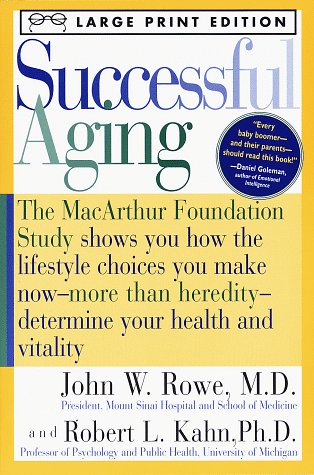
Successful Aging: The MacArthur Foundation Study shows you how the lifestyle choices you make now- -more than heredity--determine your health - Softcover
Inhaltsangabe
See the difference, read Successful Aging in Large Print
* About Large Print
All Random House Large Print editions are published in a 16-point typeface
Here at last is a compelling and inspiring presentation of what determines how well we age--the results of the MacArthur Foundation Study of Aging in America, which show how to maintain optimum physical and mental strength throughout later life.
Research into aging has been revolutionized in the past ten years largely due to the MacArthur Study, which under the leadership of Drs. John W. Rowe and Robert L. Kahn created a network of leading research scientists from key fields to determine what aging actually involves. Rejecting the established approach of studying aging in terms of anticipated decline, these scientists set out to identify the factors that were enabling vast numbers of people to preserve and even enhance their mental and physical vitality in later life.
Successful Aging brings together the remarkable results of the study for the first time. They explode the myths about aging that have long shaped individual and institutional attitudes toward growing older, including the biggest myth of all: "The key to aging well is choosing your parents wisely." In fact, they discovered that lifestyle choices--more than genes--determine how well we age. Drs. Rowe and Kahn outline those vital choices, including changes in diet, types of exercise, mental stimulation, self-efficacy, and dynamic connections. These choices can make a difference no matter how late in life they are made. In addition, Drs. Rowe and Kahn include the latest research-based strategies to delay or prevent the common diseases of old age.
Society can also influence how we age. Drs. Rowe and Kahn detail innovative programs and policies that are enabling older men and women to stay healthy and to continue to contribute to their societies.
For all of us, the rewards of successful aging are great; this eye-opening work shows how they can be attained and enjoyed.
Die Inhaltsangabe kann sich auf eine andere Ausgabe dieses Titels beziehen.
Über die Autorin bzw. den Autor
John W. Rowe, M.D., is president of the Mount Sinai School of Medicine and Mount Sinai Hospital in New York City. Dr. Rowe has chaired the MacArthur Foundation Research Network on Successful Aging since its inception. He lives in New York City.
Robert L. Kahn, Ph.D., is professor emeritus of psychology and public health at the University of Michigan. A member of the MacArthur Foundation Research Network on Successful Aging, and lives in Ann Arbor, Michigan.
Von der hinteren Coverseite
In this clear and authoritative work, Drs. John W. Rowe and Robert L. Kahn explain that successful aging is largely determined not by genetic inheritance--as common wisdom has it--but by individual lifestyle choices in diet, exercise, the pursuit of mental challenges, self-efficacy, and involvement with other people. This shift in the field of gerontology is due in great measure to the MacArthur Foundation Study of Aging in America, which was begun in 1987 and led by Drs. Rowe and Kahn. Its remarkable results are brought together for the first time in Successful Aging.
Inspiring and instructive, and based on more than ten years of groundbreaking research, the information and ideas presented here will transform our thinking about the quality of life that it is possible to obtain and sustain as we grow older.
Aus dem Klappentext
See the difference, read Successful Aging in Large Print
* About Large Print
All Random House Large Print editions are published in a 16-point typeface
Here at last is a compelling and inspiring presentation of what determines how well we age--the results of the MacArthur Foundation Study of Aging in America, which show how to maintain optimum physical and mental strength throughout later life.
Research into aging has been revolutionized in the past ten years largely due to the MacArthur Study, which under the leadership of Drs. John W. Rowe and Robert L. Kahn created a network of leading research scientists from key fields to determine what aging actually involves. Rejecting the established approach of studying aging in terms of anticipated decline, these scientists set out to identify the factors that were enabling vast numbers of people to preserve and even enhance their mental and physical vitality in later life.
Successful Aging brings together the remarkable results of the study for the first time. They explode the myths about aging that have long shaped individual and institutional attitudes toward growing older, including the biggest myth of all: "The key to aging well is choosing your parents wisely." In fact, they discovered that lifestyle choices--more than genes--determine how well we age. Drs. Rowe and Kahn outline those vital choices, including changes in diet, types of exercise, mental stimulation, self-efficacy, and dynamic connections. These choices can make a difference no matter how late in life they are made. In addition, Drs. Rowe and Kahn include the latest research-based strategies to delay or prevent the common diseases of old age.
Society can also influence how we age. Drs. Rowe and Kahn detail innovative programs and policies that are enabling older men and women to stay healthy and to continue to contribute to their societies.
For all of us, the rewards of successful aging are great; this eye-opening work shows how they can be attained and enjoyed.
Rezensionen
Gerontologist Rowe and psychologist Kahn report on a 10-year, MacArthur Foundation^-funded inquiry into "successful aging" --that is, remaining healthy, vigorous, mentally acute, and independent well into the ninth and tenth decades of life. Knowing how to do this is becoming crucial to ever more people as American life expectancy steadily increases to a full century. First dashing six myths about old age (e.g., "To be old is to be sick" and "The elderly don't pull their own weight"), they outline the structure of successful aging, contrast it with "usual aging" (a state of imminent physical breakdown), and argue against the presumption that genetic inheritance is a more powerful determinant of longevity and healthiness than are such variables as nutrition and social interaction. Separate chapters illustrate, with the experience of the study's elderly subjects, that good diet and exercise, maintaining and enhancing mental functions, positive social connections, and productive work are essential to living well while living longer. In conclusion, Rowe and Kahn recommend three large changes in social awareness: reconceptualize the course of life to accommodate increasing longevity, take account of the unpaid labor (e.g., voluntary work, caretaking) that is so much the work of elderly people, and relax the allocations of study, work, and leisure to discrete stages of life. Further, they note barriers to change and suggest governmental measures for overcoming them. However dry--its excitement lies in its content, not its style--this is a book of the first importance to the future of all Americans. Ray Olson
Auszug. © Genehmigter Nachdruck. Alle Rechte vorbehalten.
From Chapter One
BREAKING DOWN THE MYTHS OF AGING
The topic of aging is durably encapsulated in a layer of myths in our society. And, like most myths, the ones about aging include a confusing blend of truth and fancy. We have compressed six of the most familiar of the aging myths into single-sentence assertions--frequently heard, usually with some link to reality, but always (thankfully) in significant conflict with recent scientific data.
myth #1: To be old is to be sick.
myth #2: You can't teach an old dog new tricks.
myth #3: The horse is out of the barn.
myth #4: The secret to successful aging is to choose your parents wisely.
myth #5: The lights may be on, but the voltage is low.
myth #6: The elderly don't pull their own weight.
Contrasting these myths with scientific fact leads to the conclusion that our society is in persistent denial of some important truths about aging. Our perceptions about the elderly fail to keep pace with the dramatic changes in their actual status. We view the aged as sick, demented, frail, weak, disabled, powerless, sexless, passive, alone, unhappy, and unable to learn--in short, a rapidly growing mass of irreversibly ill, irretrievable older Americans. To sum up, the elderly are depicted as a figurative ball and chain holding back an otherwise spry collective society. While this image is far from true, evidence that the bias persists is everywhere around us. Media attention to the elderly continues to be focused on their frailty, occasionally interspersed, in recent years, by equally unrealistic presentations of improbably youthful elders. Gerontologists, an important group of scholars which has become prominent during the last few decades, have been as much a part of the problem as the solution. Their literature has been preoccupied with concerns about frailty, nursing home admissions, and the social and health care needs of multiply impaired elders.
That we as a society are obsessed with the negative rather than the positive aspect of aging is not a new observation. Robert Butler, a pioneering gerontologist and geriatrician who was founding director of the National Institute on Aging and established the United States's first formal Department of Geriatric Medicine at Mount Sinai Medical Center in New York, coined the term "ageism" in his Pulitzer Prize-winning book Growing Old in America--Why Survive? in 1975. Butler saw ageism as similar to racism and sexism--a negative view of a group, and a view divorced from reality. More recently Betty Friedan, a leading architect of the women's movement, wrote about the mystique that surrounds aging in America, and our obsession with "the problem of aging." The persistence of the negative, mythic view of older persons as an unproductive burden has been underlined in recent congressional debates as to whether America can "afford the elderly." Ken Dychtwald, founder and CEO of Age Wave, Inc., has consistently sounded the call for a realistic view of aging and of older persons, exhorting American corporations to become more responsive to elders' needs.
. . .
Most of us resist replacing myth-based beliefs with science-based conclusions. It involves letting go of something previously ingrained in order to make way for the newly demonstrated facts. Learning something new requires "unlearning" something old and perhaps deeply rooted. Acknowledging the truth about aging in America is critical, however, if we are to move ahead toward successful aging as individuals and as a society. In order to make use of the new scientific knowledge and experience its benefits in our daily lives, we must first "unlearn" the myths of aging. Here we present each myth with a glimpse of the scientific evidence that corrects or contradicts it. In the following chapters of this book, we will explore that evidence in greater detail and discover its implications for how long, and how well, we live.
myth #1
"TO BE OLD IS TO BE SICK"
Ironically, myth #1 could be the title of many a gerontological text. Happily, though, the MacArthur Study and other important research has proved the statement false. Still, a central question regarding the status of the elderly is, "Just who is this new breed of seniors?" Are we facing an increased number of very sick old people, or is the new elder population healthier and more robust?
The first clue comes in the prevalence of diseases. Throughout the century there has been a shift in the patterns of sickness in the aging population. In the past, acute, infectious illness dominated. Today, chronic illnesses are far more prevalent. The most common ailments in today's elderly include the following: arthritis (which affects nearly half of all old people), hypertension and heart disease (which affect nearly a third), diabetes (11 percent), and disorders which influence communication such as hearing impairment (32 percent), cataracts (17 percent), and other forms of visual impairments including macular degeneration (9 percent). When you compare sixty-five- to seventy-four-year-old individuals in 1960 with those similarly aged in 1990, you find a dramatic reduction in the prevalence of three important precursors to chronic disease: high blood pressure, high cholesterol levels, and smoking. We also know that between 1982 and 1989, there were significant reductions in the prevalence of arthritis, arteriosclerosis (hardening of the arteries), dementia, hypertension, stroke and emphysema (chronic lung disease), as well as a dramatic decrease in the average number of diseases an older person has. And dental health has improved as well. The proportion of older individuals with dental disease so severe as to result in their having no teeth has dropped from 55 percent in 1957 to 34 percent in 1980, and is currently approaching 20 percent.
But what really matters is not the number or type of diseases one has, but how those problems impact on one's ability to function. For instance, if you are told that a white male is age seventy-five, your ability to predict his functional status is limited. Even if you are given details of his medical history, and learn he has a history of hypertension, diabetes, and has had a heart attack in the past, you still couldn't say whether he is sitting on the Supreme Court of the United States or in a nursing home!
There are two key ways to determine people's ability to remain independent. One is to assess their ability to manage their personal care. The personal care activities include basic functions, such as dressing, bathing, toileting, feeding oneself, transferring from bed to chair, and walking. The second category of activities is known as nonpersonal care. These are tasks such as preparing meals, shopping, paying bills, using the telephone, cleaning the house, writing, and reading. A person is disabled or dependent when he or she cannot perform some of these usual activities without assistance. When you look at sixty-five-year-old American men, who have a total life expectancy of fifteen more years, the picture is a surprisingly positive one: twelve years are likely to be spent fully independent. By age eighty-five, the picture is more bleak: nearly half of the future years are spent inactive or dependent.
Life expectancy for women is substantially greater than that for men. At age sixty-five, women have almost nineteen years to live--four more than men of the same age. And for women, almost fourteen of those will be active, and five years dependent.
It is important to recognize that this dependency is not purely a function of physical impairments but represents, particularly in advanced age, a mixture of physical and cognitive impairment. Even at age eighty-five, women have a life expectancy advantage of nearly one and a half years over men and are likely to spend about half of the rest of their lives independent.
There are two general schools of thought regarding the implications of increased life expectancy on the overall health status of the aging population. One holds that the same advances in medical technology will produce not only longer life, but also less disease and disability in old age. This optimistic theory predicts a reduction in the incidence of nonfatal disorders such as arthritis, dementia, hearing impairment, diabetes, hypertension, and the like. It is known as the "compression of morbidity" theory--in a nutshell, it envisions prolonged active life and delayed disability for older people. A contrasting theory maintains just the opposite: that our population will become both older and sicker.
The optimistic theory may be likened to the tale of the "one-horse shay" by Oliver Wendell Holmes. Some sixty-five to seventy years ago, when one of us (RLK) was reluctantly attending the Fairbanks Elementary School in Detroit, students were required to memorize poetry. One of Robert's favorites was a long set of verses by Oliver Wendell Holmes entitled "The Deacon's Masterpiece or The Wonderful One-Horse Shay." (A shay was a two-wheeled buggy, usually fitted with a folding top. The word itself, shay, is a New England adaptation from the French chaise.)
The relevance of all this to gerontology becomes clear early in the poem. The deacon was exasperated with the tendency of horse-drawn carriages to wear out irregularly; one part or another would fail when the rest of the vehicle was still in prime condition. He promised to build a shay in which every part was equally strong and durable, so that it would not be subject to the usual breakdowns of one or another part. And he was marvelously successful. The shay showed no sign of aging whatsoever until the first day of its 101st year, when it suddenly, instantly, and mysteriously turned to dust. The poem concludes with a line that stays in memory after all the intervening years. It is the poet's challenge to those who find the story difficult to believe. Since every part of the shay was equally durable, collapse of all had to come at the same moment: "End ...
„Über diesen Titel“ kann sich auf eine andere Ausgabe dieses Titels beziehen.
Suchergebnisse für Successful Aging: The MacArthur Foundation Study shows...

Beispielbild für diese ISBN
Successful Aging : The MacArthur Foundation Study Shows How the Lifestyle Choices You Make Now--More Than Heredity--Determine Your Health and Vitality
Verlag:
Random House Large Print, 1998
ISBN 10: 0375701796
ISBN 13: 9780375701795
Gebraucht
Softcover
Anbieter: Better World Books, Mishawaka, IN, USA
Verkäuferbewertung 5 von 5 Sternen

Zustand: Good. Largeprint. Former library copy. Pages intact with minimal writing/highlighting. The binding may be loose and creased. Dust jackets/supplements are not included. Includes library markings. Stock photo provided. Product includes identifying sticker. Better World Books: Buy Books. Do Good. Artikel-Nr. 5426970-6
Gebraucht kaufen
EUR 11,34
Versand gratis
Versand innerhalb von USA
Versand innerhalb von USA
Anzahl: 1 verfügbar
Beispielbild für diese ISBN
Successful Aging : The MacArthur Foundation Study Shows How the Lifestyle Choices You Make Now--More Than Heredity--Determine Your Health and Vitality
Verlag:
Random House Large Print, 1998
ISBN 10: 0375701796
ISBN 13: 9780375701795
Gebraucht
Softcover
Anbieter: Better World Books: West, Reno, NV, USA
Verkäuferbewertung 5 von 5 Sternen
Zustand: Good. Largeprint. Former library copy. Pages intact with minimal writing/highlighting. The binding may be loose and creased. Dust jackets/supplements are not included. Includes library markings. Stock photo provided. Product includes identifying sticker. Better World Books: Buy Books. Do Good. Artikel-Nr. 5426970-6
Gebraucht kaufen
EUR 11,53
Versand gratis
Versand innerhalb von USA
Versand innerhalb von USA
Anzahl: 1 verfügbar
Beispielbild für diese ISBN
Successful Aging: The MacArthur Foundation Study shows you how the lifestyle choices you make now- -more than heredity--determine your health
Verlag:
Random House Large Print, 1998
ISBN 10: 0375701796
ISBN 13: 9780375701795
Gebraucht
Paperback
Anbieter: ThriftBooks-Atlanta, AUSTELL, GA, USA
Verkäuferbewertung 5 von 5 Sternen
Paperback. Zustand: Fair. No Jacket. Readable copy. Pages may have considerable notes/highlighting. ~ ThriftBooks: Read More, Spend Less. Artikel-Nr. G0375701796I5N00
Gebraucht kaufen
EUR 11,53
Versand gratis
Versand innerhalb von USA
Versand innerhalb von USA
Anzahl: 1 verfügbar
Beispielbild für diese ISBN
Successful Aging : The MacArthur Foundation Study Shows How the Lifestyle Choices You Make Now--More Than Heredity--Determine Your Health and Vitality
Verlag:
Random House Large Print, 1998
ISBN 10: 0375701796
ISBN 13: 9780375701795
Gebraucht
Softcover
Anbieter: Better World Books Ltd, Dunfermline, Vereinigtes Königreich
Verkäuferbewertung 5 von 5 Sternen
Zustand: Very Good. Largeprint. Former library copy. Pages intact with possible writing/highlighting. Binding strong with minor wear. Dust jackets/supplements may not be included. Includes library markings. Stock photo provided. Product includes identifying sticker. Better World Books: Buy Books. Do Good. Artikel-Nr. GRP97792425
Gebraucht kaufen
EUR 10,36
EUR 5,88 Versand
Versand von Vereinigtes Königreich nach USA
Versand von Vereinigtes Königreich nach USA
Anzahl: 1 verfügbar