
Verwandte Artikel zu Breaking Clean
Inhaltsangabe
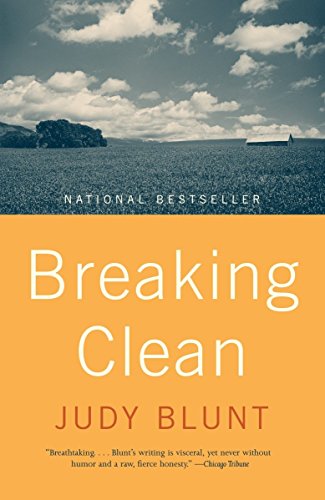
In this extraordinary literary debut third-generation homesteader Judy Blunt describes her hardscrabble life on the prairies of eastern Montana in prose as big and bold as the landscape.
On a ranch miles from nowhere, Judy Blunt grew up with cattle and snakes, outhouse and isolation, epic blizzards and devastating prairie fires. She also grew up with a set of rules and roles prescribed to her sex long before she was born, a chafing set of strictures she eventually had no choice but to flee, taking along three children and leaving behind a confused husband and the only life she’d ever known. Gritty, lyrical, unsentimental and wise, Breaking Clean is at once informed by the myths of the West and powerful enough to break them down.
Die Inhaltsangabe kann sich auf eine andere Ausgabe dieses Titels beziehen.
Über die Autorin bzw. den Autor
Judy Blunt spent more than thirty years on wheat and cattle ranches in northeastern Montana, before leaving in 1986 to attend the University of Montana. Her poems and essays have appeared in numerous journals and anthologies. She is the recipient of a Jacob K. Javits Graduate Fellowship and a Montana Arts Council Individual Artist Fellowship. Breaking Clean was awarded a 1997 PEN/Jerard Fund Award for a work in progress, as well as a 2001 Whiting Writers’ Award. She lives in Missoula, Montana.
Von der hinteren Coverseite
In this extraordinary literary debut third-generation homesteader Judy Blunt describes her hardscrabble life on the prairies of eastern Montana in prose as big and bold as the landscape.
On a ranch miles from nowhere, Judy Blunt grew up with cattle and snakes, outhouse and isolation, epic blizzards and devastating prairie fires. She also grew up with a set of rules and roles prescribed to her sex long before she was born, a chafing set of strictures she eventually had no choice but to flee, taking along three children and leaving behind a confused husband and the only life she'd ever known. Gritty, lyrical, unsentimental and wise, Breaking Clean is at once informed by the myths of the West and powerful enough to break them down.
Auszug. © Genehmigter Nachdruck. Alle Rechte vorbehalten.
I rarely go back to the ranch where I was born or to the neighboring land where I bore the fourth generation of a ranching family. My people live where hardpan and sagebrush flats give way to the Missouri River Breaks, a country so harsh and wild and distant that it must grow its own replacements, as it grows its own food, or it will die. Hereford cattle grow slick and mean foraging along the cutbanks for greasewood shoots and buffalo grass. Town lies an hour or more north over gumbo roads. Our town was Malta, population 2,500, county seat of Phillips County, Montana, and the largest settlement for nearly one hundred miles in any direction.
“Get tough,” my father snapped as I dragged my feet at the edge of a two-acre potato field. He gave me a gunnysack and started me down the rows pulling the tough fanweed that towered over the potato plants. I was learning then the necessary lessons of weeds and seeds and blisters. My favorite story as a child was of how I fainted in the garden when I was eight. My mother had to pry my fingers from around the handle of the hoe, she said, and she also said I was stupid not to wear a hat in the sun. But she was proud. My granddad hooted with glee when he heard about it.
“She’s a hell of a little worker,” he said, shaking his head. I was a hell of a little worker from that day forward, and I learned to wear a hat.
I am sometimes amazed at my own children, their outrage if they are required to do the dishes twice in one week, their tender self-absorption with minor bumps and bruises. As a mom, I’ve had to teach myself to croon over thorn scratches, admire bloody baby teeth and sponge the dirt from scraped shins. But in my mind, my mother’s voice and that of her mother still compete for expression. “Oh for Christ’s sake, you aren’t hurt!” they’re saying, and for a moment I struggle. For a moment I want to tell this new generation about my little brother calmly spitting out a palm full of tooth chips and wading back in to grab the biggest calf in the branding pen. I want to tell them how tough I was, falling asleep at the table with hands too sore to hold a fork, or about their grandmother, who cut off three fingers on the blades of a mower and finished the job before she came in to get help. For a moment I’m terrified I’ll slip and tell them to get tough.
Like my parents and grandparents, I was born and trained to live there. I could rope and ride and jockey a John Deere as well as my brothers, but being female, I also learned to bake bread and can vegetables and reserve my opinion when the men were talking. When a bachelor neighbor began courting me when I was fifteen, my parents were proud and hopeful. Though he was twelve years older than I was, his other numbers were very promising. He and his father ran five hundred cow-calf pairs and five hundred head of yearlings on 36,000 acres of range.
After supper one spring evening, my mother and I stood in the kitchen. She held her back stiff as her hands shot like pistons into the mound of bread dough on the counter. I stood tough beside her. On the porch, John had presented my father with a bottle of whiskey and was asking Dad’s permission to marry me. I wanted her to grab my cold hand and tell me how to run. I wanted her to smooth the crumpled letter from the garbage can and read the praise of my high school principal. I wanted her to tell me what I could be.
She rounded the bread neatly and efficiently and began smoothing lard over the top, intent on her fingers as they tidied the loaves.
“He’s a good man,” she said finally.
In the seventh grade, my daughter caught up with the culture shock and completed her transition from horse to bicycle, from boot-cut Levi’s to acid-washed jeans. She delighted me with her discoveries. Knowing little of slumber parties, roller skates or packs of giggling girls, sometimes I was more her peer than her parent. She wrote, too, long sentimental stories about lost puppies that found homes and loving two-parent families with adventurous daughters. Her characters were usually right back where they started, rescued and happy, by the end of the story. She’d begun watching television.
“Do you hate Daddy?” she asked once, from the depths of a divorced child’s sadness.
“Your daddy,” I replied, “is a good man.”
* * *
In the manner of good ranchmen, my father and John squatted on their haunches on the porch facing each other. The whiskey bottle rested on the floor between them. John’s good white shirt was buttoned painfully around his neck. Dad had pushed his Stetson back, and a white band of skin glowed above his dark face, smooth and strangely delicate. When I moved to the doorway, their conversation was shifting from weather and cattle to marriage. As Dad tilted back heavily on one heel to drink from the neck of the bottle, John looked down and began to plot our life with one finger in the dust on the floor.
“I been meaning to stop by . . . ,” John said to the toe of his boot. He looked up to catch Dad’s eye. Dad nodded and looked away.
“You figured a spot yet?” He spoke deliberately, weighing each word. Like all the big ranches out there, John’s place had been pieced together from old homesteads and small farms turned back to grass.
“Morgan place has good buildings,” John replied, holding Dad’s gaze for a moment. He shifted the bottle to his lips and passed it back to Dad.
“Fair grass on the north end, but the meadows need work,” Dad challenged. John shifted slightly to the left, glancing to the west through the screen door. The setting sun was balanced on the blue tips of the pines in the distance. He worked at the stiffness of his collar, leaving gray smudges of dust along his throat. Settling back, he spoke with a touch of defiance.
“If a person worked it right . . .” Then his eyes found his boots again. He held his head rigid, waiting.
Dad smoothed one hand along his jaw as if in deep thought, and the two men squatted silently for several minutes. Then Dad drew a long breath and blew it out.
“Old Morgan used to get three cuttings in a rain year,” he said at last. John’s head rose and he met my father’s steady look.
“A person might make a go of it,” John agreed softly. Dad’s shoulders lifted slightly and dropped in mock defeat. He placed a hand on each knee and pushed himself up, John rising beside him, and they shook hands, grinning. Twisting suddenly, Dad reached down and grabbed the whiskey. He held it high in a toast, then leaned forward and tapped John’s chest with the neck of the bottle.
“And you, you cocky sonofabitch! Don’t you try planting anything too early, understand?” They were still laughing when they entered the kitchen.
I talk to my father twice a year now, on Christmas and Father’s Day. We talk about the yearling weights and the rain, or the lack of rain. When I moved away from our community, my parents lost a daughter, but they will have John forever, as a neighbor, a friend. He is closer to them in spirit than I am in blood, and shares their bewilderment and anger at my rejection of their way of life. As the ultimate betrayal, I have taken John’s sons, interrupting the perfect rites of passage. The move was hardest on the boys, for here they were only boys. At the ranch they were men-in-training, and they mourned this loss of prestige.
“I used to drive tractor for my dad,” the elder son once told his friends, and they scoffed. “You’re only eleven years old,” they laughed,...
„Über diesen Titel“ kann sich auf eine andere Ausgabe dieses Titels beziehen.
Suchergebnisse für Breaking Clean

Beispielbild für diese ISBN
Breaking Clean
Anbieter: World of Books (was SecondSale), Montgomery, IL, USA
Verkäuferbewertung 5 von 5 Sternen

Paperback. Zustand: Good. In this extraordinary literary debut third-generation homesteader Judy Blunt describes her hardscrabble life on the prairies of eastern Montana in prose as big and bold as the landscape. On a ranch miles from nowhere, Judy Blunt grew up with cattle and snakes, outhouse and isolation, epic blizzards and devastating prairie fires. She also grew up with a set of rules and roles prescribed to her sex long before she was born, a chafing set of strictures she eventually had no choice but to flee, taking along three children and leaving behind a confused husband and the only life she d ever known. Gritty, lyrical, unsentimental and wise, Breaking Clean is at once informed by the myths of the West and powerful enough to break them down. Artikel-Nr. 00087657377
Gebraucht kaufen
EUR 3,90
Versand gratis
Versand innerhalb von USA
Versand innerhalb von USA
Anzahl: Mehr als 20 verfügbar
Beispielbild für diese ISBN
Breaking Clean
Anbieter: World of Books (was SecondSale), Montgomery, IL, USA
Verkäuferbewertung 5 von 5 Sternen
Paperback. Zustand: Fair. In this extraordinary literary debut third-generation homesteader Judy Blunt describes her hardscrabble life on the prairies of eastern Montana in prose as big and bold as the landscape. On a ranch miles from nowhere, Judy Blunt grew up with cattle and snakes, outhouse and isolation, epic blizzards and devastating prairie fires. She also grew up with a set of rules and roles prescribed to her sex long before she was born, a chafing set of strictures she eventually had no choice but to flee, taking along three children and leaving behind a confused husband and the only life she d ever known. Gritty, lyrical, unsentimental and wise, Breaking Clean is at once informed by the myths of the West and powerful enough to break them down. Artikel-Nr. 00089457426
Gebraucht kaufen
EUR 3,90
Versand gratis
Versand innerhalb von USA
Versand innerhalb von USA
Anzahl: 14 verfügbar
Beispielbild für diese ISBN
Breaking Clean
Verlag:
Knopf Doubleday Publishing Group (edition Reprint), 2003
ISBN 10: 0375701303
ISBN 13: 9780375701306
Gebraucht
Paperback
Anbieter: BooksRun, Philadelphia, PA, USA
Verkäuferbewertung 5 von 5 Sternen
Paperback. Zustand: Very Good. Reprint. It's a well-cared-for item that has seen limited use. The item may show minor signs of wear. All the text is legible, with all pages included. It may have slight markings and/or highlighting. Artikel-Nr. 0375701303-11-22
Gebraucht kaufen
EUR 4,76
Versand gratis
Versand innerhalb von USA
Versand innerhalb von USA
Anzahl: 1 verfügbar
Beispielbild für diese ISBN
Breaking Clean
Verlag:
Knopf Doubleday Publishing Group (edition Reprint), 2003
ISBN 10: 0375701303
ISBN 13: 9780375701306
Gebraucht
Paperback
Anbieter: BooksRun, Philadelphia, PA, USA
Verkäuferbewertung 5 von 5 Sternen
Paperback. Zustand: Fair. Reprint. The item might be beaten up but readable. May contain markings or highlighting, as well as stains, bent corners, or any other major defect, but the text is not obscured in any way. Artikel-Nr. 0375701303-7-1
Gebraucht kaufen
EUR 5,11
Versand gratis
Versand innerhalb von USA
Versand innerhalb von USA
Anzahl: 1 verfügbar
Beispielbild für diese ISBN
Breaking Clean
Verlag:
Knopf Doubleday Publishing Group, 2003
ISBN 10: 0375701303
ISBN 13: 9780375701306
Gebraucht
Softcover
Anbieter: Better World Books: West, Reno, NV, USA
Verkäuferbewertung 5 von 5 Sternen
Zustand: Good. Reprint. Former library copy. Pages intact with minimal writing/highlighting. The binding may be loose and creased. Dust jackets/supplements are not included. Includes library markings. Stock photo provided. Product includes identifying sticker. Better World Books: Buy Books. Do Good. Artikel-Nr. 3223976-75
Gebraucht kaufen
EUR 6,57
Versand gratis
Versand innerhalb von USA
Versand innerhalb von USA
Anzahl: 1 verfügbar
Beispielbild für diese ISBN
Breaking Clean
Verlag:
Knopf Doubleday Publishing Group, 2003
ISBN 10: 0375701303
ISBN 13: 9780375701306
Gebraucht
Softcover
Anbieter: Better World Books, Mishawaka, IN, USA
Verkäuferbewertung 5 von 5 Sternen
Zustand: Good. Reprint. Pages intact with minimal writing/highlighting. The binding may be loose and creased. Dust jackets/supplements are not included. Stock photo provided. Product includes identifying sticker. Better World Books: Buy Books. Do Good. Artikel-Nr. 3223975-6
Gebraucht kaufen
EUR 6,57
Versand gratis
Versand innerhalb von USA
Versand innerhalb von USA
Anzahl: 1 verfügbar
Beispielbild für diese ISBN
Breaking Clean
Verlag:
Vintage Books, New York, New York, U.S.A., 2003
ISBN 10: 0375701303
ISBN 13: 9780375701306
Gebraucht
Paperback
Anbieter: The Yard Sale Store, Narrowsburg, NY, USA
Verkäuferbewertung 5 von 5 Sternen
Paperback. Zustand: Good. A NICE edition, USEFUL! Light scuff to the paperback cover and the page edge, this book is in PRESENTABLE condition. Artikel-Nr. TPBkNov17VI135
Gebraucht kaufen
EUR 2,11
EUR 5,33 Versand
Versand innerhalb von USA
Versand innerhalb von USA
Anzahl: 1 verfügbar
Beispielbild für diese ISBN
Breaking Clean
Anbieter: Books End Bookshop, Syracuse, NY, USA
Verkäuferbewertung 4 von 5 Sternen

Trade Paperback. Zustand: Very Good. Corners bumped, pages toned fmc2%262D. Artikel-Nr. 1040736
Gebraucht kaufen
EUR 5,06
EUR 5,36 Versand
Versand innerhalb von USA
Versand innerhalb von USA
Anzahl: 1 verfügbar
Beispielbild für diese ISBN
Breaking Clean
Anbieter: Night Heron Books, Laramie, WY, USA
Verkäuferbewertung 5 von 5 Sternen
Paperback. Zustand: As New. 1st. . No writing, highlighting, or marks in text. Cover clean and in very good condition. Artikel-Nr. 748611
Gebraucht kaufen
EUR 7,36
EUR 3,79 Versand
Versand innerhalb von USA
Versand innerhalb von USA
Anzahl: 1 verfügbar