
Verwandte Artikel zu Building a Bridge to the 18th Century: How the Past...
Inhaltsangabe
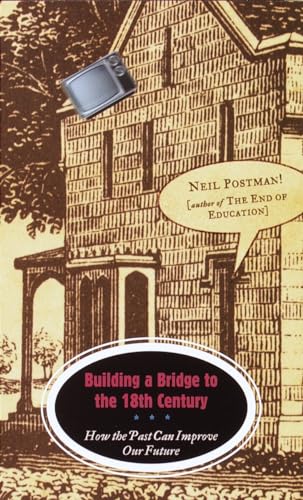
In Building a Bridge to the 18th Century, acclaimed cultural critic Neil Postman offers a cure for the hysteria and hazy values of the postmodern world.
Postman shows us how to reclaim that balance between mind and machine in a dazzling celebration of the accomplishments of the Enlightenment-from Jefferson's representative democracy to Locke's deductive reasoning to Rousseau's demand that the care and edification of children be considered an investment in our collective future. Here, too, is the bold assertion that Truth is invulnerable to fashion or the passing of time. Provocative and brilliantly argued, Building a Bridge to the 18th Century illuminates a navigable path through the Information Age-a byway whose signposts, it turns out, were there all along.
Die Inhaltsangabe kann sich auf eine andere Ausgabe dieses Titels beziehen.
Über die Autorin bzw. den Autor
Neil Postman lives in New York City.
Von der hinteren Coverseite
In Building a Bridge to the 18th Century, acclaimed cultural critic Neil Postman offers a cure for the hysteria and hazy values of the postmodern world.
Postman shows us how to reclaim that balance between mind and machine in a dazzling celebration of the accomplishments of the Enlightenment-from Jefferson's representative democracy to Locke's deductive reasoning to Rousseau's demand that the care and edification of children be considered an investment in our collective future. Here, too, is the bold assertion that Truth is invulnerable to fashion or the passing of time. Provocative and brilliantly argued, Building a Bridge to the 18th Century illuminates a navigable path through the Information Age-a byway whose signposts, it turns out, were there all along.
Auszug. © Genehmigter Nachdruck. Alle Rechte vorbehalten.
A Bridge to the 18th Century
The day before I began writing this book, I heard on the radio that somewhere between thirty-five percent and sixty-two percent of Americans believe that aliens have landed on Earth. Surveys vary about the exact percentages, as does the look of the aliens. Some are green, some gray. Some have ears, some do not. All have large heads. The report reminded me of a survey I saw some years ago about the number of people who believe in the Devil. Not the devil as metaphor and not a generalized concept of evil; the Devil, one might say, as a creature of flesh and blood, someone who walks the earth, looks like us, and is inclined to offer sly temptations and unholy propositions. Believers have in mind, I think, something on the order of Stephen Vincent Benét's creation in The Devil and Daniel Webster. I can't remember the percentages the survey uncovered, but they were high. I can't remember because I have repressed the figure or, as the psychologists now say, gone into denial. Conventional wisdom tells us that going into denial is not healthful, even though it is obvious that doing so has many advantages. Ernest Becker explains some of them in his famous book The Denial of Death. But one does not have to go as deeply as Becker to make good use of denial. If you are an American writer who fancies himself an heir of the Enlightenment, it is hard to write three pages unless you emphatically deny that many of your potential readers believe in deal-making devils.
Denial is also helpful when one begins to contemplate the mental condition of some important members of our intellectual elite. I refer to those who have fallen under the devilish spell of what is vaguely called "postmodernism," and in particular a subdivision of it sometimes called "deconstructionism." Academic responsibility requires me to give some detail about this world-view, and I will do so in a later chapter. Here, I need only remark that in this way of understanding things, language is under deep suspicion and is even thought to be delusional. Jean Baudrillard, a Frenchman, of all things, tells us that not only does language falsely represent reality, but there is no reality to represent. (Perhaps this explains, at long last, the indifferent French resistance to the German invasion of their country in World War II: They didn't believe it was real.) In an earlier time, the idea that language is incapable of mapping reality would have been considered nonsense, if not a form of mental illness. In fact, it is a form of mental illness. Nonetheless, in our own time the idea has become an organizing principle of prestigious academic departments. You can get a Ph.D. in this sort of thing.
There is, of course, a connection between alien- and devil-believers and a certain variety of deconstructionists. They are people in the thrall of a serious depression, and, in truth, it is unseemly to make fun of them, especially since most of us are suffering in varying degrees from the same malady. If I knew more about psychology, I might be able to give the sickness a name. Instead, I turn to poets -- not for a name but for a confirmation and a cause. Yeats, for example, gives us a precise description of our wayward academics and our overcommitted alienites: The former lack all conviction, while the latter are full of passionate intensity. T. S. Eliot, you will remember, wrote of the hollow men occupying a wasteland. Auden wrote of the age of anxiety. Vachel Lindsay wrote of leaden-eyed people who have no gods to serve. Edna St. Vincent Millay, in her book Huntsman, What Quarry?, wrote a poem which goes to the root of the problem. Here is an excerpt:
Upon this gifted age, in its dark hour,
Rains from the sky a meteoric shower
Of facts . . . they lie unquestioned, uncombined.
Wisdom enough to leech us of our ill
Is daily spun; but there exists no loom
To weave it into fabric.
No loom to weave facts into fabric, people with no gods to serve, hollow and anxious, distrusting language, uncertain about even the most obvious features of reality, lacking conviction, suspicious of truth.
What are we to make of this? There are many possibilities. Among them are the strange and fanciful dreams that seem always to accompany the onset of a new millennium. Some believe a new age signals the Second Coming of Christ, some believe it signals the end of everything, and in between the varieties of delusion are legion. The possibility that strikes me as most plausible is more mundane. And it has happened before, with or without the coming of a new millennium. I refer to the confusion that accompanies the absence of a narrative to give organization and meaning to our world -- a story of transcendence and mythic power. Nothing can be clearer than that we require a story to explain to ourselves why we are here and what our future is to be, and many other things, including where authority resides. I am not writing this book to document the loss of narrative. I have done that already, as have others in books better than mine. Besides, I have no intention of writing still another depressing book about the breakdown of the human spirit. But it may be said here that when people do not have a satisfactory narrative to generate a sense of purpose and continuity, a kind of psychic disorientation takes hold, followed by a frantic search for something to believe in or, probably worse, a resigned conclusion that there is nothing to find. The devil-believers reclaim a fragment of the great narrative of Genesis. The alien-believers ask for deliverance from green-gray creatures whose physics has overcome the speed of light. The deconstructionists keep confusion at bay by writing books in which they tell us that there is nothing to write books about. There is even one group who seeks meaning in the ingenuity of technological innovation. I refer to those who, looking ahead, see a field of wonders encapsulated in the phrase "the information superhighway." They are information junkies, have no interest in narratives of the past, give little thought to the question of purpose. To the poet who asks, "Where is the loom to weave it all into fabric?," they reply that none is needed. To the poet who asks, "What gods do you serve?," they reply, "Those which make information accessible in great volume, at instantaneous speed, and in diverse forms." Such people have no hesitation in speaking of building a bridge to the new century. But to the question "What will we carry across the bridge?" they answer, "What else but high-definition TV, virtual reality, e-mail, the Internet, cellular phones, and all the rest that digital technology has produced?"
These, then, are the hollow men Eliot spoke of. They are, in a sense, no different from the alien- and devil-believers in that they have found a story that will keep them going for a while, but not for long. And, in a way, they are no different from those academics who find temporary amusement and professional advancement in having no story at all. I am not writing my book for these people. I write for those who are still searching for a way to confront the future, a way that faces reality as it is, that is connected to a humane tradition, that provides sane authority and meaningful purpose. I include myself among such people.
Where shall we look for such a way? Well, of course, one turns first to the wisdom of the sages, both near and far. Marcus Aurelius said, "At every action, no matter by whom preferred, make it a practice to ask yourself, 'What is his object in doing this?' But begin with yourself; put this question to yourself first of all." Goethe told us, "One should, each day, try to hear a little song, read a good poem, see a fine picture, and, if possible, speak a few reasonable...
„Über diesen Titel“ kann sich auf eine andere Ausgabe dieses Titels beziehen.
Suchergebnisse für Building a Bridge to the 18th Century: How the Past...

Beispielbild für diese ISBN
Building a Bridge to the 18th Century: How the Past Can Improve Our Future
Anbieter: ThriftBooks-Dallas, Dallas, TX, USA
Verkäuferbewertung 5 von 5 Sternen

Paperback. Zustand: Good. No Jacket. Pages can have notes/highlighting. Spine may show signs of wear. ~ ThriftBooks: Read More, Spend Less. Artikel-Nr. G0375701273I3N00
Gebraucht kaufen
EUR 6,13
Versand gratis
Versand innerhalb von USA
Versand innerhalb von USA
Anzahl: 2 verfügbar
Beispielbild für diese ISBN
Building a Bridge to the 18th Century: How the Past Can Improve Our Future
Anbieter: ThriftBooks-Phoenix, Phoenix, AZ, USA
Verkäuferbewertung 5 von 5 Sternen
Paperback. Zustand: Good. No Jacket. Pages can have notes/highlighting. Spine may show signs of wear. ~ ThriftBooks: Read More, Spend Less. Artikel-Nr. G0375701273I3N00
Gebraucht kaufen
EUR 6,13
Versand gratis
Versand innerhalb von USA
Versand innerhalb von USA
Anzahl: 1 verfügbar
Beispielbild für diese ISBN
Building a Bridge to the 18th Century: How the Past Can Improve Our Future
Anbieter: ThriftBooks-Reno, Reno, NV, USA
Verkäuferbewertung 5 von 5 Sternen
Paperback. Zustand: Good. No Jacket. Pages can have notes/highlighting. Spine may show signs of wear. ~ ThriftBooks: Read More, Spend Less. Artikel-Nr. G0375701273I3N00
Gebraucht kaufen
EUR 6,13
Versand gratis
Versand innerhalb von USA
Versand innerhalb von USA
Anzahl: 2 verfügbar
Beispielbild für diese ISBN
Building a Bridge to the 18th Century: How the Past Can Improve Our Future
Anbieter: ThriftBooks-Reno, Reno, NV, USA
Verkäuferbewertung 5 von 5 Sternen
Paperback. Zustand: Fair. No Jacket. Readable copy. Pages may have considerable notes/highlighting. ~ ThriftBooks: Read More, Spend Less. Artikel-Nr. G0375701273I5N00
Gebraucht kaufen
EUR 6,13
Versand gratis
Versand innerhalb von USA
Versand innerhalb von USA
Anzahl: 1 verfügbar
Beispielbild für diese ISBN
Building a Bridge to the 18th Century: How the Past Can Improve Our Future
Anbieter: ThriftBooks-Atlanta, AUSTELL, GA, USA
Verkäuferbewertung 5 von 5 Sternen
Paperback. Zustand: Good. No Jacket. Pages can have notes/highlighting. Spine may show signs of wear. ~ ThriftBooks: Read More, Spend Less. Artikel-Nr. G0375701273I3N00
Gebraucht kaufen
EUR 6,13
Versand gratis
Versand innerhalb von USA
Versand innerhalb von USA
Anzahl: 2 verfügbar
Beispielbild für diese ISBN
Building a Bridge to the 18th Century: How the Past Can Improve Our Future
Anbieter: ThriftBooks-Reno, Reno, NV, USA
Verkäuferbewertung 5 von 5 Sternen
Paperback. Zustand: Very Good. No Jacket. May have limited writing in cover pages. Pages are unmarked. ~ ThriftBooks: Read More, Spend Less. Artikel-Nr. G0375701273I4N00
Gebraucht kaufen
EUR 6,13
Versand gratis
Versand innerhalb von USA
Versand innerhalb von USA
Anzahl: 1 verfügbar
Beispielbild für diese ISBN
Building a Bridge to the 18th Century: How the Past Can Improve Our Future
Anbieter: ThriftBooks-Phoenix, Phoenix, AZ, USA
Verkäuferbewertung 5 von 5 Sternen
Paperback. Zustand: Fair. No Jacket. Readable copy. Pages may have considerable notes/highlighting. ~ ThriftBooks: Read More, Spend Less. Artikel-Nr. G0375701273I5N00
Gebraucht kaufen
EUR 6,13
Versand gratis
Versand innerhalb von USA
Versand innerhalb von USA
Anzahl: 1 verfügbar
Beispielbild für diese ISBN
Building a Bridge to the 18th Century: How the Past Can Improve Our Future
Anbieter: ThriftBooks-Atlanta, AUSTELL, GA, USA
Verkäuferbewertung 5 von 5 Sternen
Paperback. Zustand: Fair. No Jacket. Readable copy. Pages may have considerable notes/highlighting. ~ ThriftBooks: Read More, Spend Less. Artikel-Nr. G0375701273I5N00
Gebraucht kaufen
EUR 6,14
Versand gratis
Versand innerhalb von USA
Versand innerhalb von USA
Anzahl: 1 verfügbar
Beispielbild für diese ISBN
Building a Bridge to the 18th Century: How the Past Can Improve Our Future
Anbieter: ThriftBooks-Dallas, Dallas, TX, USA
Verkäuferbewertung 5 von 5 Sternen
Paperback. Zustand: Good. No Jacket. Former library book; Pages can have notes/highlighting. Spine may show signs of wear. ~ ThriftBooks: Read More, Spend Less. Artikel-Nr. G0375701273I3N10
Gebraucht kaufen
EUR 6,14
Versand gratis
Versand innerhalb von USA
Versand innerhalb von USA
Anzahl: 1 verfügbar
Beispielbild für diese ISBN
Building a Bridge to the 18th Century: How the Past Can Improve Our Future
Anbieter: ThriftBooks-Dallas, Dallas, TX, USA
Verkäuferbewertung 5 von 5 Sternen
Paperback. Zustand: Good. No Jacket. Missing dust jacket; Pages can have notes/highlighting. Spine may show signs of wear. ~ ThriftBooks: Read More, Spend Less. Artikel-Nr. G0375701273I3N01
Gebraucht kaufen
EUR 6,14
Versand gratis
Versand innerhalb von USA
Versand innerhalb von USA
Anzahl: 1 verfügbar