
Verwandte Artikel zu The Fly Swatter: Portrait of an Exceptional Character
Inhaltsangabe
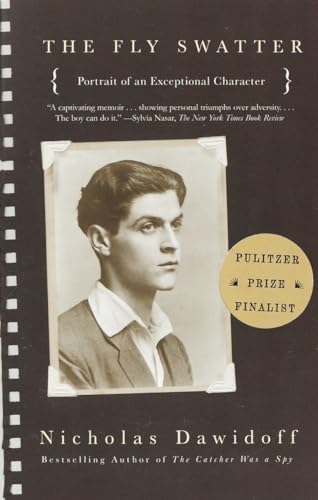
In The Fly Swatter, Nicholas Dawidoff--bestselling author of The Catcher Was a Spy--vividly reconstructs the life of his grandfather, Alexander Gerschenkron-the Harvard professor who knew the most.
A fascinating character, Gerschenkron feuded with Vladimir Nabokov and John Kenneth Galbraith, flirted with Marlene Dietrich, and played chess with Marcel Duchamp and one-upped both Isiah Berlin and (allegedly) Ted Williams. At Harvard, this celebrated polyglot was known as “The Great Gerschenkron.” He was an influential economic theorist who knew twenty languages and so much about so many other things that he was offered chairs in three departments. All this after beginning life with traumatic dramatic escapes from the Bolsheviks (in 1920) and the Nazis (in 1938). Riveting and eloquent, The Fly Swatter's most unusual accomplishment is that it succeeds in telling the extraordinary story of a man's soul.
Die Inhaltsangabe kann sich auf eine andere Ausgabe dieses Titels beziehen.
Über die Autorin bzw. den Autor
Nicholas Dawidoff is the author of The Catcher was a Spy: The Mysterious Life of Moe Berg and In the Country of Country: A Journey to the Roots of American Music, and is the editor of the Library of America’s Baseball: A Literary Anthology. He is also a contributor to The New Yorker, The American Scholar, and The New York Times Magazine. A graduate of Harvard University, he has been a Guggenheim Fellow and a Berlin Prize Fellow of the American Academy. He and his wife live in New York.
Von der hinteren Coverseite
In The Fly Swatter, Nicholas Dawidoff--bestselling author of The Catcher Was a Spy--vividly reconstructs the life of his grandfather, Alexander Gerschenkron-the Harvard professor who knew the most.
A fascinating character, Gerschenkron feuded with Vladimir Nabokov and John Kenneth Galbraith, flirted with Marlene Dietrich, and played chess with Marcel Duchamp and one-upped both Isiah Berlin and (allegedly) Ted Williams. At Harvard, this celebrated polyglot was known as "The Great Gerschenkron." He was an influential economic theorist who knew twenty languages and so much about so many other things that he was offered chairs in three departments. All this after beginning life with traumatic dramatic escapes from the Bolsheviks (in 1920) and the Nazis (in 1938). Riveting and eloquent, The Fly Swatter's most unusual accomplishment is that it succeeds in telling the extraordinary story of a man's soul.
Auszug. © Genehmigter Nachdruck. Alle Rechte vorbehalten.
ONE
Showing Off in Odessa
They talk in Western Europe of our duplicity and wily cunning; they mistake the desire to show off and swagger a bit for the desire to deceive. --Alexander Herzen, Memoirs
The Russia Alexander Gerschenkron was born into in 1904 was a vast and varied country of people who had been so frequently abused by tyrants that out of all the misery came a commonality of spirit shared even by Europeanized Russians like the Gerschenkrons. It was with enormous pride that all his life Alexander, known to his family by the nickname Shura (pronounced Shoo-rah, with the r rolled soft), referred to himself as “typically Russian.” Typically Russian behavior was a matter of both style and attitude, a rough-hewn, zestfully counterintuitive approach to living that was evident in many aspects of comportment, from the wordless sounds only Russians made to express their appreciation for something—such as a just-downed glass of vodka—to the uniquely Russian shudder that came over people experiencing strong emotion. It was typically Russian to sleep in stuffy rooms with the windows closed, to enjoy breathing in the air on dusty roads, to insist there was no finer music than the murmur of the samovar, to have political arguments in which you were quietly modifying your position all the time while loudly refusing to concede anything, and typically Russian to look at the schoolboy warning you to rub snow on your nose because it was nearly blue with frostbite and inform him that you preferred it that way. After you had sent the schoolboy packing, it was also typically Russian to think you had spited your nose for the good of a not-yet-typical child.
At its essence, to be typically Russian was to be “more so.” Though Russians, for instance, were not always energetic—were, in fact, famed for their abilities as sleepers—in his fleeting moments of vigor a typical Russian was more vigorous than anybody. In this way, Russians were “more so” about everything. As a Russian saw it, a Frenchman might be ardent when it came to France—or a Frenchwoman—but he never truly lost his head about anything except a Frenchwoman. (Usually it was someone else’s Frenchwoman.) Germans were even worse. They were so rigidly organized that they never lost their heads at all. Russians, however, believed in losing their heads and aspired to do so. Russians made outrageous claims, traveled to absurd lengths, pushed the limit, and exceeded expectations. Always they wanted to be more loyal, more devoted, more steadfast, more stoic, and—when circumstances called for it—more long-suffering. That was a lot to live up to, and to meet the perpetual challenge typical Russians spent spectacular amounts of time lying around dreaming up magnificent feats for themselves to accomplish. In other words, it was a nation of show-offs.
In Shura’s view, this behavior was rooted in the populist intelligentsia’s long-standing tradition of appropriating and preserving rural values. Russia was slow to industrialize, and into the early twentieth century many social mores still came from the provinces—from the peasantry. Even townspeople like the Gerschenkrons were familiar with tales of peasant heroics: the heavy sacks of grain this mujik had hoisted; the broad fields of ripe wheat that one had cut to the ground by himself in a single day with his scythe. Many of these stories featured men who had allowed so much work to accumulate that everyone said this time, truly, it was just impossible: no man could finish such a job in such a limited time. Whereupon the peasant went out and completed the task in a remarkable lather of activity. Sometimes these frenzied finishes were pyrrhic victories. Among other things, they led to an epidemic of Russian hernias.
Nobody but the afflicted worried too much about that. Far from earning any kind of censure, the reckless approach was prized in Russia, and peasants who betrayed too disciplined an attitude toward their work were scorned as “acting German.” Even in Soviet times, factory workers were notorious for lazing about until the end of a planning period and then compensating with the shturmovshchina—a storm of activity. As a city boy Shura was not obligated to do any physical labor, and he readily admitted that his own heroic displays were “not functional.” Still, he said of his youth that “you were called upon at all times to surprise the world by unusual achievements,” and added that “it was natural to indulge in it, since it was all around us.” That is to say, Alexander Gerschenkron was a moral and a dignified person, but he did not despise a show-off. Indeed, he was one himself.
The years of Shura’s youth were spent in the Black Sea port city of Odessa. Every August the nearby coast became crowded with men unloading boatloads of watermelons freshly harvested from the Ukrainian steppe. Shura never really thought about this until the winter of 1918, when he was fourteen and happened to read a book which described how difficult it was to be a mover of watermelons. Not only were the smallish fruits heavier than they appeared, but they were slick against a man’s hand and had an oblong shape that the book said made them cumbersome even for veteran stevedores. Shura decided that when the late summer came he would show those watermelons.
Early in August, he walked down to the water and came upon an energetic scene. Moored in the shallow surf were a number of skiffs piled high with Russian melons of the darkest green. Parked above the beach on the shore road were an equal number of fruit wagons. Between the boats and the wagons stood the watermelon movers. They worked bucket-brigade style in groups of five, tossing the melons up the line to the drayman, who settled them into his wagon. Noticing a team that had only four men, Shura stepped forward, offered his services to the foreman, and was waved into formation.
The watermelons turned out to be as unwieldy as advertised, and in no time Shura had allowed two of them to slip through his grasp and smash at his feet. Immediately he was set upon by the foreman, who marinated him in a thick stream of invective that concluded, “You drop another one and you are out, but before you go, I’ll mend that dirty running nose of yours.” In a rage Shura directed a series of murderous threats of his own back at the foreman, concluding with a guarantee of “utter destruction.” Then he bent his back. He didn’t drop another melon all morning.
At lunchtime he was not required to make good on his vows of mayhem; instead he was given his first short snort of vodka and was otherwise treated with great affection by his new colleagues, including the foreman, who, after inquiring if Shura would like some help changing his diapers, quivered with laughter and announced that he was not such a bad kid after all. Then the foreman proceeded to teach him what Shura remembered as a dazzling multitude of unsurpassable blasphemies. More melons were fumbled that afternoon, but not by Shura, who received his pay and hurried home to fulfill his real purpose in the whole enterprise—telling everyone in the family all about it.
All the Gerschenkrons enjoyed the tales of little Shura leaping across broad ditches or charging through rushing currents yelling “Dvum smertiam nye by vat, I odnoi nye mino vat” (Two deaths cannot happen to one person and one death cannot be avoided). From the time he was four, his parents had him standing up on chairs in front of the company, reciting little poems he’d memorized. As he grew older much of the inspiration for his “achievements” came from the conventional...
„Über diesen Titel“ kann sich auf eine andere Ausgabe dieses Titels beziehen.
Suchergebnisse für The Fly Swatter: Portrait of an Exceptional Character

Beispielbild für diese ISBN
The Fly Swatter: Portrait of an Exceptional Character
Verlag:
Knopf Doubleday Publishing Group (edition Reprint), 2003
ISBN 10: 0375700064
ISBN 13: 9780375700064
Gebraucht
Paperback
Anbieter: BooksRun, Philadelphia, PA, USA
Verkäuferbewertung 5 von 5 Sternen

Paperback. Zustand: Very Good. Reprint. It's a well-cared-for item that has seen limited use. The item may show minor signs of wear. All the text is legible, with all pages included. It may have slight markings and/or highlighting. Artikel-Nr. 0375700064-8-22
Gebraucht kaufen
EUR 5,02
Versand gratis
Versand innerhalb von USA
Versand innerhalb von USA
Anzahl: 1 verfügbar
Beispielbild für diese ISBN
The Fly Swatter: Portrait of an Exceptional Character
Verlag:
Knopf Doubleday Publishing Group, 2003
ISBN 10: 0375700064
ISBN 13: 9780375700064
Gebraucht
Paperback
Anbieter: ThriftBooks-Dallas, Dallas, TX, USA
Verkäuferbewertung 5 von 5 Sternen
Paperback. Zustand: Fair. No Jacket. Readable copy. Pages may have considerable notes/highlighting. ~ ThriftBooks: Read More, Spend Less. Artikel-Nr. G0375700064I5N00
Gebraucht kaufen
EUR 5,94
Versand gratis
Versand innerhalb von USA
Versand innerhalb von USA
Anzahl: 1 verfügbar
Beispielbild für diese ISBN
The Fly Swatter: Portrait of an Exceptional Character
Verlag:
Knopf Doubleday Publishing Group, 2003
ISBN 10: 0375700064
ISBN 13: 9780375700064
Gebraucht
Paperback
Anbieter: ThriftBooks-Atlanta, AUSTELL, GA, USA
Verkäuferbewertung 5 von 5 Sternen
Paperback. Zustand: Very Good. No Jacket. May have limited writing in cover pages. Pages are unmarked. ~ ThriftBooks: Read More, Spend Less. Artikel-Nr. G0375700064I4N00
Gebraucht kaufen
EUR 5,94
Versand gratis
Versand innerhalb von USA
Versand innerhalb von USA
Anzahl: 1 verfügbar
Beispielbild für diese ISBN
The Fly Swatter: Portrait of an Exceptional Character
Verlag:
Knopf Doubleday Publishing Group, 2003
ISBN 10: 0375700064
ISBN 13: 9780375700064
Gebraucht
Paperback
Anbieter: ThriftBooks-Atlanta, AUSTELL, GA, USA
Verkäuferbewertung 5 von 5 Sternen
Paperback. Zustand: Fair. No Jacket. Readable copy. Pages may have considerable notes/highlighting. ~ ThriftBooks: Read More, Spend Less. Artikel-Nr. G0375700064I5N00
Gebraucht kaufen
EUR 5,94
Versand gratis
Versand innerhalb von USA
Versand innerhalb von USA
Anzahl: 1 verfügbar
Beispielbild für diese ISBN
The Fly Swatter: Portrait of an Exceptional Character
Verlag:
Knopf Doubleday Publishing Group, 2003
ISBN 10: 0375700064
ISBN 13: 9780375700064
Gebraucht
Paperback
Anbieter: ThriftBooks-Dallas, Dallas, TX, USA
Verkäuferbewertung 5 von 5 Sternen
Paperback. Zustand: Very Good. No Jacket. May have limited writing in cover pages. Pages are unmarked. ~ ThriftBooks: Read More, Spend Less. Artikel-Nr. G0375700064I4N00
Gebraucht kaufen
EUR 5,94
Versand gratis
Versand innerhalb von USA
Versand innerhalb von USA
Anzahl: 1 verfügbar
Beispielbild für diese ISBN
The Fly Swatter: Portrait of an Exceptional Character
Verlag:
Knopf Doubleday Publishing Group, 2003
ISBN 10: 0375700064
ISBN 13: 9780375700064
Gebraucht
Paperback
Anbieter: ThriftBooks-Atlanta, AUSTELL, GA, USA
Verkäuferbewertung 5 von 5 Sternen
Paperback. Zustand: Very Good. No Jacket. Former library book; May have limited writing in cover pages. Pages are unmarked. ~ ThriftBooks: Read More, Spend Less. Artikel-Nr. G0375700064I4N10
Gebraucht kaufen
EUR 5,94
Versand gratis
Versand innerhalb von USA
Versand innerhalb von USA
Anzahl: 1 verfügbar
Beispielbild für diese ISBN
The Fly Swatter: Portrait of an Exceptional Character
Verlag:
Knopf Doubleday Publishing Group, 2003
ISBN 10: 0375700064
ISBN 13: 9780375700064
Gebraucht
Paperback
Anbieter: ThriftBooks-Reno, Reno, NV, USA
Verkäuferbewertung 5 von 5 Sternen
Paperback. Zustand: Very Good. No Jacket. May have limited writing in cover pages. Pages are unmarked. ~ ThriftBooks: Read More, Spend Less. Artikel-Nr. G0375700064I4N00
Gebraucht kaufen
EUR 5,94
Versand gratis
Versand innerhalb von USA
Versand innerhalb von USA
Anzahl: 1 verfügbar
Beispielbild für diese ISBN
The Fly Swatter: Portrait of an Exceptional Character
Verlag:
Knopf Doubleday Publishing Group, 2003
ISBN 10: 0375700064
ISBN 13: 9780375700064
Gebraucht
Paperback
Anbieter: ThriftBooks-Dallas, Dallas, TX, USA
Verkäuferbewertung 5 von 5 Sternen
Paperback. Zustand: Good. No Jacket. Former library book; Pages can have notes/highlighting. Spine may show signs of wear. ~ ThriftBooks: Read More, Spend Less. Artikel-Nr. G0375700064I3N10
Gebraucht kaufen
EUR 5,94
Versand gratis
Versand innerhalb von USA
Versand innerhalb von USA
Anzahl: 1 verfügbar
Beispielbild für diese ISBN
The Fly Swatter : Portrait of an Exceptional Character
Verlag:
Knopf Doubleday Publishing Group, 2003
ISBN 10: 0375700064
ISBN 13: 9780375700064
Gebraucht
Softcover
Anbieter: Better World Books, Mishawaka, IN, USA
Verkäuferbewertung 5 von 5 Sternen
Zustand: Very Good. Reprint. Former library copy. Pages intact with possible writing/highlighting. Binding strong with minor wear. Dust jackets/supplements may not be included. Includes library markings. Stock photo provided. Product includes identifying sticker. Better World Books: Buy Books. Do Good. Artikel-Nr. 9680438-6
Gebraucht kaufen
EUR 6,17
Versand gratis
Versand innerhalb von USA
Versand innerhalb von USA
Anzahl: 1 verfügbar
Beispielbild für diese ISBN
The Fly Swatter : Portrait of an Exceptional Character
Verlag:
Knopf Doubleday Publishing Group, 2003
ISBN 10: 0375700064
ISBN 13: 9780375700064
Gebraucht
Softcover
Anbieter: Better World Books, Mishawaka, IN, USA
Verkäuferbewertung 5 von 5 Sternen
Zustand: Very Good. Reprint. Pages intact with possible writing/highlighting. Binding strong with minor wear. Dust jackets/supplements may not be included. Stock photo provided. Product includes identifying sticker. Better World Books: Buy Books. Do Good. Artikel-Nr. 13979688-6
Gebraucht kaufen
EUR 6,17
Versand gratis
Versand innerhalb von USA
Versand innerhalb von USA
Anzahl: 1 verfügbar