
Verwandte Artikel zu Why America Slept: The Failure to Prevent 9/11
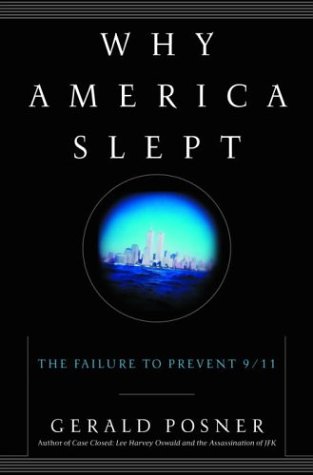
Inhaltsangabe
Examines the terrorist attacks of September 11th and why the disaster was not prevented, discussing how breakdowns in intelligence and political infighting allowed terrorists to carry out an unprecedented attack on American soil.
Die Inhaltsangabe kann sich auf eine andere Ausgabe dieses Titels beziehen.
Über die Autorin bzw. den Autor
Gerald Posner, a former Wall Street lawyer, is an award-winning author of eight books on subjects ranging from Nazi war criminals, to assassinations, to the careers of politicians. A regular panelist on the History Channel’s HistoryCENTER, he has also written for many national publications, including <i>The New York Times, The New Yorker, Time, Newsweek, The Wall Street Journal,</i> and <i>U.S. News & World Report.</i> He lives in Miami and New York City with his wife, the author Trisha Posner. More information is available at www.posner.com.
Aus dem Klappentext
The story of the years leading up to 9/11 is the story of what might have been, and also serves as a call to the defense of America’s future. Since 9/11, one important question has persisted: What was really going on behind the scenes with intelligence services and government leaders during the time preceding the World Trade Center and Pentagon attacks? <br><br>After an eighteen-month investigation that uncovered explosive new evidence through interviews and in classified documents, Gerald Posner reveals much previously undisclosed information:<br><br>• the identity of two countries that might have had foreknowledge that a terrorist attack was scheduled for September 11 on U.S. soil<br>• a startling account of the interrogation of a leading al Qaeda captive<br>• facts about a series of deaths that point to an ongoing conspiracy by some governments to hide the extent of their earlier relationships with al Qaeda<br>• how the U.S. government missed several chances to kill or capture bin Laden<br>• evidence that German intelligence may have protected an informant who was involved with many of the 9/11 plotters<br>• how the CIA tracked―and then lost―two of the hijackers when they entered the United States more than twenty months before the attacks<br>• the devastating consequences of the crippling rivalry between the CIA and FBI as the United States moved unwittingly toward 9/11 <br><br>In a dramatic narrative, <b>Why America Slept</b> exposes the frequent mistakes made by law enforcement and government agencies, and demonstrates how the failures to prevent 9/11 were tragically not an exception but typical. Along the way, by delving into terror financing, the links between far-flung terror organizations, and how the United States responded over the years to other attacks, Posner also makes a damning case that 9/11 could have been prevented.<br><br><b>Why America Slept </b>lays to rest two years of conjecture about what led up to the worst terror attacks in America’s history. This breakthrough book presents an infuriating review of how incompetence and misplaced priorities made America an easy target for terrorists.
Auszug. © Genehmigter Nachdruck. Alle Rechte vorbehalten.
CHAPTER 1
THE TAKEOVER
A decade before 9/11, the worldwide surge in Islamic fundamentalism and its virulent hatred of the West was largely unrecognized in America. We did not notice when some of the most prominent radicals moved to this country and set up operations just across the river from the World Trade Center. Those early militants, ignored in their new chosen homeland, would become the role models and inspiration for some of the World Trade Center and Pentagon hijackers in 2001.
Brooklyn's Atlantic Avenue is only thirty minutes away by the Number 4 train from the World Trade Center. Before September 11, a nearby waterfront promenade offered postcard views of the twin towers. But these two New York neighborhoods might as well be different countries. The sterile and overbuilt financial center on the tip of Manhattan that was rendered into a giant open-air cemetery covered by tons of twisted debris is quintessentially American. The mile stretch of Brooklyn seems a much closer cousin to downtown Cairo than Wall Street. It is a neighborhood overcrowded with the city's densest concentration of Arabs.
If someone just arrived from Lebanon or Syria, they might feel at home along those gritty and packed streets. Many Muslims, in traditional robe and turban, crowd near the Islamic community centers and bookshops, Middle Eastern restaurants, grocery stores and bakeries, smoke shops, translation services, and hairdressers. Some men gather in small groups at outdoor cafés, sipping minted tea and smoking from bubbling hookahs, large, standing water pipes filled with fruit- and herb-infused tobacco. Women in layered skirts and head-covering scarves, babies in tow, walk several paces behind the men. Quavering Arab music blares from several record stores. On Fridays, the Muslim day of prayer, when the mosques fill, overflow crowds by the hundreds throw down small prayer rugs on the sidewalk and prostrate themselves toward Mecca.
The mosques range from lavish Ottoman-style buildings to basements of car service garages. But the best known house of worship is Masjid al-Farooq, located on several floors of a run-down commercial building. The second-floor sanctuary is bathed in a soft light, tinted green from jade-colored walls and worn purple-and-emerald-colored carpet. Worshipers line up shoulder to shoulder, creating human stripes across the carpet, all facing Mecca and praying. Incense sticks resting in cracks in the plaster walls fill the room with a sweet smell. Racks along the back wall hold a collection of workingmen's shoes: Nike sneakers, paint-spattered construction boots, worn-out wing tips, scuffed thick-soled shoes of civil servants. Among the crowd of émigrés are African-Americans, young men with knitted skullcaps or baseball caps turned backward.
The imam, the mosque's prayer leader, stands in a simple brown robe behind a plain wooden lectern, reading verses from the Koran. Many of the faithful-men in their twenties from Yemen, Egypt, Jordan, and the West Bank-gather in the hallway after the service. They trade information about jobs at cab companies and at construction sites, and pass along tips on cheap rooms for rent and religious activities for Arabic-speaking newcomers. Some discuss the attack on the World Trade Center three days ago, but when they see a stranger approach, they revert to Arabic.*
This Arab mecca in the heart of New York is not a recent phenomenon. The migration had started in the early 1900s as Arabs fled persecution in the Ottoman Empire. Some set up shop not far from their stop at Ellis Island-on Manhattan's Washington Street and Brooklyn's Atlantic Avenue. In the 1930s, and again after World War II, there were waves of new immigrants. Manhattan's high prices drove most newcomers to Brooklyn. "This area is known as an Arab enclave throughout the world," boasts Sam Moustapha, a co-owner of the family-run Oriental Pastry and Grocery Company.
It is a neighborhood where Arabs are not timid about embracing political sentiments that often seem continents removed from nearby Manhattan. Many of the local businesses have long displayed prominent anti-Israeli, pro-intifada signs and banners. Even in the immediate wake of 9/11, a flyer posted outside al-Qaraween's Islamic bookstore, next to a mosque, declared, "Allah is great-may justice come to the infidels." At the nearby Fertile Crescent, a Middle Eastern market, pictures of Israeli prime minister Ariel Sharon were stamped over with the crosshairs of a sniper's rifle scope.
A small convenience store had a half dozen posters plastered on the wall behind the counter. They were grainy black-and-white blowups of young men, all holding weapons, wearing kaffiyehs wrapped around their heads and covering their faces like Bedouins in a sandstorm. All that was visible were the intense stares of angry young Arab militants that Americans have now come to know too well. Arabic writing was scrawled on the posters. They were tributes to suicide bombers. Each of the men on the wall had blown himself apart in a terror attack against Israel. When asked about the posters and why they were on display, only miles from where thousands of Americans and foreigners lay dead from a suicide mission, the clerk pretended he did not speak English. More questions were answered only with grunts and dismissive waves.
Further down the block, at the sixty-five-year-old Damascus Bread and Pastry, Arab men have been eating and arguing politics for decades. The showcases are packed with displays of sticky dates, nut-filled pastries, and an amazing assortment of pita bread, some of which is put to good use right outside by a falafel vendor. Inside the tiny room, dense with thick and heady smoke from hours of chain-smoking, Egyptians, Syrians, Jordanians, and Lebanese sit, packed elbow to elbow, discussing the terror attacks. Many have lived through years of crises, including four Arab-Israeli wars, the arrests of local Hamas bomb makers, the nearby murder ten years earlier of radical Jewish activist Rabbi Meir Kahane, the Gulf War, and the now legendary neighborhood tales of the first World Trade Center bombers who lived and worshiped along these very streets.
Five young men at the counter, cradling cell phones and packs of cigarettes, were not as reticent as the others to talk to a stranger. Yes, the World Trade Center attack was terrible. But America must have known how hated it was, and that such a strike was surely coming. One slammed the Formica counter so hard with the palm of his hand that his demitasse of mudlike coffee flipped over. How could America support the terror state of Israel, he asked, and then cry foul when the underpowered struck back?
On this unusually warm autumn day, only days after the September 11 attacks that pushed America into a world it did not seek nor for which it was prepared, walking along Atlantic Avenue, one can still see the buildings that once served as rallying grounds for the neighborhood's militants. These were the places that fueled the activism that eventually led to attacks like 9/11.
At one end of a block, where the elevated subway train casts deep angular shadows over the intersection of Foster and McDonald avenues, an Arabic chant blares over a loudspeaker every Friday, sounding the call to prayer at the Abu Bakr Siddique mosque. Except for a fortresslike entry, the building doesn't look much different from other wood-frame houses nearby. But it was here that Sheikh Omar Abdel Rahman, the blind extremist Egyptian cleric now serving a life sentence for seditious conspiracy for the "day of terror" plot intended to blow up New York City landmarks, tunnels, and bridges, preached his violent rhetoric.2 Rahman had immigrated to the United States in 1990 and inexplicably cleared Customs although he was on a domestic terrorist watch...
„Über diesen Titel“ kann sich auf eine andere Ausgabe dieses Titels beziehen.
Suchergebnisse für Why America Slept: The Failure to Prevent 9/11

Beispielbild für diese ISBN
Why America Slept: The Failure to Prevent 9/11
Verlag:
Random House (edition 1), 2003
ISBN 10: 0375508791
ISBN 13: 9780375508790
Gebraucht
Hardcover
Anbieter: BooksRun, Philadelphia, PA, USA
Verkäuferbewertung 5 von 5 Sternen

Hardcover. Zustand: Very Good. 1. With dust jacket. It's a well-cared-for item that has seen limited use. The item may show minor signs of wear. All the text is legible, with all pages included. It may have slight markings and/or highlighting. Artikel-Nr. 0375508791-11-1-29
Gebraucht kaufen
EUR 5,60
Versand gratis
Versand innerhalb von USA
Versand innerhalb von USA
Anzahl: 1 verfügbar
Beispielbild für diese ISBN
Why America Slept: The Failure to Prevent 9/11
Anbieter: ThriftBooks-Dallas, Dallas, TX, USA
Verkäuferbewertung 5 von 5 Sternen
Hardcover. Zustand: Good. No Jacket. Former library book; Pages can have notes/highlighting. Spine may show signs of wear. ~ ThriftBooks: Read More, Spend Less. Artikel-Nr. G0375508791I3N10
Gebraucht kaufen
EUR 6,44
Versand gratis
Versand innerhalb von USA
Versand innerhalb von USA
Anzahl: 1 verfügbar
Beispielbild für diese ISBN
Why America Slept: The Failure to Prevent 9/11
Anbieter: ThriftBooks-Dallas, Dallas, TX, USA
Verkäuferbewertung 5 von 5 Sternen
Hardcover. Zustand: Good. No Jacket. Pages can have notes/highlighting. Spine may show signs of wear. ~ ThriftBooks: Read More, Spend Less. Artikel-Nr. G0375508791I3N00
Gebraucht kaufen
EUR 6,44
Versand gratis
Versand innerhalb von USA
Versand innerhalb von USA
Anzahl: 1 verfügbar
Beispielbild für diese ISBN
Why America Slept: The Failure to Prevent 9/11
Anbieter: Wonder Book, Frederick, MD, USA
Verkäuferbewertung 5 von 5 Sternen
Zustand: Very Good. Very Good condition. Like New dust jacket. A copy that may have a few cosmetic defects. May also contain light spine creasing or a few markings such as an owner's name, short gifter's inscription or light stamp. Artikel-Nr. Q12K-00927
Gebraucht kaufen
EUR 7,37
Versand gratis
Versand innerhalb von USA
Versand innerhalb von USA
Anzahl: 1 verfügbar
Beispielbild für diese ISBN
Why America Slept : The Failure to Prevent 9/11
Verlag:
Random House Publishing Group, 2003
ISBN 10: 0375508791
ISBN 13: 9780375508790
Gebraucht
Hardcover
Erstausgabe
Anbieter: Better World Books, Mishawaka, IN, USA
Verkäuferbewertung 5 von 5 Sternen
Zustand: Good. 1st. Pages intact with minimal writing/highlighting. The binding may be loose and creased. Dust jackets/supplements are not included. Stock photo provided. Product includes identifying sticker. Better World Books: Buy Books. Do Good. Artikel-Nr. 3223855-75
Gebraucht kaufen
EUR 9,50
Versand gratis
Versand innerhalb von USA
Versand innerhalb von USA
Anzahl: 2 verfügbar
Beispielbild für diese ISBN
Why America Slept: The Failure to Prevent 9/11
Anbieter: AwesomeBooks, Wallingford, Vereinigtes Königreich
Verkäuferbewertung 5 von 5 Sternen
Hardcover. Zustand: Very Good. Why America Slept: The Failure to Prevent 9/11 This book is in very good condition and will be shipped within 24 hours of ordering. The cover may have some limited signs of wear but the pages are clean, intact and the spine remains undamaged. This book has clearly been well maintained and looked after thus far. Money back guarantee if you are not satisfied. See all our books here, order more than 1 book and get discounted shipping. Artikel-Nr. 7719-9780375508790
Gebraucht kaufen
EUR 8,46
EUR 4,92 Versand
Versand von Vereinigtes Königreich nach USA
Versand von Vereinigtes Königreich nach USA
Anzahl: 2 verfügbar
Beispielbild für diese ISBN
Why America Slept: The Failure to Prevent 9/11
Anbieter: Bahamut Media, Reading, Vereinigtes Königreich
Verkäuferbewertung 4 von 5 Sternen

Hardcover. Zustand: Very Good. This book is in very good condition and will be shipped within 24 hours of ordering. The cover may have some limited signs of wear but the pages are clean, intact and the spine remains undamaged. This book has clearly been well maintained and looked after thus far. Money back guarantee if you are not satisfied. See all our books here, order more than 1 book and get discounted shipping. Artikel-Nr. 6545-9780375508790
Gebraucht kaufen
EUR 8,30
EUR 8,34 Versand
Versand von Vereinigtes Königreich nach USA
Versand von Vereinigtes Königreich nach USA
Anzahl: 2 verfügbar
Beispielbild für diese ISBN
Why America Slept: The Failure to Prevent 9/11
Anbieter: Revaluation Books, Exeter, Vereinigtes Königreich
Verkäuferbewertung 5 von 5 Sternen
Hardcover. Zustand: Brand New. 1st edition. 241 pages. 9.50x6.50x1.00 inches. In Stock. Artikel-Nr. 0375508791
Neu kaufen
EUR 39,82
EUR 11,94 Versand
Versand von Vereinigtes Königreich nach USA
Versand von Vereinigtes Königreich nach USA
Anzahl: 1 verfügbar