
Verwandte Artikel zu Eleventh Month, Eleventh Day, Eleventh Hour: Armistice...
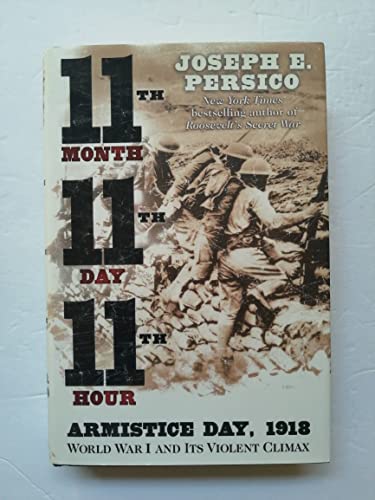
Eleventh Month, Eleventh Day, Eleventh Hour: Armistice Day, 1918 : World War I and Its Violent Climax - Hardcover
Inhaltsangabe
The best-selling author of Roosevelt's Secret War re-creates November 11, 1918, the final day of World War I, when Allied military commanders in search of glory and advancement, flung men against an already beaten enemy, leading to eleven thousand casualties. 75,000 first printing.
Die Inhaltsangabe kann sich auf eine andere Ausgabe dieses Titels beziehen.
Über die Autorin bzw. den Autor
JOSEPH E. PERSICO’s books include Nuremberg: Infamy on Trial, which was made into a television docudrama; Piercing the Reich, on the penetration of Nazi Germany by American agents; My American Journey (as collaborator with Colin Powell); and Roosevelt’s Secret War. He lives in Guilderland, New York.
Auszug. © Genehmigter Nachdruck. Alle Rechte vorbehalten.
1
The Desperate Hours
November 11, 1918. The runner, shivering, his breath visible in the morning air, waited for the captain to acknowledge the message. The night had been bitter, the temperature hovering near freezing. The cold had stiffened the mud, caking uniforms and frosting the rim of the trench. Leaden skies threatened snow. A medic moved along the duckboards handing out aspirin to sneezing, hacking men with heavy colds. They gripped tin mugs of coffee, grateful for the warmth, and eyed the runner, wondering what news he bore.
The captain read the message twice. It must be a mistake. True, the night before, the U.S. 26th Division had received Field Order 105 to attack at 9:30 this morning. But at 9:10, just as they had been checking their ammunition and fixing bayonets, word came that the armistice had been signed. Hostilities were to cease at 11 a.m. The attack had been canceled. And here was another message telling the captain that the assault had been reinstated. His watch showed 10:30. A half hour remained in the war.
To Private Connell Albertine, in Company A of the division’s 104th Infantry, the earlier word that the assault had been canceled had produced deep, wordless relief. He would live. Rumors that an armistice was imminent had been rife for days. And at 5:45 that morning, the division’s radiomen had picked up a message transmitted from the Eiffel Tower in Paris from the Allied commander, Marshal Ferdinand Foch, confirming the signing. That the attack would now go forward, after having been rescinded, struck him as insane, even murderous. Seventeen months had passed since the fresh-faced young New Englander had stood with the crowd reading the bulletin in the window of The Boston Globe. A giant keyboard tapped out on an unfolding paper roll, “A state of War between the Imperial German Government which has been thrust upon the United States is hereby declared.” President Woodrow Wilson’s long agony, his peaceful impulses pitted against the tide of events, had led him to take his nation into Europe’s conflict, just five months after he had been reelected president on the slogan “He kept us out of the War.” The personal import of the Globe’s bulletin was immediately evident to Albertine. He belonged to the Massachusetts National Guard, and its mobilization would be inevitable. “An indescribable feeling swelled within me,” he recalled of that day, “driving out all thoughts of my work and daily routine and filling me with an urgent desire to hasten to my gathering buddies and the comfort of my rifle.”
Since then, intervening realities had cooled his ardor. In the beginning, war had seemed a romp. The 104th had first entered the trenches in a quiet sector of the western front near Toul in northeast France. In the evenings, the doughboys could hear the sounds of a violin rising from the enemy trenches. When the Germans realized that they were facing Americans, they had behaved as if they had found long-lost family. They came out into no-man’s-land offering sausages for American cigarettes, black bread for white. “Hey, Yank!” one called out. “Where’re you from?” When the soldier replied, “Boston,” the German responded, “I was a bartender at Jake Wirth’s.” The camaraderie ended abruptly when regimental headquarters at Toul brought court-martial proceedings against twelve soldiers for fraternizing with the enemy. Soon after, the opposing artillery batteries began exchanging fire.
February 17, 1918, stood out starkly in Albertine’s memory. He had been crouched in a funkhole clawed from the earth watching geysers of dirt heaved up by exploding shells. A blast over a nearby company tossed up what looked like a rag doll. Albertine watched the stretcher bearers drag a lifeless form from a shell hole. The 104th had taken its first fatality, Private George G. Clarke, Company E.
Soon afterward, through the din of artillery fire, Albertine heard the wail of a klaxon. Gas alert. He pulled his mask over his face just as shells of mustard gas fell to earth with a seemingly innocent thump. They did not explode but issued a pinging sound and then a whistle as the fumes escaped. The gas had caught nearby French troops asleep. Albertine watched the victims being carted from the field, coughing up bits of their lungs, the exposed parts of their bodies blistered, their eyelids swollen shut, blinding them.
Through the months that followed, Albertine had worn the psychological armor that kept soldiers fighting: these things happened to others, not me. That was before the incident in the churchyard cemetery. They had been moving among the graves when shells began exploding close by. As Albertine flung himself to the ground, he felt something cold and hard under his hand, a cast-iron marker blown off a cross. He stared in disbelief. The marker bore the name “Albertine.” He flung it aside but, as the months wore on, could never erase its portent from his memory.
The 104th had fought through Château-Thierry and Saint- Mihiel and was now deployed in the Verdun sector. On the morning of the armistice, when it had appeared the assault had been canceled, Albertine could finally believe that he had outlasted the war. He glanced toward Chaplain de Valles, whom he credited with his survival.
John B. de Valles had been born in the Azores to Portuguese parents who had taken him to Massachusetts as a child. He had been ordained in 1906 and became a popular parish priest, first in Fall River and then in New Bedford. When America went to war, Father de Valles immediately joined the Chaplains’ Corps. His popularity transferred easily to the 104th. When a soldier found himself short before payday, the priest could be touched for a loan of a few francs—on one condition: he must promise not to use the money for what de Valles called “cohabitation.” His orderly kept a ledger in which the loans were recorded. But when payday came around, Father de Valles would tell him to tear out the page. The orderly was Connell Albertine, who looked upon the day the chaplain had chosen him as the luckiest of his young life.
Albertine felt secure in the priest’s presence. The previous April, near Saint-Agnant, when Private Burns had been hung up on the wire in no-man’s-land, screaming in agony, Chaplain de Valles heaved himself out of the trench and began crawling toward the wounded man. The priest disentangled Burns from the wire, lifted him onto his back, and staggered to the trench as enemy machine-gun bullets tore into the ground around them.
After bloody fighting at Commercy, de Valles had stood mutely watching a procession of carts haul the 104th’s dead from the field. Albertine heard Father de Valles curse through clenched teeth, “Kill them! Kill the bastards!” The priest later apologized to his orderly, but the words, he said, had tumbled out and felt right. The incident had bound Albertine more closely to the chaplain, making de Valles as humanly imperfect as his flock.
Now, on this last day, the nightmare of raglike bodies, gas-seared lungs, and unholy shrieks from the wire, he believed, had to end.
Colonel Cassius M. Dowell commanded another regiment of the 26th Division, the 103rd. That November 11, Dowell was in his dugout bent over a map, marking the point where his regiment could expect to end the war. At 9:45 a.m., his field phone rang. Colonel Duncan K. Major, the division’s chief of staff, was on the line informing him that the attack had been reinstated. Dowell was to send his men against German machine guns in a war that would end in a little over an hour. “Why?” Dowell asked. “The French compelled us to do it,” Major...
„Über diesen Titel“ kann sich auf eine andere Ausgabe dieses Titels beziehen.
Weitere beliebte Ausgaben desselben Titels

Suchergebnisse für Eleventh Month, Eleventh Day, Eleventh Hour: Armistice...

Beispielbild für diese ISBN
Eleventh Month Eleventh Day El
Anbieter: World of Books (was SecondSale), Montgomery, IL, USA
Verkäuferbewertung 5 von 5 Sternen

Zustand: Very Good. Item in very good condition! Textbooks may not include supplemental items i.e. CDs, access codes etc. Artikel-Nr. 00103241192
Gebraucht kaufen
EUR 4,79
Versand gratis
Versand innerhalb von USA
Versand innerhalb von USA
Anzahl: 4 verfügbar
Beispielbild für diese ISBN
Eleventh Month Eleventh Day El
Anbieter: World of Books (was SecondSale), Montgomery, IL, USA
Verkäuferbewertung 5 von 5 Sternen
Zustand: Good. Item in good condition. Textbooks may not include supplemental items i.e. CDs, access codes etc. Artikel-Nr. 00099681979
Gebraucht kaufen
EUR 4,79
Versand gratis
Versand innerhalb von USA
Versand innerhalb von USA
Anzahl: 6 verfügbar
Beispielbild für diese ISBN
Eleventh Month, Eleventh Day, Eleventh Hour: Armistice Day, 1918, World War I and Its Violent Climax
Anbieter: World of Books (was SecondSale), Montgomery, IL, USA
Verkäuferbewertung 5 von 5 Sternen
Zustand: Good. Good condition ex-library book with usual library markings and stickers. Artikel-Nr. 00101328187
Gebraucht kaufen
EUR 5,18
Versand gratis
Versand innerhalb von USA
Versand innerhalb von USA
Anzahl: 1 verfügbar
Beispielbild für diese ISBN
Eleventh Month, Eleventh Day, Eleventh Hour: Armistice Day, 1918, World War I and Its Violent Climax
Anbieter: ThriftBooks-Atlanta, AUSTELL, GA, USA
Verkäuferbewertung 5 von 5 Sternen
Hardcover. Zustand: Very Good. No Jacket. Missing dust jacket; May have limited writing in cover pages. Pages are unmarked. ~ ThriftBooks: Read More, Spend Less. Artikel-Nr. G0375508252I4N01
Gebraucht kaufen
EUR 6,12
Versand gratis
Versand innerhalb von USA
Versand innerhalb von USA
Anzahl: 1 verfügbar
Beispielbild für diese ISBN
Eleventh Month, Eleventh Day, Eleventh Hour: Armistice Day, 1918, World War I and Its Violent Climax
Anbieter: ThriftBooks-Phoenix, Phoenix, AZ, USA
Verkäuferbewertung 5 von 5 Sternen
Hardcover. Zustand: Very Good. No Jacket. Missing dust jacket; May have limited writing in cover pages. Pages are unmarked. ~ ThriftBooks: Read More, Spend Less. Artikel-Nr. G0375508252I4N01
Gebraucht kaufen
EUR 6,12
Versand gratis
Versand innerhalb von USA
Versand innerhalb von USA
Anzahl: 1 verfügbar
Beispielbild für diese ISBN
Eleventh Month, Eleventh Day, Eleventh Hour: Armistice Day, 1918, World War I and Its Violent Climax
Anbieter: Wonder Book, Frederick, MD, USA
Verkäuferbewertung 5 von 5 Sternen
Zustand: Very Good. Very Good condition. Very Good dust jacket. A copy that may have a few cosmetic defects. May also contain light spine creasing or a few markings such as an owner's name, short gifter's inscription or light stamp. Artikel-Nr. B17B-01379
Gebraucht kaufen
EUR 6,24
Versand gratis
Versand innerhalb von USA
Versand innerhalb von USA
Anzahl: 1 verfügbar
Beispielbild für diese ISBN
Eleventh Month, Eleventh Day, Eleventh Hour: Armistice Day, 1918, World War I and Its Violent Climax
Anbieter: Wonder Book, Frederick, MD, USA
Verkäuferbewertung 5 von 5 Sternen
Zustand: Good. Good condition. Very Good dust jacket. A copy that has been read but remains intact. May contain markings such as bookplates, stamps, limited notes and highlighting, or a few light stains. Artikel-Nr. V02A-04749
Gebraucht kaufen
EUR 6,24
Versand gratis
Versand innerhalb von USA
Versand innerhalb von USA
Anzahl: 2 verfügbar
Beispielbild für diese ISBN
Eleventh Month, Eleventh Day, Eleventh Hour : Armistice Day, 1918: World War I and Its Violent Climax
Verlag:
Random House Publishing Group, 2004
ISBN 10: 0375508252
ISBN 13: 9780375508257
Gebraucht
Hardcover
Anbieter: Better World Books: West, Reno, NV, USA
Verkäuferbewertung 5 von 5 Sternen
Zustand: Good. Former library copy. Pages intact with minimal writing/highlighting. The binding may be loose and creased. Dust jackets/supplements are not included. Includes library markings. Stock photo provided. Product includes identifying sticker. Better World Books: Buy Books. Do Good. Artikel-Nr. 2295603-6
Gebraucht kaufen
EUR 6,32
Versand gratis
Versand innerhalb von USA
Versand innerhalb von USA
Anzahl: 1 verfügbar
Beispielbild für diese ISBN
Eleventh Month, Eleventh Day, Eleventh Hour : Armistice Day, 1918: World War I and Its Violent Climax
Verlag:
Random House Publishing Group, 2004
ISBN 10: 0375508252
ISBN 13: 9780375508257
Gebraucht
Hardcover
Anbieter: Better World Books, Mishawaka, IN, USA
Verkäuferbewertung 5 von 5 Sternen
Zustand: Good. Former library copy. Pages intact with minimal writing/highlighting. The binding may be loose and creased. Dust jackets/supplements are not included. Includes library markings. Stock photo provided. Product includes identifying sticker. Better World Books: Buy Books. Do Good. Artikel-Nr. 2295603-6
Gebraucht kaufen
EUR 6,32
Versand gratis
Versand innerhalb von USA
Versand innerhalb von USA
Anzahl: 2 verfügbar
Beispielbild für diese ISBN
Eleventh Month, Eleventh Day, Eleventh Hour: Armistice Day, 1918, World War I and Its Violent Climax
Verlag:
Random House (edition First Edition), 2004
ISBN 10: 0375508252
ISBN 13: 9780375508257
Gebraucht
Hardcover
Erstausgabe
Anbieter: BooksRun, Philadelphia, PA, USA
Verkäuferbewertung 5 von 5 Sternen
Hardcover. Zustand: Very Good. First Edition. With dust jacket. It's a well-cared-for item that has seen limited use. The item may show minor signs of wear. All the text is legible, with all pages included. It may have slight markings and/or highlighting. Artikel-Nr. 0375508252-11-6-29
Gebraucht kaufen
EUR 6,55
Versand gratis
Versand innerhalb von USA
Versand innerhalb von USA
Anzahl: 1 verfügbar