
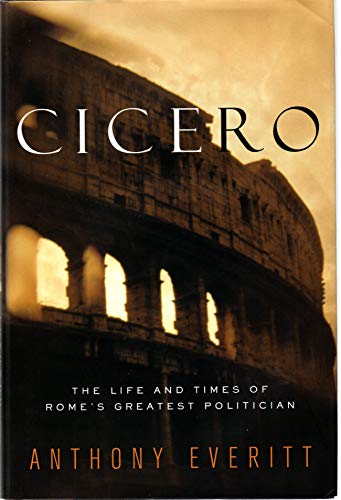
Verwandte Artikel zu Cicero: The Life and Times of Rome's Greatest Politician
Inhaltsangabe
In this biography, Anthony Everitt plunges us into the world of ancient Rome in its most glorious heyday. Accessible to us through his legendary speeches but also through an unrivaled collection of unguarded letters to his friend Atticus, Cicero comes to life in these pages as a witty and cunning political orator.
Cicero leapt onto the public stage at twenty-six, came of age during Spartacus' famous revolt of the gladiators and presided over Roman law and politics for almost half a century. He foiled the legendary Cataline conspiracy, advised Pompey, the victorious general who brought the Middle East under Roman rule, and fought to mobilize the Senate against Ceasar. He witnessed the conquest of Gaul, the civil war that followed and Caesar's dictatorship and assassination. Cicero was a legendary defender of freedom and a model, later, to French and American revolutionaries who saw themselves as following in his footsteps in the resistance to tyranny.
Cicero was a wily political orator. As a lawyer, he knew no equal. Boastful, often incapable of making up his mind, emotional enough to wander through the woods weeping when his beloved daughter died in childbirth, he emerges in these pages as intensely human, yet he was also the most eloquent and astute witness to the last days of the Republican Rome.
Die Inhaltsangabe kann sich auf eine andere Ausgabe dieses Titels beziehen.
Über die Autorinnen und Autoren
Anthony Everitt is a visiting professor of arts and cultural policy at Nottingham Trent University and City University.
Anthony Everitt’s fascination with ancient Rome began when he studied classics in school and has persisted ever since. He read English literature at Cambridge University and served four years as secretary general of the Arts Council for Great Britain. A visiting professor of arts and cultural policy at Nottingham Trent University and City University, Everitt has written extensively on European culture and development, and has contributed to the <i>Guardian</i> and <i>Financial Times</i> since 1994. <i>Cicero,</i> his first biography, was chosen by both Allan Massie and Andrew Roberts as the best book of the year in the United Kingdom. Anthony Everitt lives near Colchester, England’s first recorded town, founded by the Romans, and is working on a biography of Augustus.
Aus dem Klappentext
ges of the world have not produced a greater statesman and philosopher combined.”<br>―John Adams<br><br>He squared off against Caesar and was friends with young Brutus. He advised the legendary Pompey on his somewhat botched transition from military hero to politician. He lambasted Mark Antony and was master of the smear campaign, as feared for his wit as he was for exposing his opponents’ sexual peccadilloes. Brilliant, voluble, cranky, a genius of political manipulation but also a true patriot and idealist, Cicero was Rome’s most feared politician, one of the greatest lawyers and statesmen of all times. Machiavelli, Queen Elizabeth, John Adams and Winston Churchill all studied his example. No man has loomed larger in the political history of mankind.<br><br>In this dynamic and engaging biography, Anthony Everitt plunges us into the fascinating, scandal-ridden world of ancient Rome in its most glorious heyday. Accessible to us through his legendary speeches but
Auszug. © Genehmigter Nachdruck. Alle Rechte vorbehalten.
Chapter 1
FAULT LINES
The Empire in Crisis: First Century BC
To understand Cicero¹s life, which spanned the first two thirds of the first century bc, it is necessary to picture the world in which he lived, and especially the nature of Roman politics.
Rome in Cicero¹s day was a complex and sophisticated city, with up to a million inhabitants, and much of its pattern of life is recognizably familiar, even at a distance of two millennia. There were shopping malls and bars and a lively cultural scene with theater and sport. Poetry and literature thrived and new books were much talked about. Leading actors were household names. The affluent led a busy social round of dinner parties and gossip, and they owned country homes to which they could retreat from the pressures of urban living. Politics was conducted with a familiar blend of private affability and public invective. Speech was free. Everyone complained about the traffic.
The little city-state, hardly more than a village when it was founded (according to tradition) in 753 bc, gradually annexed the numerous tribes and statelets in the Italian peninsula and Sicily. The Romans were tough, aggressive and, to reverse von Clausewitz, inclined to see politics as a continuation of war by other means. They came to dominate the western Mediterranean. First, they gained a small foothold in the Maghreb, the province of Africa which covered roughly the territory of modern Tunisia. From here the great city of Carthage ruled its empire, until it was twice defeated by Rome and later razed to the ground in the second century bc. Spain was another prize of these wars and was divided into two provinces, Near Spain and Far Spain. In what is now Provence, Rome established Transalpine Gaul (Gallia Transalpina), but the rest of France was an unconquered and mysterious mélange of jostling tribes. Northern Italy was not merged into the home nation but was administered as a separate province, Italian Gaul (Gallia Cisalpina).
Then Rome invaded Greece and the kingdoms of Asia Minor, enfeebled inheritors of the conquests of Alexander the Great. In the first century bc, along the eastern seaboard of the Mediterranean, now named with literal-minded accuracy ³our sea² (Mare Nostrum), Rome directly governed a chain of territories: Macedonia (which included Greece), Asia (in western Turkey), Cilicia (in southern Turkey) and Syria (broadly, today¹s Syria and Lebanon). Beyond them, client monarchies stood as buffers between Rome¹s possessions and the unpredictable Parthian Empire, which lay beyond the River Euphrates. Pharaohs still ruled Egypt, but their independence was precarious.
This empire, the largest the western world had so far seen, was created more through inadvertence than design and presented Rome with a heavy and complicated administrative burden. This was partly because communications were slow and unreliable. Although a network of well-engineered roads was constructed, travel was limited to the speed of a horse. The rich would often travel by litter or coach, and so proceeded at walking pace or not much faster. Sailing ships before the age of the compass tended to hug the coast and seldom ventured beyond sight of land.
There being no public postal service, letters (which were scratched on waxed tablets or written on pieces of papyrus and sealed) were sent at considerable cost by messengers. The state employed couriers, as did commercial enterprises, and the trick for a private correspondent was to persuade them, or friendly travelers going in the right direction, to take his or her post with them and deliver it.
The greatest underlying problem facing the Republic, however, lay at home in its system of governance. Rome was a state without most of the institutions needed to run a state. There was no permanent civil service except for a handful of officials at the Treasury; when politicians took office or went to govern a province they had to bring in their own people to help them conduct business. The concept of a police force did not exist, which meant that the public spaces of the capital city were often hijacked by gangs of hooligans in the service of one interest or another. Soldiers in arms were absolutely forbidden to enter Rome, so all the authorities could do to enforce law and order was to hire their own ruffians.
The Republic was governed by the rule of law but did not operate a public prosecution service, and elected politicians acted as judges. Both in civil and criminal cases it was left to private individuals to bring suits. Usually litigants delegated this task to professional advocates, who acted as private detectives, assembling evidence and witnesses, as well as speaking at trials. Officially these advocates were unpaid, but in practice they could expect to receive favors, gifts and legacies in return for their services.
There was no penal system, and prisons were used for emergencies rather than for housing convicts. (Distinguished foreign captives and state hostages were exceptions and could be kept under lock and key or house arrest for years.) Penalties were usually exile or a fine and capital punishment was rare: no Roman citizen could be put to death without trial, although some argued that this was permissible during an official state of emergency.
The Republic became enormously rich on the spoils of empire, so much so that from 167 bc Roman citizens in Italy no longer paid any personal taxes. However, banking was in its infancy, and there were no major commercial financial institutions. Moneylenders (silversmiths and goldsmiths) laid cash out at interest and it was even possible to hold private accounts with them; but most people felt it safer to borrow from and lend to their family and friends. Without a bureaucracy the government was not in a position to collect taxes, selling the right to do so to the highest bidder. Tax farmers and provincial governors often colluded to make exorbitant profits.
All these things, in their various ways, were obstacles to effective administration. However, the constitution, which controlled the conduct of politics, was the Republic¹s greatest weakness.
Rome was an evolutionary society, not a revolutionary one. Constitutional crises tended to lead not to the abolition of previous arrangements but to the accretion of new layers of governance. For two and a half centuries Rome was a monarchy that was very much under the thumb of neighboring Etruria (today¹s Tuscany). In 510 bc King Tarquin was expelled in circumstances of great bitterness; according to legend he had raped a leading Roman¹s daughter, Lucretia. Whatever really happened, the citizenry was determined that never again would any single man be allowed to obtain supreme power. This was the main principle that underpinned constitutional arrangements which, by Cicero¹s time, were of a baffling complexity.
For generations the system worked well. It created a sense of community. To be a Roman citizen did not confer equality, but it did mean that one lived under the rule of law and felt a personal stake in the Republic¹s future. Rights, of course, were accompanied by duties and one of the secrets of Rome¹s strength was that even in moments of military catastrophe the state could call on all its citizens to come to its rescue. Another was pragmatism: for most of its history Rome¹s leaders showed a remarkable talent for imaginative improvisation when they met intractable problems. These were the qualities that assured the triumph of the Republic¹s legions and the creation of its empire.
After the fall of the monarchy, royal authority was transferred to two Consuls who alternated in executive seniority month by month. They were elected by the people (that is, all male Roman citizens within reach of the capital city,...
„Über diesen Titel“ kann sich auf eine andere Ausgabe dieses Titels beziehen.
Suchergebnisse für Cicero: The Life and Times of Rome's Greatest Politician

Foto des Verkäufers
Cicero: The Life and Times of Rome's Greatest Politician
Anbieter: Dream Books Co., Denver, CO, USA
Verkäuferbewertung 5 von 5 Sternen

Zustand: acceptable. This copy has clearly been enjoyedâ"expect noticeable shelf wear and some minor creases to the cover. Binding is strong, and all pages are legible. May contain previous library markings or stamps. Artikel-Nr. DBV.0375507469.A
Gebraucht kaufen
EUR 5,47
Versand gratis
Versand innerhalb von USA
Versand innerhalb von USA
Anzahl: 1 verfügbar
Beispielbild für diese ISBN
Cicero: The Life and Times of Rome's Greatest Politician
Anbieter: World of Books (was SecondSale), Montgomery, IL, USA
Verkäuferbewertung 5 von 5 Sternen
Zustand: Good. Item in good condition. Textbooks may not include supplemental items i.e. CDs, access codes etc. Artikel-Nr. 00106209027
Gebraucht kaufen
EUR 5,60
Versand gratis
Versand innerhalb von USA
Versand innerhalb von USA
Anzahl: 5 verfügbar
Beispielbild für diese ISBN
Cicero: The Life and Times of Rome's Greatest Politician
Anbieter: World of Books (was SecondSale), Montgomery, IL, USA
Verkäuferbewertung 5 von 5 Sternen
Zustand: Acceptable. Item in acceptable condition! Textbooks may not include supplemental items i.e. CDs, access codes etc. Artikel-Nr. 00102836505
Gebraucht kaufen
EUR 5,60
Versand gratis
Versand innerhalb von USA
Versand innerhalb von USA
Anzahl: 2 verfügbar
Beispielbild für diese ISBN
Cicero : The Life and Times of Rome's Greatest Politician
Verlag:
Random House Publishing Group, 2002
ISBN 10: 0375507469
ISBN 13: 9780375507465
Gebraucht
Hardcover
Anbieter: Better World Books, Mishawaka, IN, USA
Verkäuferbewertung 5 von 5 Sternen
Zustand: Good. Pages intact with minimal writing/highlighting. The binding may be loose and creased. Dust jackets/supplements are not included. Stock photo provided. Product includes identifying sticker. Better World Books: Buy Books. Do Good. Artikel-Nr. 470554-6
Gebraucht kaufen
EUR 6,55
Versand gratis
Versand innerhalb von USA
Versand innerhalb von USA
Anzahl: 1 verfügbar
Beispielbild für diese ISBN
Cicero : The Life and Times of Rome's Greatest Politician
Verlag:
Random House Publishing Group, 2002
ISBN 10: 0375507469
ISBN 13: 9780375507465
Gebraucht
Hardcover
Anbieter: Better World Books: West, Reno, NV, USA
Verkäuferbewertung 5 von 5 Sternen
Zustand: Good. Former library copy. Pages intact with minimal writing/highlighting. The binding may be loose and creased. Dust jackets/supplements are not included. Includes library markings. Stock photo provided. Product includes identifying sticker. Better World Books: Buy Books. Do Good. Artikel-Nr. 3986582-6
Gebraucht kaufen
EUR 6,55
Versand gratis
Versand innerhalb von USA
Versand innerhalb von USA
Anzahl: 1 verfügbar
Beispielbild für diese ISBN
Cicero: The Life and Times of Rome's Greatest Politician
Anbieter: ThriftBooks-Dallas, Dallas, TX, USA
Verkäuferbewertung 5 von 5 Sternen
Hardcover. Zustand: Good. No Jacket. Missing dust jacket; Pages can have notes/highlighting. Spine may show signs of wear. ~ ThriftBooks: Read More, Spend Less. Artikel-Nr. G0375507469I3N01
Gebraucht kaufen
EUR 7,52
Versand gratis
Versand innerhalb von USA
Versand innerhalb von USA
Anzahl: 1 verfügbar
Beispielbild für diese ISBN
Cicero: The Life and Times of Rome's Greatest Politician
Anbieter: ThriftBooks-Reno, Reno, NV, USA
Verkäuferbewertung 5 von 5 Sternen
Hardcover. Zustand: Good. No Jacket. Missing dust jacket; Pages can have notes/highlighting. Spine may show signs of wear. ~ ThriftBooks: Read More, Spend Less. Artikel-Nr. G0375507469I3N01
Gebraucht kaufen
EUR 7,52
Versand gratis
Versand innerhalb von USA
Versand innerhalb von USA
Anzahl: 1 verfügbar
Beispielbild für diese ISBN
Cicero: The Life and Times of Rome's Greatest Politician
Anbieter: ThriftBooks-Reno, Reno, NV, USA
Verkäuferbewertung 5 von 5 Sternen
Hardcover. Zustand: Fair. No Jacket. Readable copy. Pages may have considerable notes/highlighting. ~ ThriftBooks: Read More, Spend Less. Artikel-Nr. G0375507469I5N00
Gebraucht kaufen
EUR 7,52
Versand gratis
Versand innerhalb von USA
Versand innerhalb von USA
Anzahl: 1 verfügbar
Beispielbild für diese ISBN
Cicero: The Life and Times of Rome's Greatest Politician
Anbieter: ThriftBooks-Atlanta, AUSTELL, GA, USA
Verkäuferbewertung 5 von 5 Sternen
Hardcover. Zustand: Fair. No Jacket. Readable copy. Pages may have considerable notes/highlighting. ~ ThriftBooks: Read More, Spend Less. Artikel-Nr. G0375507469I5N00
Gebraucht kaufen
EUR 7,52
Versand gratis
Versand innerhalb von USA
Versand innerhalb von USA
Anzahl: 1 verfügbar
Beispielbild für diese ISBN
Cicero: The Life and Times of Rome's Greatest Politician
Anbieter: ThriftBooks-Dallas, Dallas, TX, USA
Verkäuferbewertung 5 von 5 Sternen
Hardcover. Zustand: Fair. No Jacket. Readable copy. Pages may have considerable notes/highlighting. ~ ThriftBooks: Read More, Spend Less. Artikel-Nr. G0375507469I5N00
Gebraucht kaufen
EUR 7,52
Versand gratis
Versand innerhalb von USA
Versand innerhalb von USA
Anzahl: 1 verfügbar