
Verwandte Artikel zu No Certain Rest
Inhaltsangabe
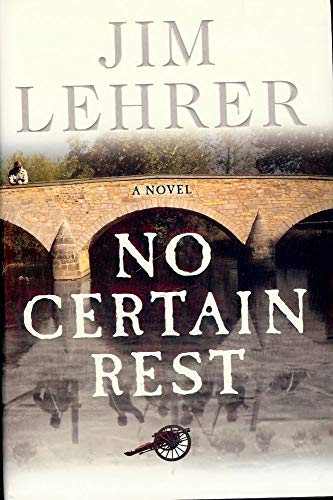
The discovery of the grave of an unknown Union officer on the Antietam battlefield leads Parks Department archaeologist Dan Spaniel into a baffling historical mystery, after finding out that the man had been murdered and his identity concealed.
Die Inhaltsangabe kann sich auf eine andere Ausgabe dieses Titels beziehen.
Über die Autorin bzw. den Autor
<i>No Certain Rest</i> is Jim Lehrer’s thirteenth novel. He has also written two memoirs and three plays. The executive editor and anchor of <i>The NewsHour with Jim Lehrer</i> on PBS, he lives with his wife, Kate, in Washington, D.C. They have three daughters.
Aus dem Klappentext
On a ridge overlooking Burnside Bridge―the focus of the Battle of Antietam―souvenir hunters find the unmarked grave of an unknown Union officer. <br> <br>Don Spaniel, an archeologist in the National Park Service, is called in to examine the remains. He soon discovers that the officer was murdered and that his identification disk could not possibly belong to him, since its rightful owner is buried elsewhere. So who was this officer? Where did he come from? And why was he killed?<br><br>Spaniel’s obsessive investigation leads not only to his reliving the horrible carnage that occurred at Burnside Bridge over a century before, but to the true identity of the Union officer and the reason why another body resides in his grave in a small New England town.<br><br>In a swift narrative deftly combining the past with the present, Jim Lehrer has created an engrossing story that will appeal to a wide variety of readers.
Auszug. © Genehmigter Nachdruck. Alle Rechte vorbehalten.
She said she would be the short, dumpy blond woman carrying a thin, green leather valise. He told her he would be the tall, skinny man wearing rimless glasses and an Indiana Jones fedora.
There she was. There was Rebecca Fentress of the Marion County, Iowa, Historical Society. And here he was, Don Spaniel of the National Park Service. He had guessed, from the sound of her voice on the phone, that she could be somewhat elderly, as old as seventy possibly. But fifty-five or even less was his best estimate now upon seeing her in person. Not only did she talk older than she was, she was dressed that way in a two-piece dark blue cotton dress with a skirt that fell a good two inches below the knee.
“Doctor Spaniel, I presume,” she said to him.
“Ms. Fentress?” he said, removing his hat.
A friend had given him the fedora two years ago as a thirty-fifth birthday present. It was meant as a joke because Don, like Indiana Jones, was an archeologist. But Don so loved the hat that he had made it part of who he was, wearing it routinely. Reg Wom- ach, his laid-back Smithsonian anthropologist friend, often called him Harrison, as in Harrison Ford, the actor who played Indiana Jones in the movies. That didn’t bother Don. He figured there were worse things in life for a skinny guy in glasses to be called than Harrison Ford.
“I have always wanted to say something like ‘Doctor Spaniel, I presume,’ ” Ms. Fentress said.
Don Spaniel smiled at her. His impression was that here was a woman who was as pleasant as she was plain and who most probably, in his instant analysis, was very smart. He was prepared to like and admire her even more if the private Civil War papers of the late Albert Randolph of the Eleventh Connecticut Volunteers were in that green case she was clutching to her body.
They were standing just inside the main entrance of Washington’s majestic Union Station—a six-foot-four gawky man leaning down to a speak to a five-foot-four solid woman who was looking almost straight up. In silhouette, they could have easily passed for a Norman Rockwell painting, possibly a small-town high school English teacher speaking to the basketball coach about a star player’s D2 theme on a Charles Dickens novel.
Rebecca Fentress had called Don from Union Station less than twenty minutes earlier to announce her surprise arrival in Washington, D.C., and to arrange an immediate meeting with him. He had suggested she get in a taxi and come to his office, which he assured her was barely ten minutes away in an area called Potomac Park. She said she really would rather not leave the station. All right, he said. How about meeting me in front of the huge electronic schedule board at the main entrance of the train station?
It was three in the afternoon. There were many people going to and from trains and milling about the many shops in Union Station, which had been very successful since being rehabilitated into a retail center as well as a train station a few years ago. He noticed the several open restaurants there in the main rotunda were not crowded and he suggested they find a quiet place in one.
“I don’t fly on airplanes,” Ms. Fentress said to Don. “It takes a long time to get from Iowa to here by train, it really does. You have to go through Chicago, for one thing; Pittsburgh, for another.”
Soon, they were seated in the quietest corner of a place which, according to its menu, offered at least one food specialty from each of the fifty states.
“I’ll bet the one from Iowa has something to do with corn,” said Rebecca Fentress. “Corn is what people think of when they think of Iowa—corn and pigs.” She was right. Iowa’s representative was listed under side orders: corn on the cob.
She ordered a piece of pecan meringue pie, a specialty of New Mexico, and a cup of Maryland coffee, which appeared to Don to be like any other kind of coffee.
He didn’t want anything now except what might be in Ms. Fentress’s valise, but, to be polite, he got a simple no-state’s Diet Coke.
“I have brought you Xerox copies of the Albert Randolph materials,” Ms. Fentress said before she made even a move to touch anything.
Don wanted to reach across the table and hug Rebecca Fentress. But all he did—all he thought that was appropriate to do—was say, “Thank you very much. I really do appreciate what you have done.” He came close to speaking on behalf of some long-dead men from a Connecticut regiment of volunteers with names such as Kingsbury, Griswold, Allbritten, and Mackenzie. But he thought better of it. That, too, would have been over the top.
“The originals are under lock and key at our local bank, and there they will likely always remain,” she said. “No one will ever again be allowed to read them.”
Don, in his state of hyperhappiness, didn’t quite get it. What was she saying? “Why? What’s the problem?” he asked.
“The problem is only that the board of trustees of our historical society decided our purpose was only to collect and preserve things from the past, not to stir them up.”
She was no longer smiling as she took several bites of her pie and a sip of coffee.
“How do you plan to use the information contained in these papers, doctor?” she then asked.
“I’m not sure, to tell you the absolute truth. I am not sure, of course, what is in them to begin with. . . .”
“I told you on the phone that they were sensitive and that they were definitive. I am confident you will find them so as well. They will undoubtedly clear up any questions you might have about what happened at the bridge at Antietam on September 17, 1862.”
“I’m delighted and excited at that prospect.” Delighted and excited said only half of it. His very soul swung and swayed with the prospect of finally knowing exactly what had happened.
She pushed away her pie plate and coffee cup and reached over to her green case, which she had placed on the table to her left. She moved it in front of her and zipped it open.
Don Spaniel began to feel as if he were some kind of mysterious operative, here amid the cover of a crowded train station, receiving from Courier Fentress of Iowa the secrets, the goods—the magic.
“Here,” she said, handing him a sealed white envelope. It looked thick. There were several pages of something inside.
Don took the envelope and said, “Thank you, Ms. Fentress. I promise you that I will not—”
“No promises, please. None is necessary. I did this of my own free will to satisfy my own needs and beliefs.”
She zipped the valise closed, looked at her watch, and stood. “Now I must go catch my train.”
Don was on his feet. “Where are you going?”
“Home, doctor. Home.”
“But didn’t you just get here?”
“I came here to hand you that envelope personally. I felt it was too important to leave to the vagaries of the U.S. mails or one of the private express firms. My mission accomplished, I am going home.”
Don left a ten-dollar bill on the table. She started walking; he fell in beside her.
“Your luggage? Where is your luggage?”
“A redcap took it when I got off the train. He’s probably now, as we speak, putting it in my compartment on the new train. That is what I asked him to do, at least. I love traveling in those bedrooms. Have you ever done that?”
“No, ma’am, I haven’t.”
“It’s tight for...
„Über diesen Titel“ kann sich auf eine andere Ausgabe dieses Titels beziehen.
Suchergebnisse für No Certain Rest

Beispielbild für diese ISBN
No Certain Rest: A Novel
Anbieter: World of Books (was SecondSale), Montgomery, IL, USA
Verkäuferbewertung 5 von 5 Sternen

Zustand: Acceptable. Item in acceptable condition! Textbooks may not include supplemental items i.e. CDs, access codes etc. Artikel-Nr. 00109835523
Gebraucht kaufen
EUR 5,14
Versand gratis
Versand innerhalb von USA
Versand innerhalb von USA
Anzahl: 1 verfügbar
Beispielbild für diese ISBN
No Certain Rest: A Novel
Anbieter: World of Books (was SecondSale), Montgomery, IL, USA
Verkäuferbewertung 5 von 5 Sternen
Zustand: Very Good. Item in very good condition! Textbooks may not include supplemental items i.e. CDs, access codes etc. Artikel-Nr. 00094696615
Gebraucht kaufen
EUR 5,14
Versand gratis
Versand innerhalb von USA
Versand innerhalb von USA
Anzahl: 5 verfügbar
Beispielbild für diese ISBN
No Certain Rest: A Novel
Anbieter: World of Books (was SecondSale), Montgomery, IL, USA
Verkäuferbewertung 5 von 5 Sternen
Zustand: Good. Item in good condition. Textbooks may not include supplemental items i.e. CDs, access codes etc. Artikel-Nr. 00083122029
Gebraucht kaufen
EUR 5,14
Versand gratis
Versand innerhalb von USA
Versand innerhalb von USA
Anzahl: 6 verfügbar
Beispielbild für diese ISBN
No Certain Rest: A Novel
Verlag:
Random House (edition First Edition), 2002
ISBN 10: 0375503722
ISBN 13: 9780375503726
Gebraucht
Hardcover
Erstausgabe
Anbieter: BooksRun, Philadelphia, PA, USA
Verkäuferbewertung 5 von 5 Sternen
Hardcover. Zustand: Very Good. First Edition. It's a well-cared-for item that has seen limited use. The item may show minor signs of wear. All the text is legible, with all pages included. It may have slight markings and/or highlighting. Artikel-Nr. 0375503722-11-1
Gebraucht kaufen
EUR 5,22
Versand gratis
Versand innerhalb von USA
Versand innerhalb von USA
Anzahl: 1 verfügbar
Beispielbild für diese ISBN
No Certain Rest : A Novel
Verlag:
Random House Publishing Group, 2002
ISBN 10: 0375503722
ISBN 13: 9780375503726
Gebraucht
Hardcover
Erstausgabe
Anbieter: Better World Books, Mishawaka, IN, USA
Verkäuferbewertung 5 von 5 Sternen
Zustand: Very Good. 1st. Former library copy. Pages intact with possible writing/highlighting. Binding strong with minor wear. Dust jackets/supplements may not be included. Includes library markings. Stock photo provided. Product includes identifying sticker. Better World Books: Buy Books. Do Good. Artikel-Nr. 3223468-6
Gebraucht kaufen
EUR 6,36
Versand gratis
Versand innerhalb von USA
Versand innerhalb von USA
Anzahl: 1 verfügbar
Beispielbild für diese ISBN
No Certain Rest : A Novel
Verlag:
Random House Publishing Group, 2002
ISBN 10: 0375503722
ISBN 13: 9780375503726
Gebraucht
Hardcover
Erstausgabe
Anbieter: Better World Books, Mishawaka, IN, USA
Verkäuferbewertung 5 von 5 Sternen
Zustand: Very Good. 1st. Pages intact with possible writing/highlighting. Binding strong with minor wear. Dust jackets/supplements may not be included. Stock photo provided. Product includes identifying sticker. Better World Books: Buy Books. Do Good. Artikel-Nr. 3223467-6
Gebraucht kaufen
EUR 6,36
Versand gratis
Versand innerhalb von USA
Versand innerhalb von USA
Anzahl: 1 verfügbar
Beispielbild für diese ISBN
No Certain Rest: A Novel
Anbieter: Redux Books, Grand Rapids, MI, USA
Verkäuferbewertung 5 von 5 Sternen
Hardcover. Zustand: Very Good. Hardcover with dust jacket. Pages are clean and unmarked. Covers show very minor shelf wear. Dust jacket shows light edge wear. Binding is tight, hinges strong.; 100% Satisfaction Guaranteed! Ships same or next business day! Artikel-Nr. 142510200007
Gebraucht kaufen
EUR 6,36
Versand gratis
Versand innerhalb von USA
Versand innerhalb von USA
Anzahl: 1 verfügbar
Beispielbild für diese ISBN
No Certain Rest : A Novel
Verlag:
Random House Publishing Group, 2002
ISBN 10: 0375503722
ISBN 13: 9780375503726
Gebraucht
Hardcover
Erstausgabe
Anbieter: Better World Books, Mishawaka, IN, USA
Verkäuferbewertung 5 von 5 Sternen
Zustand: Good. 1st. Former library copy. Pages intact with minimal writing/highlighting. The binding may be loose and creased. Dust jackets/supplements are not included. Includes library markings. Stock photo provided. Product includes identifying sticker. Better World Books: Buy Books. Do Good. Artikel-Nr. 3223466-75
Gebraucht kaufen
EUR 6,36
Versand gratis
Versand innerhalb von USA
Versand innerhalb von USA
Anzahl: 2 verfügbar
Beispielbild für diese ISBN
No Certain Rest: A Novel
Anbieter: ThriftBooks-Dallas, Dallas, TX, USA
Verkäuferbewertung 5 von 5 Sternen
Hardcover. Zustand: As New. No Jacket. Pages are clean and are not marred by notes or folds of any kind. ~ ThriftBooks: Read More, Spend Less. Artikel-Nr. G0375503722I2N00
Gebraucht kaufen
EUR 6,65
Versand gratis
Versand innerhalb von USA
Versand innerhalb von USA
Anzahl: 1 verfügbar
Beispielbild für diese ISBN
No Certain Rest: A Novel
Anbieter: ThriftBooks-Atlanta, AUSTELL, GA, USA
Verkäuferbewertung 5 von 5 Sternen
Hardcover. Zustand: As New. No Jacket. Pages are clean and are not marred by notes or folds of any kind. ~ ThriftBooks: Read More, Spend Less. Artikel-Nr. G0375503722I2N00
Gebraucht kaufen
EUR 6,65
Versand gratis
Versand innerhalb von USA
Versand innerhalb von USA
Anzahl: 1 verfügbar