
Verwandte Artikel zu How I Came into My Inheritance: And Other True Stories
Inhaltsangabe
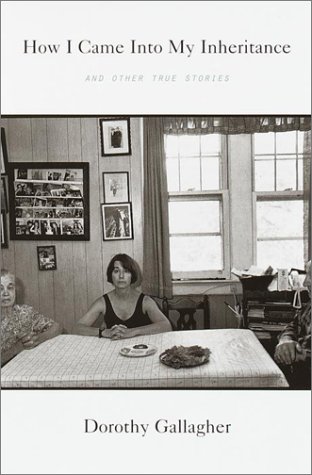
The author describes growing up in Washington Heights as a member of a Russian-Jewish immigrant family with left-wing political leanings, in a series of episodes that chronicles her childhood, family secrets, and writing career.
Die Inhaltsangabe kann sich auf eine andere Ausgabe dieses Titels beziehen.
Über die Autorin bzw. den Autor
Dorothy Gallagher was born and raised in New York City. She was a features editor for <i>Redbook</i> magazine, and then became a freelance writer, and her work has been published <i>in The New York Times Magazine, The New York Times Book Review</i>, and <i>Grand Street</i>. Her two previous books are <i>Hannah's Daughters</i>, an account of a six-generation matrilineal family, and <i>All the Right Enemies</i>, a biography of the Italian-American anarchist Carlo Tresca. She lives in New York.
Aus dem Klappentext
agher began her literary career fabricating sensational stories about celebrities for a pulp magazine whose other writers included Mario Puzo and Bruce Jay Friedman. Nothing she made up, though, could rival in color and drama the true story of her own family; Russian-immigrant Jews who lived in Washington Heights, swore allegiance to Marx and Stalin, and tried to ignore the realities of the new world in which their daughter had to make her way. Her mother tells Dorothy that the black girls who beat her up after school are the real victims. Her cousin Meyer returns to the Ukraine during the thirties and finds, to his astonishment, that the whole village is near death from starvation; still he retains his belief in Stalin's leadership. Dorothy moves into a loft on the Bowery, and her father scrounges wood for her stove from nearby vacant lots. She signs a contract for a book with a famous editor and is plunged into despair when he rejects her manuscript. Her Aunt Clara is murdered in her Bronx apartment
Auszug. © Genehmigter Nachdruck. Alle Rechte vorbehalten.
After my mother broke her hip, I put her in a nursing home.
"You want to put me here?" she said.
The woman was certified senile, but she still knew how to push my buttons. Not that she didn't have reason to worry; had I listened when she'd begged me "Darling, please, please don't do anything
to hurt Daddy. It will kill him . . ."?
I swear, what I did, it wasn't just for the money.
You know that tone people take about old age? The stuff about dignity and wisdom and how old people (pardon me for saying old) should be allowed to make their own decisions. Allowed! My father treated nicely reasoned arguments like mosquitoes. As for dignity, let's pass over the question of bodily wastes for the moment; let's suppose that the chronologically challenged father of one such pious person decided to torture and starve his or her chronologically challenged mother. ("So she falls! She'll lie
there till she gets up! . . . What does she need orange juice for? If she's thirsty she'll drink water!") And not only that, but also gives away practically all that person's inheritance to a crook. Do you think you
might see any revisionism in attitude then?
Until the day I took him to court and the judge laid down the law, nobody, but nobody, interfered with my father. I mean, he was awesome. For instance, he owned this slum building. It was filled with some characters you wouldn't want to meet in broad daylight on a busy street. The tenants didn't pay rent, welfare paid the rent. But welfare didn't pay exactly as much as my father was legally entitled to. So every month, even when he was up in his late eighties, he'd get in his car and drive over to that building, haul himself up the stairs, bang his cane on every door, and demand his five or ten dollars. He got it. Nobody laid a finger on him. Nobody even slammed the door in his face. And the only way you could tell he might be even a little bit nervous was that he left his motor running. And the car was never stolen!
It wasn't easy to tell when my father began to lose his marbles, because he'd always been such a headstrong summabitch, as he called everyone who had a slightly different idea. But the winter he was ninety he took out the water heater. That was a clue. I went up there one day — they lived about sixty miles upstate in this house they'd lived in forever. Now, the house should have been my first clue. I knew that house. I grew up there. If ever there was a homemade house, that was it. My father built it all around us. First we were living in two rooms, then three; nine by the time he got finished, the rooms all stuck on in unexpected places, connected by closets you walked through to get to other rooms, short dark corridors and twisting staircases. He never got tired of making new rooms. When I was a kid I thought he had made the world. Like once, we needed a shovel for the woodstove. My father took a metal ice
tray, cut off one end, rounded it, put a hole in the other end, and stuck a bit of pipe in. Voilà! I idolized that man.
And now the house was a wreck: jury-rigged electrical cords you tripped over, water dripping from the roof, buckets on the floor, smells of accumulated filth. I'd piss in my pants before I'd go into the bathroom.
But the thing is, I still believed in my father; he'd always taken care of everything. So when I'd say, "Daddy, there's a leak over Mama's bed. Let me find someone to fix the roof,"and he'd say, "Don't you do anything, I'll take care of it," I'd think, Okay, I guess he knows what he's doing.
Or I might say, "I'll get somebody to clean the house."
"It's clean! Mama cleans!"
So I say, "Mama, when did you clean the house?" She says, dementedly, "You saw, I just swept out. You know it doesn't get so dirty in the country."
I say, "But it smells bad," and my father says, "It doesn't smell!" I'd think: He seems sure. I guess it's not so bad. And everything happened so gradually.
„Über diesen Titel“ kann sich auf eine andere Ausgabe dieses Titels beziehen.
Suchergebnisse für How I Came into My Inheritance: And Other True Stories

Beispielbild für diese ISBN
How I Came Into My Inheritance: and Other True Stories
Anbieter: World of Books (was SecondSale), Montgomery, IL, USA
Verkäuferbewertung 5 von 5 Sternen

Zustand: Good. Item in very good condition! Textbooks may not include supplemental items i.e. CDs, access codes etc. Artikel-Nr. 00073512062
Gebraucht kaufen
EUR 3,14
Versand gratis
Versand innerhalb von USA
Versand innerhalb von USA
Anzahl: 1 verfügbar
Beispielbild für diese ISBN
How I Came Into My Inheritance: and Other True Stories
Anbieter: World of Books (was SecondSale), Montgomery, IL, USA
Verkäuferbewertung 5 von 5 Sternen
Zustand: Very Good. Item in very good condition! Textbooks may not include supplemental items i.e. CDs, access codes etc. Artikel-Nr. 00074042379
Gebraucht kaufen
EUR 3,14
Versand gratis
Versand innerhalb von USA
Versand innerhalb von USA
Anzahl: 3 verfügbar
Beispielbild für diese ISBN
How I Came into My Inheritance : And Other True Stories
Verlag:
Random House, 2001
ISBN 10: 0375503463
ISBN 13: 9780375503467
Gebraucht
Softcover
Erstausgabe
Anbieter: Better World Books, Mishawaka, IN, USA
Verkäuferbewertung 5 von 5 Sternen
Zustand: Very Good. 1st ed. Pages intact with possible writing/highlighting. Binding strong with minor wear. Dust jackets/supplements may not be included. Stock photo provided. Product includes identifying sticker. Better World Books: Buy Books. Do Good. Artikel-Nr. 16440864-6
Gebraucht kaufen
EUR 6,03
Versand gratis
Versand innerhalb von USA
Versand innerhalb von USA
Anzahl: 1 verfügbar
Beispielbild für diese ISBN
How I Came into My Inheritance : And Other True Stories
Verlag:
Random House, 2001
ISBN 10: 0375503463
ISBN 13: 9780375503467
Gebraucht
Softcover
Erstausgabe
Anbieter: Better World Books, Mishawaka, IN, USA
Verkäuferbewertung 5 von 5 Sternen
Zustand: Good. 1st ed. Former library copy. Pages intact with minimal writing/highlighting. The binding may be loose and creased. Dust jackets/supplements are not included. Includes library markings. Stock photo provided. Product includes identifying sticker. Better World Books: Buy Books. Do Good. Artikel-Nr. 18146760-6
Gebraucht kaufen
EUR 6,03
Versand gratis
Versand innerhalb von USA
Versand innerhalb von USA
Anzahl: 1 verfügbar
Beispielbild für diese ISBN
How I Came Into My Inheritance: and Other True Stories
Anbieter: ThriftBooks-Atlanta, AUSTELL, GA, USA
Verkäuferbewertung 5 von 5 Sternen
Paperback. Zustand: As New. No Jacket. Pages are clean and are not marred by notes or folds of any kind. ~ ThriftBooks: Read More, Spend Less. Artikel-Nr. G0375503463I2N00
Gebraucht kaufen
EUR 7,37
Versand gratis
Versand innerhalb von USA
Versand innerhalb von USA
Anzahl: 1 verfügbar
Foto des Verkäufers
How I Came Into My Inheritance
Verlag:
Random House, 2001
ISBN 10: 0375503463
ISBN 13: 9780375503467
Gebraucht
Hardcover
Erstausgabe
Anbieter: Southampton Books, Sag Harbor, NY, USA
Verkäuferbewertung 5 von 5 Sternen
Hardcover. Zustand: Like New. First Edition. First Edition, First Printing. Published by Random House, 2001. Octavo. Hardcover. Book is like new with previous owner inscription on flyleaf. Dust jacket is like new and price-clipped. 100% positive feedback. 30 day money back guarantee. NEXT DAY SHIPPING! Excellent customer service. Please email with any questions. All books packed carefully and ship with free delivery confirmation/tracking. All books come with free bookmarks. Ships from Sag Harbor, New York. Artikel-Nr. 414274
Gebraucht kaufen
EUR 17,93
EUR 4,34 Versand
Versand innerhalb von USA
Versand innerhalb von USA
Anzahl: 1 verfügbar
Foto des Verkäufers
How I Came into My Inheritance: And Other True Stories
Anbieter: WeBuyBooks, Rossendale, LANCS, Vereinigtes Königreich
Verkäuferbewertung 5 von 5 Sternen
paperback. Zustand: Good. Most items will be dispatched the same or the next working day. A copy that has been read but remains in clean condition. All of the pages are intact and the cover is intact and the spine may show signs of wear. The book may have minor markings which are not specifically mentioned. Signed by Author(Unverified). Artikel-Nr. rev1305756820
Gebraucht kaufen
EUR 15,57
EUR 7,36 Versand
Versand von Vereinigtes Königreich nach USA
Versand von Vereinigtes Königreich nach USA
Anzahl: 1 verfügbar
Foto des Verkäufers
How I Came Into My Inheritance: and Other True Stories
Verlag:
Random House, 2001
ISBN 10: 0375503463
ISBN 13: 9780375503467
Gebraucht
Hardcover
Erstausgabe
Signiert
Anbieter: Southampton Books, Sag Harbor, NY, USA
Verkäuferbewertung 5 von 5 Sternen
Hardcover. Zustand: Like New. First Edition. First Edition, First Printing. Not price-clipped. Published by Random House, 2001. Octavo. Hardcover. Signed on title page. Book is like new. Dust jacket is like new with "Autographed copy" sticker on front cover. Great signed copy of this biographical account.100% positive feedback. 30 day money back guarantee. NEXT DAY SHIPPING! Excellent customer service. Please email with any questions. All books packed carefully and ship with free delivery confirmation/tracking. All books come with free bookmarks. Ships from Sag Harbor, New York. Artikel-Nr. 351925
Gebraucht kaufen
EUR 31,39
EUR 4,34 Versand
Versand innerhalb von USA
Versand innerhalb von USA
Anzahl: 1 verfügbar
Beispielbild für diese ISBN
How I Came into My Inheritance
Anbieter: Whodunit Bookshop, Winnipeg, MB, Kanada
Verkäuferbewertung 5 von 5 Sternen
Hardcover. Zustand: Very Good. Artikel-Nr. 978037550346U
Gebraucht kaufen
EUR 8,47
EUR 46,14 Versand
Versand von Kanada nach USA
Versand von Kanada nach USA
Anzahl: 1 verfügbar