
Verwandte Artikel zu Bone by Bone
Inhaltsangabe
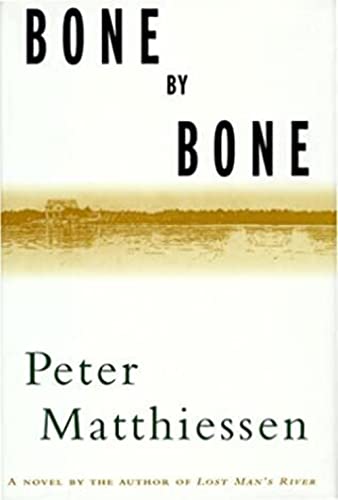
Continues the saga of anti-hero E.J. Watson, an entrepreneurial sugar cane farmer in the Everglades, exile in Indian territory, devoted husband, distant father, and allegedly, a cold-blooded killer
Die Inhaltsangabe kann sich auf eine andere Ausgabe dieses Titels beziehen.
Über die Autorin bzw. den Autor
<b>Peter Matthiessen</b> was born in New York City in 1927 and had already begun his writing career by the time he graduated from Yale University in 1950. The following year, he was a founder of The Paris Review. Besides At Play in the Fields of the Lord, which was nominated for the National Book Award, he has published six other novels, most notably Killing Mister Watson, Lost Man's River (the first and second books of this trilogy), and Far Tortuga. Mr. Matthiessen's parallel career as a naturalist and explorer has resulted in numerous and widely acclaimed books of nonfiction, among them The Tree Where Man Was Born, which was nominated for the National Book Award, and The Snow Leopard, which won it.
Aus dem Klappentext
essen is one of America's most respected writers and one of the very few National Book Award winners nominated for both fiction and nonfiction. <b>Bone by Bone</b> is arguably his finest novel. Although it stands alone, it is also the capstone of the Watson trilogy, which has been described by the San Francisco Chronicle Book Review as "one of the grand projects of contemporary literature." <br> <br>In the critically acclaimed <i>Killing Mister Watson</i>, Peter Matthiessen brilliantly re-created the life of the legendary E. J. Watson, who was gunned down by a posse of fearful neighbors before World War I. In his masterful sequel, Lost Man's River, Matthiessen returned us to the lawless frontier of the Florida Everglades, where Watson's son Lucius sought to untangle the knot of truth and lies surrounding his notorious father and his strange death. And now, in Bone by Bone, the story unfolds in its final form, in the voice of th
Auszug. © Genehmigter Nachdruck. Alle Rechte vorbehalten.
Oh Mercy, cries the Reader. What? Old Edgefield again?
It must be Pandemonium itself, a very District of Devils!
-Parson Mason L. Weems
Edgefield Court House
Edgefield Court House, which gave its name to the settlement which grew from a small crossroads east of the Savannah River, is a white-windowed brick edifice upon a hill approached by highroads from the four directions, as if drawing the landscape all around to a point of harmony and concord. The building is faced with magisterial broad steps on which those in pursuit of justice may ascend from Court House Square to the brick terrace. White columns serve as portals to the second-story courtroom, and an arched sunrise window over the door fills that room with austere light, permitting the magistrate to freshen his perspective by gazing away over the village roofs to the open countryside and the far hills, blue upon blue.
Early in the War, a boy of six, I was borne lightly up those steps on the strong arm of my father. On the courthouse terrace, I gazed with joy at this tall man in Confederate uniform who stood with his hand shielding his eyes, enjoying the fine prospect of the Piedmont, bearing away toward the northwest and the Great Smoky Mountains. In those nearer distances lay the Ridge, where a clear spring appeared out of the earth to commence its peaceful slow descent through woodland and plantation to the Edisto River. This tributary was Clouds Creek, where I was born.
On that sunny day when we climbed to the terrace, my father, Elijah Daniel Watson, rode away to war and childhood ended. As a "Daughter of Edgefield," his wife Ellen, with me and my little sister, waved prettily from the courthouse steps as the First Edgefield Volunteers assembled on the square. Her handsome Lige, wheeling his big roan and flourishing a crimson pennant on his saber, pranced in formation in the company of cavalry formed and captained by his uncle Tillman Watson. Governor Andrew Pickens saluted the new company from the terrace, and so did Mama's cousin Selden Tilghman, the first volunteer from our Old Edgefield District and its first casualty. Called to the top step to inspire his townsmen, the young cavalry officer used one crutch to wave the blue flag of the Confederacy.
Hurrah, hurrah, for Southern rights, hurrah! Hurrah for the bonnie blue flag that flies the single star!
Governor Pickens roared, "May the brave boys of Edgefield defend to the death the honor and glory of our beloved South Carolina, the first great sovereign state of the Confederacy to secede from the Yankee Union!" And Cousin Selden, on some mad contrary impulse, dared answer the Governor's exhortation by crying out oddly in high tenor voice, "May the brave boys of Edgefield defend to their deaths our sovereign right to enslave the darker members of our human species."
The cheering faltered, then died swiftly to a low hard groan like an ill wind. Voices catcalled rudely in the autumn silence. Most citizens gave the wounded lieutenant the benefit of the doubt, concluding that he must have been dead drunk. He had fought bravely and endured a grievous wound, and he soon rode off to war again, half-mended.
Clouds Creek
When the War was nearly at an end, and many slaves were escaping to the North, a runaway was slain by Overseer Claxton on my great-uncle's plantation at Clouds Creek.
Word had passed the day before that Dock and Joseph were missing. At the racketing echo of shots from the creek bottoms, I yelped in dismay and dropped my hoe and lit out across the furrows toward the wood edge, trailing the moaning of the hounds down into swamp shadows and along wet black mud margins, dragged at by thorns and scratched by tentacles of old and evil trees.
I saw Dock first-dull stubborn Dock, lashed to a tree-then the overseer whipping back his hounds, then two of my great-uncles, tall and rawboned on rawboned black horses. The overseer's pony shifted in the shadows. Behind the boots and milling legs, the heavy hoof stamp and horse shivers, bit jangle and creak of leather, lay a lumped thing in earth-colored homespun. I was panting so hard that my wet eyes could scarcely make out the broken shoes, the legs hard-twisted in the bloody pants, the queer gray thing stuck out askew from beneath the chest-how could that thing be the limber hand that had offered nuts or berries, caught my mistossed balls, set young "Mast' Edguh" on his feet after a fall? All in a bunch, the fingers had contracted like the toes of a stunned bird, closing on nothing.
At daybreak Mr. Claxton, on the lookout, had seen a small smoke rising from a far corner of the swamp. His horse was saddled and he did not wait for help, just loosed his hounds and rode on down there. The runaways had fled his dogs, obliging him to shoot and wound them both-that was his story. He was marching them home when this damned Joseph sagged down like a croker sack, pissing his pants. "I told that other'n over yonder, Shut up your damn moanin. Told him, Stand that son-bitch on his feet, I ain't got all day. Done my duty, Major, but it weren't no use."
Major Tillman Watson and Elijah Junior sat their horses, never once dismounted. My great-uncles chewed on Claxton's story. The dead boy's wet homespun was patched dark and stuck with dirt, and a faint piss stink mixed with dog smell and the sweet musk of horses. "Wet his damn pants," the overseer repeated to no one in particular, awaiting the judgment of those mounted men. He was a closed-face man, as hard as wire.
"You have no business here," Great-Uncle Elijah Junior told me, not because night was coming on or because I was too young to witness this grim sight but because I was certainly neglecting whichever chore I had abandoned without leave. To the overseer he never spoke, confining his exasperation to muttered asides in the direction of his older brother concerning "the waste of a perfectly good nigger."
Major Tillman Watson, home from war, seemed more disturbed by Claxton's viciousness. "Dammit, Z.P., you trying to tell us these boys was aiming to outrun them hounds of yours? How come you had to go and pull the trigger?" He was backing his big horse, reining its wild-eyed head away toward home. "Close his eyes, goddamnit." He was utterly fed up. "Go fetch a cart."
"I reckon he'll keep till mornin," Claxton muttered, sullen.
Major Tillman frowned down on me, in somber temper. "What do you want here, boy?" (Badly enough to run out here barefoot, that's what he meant.) "It's almost dark," he called, half-turned in the saddle. "You're not afraid out here? All by yourself?"
"Yessir. I mean, nosir."
"Nosir." The Major grunted. "You're a Watson anyways, I'll say that much. All the same, you best go on home while there's still light, and don't go worrying your poor mama." The old soldier rode away through the dark trees.
"Tell them niggers bring the wagon if they want him!" the overseer bawled, not wishing to be heard. Receiving no answer, he swore foully. "Niggers'll come fetch him or they won't-that sure ain't my job." He did not bother to shut the black boy's eyes. "Too bad it weren't this monkey here," he rasped, stripping the bonds from the wounded Dock, who yelped with each rough jerk of the hemp line.
Though Claxton had grumped in my direction, he had paid me no attention until this moment. "What in the name of hell you want? Ain't never seen a dead nigger before?" He climbed gracelessly onto his horse, cracked his hide whip like a mule skinner. "Nosir, I ain't goin to no damn court, cause I ain't broke no law. Just done my job." The slave stumbled forward, with...
„Über diesen Titel“ kann sich auf eine andere Ausgabe dieses Titels beziehen.
Suchergebnisse für Bone by Bone

Beispielbild für diese ISBN
Bone by Bone: A Novel
Anbieter: World of Books (was SecondSale), Montgomery, IL, USA
Verkäuferbewertung 5 von 5 Sternen

Zustand: Good. Item in good condition. Textbooks may not include supplemental items i.e. CDs, access codes etc. Artikel-Nr. 00097386466
Gebraucht kaufen
EUR 3,95
Versand gratis
Versand innerhalb von USA
Versand innerhalb von USA
Anzahl: 3 verfügbar
Beispielbild für diese ISBN
Bone by Bone: A Novel
Verlag:
Random House (edition First Edition), 1999
ISBN 10: 0375501029
ISBN 13: 9780375501029
Gebraucht
Hardcover
Erstausgabe
Anbieter: BooksRun, Philadelphia, PA, USA
Verkäuferbewertung 5 von 5 Sternen
Hardcover. Zustand: Fair. First Edition. With dust jacket. The item might be beaten up but readable. May contain markings or highlighting, as well as stains, bent corners, or any other major defect, but the text is not obscured in any way. Artikel-Nr. 0375501029-7-1-29
Gebraucht kaufen
EUR 5,70
Versand gratis
Versand innerhalb von USA
Versand innerhalb von USA
Anzahl: 1 verfügbar
Beispielbild für diese ISBN
Bone by Bone: A Novel
Anbieter: ThriftBooks-Reno, Reno, NV, USA
Verkäuferbewertung 5 von 5 Sternen
Hardcover. Zustand: Good. No Jacket. Former library book; Pages can have notes/highlighting. Spine may show signs of wear. ~ ThriftBooks: Read More, Spend Less. Artikel-Nr. G0375501029I3N10
Gebraucht kaufen
EUR 5,94
Versand gratis
Versand innerhalb von USA
Versand innerhalb von USA
Anzahl: 1 verfügbar
Beispielbild für diese ISBN
Bone by Bone: A Novel
Anbieter: ThriftBooks-Atlanta, AUSTELL, GA, USA
Verkäuferbewertung 5 von 5 Sternen
Hardcover. Zustand: Very Good. No Jacket. Former library book; May have limited writing in cover pages. Pages are unmarked. ~ ThriftBooks: Read More, Spend Less. Artikel-Nr. G0375501029I4N10
Gebraucht kaufen
EUR 5,96
Versand gratis
Versand innerhalb von USA
Versand innerhalb von USA
Anzahl: 1 verfügbar
Beispielbild für diese ISBN
Bone by Bone: A Novel
Anbieter: ThriftBooks-Atlanta, AUSTELL, GA, USA
Verkäuferbewertung 5 von 5 Sternen
Hardcover. Zustand: Fair. No Jacket. Readable copy. Pages may have considerable notes/highlighting. ~ ThriftBooks: Read More, Spend Less. Artikel-Nr. G0375501029I5N00
Gebraucht kaufen
EUR 5,96
Versand gratis
Versand innerhalb von USA
Versand innerhalb von USA
Anzahl: 1 verfügbar
Beispielbild für diese ISBN
Bone by Bone: A Novel
Anbieter: ThriftBooks-Atlanta, AUSTELL, GA, USA
Verkäuferbewertung 5 von 5 Sternen
Hardcover. Zustand: Good. No Jacket. Former library book; Pages can have notes/highlighting. Spine may show signs of wear. ~ ThriftBooks: Read More, Spend Less. Artikel-Nr. G0375501029I3N10
Gebraucht kaufen
EUR 5,96
Versand gratis
Versand innerhalb von USA
Versand innerhalb von USA
Anzahl: 1 verfügbar
Beispielbild für diese ISBN
Bone by Bone: A Novel
Anbieter: ThriftBooks-Dallas, Dallas, TX, USA
Verkäuferbewertung 5 von 5 Sternen
Hardcover. Zustand: Good. No Jacket. Pages can have notes/highlighting. Spine may show signs of wear. ~ ThriftBooks: Read More, Spend Less. Artikel-Nr. G0375501029I3N00
Gebraucht kaufen
EUR 5,96
Versand gratis
Versand innerhalb von USA
Versand innerhalb von USA
Anzahl: 1 verfügbar
Beispielbild für diese ISBN
Bone by Bone: A Novel
Anbieter: ThriftBooks-Dallas, Dallas, TX, USA
Verkäuferbewertung 5 von 5 Sternen
Hardcover. Zustand: Good. No Jacket. Former library book; Pages can have notes/highlighting. Spine may show signs of wear. ~ ThriftBooks: Read More, Spend Less. Artikel-Nr. G0375501029I3N10
Gebraucht kaufen
EUR 5,96
Versand gratis
Versand innerhalb von USA
Versand innerhalb von USA
Anzahl: 1 verfügbar
Beispielbild für diese ISBN
Bone by Bone: A Novel
Anbieter: Wonder Book, Frederick, MD, USA
Verkäuferbewertung 5 von 5 Sternen
Zustand: Very Good. Very Good condition. Very Good dust jacket. A copy that may have a few cosmetic defects. May also contain light spine creasing or a few markings such as an owner's name, short gifter's inscription or light stamp. Artikel-Nr. F09B-02423
Gebraucht kaufen
EUR 6,08
Versand gratis
Versand innerhalb von USA
Versand innerhalb von USA
Anzahl: 1 verfügbar
Beispielbild für diese ISBN
Bone by Bone
Verlag:
Random House Publishing Group, 1999
ISBN 10: 0375501029
ISBN 13: 9780375501029
Gebraucht
Hardcover
Erstausgabe
Anbieter: Better World Books, Mishawaka, IN, USA
Verkäuferbewertung 5 von 5 Sternen
Zustand: Very Good. 1st. Former library copy. Pages intact with possible writing/highlighting. Binding strong with minor wear. Dust jackets/supplements may not be included. Includes library markings. Stock photo provided. Product includes identifying sticker. Better World Books: Buy Books. Do Good. Artikel-Nr. 9795950-6
Gebraucht kaufen
EUR 6,76
Versand gratis
Versand innerhalb von USA
Versand innerhalb von USA
Anzahl: 1 verfügbar