
Inhaltsangabe
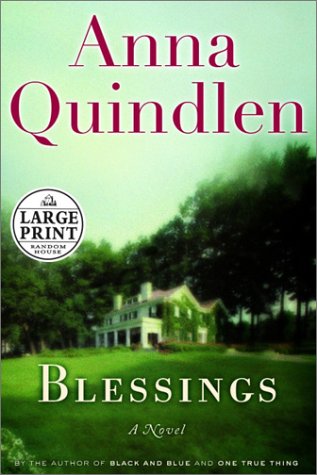
This powerful new novel by the bestselling author of Black and Blue, One True Thing, Object Lessons, and A Short Guide to a Happy Life begins when a teenage couple drives up, late at night, headlights out, to Blessings, the estate owned by Lydia Blessing. They leave a box and drive away, and in this instant, the world of Blessings is changed forever. Richly written, deeply moving, beautifully crafted, Blessings tells the story of Skip Cuddy, caretaker of the estate, who finds a baby asleep in that box and decides he wants to keep her, and of matriarch Lydia Blessing, who, for her own reasons, decides to help him. The secrets of the past, how they affect the decisions and lives of people in the present; what makes a person, a life, legitimate or illegitimate, and who decides; the unique resources people find in themselves and in a community—these are at the center of this wonderful novel of love, redemption, and personal change by the writer about whom The Washington Post Book World said, “Quindlen knows that all the things we ever will be can be found in some forgotten fragment of family.”
Die Inhaltsangabe kann sich auf eine andere Ausgabe dieses Titels beziehen.
Über die Autorin bzw. den Autor
Anna Quindlen is the author of three previous novels (Object Lessons, One True Thing, Black and Blue), and four nonfiction books (A Short Guide to a Happy Life, Living Out Loud, Thinking Out Loud, How Reading Changed My Life). She has also written two children’s books (The Tree That Came to Stay, Happily Ever After). Her New York Times column “Public & Private” won the Pulitzer Prize in 1992. Her column now appears every other week in Newsweek.
Auszug. © Genehmigter Nachdruck. Alle Rechte vorbehalten.
Blessings
By Anna QuindlenRandom House Large Print Publishing
Copyright © 2002 Anna QuindlenAll right reserved.
ISBN: 0375431845
Chapter One
From Chapter One
In the early hours of June 24 a car pulled into a long macadam drive on Rolling Hills Road in the town of Mount Mason. The driver cut the engine, so that as the car rolled down the drive and into the oval turnaround between the back of the big white clapboard house and the garage, it made only a soft swishing sound, like the whisper of summer rain those first few moments after the dirty gray storm clouds open.
There were deer in the fields that surrounded the house, cropping the rye grass with their spotted fawns at their flanks. But the fields stretched so far from the drive on either side, and the deer kept so close to the tree line, that the does did not even raise their divot heads from the ground as the car slid past, although one or two stopped chewing, and the smallest of the babies edged toward their mothers, stepping delicately sideways, en pointe on their small hooves.
“I don’t feel that good,” said the young woman in the passenger seat, her hair veiling her face.
The moonlight slipping at an oblique angle through the windows and the windshield of the car picked out what there was of her to be seen: a suggestion of the whites of her eyes between the curtains of her hair, the beads of sweat on her arched upper lip, the silver chain around her neck, the chipped maroon polish on her nails—a jigsaw puzzle of a girl, half the pieces not visible. She was turned away from the driver, turned toward the door as though she were a prisoner in the car and, at any moment, might pull the door handle and tumble out. The fingers of one hand played with her full bottom lip as she stared at the black shadows of the trees on the rough silver of the lawns, silhouettes cut from construction paper. At the edge of the drive, halfway down it, was a small sign, black on white. blessings, it said.
Blessings was one of those few places that visitors always found, on their return, even more pleasing than the pleasant memories they had of it. The house sat, big and white, low and sprawling, in a valley of overgrown fields, its terrace gardens spilling white hydrangeas, blue bee balm, and bushy patches of catnip and lavender onto a flagstone patio that ran its length. The land surrounding it was flat and rich for a long ways, to the end of the drive, and then the stony mountains rose around as though to protect it, a great God-sized berm spiky with pine trees.
The house had a squat and stolid quality, as though it had lain down to rest in the valley and grown middle-aged. Ill-advised additions had been made, according to the fashion of the times: a den paneled in rustic pine, a long screened porch, some dormers scattered above the horizontal roof line like eyes peering down the drive. The weeping willows at one end of the pond dipped low, but the cedars at the other were too tall and rangy for grace, and there had been sporadic talk of cutting them down almost from the day they were planted. The gardens were of the most conventional sort, hollyhocks in the back, day lilies in the center, alyssum along the borders. Wild rhododendrons grew in the shade wherever a stream sprang from the ground to spill down the hillside and into the big pond, a lake almost, that lay along one side of the house. None of it amounted to much on its own.
But taken altogether it was something almost perfect, the sort of place that, from the road, which was how these two had first seen it, promised plenty without pretense, ease without arrogance. From the road Blessings looked like a place where people would sit on the terrace at dusk, sip a drink and exult in the night breeze over the mountain, pull a light cardigan around their shoulders, and go to bed content. At one time or another, in fact all of these things had been true, but not for some time.
In the fashion of the young, the two in the car, peering down the drive some months before, had convinced themselves that appearance was reality. For the girl, it was the awnings that had finally convinced her, faded green and gold stripes over each window, like proud flags of this little nation-state, where it had been arranged that the sun would never fade the upholstery. That, and a small boat to one side of the pond, in which it was not only possible but indubitable that children could sit safely, row handily, put out a fishing line. In the light from a thumbnail moon the boat, upended on the grass, shone as though a smaller moon had dropped down to earth. The girl saw the sign by the side of the drive in the car’s headlights as a benediction, not as a sign of ownership, the proud name of an old family at the end of its bloodline.
The pond made the car’s driver nervous. It was shiny bright as a mirror, every star, every constellation, even the path of planes, reflecting back within its dark water and seemingly magnified by the pitch black of the night and the stillness of its surface. Frogs called from its banks, and as the car rolled silently into the circular driveway turnaround a fish jumped and left circles on the surface of the water. At the same moment the car tripped the automatic light at the corner of the house’s long porch, and it lit up the drive and the water and the bats that flew crazy eights in search of mosquitoes. The light caught the car itself squarely, so that the two people in the front seat, a boy and girl, each poised between the raw uncertain beauty of adolescence and the duller settled contours of adulthood, were illuminated momentarily as though by the flash from a camera. Their light hair shone, enough alike that at first glance they could have passed for siblings.
“Oh, shit,” said the driver, stepping down hard on the brake, so that the car bucked.
“Don’t do that,” cried the girl. Her hand touched a cardboard box on the backseat, then her own forehead, then dropped to her lap. “I’d kill for a cigarette,” she murmured.
“Right,” whispered the boy harshly. “So you could have an asthma attack right here and wake everybody up.”
“That’s not why I’m not smoking,” the girl muttered.
“Let’s just get this over with,” he said.
The car glided to the corner of the big garage, with its five bays. There was a narrow door on one side of the oblong building, and three flagstone steps leading to it. The boy had oiled the doors of the car that morning, with a foresight and industry and stealth the girl had not expected of him. They had both surprised each other and themselves in the last two days, he with his hardness and his determination, she with her weakness and her grief. Anyone familiar with the love affairs between men and women could have told them that theirs would soon be over.
As he slid out and opened the back door there was almost no sound, only the sort of clicks and snaps that could have been a moth hitting a screen or a raccoon stepping on a stick in the woods that stretched behind the garage and into the black of the mountains and the night. The girl was huddled against the door on her side now, all folded in upon herself like an old woman, or like a child who’d fallen asleep on a long journey; she heard the sounds of him as though they were musical notes, each distinct and clear, and her shoulders moved slightly beneath her shirt, and her hands were jammed between her knees. She felt as though they were somehow alone in the...
„Über diesen Titel“ kann sich auf eine andere Ausgabe dieses Titels beziehen.
Weitere beliebte Ausgaben desselben Titels

Suchergebnisse für Blessings (Random House Large Print)

Beispielbild für diese ISBN
Blessings
Verlag:
Random House Large Print, 2002
ISBN 10: 0375431845
ISBN 13: 9780375431845
Gebraucht
Hardcover
Anbieter: Better World Books, Mishawaka, IN, USA
Verkäuferbewertung 5 von 5 Sternen

Zustand: Good. Lrg. Former library copy. Pages intact with minimal writing/highlighting. The binding may be loose and creased. Dust jackets/supplements are not included. Includes library markings. Stock photo provided. Product includes identifying sticker. Better World Books: Buy Books. Do Good. Artikel-Nr. 3223529-20
Gebraucht kaufen
EUR 8,74
Versand gratis
Versand innerhalb von USA
Versand innerhalb von USA
Anzahl: 3 verfügbar
Beispielbild für diese ISBN
Blessings
Verlag:
Random House Large Print, 2002
ISBN 10: 0375431845
ISBN 13: 9780375431845
Gebraucht
Hardcover
Anbieter: Wonder Book, Frederick, MD, USA
Verkäuferbewertung 5 von 5 Sternen
Zustand: Very Good. Very Good condition. Very Good dust jacket. A copy that may have a few cosmetic defects. May also contain light spine creasing or a few markings such as an owner's name, short gifter's inscription or light stamp. Artikel-Nr. A16A-04812
Gebraucht kaufen
EUR 8,83
Versand gratis
Versand innerhalb von USA
Versand innerhalb von USA
Anzahl: 1 verfügbar
Beispielbild für diese ISBN
Blessings
Verlag:
Random House Large Print, 2002
ISBN 10: 0375431845
ISBN 13: 9780375431845
Gebraucht
Hardcover
Anbieter: ThriftBooks-Dallas, Dallas, TX, USA
Verkäuferbewertung 5 von 5 Sternen
Hardcover. Zustand: Very Good. No Jacket. May have limited writing in cover pages. Pages are unmarked. ~ ThriftBooks: Read More, Spend Less. Artikel-Nr. G0375431845I4N00
Gebraucht kaufen
EUR 10,14
Versand gratis
Versand innerhalb von USA
Versand innerhalb von USA
Anzahl: 1 verfügbar
Beispielbild für diese ISBN
Blessings
Verlag:
Random House Large Print, 2002
ISBN 10: 0375431845
ISBN 13: 9780375431845
Gebraucht
Hardcover
Anbieter: ThriftBooks-Atlanta, AUSTELL, GA, USA
Verkäuferbewertung 5 von 5 Sternen
Hardcover. Zustand: Very Good. No Jacket. May have limited writing in cover pages. Pages are unmarked. ~ ThriftBooks: Read More, Spend Less. Artikel-Nr. G0375431845I4N00
Gebraucht kaufen
EUR 10,14
Versand gratis
Versand innerhalb von USA
Versand innerhalb von USA
Anzahl: 1 verfügbar
Beispielbild für diese ISBN
Blessings
Verlag:
Random House Large Print, 2002
ISBN 10: 0375431845
ISBN 13: 9780375431845
Gebraucht
Hardcover
Anbieter: ThriftBooks-Reno, Reno, NV, USA
Verkäuferbewertung 5 von 5 Sternen
Hardcover. Zustand: Very Good. No Jacket. May have limited writing in cover pages. Pages are unmarked. ~ ThriftBooks: Read More, Spend Less. Artikel-Nr. G0375431845I4N00
Gebraucht kaufen
EUR 10,14
Versand gratis
Versand innerhalb von USA
Versand innerhalb von USA
Anzahl: 1 verfügbar
Beispielbild für diese ISBN
Blessings
Verlag:
Random House Large Print, 2002
ISBN 10: 0375431845
ISBN 13: 9780375431845
Gebraucht
Hardcover
Anbieter: ThriftBooks-Dallas, Dallas, TX, USA
Verkäuferbewertung 5 von 5 Sternen
Hardcover. Zustand: As New. No Jacket. Pages are clean and are not marred by notes or folds of any kind. ~ ThriftBooks: Read More, Spend Less. Artikel-Nr. G0375431845I2N00
Gebraucht kaufen
EUR 10,14
Versand gratis
Versand innerhalb von USA
Versand innerhalb von USA
Anzahl: 1 verfügbar