
Verwandte Artikel zu Your Inner Fish
Inhaltsangabe
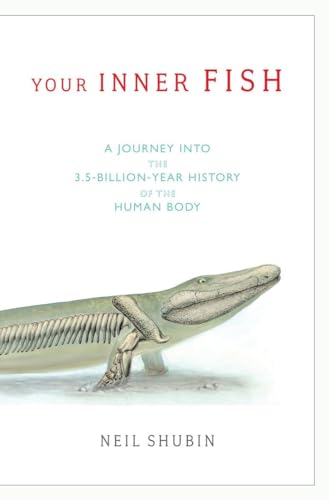
Why do we look the way we do? What does the human hand have in common with the wing of a fly? Are breasts, sweat glands, and scales connected in some way? To better understand the inner workings of our bodies and to trace the origins of many of today's most common diseases, we have to turn to unexpected sources: worms, flies, and even fish.
Neil Shubin, a leading paleontologist and professor of anatomy who discovered Tiktaalik—the "missing link" that made headlines around the world in April 2006—tells the story of evolution by tracing the organs of the human body back millions of years, long before the first creatures walked the earth. By examining fossils and DNA, Shubin shows us that our hands actually resemble fish fins, our head is organized like that of a long-extinct jawless fish, and major parts of our genome look and function like those of worms and bacteria.
Shubin makes us see ourselves and our world in a completely new light. Your Inner Fish is science writing at its finest—enlightening, accessible, and told with irresistible enthusiasm.
Die Inhaltsangabe kann sich auf eine andere Ausgabe dieses Titels beziehen.
Über die Autorin bzw. den Autor
NEIL SHUBIN is provost of The Field Museum as well as a professor of anatomy at the University of Chicago, where he also serves as an associate dean. Educated at Columbia, Harvard, and the University of California at Berkeley, he lives in Chicago.
Auszug. © Genehmigter Nachdruck. Alle Rechte vorbehalten.
FINDING YOUR INNER FISH
Typical summers of my adult life are spent in snow and sleet, cracking rocks on cliffs well north of the Arctic Circle. Most of the time I freeze, get blisters, and find absolutely nothing. But if I have any luck, I find ancient fish bones. That may not sound like buried treasure to most people, but to me it is more valuable than gold.
Ancient fish bones can be a path to knowledge about who we are and how we got that way. We learn about our own bodies in seemingly bizarre places, ranging from the fossils of worms and fish recovered from rocks from around the world to the DNA in virtually every animal alive on earth today. But that does not explain my confidence about why skeletal remains from the past—and the remains of fish, no less—offer clues about the fundamental structure of our bodies.
How can we visualize events that happened millions and, in many cases, billions of years ago? Unfortunately, there were no eyewitnesses; none of us was around. In fact, nothing that talks or has a mouth or even a head was around for most of this time. Even worse, the animals that existed back then have been dead and buried for so long their bodies are only rarely preserved. If you consider that over 99 percent of all species that ever lived are now extinct, that only a very small fraction are preserved as fossils, and that an even smaller fraction still are ever found, then any attempt to see our past seems doomed from the start.
DIGGING FOSSILS—SEEING OURSELVES
I first saw one of our inner fish on a snowy July afternoon while studying 375-million-year-old rocks on Ellesmere Island, at a latitude about 80 degrees north. My colleagues and I had traveled up to this desolate part of the world to try to discover one of the key stages in the shift from fish to land-living animals. Sticking out of the rocks was the snout of a fish. And not just any fish: a fish with a flat head. Once we saw the flat head we knew we were onto something. If more of this skeleton were found inside the cliff, it would reveal the early stages in the history of our skull, our neck, even our limbs.
What did a flat head tell me about the shift from sea to land? More relevant to my personal safety and comfort, why was I in the Arctic and not in Hawaii? The answers to these questions lie in the story of how we find fossils and how we use them to decipher our own past.
Fossils are one of the major lines of evidence that we use to understand ourselves. (Genes and embryos are others, which I will discuss later.) Most people do not know that finding fossils is something we can often do with surprising precision and predictability. We work at home to maximize our chances of success in the field. Then we let luck take over.
The paradoxical relationship between planning and chance is best described by Dwight D. Eisenhower’s famous remark about warfare: “In preparing for battle, I have found that planning is essential, but plans are useless.” This captures field paleontology in a nutshell. We make all kinds of plans to get us to promising fossil sites. Once we’re there, the entire field plan may be thrown out the window. Facts on the ground can change our best-laid plans.
Yet we can design expeditions to answer specific scientific questions. Using a few simple ideas, which I’ll talk about below, we can predict where important fossils might be found. Of course, we are not successful 100 percent of the time, but we strike it rich often enough to make things interesting. I have made a career out of doing just that: finding early mammals to answer questions of mammal origins, the earliest frogs to answer questions of frog origins, and some of the earliest limbed animals to understand the origins of land-living animals.
In many ways, field paleontologists have a significantly easier time finding new sites today than we ever did before. We know more about the geology of local areas, thanks to the geological exploration undertaken by local governments and oil and gas companies. The Internet gives us rapid access to maps, survey information, and aerial photos. I can even scan your backyard for promising fossil sites right from my laptop. To top it off, imaging and radiographic devices can see through some kinds of rock and allow us to visualize the bones inside.
Despite these advances, the hunt for the important fossils is much what it was a hundred years ago. Paleontologists still need to look at rock—literally to crawl over it—and the fossils within must often be removed by hand. So many decisions need to be made when prospecting for and removing fossil bone that these processes are difficult to automate. Besides, looking at a monitor screen to find fossils would never be nearly as much fun as actually digging for them.
What makes this tricky is that fossil sites are rare. To maximize our odds of success, we look for the convergence of three things. We look for places that have rocks of the right age, rocks of the right type to preserve fossils, and rocks that are exposed at the surface. There is another factor: serendipity. That I will show by example.
Our example will show us one of the great transitions in the history of life: the invasion of land by fish. For billions of years, all life lived only in water. Then, as of about 365 million years ago, creatures also inhabited land. Life in these two environments is radically different. Breathing in water requires very different organs than breathing in air. The same is true for excretion, feeding, and moving about. A whole new kind of body had to arise. At first glance, the divide between the two environments appears almost unbridgeable. But everything changes when we look at the evidence; what looks impossible actually happened.
In seeking rocks of the right age, we have a remarkable fact on our side. The fossils in the rocks of the world are not arranged at random. Where they sit, and what lies inside them, is most definitely ordered, and we can use this order to design our expeditions. Billions of years of change have left layer upon layer of different kinds of rock in the earth. The working assumption, which is easy to test, is that rocks on the top are younger than rocks on the bottom; this is usually true in areas that have a straightforward, layer-cake arrangement (think the Grand Canyon). But movements of the earth’s crust can cause faults that shift the position of the layers, putting older rocks on top of younger ones. Fortunately, once the positions of these faults are recognized, we can often piece the original sequence of layers back together.
The fossils inside these rock layers also follow a progression, with lower layers containing species entirely different from those in the layers above. If we could quarry a single column of rock that contained the entire history of life, we would find an extraordinary range of fossils. The lowest layers would contain little visible evidence of life. Layers above them would contain impressions of a diverse set of jellyfish-like things. Layers still higher would have creatures with skeletons, appendages, and various organs, such as eyes. Above those would be layers with the first animals to have backbones. And so on. The layers with the first people would be found higher still. Of course, a single column containing the entirety of earth history does not exist. Rather, the rocks in each location on earth represent only a small sliver of time. To get the whole picture, we need to put the pieces together by comparing the rocks themselves and the fossils inside them, much as if working a giant jigsaw puzzle.
That a column of rocks has a progression of fossil species probably comes as no surprise. Less obvious is that we can make detailed predictions about what the species in each layer...
„Über diesen Titel“ kann sich auf eine andere Ausgabe dieses Titels beziehen.
Suchergebnisse für Your Inner Fish

Beispielbild für diese ISBN
Your Inner Fish: a Journey into the 3.5-billion-year History of the Human Body
Anbieter: World of Books (was SecondSale), Montgomery, IL, USA
Verkäuferbewertung 5 von 5 Sternen

Zustand: Good. Why do we look the way we do? What does the human hand have in common with the wing of a fly? Are breasts, sweat glands, and scales connected in some way? To better understand the inner workings of our bodies and to trace the origins of many of today's most common diseases, we have to turn to unexpected sources: worms, flies, and even fish. Neil Shubin, a leading paleontologist and professor of anatomy who discovered Tiktaalik--the missing link that made headlines around the world in April 2006--tells the story of evolution by tracing the organs of the human body back millions of years, long before the first creatures walked the earth. By examining fossils and DNA, Shubin shows us that our hands actually resemble fish fins, our head is organized like that of a long-extinct jawless fish, and major parts of our genome look and function like those of worms and bacteria. Shubin makes us see ourselves and our world in a completely new light. Your Inner Fish is science writing at its finest--enlightening, accessible, and told with irresistible enthusiasm. Artikel-Nr. 00105992548
Gebraucht kaufen
EUR 4,89
Versand gratis
Versand innerhalb von USA
Versand innerhalb von USA
Anzahl: 9 verfügbar
Beispielbild für diese ISBN
Your Inner Fish: A Journey into the 3.5-Billion-Year History of the Human Body
Anbieter: Wonder Book, Frederick, MD, USA
Verkäuferbewertung 5 von 5 Sternen
Zustand: Good. Good condition. Good dust jacket. A copy that has been read but remains intact. May contain markings such as bookplates, stamps, limited notes and highlighting, or a few light stains. Artikel-Nr. I24A-03930
Gebraucht kaufen
EUR 6,40
Versand gratis
Versand innerhalb von USA
Versand innerhalb von USA
Anzahl: 2 verfügbar
Beispielbild für diese ISBN
Your Inner Fish: A Journey into the 3.5-Billion-Year History of the Human Body
Anbieter: ThriftBooks-Reno, Reno, NV, USA
Verkäuferbewertung 5 von 5 Sternen
Hardcover. Zustand: Good. No Jacket. Pages can have notes/highlighting. Spine may show signs of wear. ~ ThriftBooks: Read More, Spend Less. Artikel-Nr. G0375424474I3N00
Gebraucht kaufen
EUR 6,87
Versand gratis
Versand innerhalb von USA
Versand innerhalb von USA
Anzahl: 1 verfügbar
Beispielbild für diese ISBN
Your Inner Fish: A Journey into the 3.5-Billion-Year History of the Human Body
Anbieter: ThriftBooks-Dallas, Dallas, TX, USA
Verkäuferbewertung 5 von 5 Sternen
Hardcover. Zustand: Good. No Jacket. Pages can have notes/highlighting. Spine may show signs of wear. ~ ThriftBooks: Read More, Spend Less. Artikel-Nr. G0375424474I3N00
Gebraucht kaufen
EUR 6,89
Versand gratis
Versand innerhalb von USA
Versand innerhalb von USA
Anzahl: 1 verfügbar
Beispielbild für diese ISBN
Your Inner Fish: A Journey into the 3.5-Billion-Year History of the Human Body
Anbieter: ThriftBooks-Atlanta, AUSTELL, GA, USA
Verkäuferbewertung 5 von 5 Sternen
Hardcover. Zustand: Good. No Jacket. Pages can have notes/highlighting. Spine may show signs of wear. ~ ThriftBooks: Read More, Spend Less. Artikel-Nr. G0375424474I3N00
Gebraucht kaufen
EUR 6,89
Versand gratis
Versand innerhalb von USA
Versand innerhalb von USA
Anzahl: 1 verfügbar
Beispielbild für diese ISBN
Your Inner Fish: A Journey into the 3.5-Billion-Year History of the Human Body
Anbieter: ThriftBooks-Atlanta, AUSTELL, GA, USA
Verkäuferbewertung 5 von 5 Sternen
Hardcover. Zustand: Good. No Jacket. Missing dust jacket; Pages can have notes/highlighting. Spine may show signs of wear. ~ ThriftBooks: Read More, Spend Less. Artikel-Nr. G0375424474I3N01
Gebraucht kaufen
EUR 6,89
Versand gratis
Versand innerhalb von USA
Versand innerhalb von USA
Anzahl: 1 verfügbar
Beispielbild für diese ISBN
Your Inner Fish: A Journey into the 3.5-Billion-Year History of the Human Body
Anbieter: ThriftBooks-Dallas, Dallas, TX, USA
Verkäuferbewertung 5 von 5 Sternen
Hardcover. Zustand: Good. No Jacket. Missing dust jacket; Pages can have notes/highlighting. Spine may show signs of wear. ~ ThriftBooks: Read More, Spend Less. Artikel-Nr. G0375424474I3N01
Gebraucht kaufen
EUR 6,89
Versand gratis
Versand innerhalb von USA
Versand innerhalb von USA
Anzahl: 1 verfügbar
Beispielbild für diese ISBN
Your Inner Fish: A Journey into the 3.5-Billion-Year History of the Human Body
Anbieter: ThriftBooks-Atlanta, AUSTELL, GA, USA
Verkäuferbewertung 5 von 5 Sternen
Hardcover. Zustand: Very Good. No Jacket. May have limited writing in cover pages. Pages are unmarked. ~ ThriftBooks: Read More, Spend Less. Artikel-Nr. G0375424474I4N00
Gebraucht kaufen
EUR 6,89
Versand gratis
Versand innerhalb von USA
Versand innerhalb von USA
Anzahl: 1 verfügbar
Beispielbild für diese ISBN
Your Inner Fish : A Journey into the 3. 5-Billion-Year History of the Human Body
Verlag:
Knopf Doubleday Publishing Group, 2008
ISBN 10: 0375424474
ISBN 13: 9780375424472
Gebraucht
Hardcover
Anbieter: Better World Books, Mishawaka, IN, USA
Verkäuferbewertung 5 von 5 Sternen
Zustand: Good. Former library copy. Pages intact with minimal writing/highlighting. The binding may be loose and creased. Dust jackets/supplements are not included. Includes library markings. Stock photo provided. Product includes identifying sticker. Better World Books: Buy Books. Do Good. Artikel-Nr. GRP93717475
Gebraucht kaufen
EUR 8,31
Versand gratis
Versand innerhalb von USA
Versand innerhalb von USA
Anzahl: 2 verfügbar
Beispielbild für diese ISBN
Your Inner Fish : A Journey into the 3. 5-Billion-Year History of the Human Body
Verlag:
Knopf Doubleday Publishing Group, 2008
ISBN 10: 0375424474
ISBN 13: 9780375424472
Gebraucht
Hardcover
Anbieter: Better World Books, Mishawaka, IN, USA
Verkäuferbewertung 5 von 5 Sternen
Zustand: Very Good. Pages intact with possible writing/highlighting. Binding strong with minor wear. Dust jackets/supplements may not be included. Stock photo provided. Product includes identifying sticker. Better World Books: Buy Books. Do Good. Artikel-Nr. 3947978-6
Gebraucht kaufen
EUR 8,31
Versand gratis
Versand innerhalb von USA
Versand innerhalb von USA
Anzahl: 1 verfügbar