
Verwandte Artikel zu Room for Doubt
Inhaltsangabe
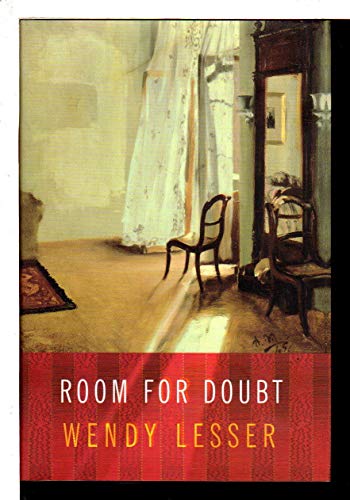
A cultural critic raised as an atheist reflects on the meaning of her Jewish heritage and her "difficult friendship" with the writer Leonard Michaels, who continues to influence her life, even after his death.
Die Inhaltsangabe kann sich auf eine andere Ausgabe dieses Titels beziehen.
Über die Autorin bzw. den Autor
Wendy Lesser is the editor of The Threepenny Review and the author of seven previous books. She is the recipient of numerous awards, including fellowships from the Guggenheim Foundation, the Remarque Institute, and the American Academy in Berlin. She divides her year between Berkeley and New York.
Auszug. © Genehmigter Nachdruck. Alle Rechte vorbehalten.
Part One: Out of Berlin
I expected to go a lifetime without ever setting foot in Germany. When I first began traveling to Europe as a college student, it was Ireland, Britain, Holland, France, and Italy that I ended up visiting—neither wholly by chance nor wholly by choice, but in that drifty, in-between way college students do things. Afterwards, when I was living in England for two years, it would have been easy enough to go to Germany, but I didn’t. And then, as I grew into my thirties and forties, this coincidence hardened into a resolve. “I have never been to Germany” became one of the totemic sentences of my identity, like “I have never been to a professional ball game” or “I have never been sky-diving.” And never will, these sentences implied.
But of course Germany was a different case. Nothing prevented me from attending ball games or taking up sky-diving except fear—fear of crowds and boredom in the former instance, just plain fear in the latter. The feeling that kept me away from Germany, while it had elements of fear mingled into it, was much more complicated. It partook of moral distaste and historical allegiance. It stemmed from a notion that Jews do not visit Germany, and broadened out to include all morally upright people in its scope. I found myself unduly shocked when friends of mine reported that they had enjoyed their trips to Germany. “Shocked” is perhaps not the right word: I found it incomprehensible that one could have a good time there. And since pleasure (though sometimes a very abstruse pleasure, of a sort that other people might call work) is what fuels all my travel decisions, I couldn’t imagine ever wanting to go to Germany.
My Jewishness, though it clearly had something to do with this attitude, was not enough to explain it. I am not and have never been a very good Jew. Born into a family of secular Jews in which religious disbelief went back several generations, I grew up celebrating Christmas and attending school on Jewish holidays, as did most of the other California Jews I knew; in fact, we were all so assimilated that I barely knew which of my childhood friends were Jewish and which were not. On my father’s side, there had once been some synagogue-going by my grandfather, but that, I suspect, was largely for business purposes: as a child, I was told that this grandfather had been sent to San Quentin for selling land that didn’t exist “to other members of the synagogue,” a description which managed to suggest that the crime inhered mainly in the tribal betrayal. My father’s reaction to having a father like this was to become scrupulously rule-abiding and unshakably agnostic.
My mother’s relationship to Judaism was slightly more mystical. Her parents—a Russian-Jewish woman, staunchly tough and unremittingly difficult during all the years I knew her, who had wanted to be a doctor but had been channeled by anti-Semitism and anti-feminism into nursing; and a man about whom I have no information except that his name was Ephraim Gerson, that he abandoned his family when the children were young, and that he joined the Communist Party shortly before dying of alcoholism—had no religious feelings whatsoever. Perhaps because of this, my mother longed to see what religious belief felt like. She would introduce into our family bizarre versions of Jewish practice in an attempt to simulate the real thing. At one point she insisted we have a Passover seder, and when the Haggadah specified that a ceremonial bone be placed on the table, she went out to the backyard and fetched in the family dog’s chewed-up bone. One year she attempted to ban Christmas from the house. (I cannot remember whether my sister and I overcame the ban that year, or only the following year.) Her second marriage, to a non-Jew, was conducted by a rabbi. None of these attempts were viewed by either me or my sister as serious efforts to inculcate us with religion. And the result, in my case, is that I am a devout atheist who acknowledges her Jewish ancestry mainly because it would seem to be caving in to Hitler not to do so.
Hitler was a definite presence in my childhood. Though he was already seven years dead by the time I was born, he lived on in the collective imagination as the ultimate incarnation of evil. Among people my age, he was the endpoint of every philosophical argument (“Well, would you believe in the death penalty if it were Hitler being executed?”) and a useful spur to action (when I ran fast in schoolyard races, I always imagined being chased by the Nazis). In our secular household he stood in for the devil, but he was much more effective than the devil, in that his works were undeniable. Among the pictures in our family photograph albums was a yellowing news photo my mother had preserved from her youth, a picture of a Jewish child looking straight at the camera as she was herded off to a concentration camp. Though she looked as if she could have been related to us, she was not: all our relatives (with whom, in any case, we were mostly not on speaking terms) were safely in America by the time of Hitler’s rise to power. But it was made clear to me that he would have come after me if he could have. Being merely Jew-ish, as Jonathan Miller puts it, would not have been enough to save me.
We were not the kind of family that boycotted all things German. Our cars were Volkswagen Bugs, we had a recording of Lotte Lenya singing The Threepenny Opera, and one of the few things my mother taught me to cook was a raisin-studded noodle kugel, identical in its title and contents to the dish made by a Lutheran friend I met at college. But the strange thing is that when German things did seep into our household, I always faintly imagined they were Jewish. It was not until I was well into adulthood, for instance, that I realized Bertolt Brecht was not a Jew.
These misperceptions of mine were not entirely wrong. One of the things I was to discover, when I eventually went to Berlin, was how deeply Jewish that city’s culture still is. Or perhaps what I observed is how deeply the German and Jewish cultures had once entered into each other, so that the versions we now have of them, at least here in America and there in Berlin, are still colored by that mutual infusion. It’s not just a matter of language, though it’s true that for an urban, coastal American, German words are mostly familiar because they sound like Yiddish. And it’s not just that many Jews used to live in Berlin (seventy percent of the city’s lawyers, I’ve read, and ninety percent of its doctors, or perhaps it was the other way around, were Jewish in 1930). The real oddity lies in the number of things about the city that still feel Jewish: for instance, its passion for concert-hall performances—for art and culture in any of their manifestations, really; or its insistence on punctuality; or the blunt, practical manner of its inhabitants. Arriving in Berlin, I felt in some strange way as if I were coming to a homeland I’d never known about, a place where people shared all my personal quirks. My love of order, my brusque aggressiveness, my linear mode of thought, my insistence on constantly distinguishing better from worse, all blended in with the surrounding culture rather than marking me off as a weirdo, as they had in California. Some of these qualities could have, and did, find fellowship in New York, but that did not surprise me: Jews still lived there, after all. What amazed me was that even more of these Jewish traits of mine (if they were indeed Jewish, and not just mysteriously, inexplicably German) found a roost, a homecoming, in this city from which the Jews had mainly disappeared.
There were...
„Über diesen Titel“ kann sich auf eine andere Ausgabe dieses Titels beziehen.
Suchergebnisse für Room for Doubt

Beispielbild für diese ISBN
Room for Doubt
Anbieter: ThriftBooks-Atlanta, AUSTELL, GA, USA
Verkäuferbewertung 5 von 5 Sternen

Hardcover. Zustand: Very Good. No Jacket. May have limited writing in cover pages. Pages are unmarked. ~ ThriftBooks: Read More, Spend Less. Artikel-Nr. G0375424008I4N00
Gebraucht kaufen
EUR 14,73
Versand gratis
Versand innerhalb von USA
Versand innerhalb von USA
Anzahl: 1 verfügbar
Beispielbild für diese ISBN
Room for Doubt
Verlag:
Knopf Doubleday Publishing Group, 2007
ISBN 10: 0375424008
ISBN 13: 9780375424007
Gebraucht
Hardcover
Anbieter: Better World Books, Mishawaka, IN, USA
Verkäuferbewertung 5 von 5 Sternen
Zustand: Good. Former library copy. Pages intact with minimal writing/highlighting. The binding may be loose and creased. Dust jackets/supplements are not included. Includes library markings. Stock photo provided. Product includes identifying sticker. Better World Books: Buy Books. Do Good. Artikel-Nr. GRP92152238
Gebraucht kaufen
EUR 16,46
Versand gratis
Versand innerhalb von USA
Versand innerhalb von USA
Anzahl: 1 verfügbar
Foto des Verkäufers
ROOM FOR DOUBT.
Verlag:
Pantheon, New York, 2007
ISBN 10: 0375424008
ISBN 13: 9780375424007
Gebraucht
Hardcover
Erstausgabe
Anbieter: Bookfever, IOBA (Volk & Iiams), Ione, CA, USA
Verkäuferbewertung 5 von 5 Sternen
Zustand: FINE. First printing. An uncommon memoir - In Berlin, where Lesser was planning to write a book about the Scottish philosopher David Hume, she finds herself instead writing "about her 'difficult friendship' with Leonard Michaels. In doing so, she comes to see that their difficulties - fights and reconciliations, mutual obstinacy, and an intensely shared interest in the arts - were an essential and binding aspect of a friendship which, despite Michaels recent death, remains an important part of her life." 205 pp. Fine in fine dust jacket. Artikel-Nr. 68966
Gebraucht kaufen
EUR 18,33
EUR 4,40 Versand
Versand innerhalb von USA
Versand innerhalb von USA
Anzahl: 1 verfügbar