
Verwandte Artikel zu How To Be A Bad Birdwatcher
Inhaltsangabe
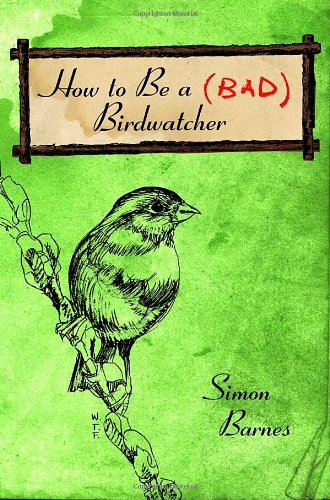
An entertaining and irreverent introduction to the art of birdwatching explains how to appreciate the beauty and color of the avian world, without becoming caught up in the scientific names, drawing on the works of fellow writers, as well as his own experiences, to express the pleasure of the pastime. 20,000 first printing.
Die Inhaltsangabe kann sich auf eine andere Ausgabe dieses Titels beziehen.
Über die Autorin bzw. den Autor
Simon Barnes is the award-winning chief sportswriter for The Times of London. He is the author of a number of books on wildlife, conservation, and travel, and of three novels. He is also the well-loved and controversial columnist of Birds magazine, a publication of the Royal Society for the Protection of Birds.
Auszug. © Genehmigter Nachdruck. Alle Rechte vorbehalten.
ONE
Not just a nice hobby
I am a Bad Birdwatcher.
On the other hand, and taking one thing with another, when it comes to enjoying birds I am world-class.
Where shall I start? With the carmine bee-eaters of the Luangwa Valley in Zambia? With the rhinoceros hornbill glimpsed through a gap in the canopy in the rain forests of Borneo? Or with the crested oropendola seen from the press box at the Queen's Park cricket ground in Trinidad (when I was being paid to watch Ian Botham)?
No. Let's start in Barnet, on the extreme edge of London. I used to live there. I was going into the center of London to meet someone, perhaps even to do some work. I wasn't looking for birds. I hadn't even got binoculars; you can't use them in a London pub, not without attracting adverse comment, anyway.
I wasn't looking for birds, but I am always looking at them, you see. Not for reasons of science, or in hopes of a fabulous rarity, or to make careful observations of seasonal behavior. Just because looking at birds is one of life's greatest pleasures. Looking at birds is a key: it opens doors, and if you choose to go through them you find you enjoy life more and understand life better.
It was a nice day of early summer, the kind of day when a chap's eyes keep turning to the girls who have molted into their skimpy summer plumage and men wear their jackets on their thumbs. And because it was such a nice day, I thought I'd walk past the common to Hadley Wood train station rather than through the High Street to High Barnet tube. It turned out to be one of my better decisions.
I was going through Monken Hadley churchyard to catch a train that would get me to Oxford Circus (change at Highbury and Islington) in forty minutes. And there were lots (note scientific precision) of house martins whizzing round and round the church tower.
House martins are related to American purple martins. Both are related to barn swallows, which appear on both sides of the Atlantic. House martins are jaunty and swallow-like and, if you are lucky, they nest under the eaves of your house and leave aromatic trails down the wall and bring joy to your heart on the rare day in spring when they return from their travels.
They are dapper little chaps, navy blue with white bums, and they are one of the sights and sounds of the English summer, doing things like whizzing round church steeples and catching flies in their beaks. Later in the season the young ones take up whizzing themselves, trying to get the hang of this flying business. I always imagine the martin mother saying: Well done, little one. You flew three times round the church tower. Now you've got another flight to try. Cape Town.
Where was I? Monken Hadley church, pausing on my journey to Oxford Street to spend a few moments gazing at the whirligig of martins. It was nothing special, nothing exceptional, and it was very good indeed. Note this: one of the great pleasures of birdwatching is the quiet enjoyment of the absolutely ordinary.
And then it happened. Bam!
Gone.
From the tail of my eye, I saw what I took to be a kestrel. I turned my head to watch it as it climbed, and I waited for it to go into its hover, according to time-honored kestrel custom. But it did nothing of the kind. It turned itself into an anchor, or the Greek letter psi. Or a thunderbolt.
No kestrel this: it crashed into the crowd of martins like the wrath of God, and almost as swiftly vanished. I think it got one, but I can't swear to it, it was all so fast. And there I was down on the pavement with a bag full of books on my back, uttering incredulous obscenities and prayerful blasphemies. What the hell was that?
It was a hobby. Perhaps the most dashing falcon of them all: slim, elegant, and deadly fast. Not rare as rare-bird addicts reckon things; they come to Britain in reasonable numbers every summer to breed. The sight of a hobby makes no headlines in the birdwatching world. It was just a wonderful and wholly unexpected sight of a wonderful and wholly unexpected bird. It was a moment of perfect drama. Note this: one of the great pleasures of birdwatching is the moments of peak experience.
We humans tend to simultaneous and mutually exclusive desires: to be married, to be single; to be social, to be alone; to travel adventurously, to stay at home. Birdwatching embraces both halves of our natural desire for contradiction. It brings us enhanced enjoyment of the ordinary, the easy, and the safe, and it brings us moments of high drama and gratification and dangerous delight.
Rather like life, really. And that is what bad birdwatching is all about. Life, that is to say.
Let's go back to that hobby, and those martins. How much skill was required? How much knowledge? How much scientific background? None, none, and none. The martins were just there, being obvious and making their merry farting calls to on another: one of the great ambient birds of the English summer. Everyone in Britain has seen martins, just as everyone on both sides of the Atlantic has seen barn swallows, even if he can't put a name to them.
And the hobby was unmissable, unmistakable: a great black (I saw him only in silhouette) force. It wasn't necessary to identify the bird, to know it by name; it was enough to witness a fierce and terrible drama. Any bad birdwatcher would know it was a bird of prey, and any human being would have known it was something dreadful. Knowing its name was a luxury. It wasn't exciting because it was rare and because I could call it Falco subbuteo and because I could tick it and boast about it. It was exciting because it was a thrilling bird in a thrilling moment.
Now, I am lying here just a bit. Knowing that the bird was a hobby was a formal completion of the business. It was an explanation, a key to the drama. That is what hobbies do, you see: they turn into anchors or psis and make sudden lacerating dives into flocks of circling martins. It was gratifying to have the explanation, the understanding.
But before the understanding comes the wonder. Comes the delight. And that is the first aim of being a bad birdwatcher: the calm delight of the utterly normal, and the rare and sudden delight of the utterly unexpected.
The only real skill involved in this perfect birdwatching moment was the willingness to look. It was not skill that gave me the sight; it was habit. I have developed the habit of looking: when I see a bird I always look, wherever I am. It is no longer a conscious decision. I might be in the middle of a conversation of amazing importance about the Direction of Our Marriage, but my eye will flick out of the window at a hint of movement, caught in the tail of my eye, and I will register: bloody hell, sparrowhawk. I might say it aloud, too--not necessarily a wise decision.
I once found a questionnaire in a birdwatching magazine. It asked: "How often do you go birdwatching?" I reject the question out of hand. I don't go birdwatching. I am birdwatching. Birdwatching is a state of being, not an activity. It doesn't depend on place, on equipment, on specific purpose, like, say, fishing. It is not a matter of organic train-spotting; it is about life and it is about living.
It is a matter of keeping the eyes and ears and mind open. It is not a matter of obsession, not at all. It is just quiet enjoyment. A happy married man will still glance at pretty girls and appreciate their loveliness without the need to do anything about it. It is just a habit of heterosexual males to look, and it is one that adds to the gaiety of life.
A car nut will make a quiet, unthinking appraisal of every vehicle he sees; it is part of the way his mind works. He will hardly be aware that he is doing...
„Über diesen Titel“ kann sich auf eine andere Ausgabe dieses Titels beziehen.
Suchergebnisse für How To Be A Bad Birdwatcher

Beispielbild für diese ISBN
How to Be a (Bad) Birdwatcher
Anbieter: World of Books (was SecondSale), Montgomery, IL, USA
Verkäuferbewertung 5 von 5 Sternen

Zustand: Very Good. Item in very good condition! Textbooks may not include supplemental items i.e. CDs, access codes etc. Artikel-Nr. 00105004356
Gebraucht kaufen
EUR 4,82
Versand gratis
Versand innerhalb von USA
Versand innerhalb von USA
Anzahl: 2 verfügbar
Beispielbild für diese ISBN
How to Be a (Bad) Birdwatcher
Anbieter: World of Books (was SecondSale), Montgomery, IL, USA
Verkäuferbewertung 5 von 5 Sternen
Zustand: Good. Item in good condition. Textbooks may not include supplemental items i.e. CDs, access codes etc. Artikel-Nr. 00106982179
Gebraucht kaufen
EUR 4,82
Versand gratis
Versand innerhalb von USA
Versand innerhalb von USA
Anzahl: 1 verfügbar
Beispielbild für diese ISBN
How to Be a (Bad) Birdwatcher
Verlag:
Pantheon (edition X-Library - 1st), 2005
ISBN 10: 0375423559
ISBN 13: 9780375423550
Gebraucht
Hardcover
Anbieter: BooksRun, Philadelphia, PA, USA
Verkäuferbewertung 5 von 5 Sternen
Hardcover. Zustand: Very Good. X-Library - 1st. With dust jacket. It's a well-cared-for item that has seen limited use. The item may show minor signs of wear. All the text is legible, with all pages included. It may have slight markings and/or highlighting. Artikel-Nr. 0375423559-11-1-29
Gebraucht kaufen
EUR 4,82
Versand gratis
Versand innerhalb von USA
Versand innerhalb von USA
Anzahl: 1 verfügbar
Beispielbild für diese ISBN
How to Be a (Bad) Birdwatcher
Anbieter: ThriftBooks-Dallas, Dallas, TX, USA
Verkäuferbewertung 5 von 5 Sternen
Hardcover. Zustand: Very Good. No Jacket. May have limited writing in cover pages. Pages are unmarked. ~ ThriftBooks: Read More, Spend Less. Artikel-Nr. G0375423559I4N00
Gebraucht kaufen
EUR 6,50
Versand gratis
Versand innerhalb von USA
Versand innerhalb von USA
Anzahl: 1 verfügbar
Beispielbild für diese ISBN
How to Be a (Bad) Birdwatcher
Anbieter: ThriftBooks-Atlanta, AUSTELL, GA, USA
Verkäuferbewertung 5 von 5 Sternen
Hardcover. Zustand: Very Good. No Jacket. May have limited writing in cover pages. Pages are unmarked. ~ ThriftBooks: Read More, Spend Less. Artikel-Nr. G0375423559I4N00
Gebraucht kaufen
EUR 6,50
Versand gratis
Versand innerhalb von USA
Versand innerhalb von USA
Anzahl: 1 verfügbar
Beispielbild für diese ISBN
How to Be a (Bad) Birdwatcher
Anbieter: ThriftBooks-Reno, Reno, NV, USA
Verkäuferbewertung 5 von 5 Sternen
Hardcover. Zustand: Good. No Jacket. Missing dust jacket; Pages can have notes/highlighting. Spine may show signs of wear. ~ ThriftBooks: Read More, Spend Less. Artikel-Nr. G0375423559I3N01
Gebraucht kaufen
EUR 6,50
Versand gratis
Versand innerhalb von USA
Versand innerhalb von USA
Anzahl: 1 verfügbar
Beispielbild für diese ISBN
How to Be a (Bad) Birdwatcher
Anbieter: ThriftBooks-Reno, Reno, NV, USA
Verkäuferbewertung 5 von 5 Sternen
Hardcover. Zustand: Very Good. No Jacket. May have limited writing in cover pages. Pages are unmarked. ~ ThriftBooks: Read More, Spend Less. Artikel-Nr. G0375423559I4N00
Gebraucht kaufen
EUR 6,50
Versand gratis
Versand innerhalb von USA
Versand innerhalb von USA
Anzahl: 1 verfügbar
Beispielbild für diese ISBN
How to Be a (Bad) Birdwatcher
Anbieter: ThriftBooks-Dallas, Dallas, TX, USA
Verkäuferbewertung 5 von 5 Sternen
Hardcover. Zustand: Good. No Jacket. Former library book; Pages can have notes/highlighting. Spine may show signs of wear. ~ ThriftBooks: Read More, Spend Less. Artikel-Nr. G0375423559I3N10
Gebraucht kaufen
EUR 6,50
Versand gratis
Versand innerhalb von USA
Versand innerhalb von USA
Anzahl: 1 verfügbar
Beispielbild für diese ISBN
How to Be a (Bad) Birdwatcher
Anbieter: ThriftBooks-Reno, Reno, NV, USA
Verkäuferbewertung 5 von 5 Sternen
Hardcover. Zustand: Good. No Jacket. Pages can have notes/highlighting. Spine may show signs of wear. ~ ThriftBooks: Read More, Spend Less. Artikel-Nr. G0375423559I3N00
Gebraucht kaufen
EUR 6,50
Versand gratis
Versand innerhalb von USA
Versand innerhalb von USA
Anzahl: 1 verfügbar
Beispielbild für diese ISBN
How to Be a (Bad) Birdwatcher
Anbieter: ThriftBooks-Phoenix, Phoenix, AZ, USA
Verkäuferbewertung 5 von 5 Sternen
Hardcover. Zustand: Very Good. No Jacket. May have limited writing in cover pages. Pages are unmarked. ~ ThriftBooks: Read More, Spend Less. Artikel-Nr. G0375423559I4N00
Gebraucht kaufen
EUR 6,50
Versand gratis
Versand innerhalb von USA
Versand innerhalb von USA
Anzahl: 1 verfügbar