
Verwandte Artikel zu Disarming Iraq
Inhaltsangabe
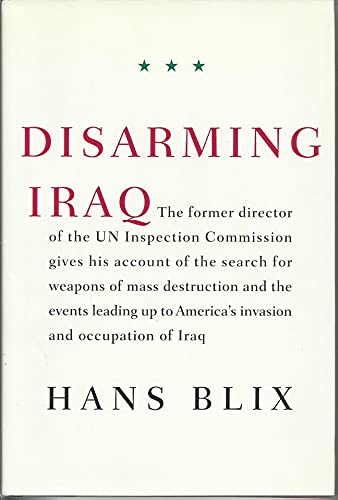
The chairman of the International Commission on Weapons of Mass Destruction and the former leader of the U.N.'s weapons inspection team provides an objective, firsthand account of the events leading up to the 2003 invasion of Iraq, detailing meetings with international leaders, the activities of his inspection team, and more. 75,000 first printing.
Die Inhaltsangabe kann sich auf eine andere Ausgabe dieses Titels beziehen.
Über die Autorinnen und Autoren
Hans Blix was the director general of the International Atomic Energy Agency from 1981 to 1997 and was a member of Sweden s delegation to the United Nations from 1961 to 1981. From 2000 to 2003, he was the executive director of the United Nations Monitoring, Verification, and Inspection Commission (UNMOVIC), supervising international inspections for weapons of mass destruction in Iraq until the inspections were suspended in March 2003. Blix has been named chairman of the newly formed International Commission on Weapons of Mass Destruction, which began its work in January 2004. He lives in Sweden.
Hans Blix was the director general of the International Atomic Energy Agency from 1981 to 1997, was a member of Sweden's delegation to the United Nations from 1961 to 1981, and from 2000 to 2003, was the executive director of the United Nations Monitoring, Verification, and Inspection Commission (UNMOVIC), supervising international inspections for weapons of mass destruction in Iraq until the inspections were suspended in March 2003. Blix has been named chairman of the newly formed International Commission on Weapons of Mass Destruction, which began its work in January 2004.
Auszug. © Genehmigter Nachdruck. Alle Rechte vorbehalten.
Chapter 1
Disarming Iraq:
Moments of Truth? Invasion Instead of Inspection
On the afternoon of Sunday, March 16, 2003, I was in my office on the thirty-first floor of the United Nations Secretariat building in New York, the headquarters of the UN Monitoring, Verification and Inspection Commission for Iraq (UNMOVIC). Some of my close collaborators had joined me to put the final touches on a work program I was to submit to the Security Council.
When our commission was established by a Security Council resolution in December 1999, the Council had recognized that there might still be weapons of mass destruction (WMD) in Iraq, despite the fact that a great deal of disarmament had been accomplished through UN inspections after the end of the Gulf War in 1991. In November 2002, a new round of inspections had been initiated to identify key remaining tasks in the disarming of Iraq.
Although the inspection organization was now operating at full strength and Iraq seemed as determined to give it prompt access everywhere, the United States appeared determined to replace our inspection force with an invasion army. After the terror attacks on New York and Washington on September 11, 2001, a policy of containment-keeping Saddam Hussein in his box-and ensuring the disarmament of Iraq through UN inspections was deemed no longer acceptable.
The people around me were all solid professionals coming from different parts of the world. There was Dimitri Perricos, probably the world's most experienced inspector. A Greek and by profession a chemist, he had more than twenty years of experience with international nuclear inspections-in Iraq, North Korea, South Africa and many other places. He was the head of operations. Muttusamy Sanmuganathan, known to all as Sam, was from Sri Lanka. Both Dimitri and Sam had worked closely with me for many years in Vienna, when I was the director general of the International Atomic Energy Agency (IAEA). Ewen Buchanan, a Scot, was our manager of media relations and institutional memory. For years he had been a political expert and the spokesman of the previous inspection authority, the UN Special Commission (UNSCOM). There was Torkel Stiernlöf, who had been stationed in Baghdad and knew Arabic. He was about to return to his job at the foreign ministry in Stockholm after six intense months as my executive assistant. Lastly, there was Torkel's successor, Olof Skoog, an ambassador at the early age of 35 and on loan to me.
The military invasion of Iraq was all but announced and here we were at the UN sketching a peaceful way to try to ensure the country's disarmament! The military force, whose buildup had begun in the summer of 2002 and had been an essential reason why Iraq had accepted the inspectors back, had reached invasion strength and was now waiting to be deployed.
In the Security Council, all efforts to reach agreement on what might be demanded of Iraq in the next few weeks had collapsed. Proposals had been made by the British that Saddam Hussein should go before Iraqi television and declare his determination to disarm and to cooperate fully with the inspectors. The declaration would be accompanied by Iraq's fulfillment of a number of specific disarmament tasks within a very short time-perhaps ten days. (The approach had some similarity to the British efforts which ten months later would prompt Libya's leader, Colonel Muammar Qaddafi, to declare that Libya was stopping all efforts to acquire weapons of mass destruction and would open up for thorough inspection.) The U.S./UK would consider themselves authorized to take armed action against Iraq if they determined that Iraq was in non-fulfillment of the demands.
While the guidelines in the December 1999 UNMOVIC resolution were perfectly valid and called for a work program covering a first period of 120 days of inspections, the U.S., the UK and Spain had been taking their cues from Security Council Resolution 1441, adopted on November 8, 2002. In their reading, this resolution gave Iraq only a limited time and a last opportunity to cooperate to attain disarmament or else face "serious consequences." That limited time, in their view, had now expired. Others in the Security Council thought the process of inspections required more time. They were not ready, at this stage, to authorize "serious consequences"-armed action. Most member states of the Council were of the view that such a decision was for the Council collectively, not for individual members, as the U.S. and the UK insisted.
On this Sunday, U.S. president George W. Bush, British prime minister Tony Blair and Spanish prime minister Jose Maria Aznar Lopez had met for an hour on the Azores islands in the middle of the Atlantic and, for the record, made a last appeal to reluctant members of the Security Council to go along with the draft resolution on Iraq. Blair had stressed that they had gone an extra mile for peace, but Bush seemed already to be describing the blessings that would follow from armed action.
Most observers felt the war was now a certainty-and, indeed, it came. Although I thought the probability was very high, I was also, even at this very late date, aware that unexpected things can happen. I remembered how, in July 1991, after confrontations, the Iraqis had sent the IAEA a note admitting that they had tried several methods of enriching uranium. In October 1998, Kofi Annan, the secretary general of the United Nations, had secured an important concession from Iraq, prompting U.S. president Bill Clinton to call back bombers that had been sent to punish Iraq for its lack of cooperation. If, in the current situation, Saddam Hussein had made the kind of dramatic speech the British suggested, and offered quickly to solve a number of issues, there might well have been a suspension of the marching and flying orders and, instead, intensified inspections. Saddam did make a speech on his son's television channel, but it was not the dramatic gesture that the situation called for. In it, he noted that Iraq had had weapons of mass destruction in the past, but that it had none now.
As we were sitting around the table in my office, the telephone rang. It was Assistant Secretary of State John Wolf in Washington, calling to advise me that it was time to withdraw our inspectors from Iraq. No further notice would be issued and expeditious action was suggested.
Preparations for the Withdrawal of Inspectors
We had been preparing for this situation since the end of February, and in the previous few weeks had deliberately decreased the total number of our staff in Iraq. The chartered helicopters had already been removed by their owners. We had one airplane sitting in Baghdad and another was chartered to enable us to assist the UN by airlifting staff dealing with humanitarian assistance. Jeeps and buses for land transport would also be available, if this were to prove necessary.
It was now around 3 p.m. this Sunday in New York, and 11 p.m. in Baghdad. If Dr. Miroslav Gregovic, the head of our mission in Baghdad, were instructed immediately, the first planeload of staff would leave Baghdad the following morning. I was anxious to bring the people for whom I was responsibile to security as soon as possible. However, I was not the only one with responsibility. As secretary general, Kofi Annan had the highest managerial responsibility for all UN staff in Iraq. My colleague Mohamed ElBaradei, director general of the IAEA, was responsible for the nuclear inspectors in Baghdad. I phoned both. Mohamed did not want to hasten the process. He was anxious that the withdrawal should not look like a retreat.
Although the secretary general did not need permission from the Security Council to issue an order of withdrawal, he wanted to inform the Council before he gave the instruction. He decided that he would do so at a...
„Über diesen Titel“ kann sich auf eine andere Ausgabe dieses Titels beziehen.
Suchergebnisse für Disarming Iraq

Beispielbild für diese ISBN
Disarming Iraq
Anbieter: World of Books (was SecondSale), Montgomery, IL, USA
Verkäuferbewertung 5 von 5 Sternen

Hardback. Zustand: Good. Artikel-Nr. 00105470759
Gebraucht kaufen
EUR 4,78
Versand gratis
Versand innerhalb von USA
Versand innerhalb von USA
Anzahl: 4 verfügbar
Beispielbild für diese ISBN
Disarming Iraq
Anbieter: World of Books (was SecondSale), Montgomery, IL, USA
Verkäuferbewertung 5 von 5 Sternen
Hardback. Zustand: Very Good. Artikel-Nr. 00109066317
Gebraucht kaufen
EUR 4,78
Versand gratis
Versand innerhalb von USA
Versand innerhalb von USA
Anzahl: 1 verfügbar
Beispielbild für diese ISBN
Disarming Iraq
Anbieter: BooksRun, Philadelphia, PA, USA
Verkäuferbewertung 5 von 5 Sternen
Hardcover. Zustand: Very Good. 1. With dust jacket. It's a well-cared-for item that has seen limited use. The item may show minor signs of wear. All the text is legible, with all pages included. It may have slight markings and/or highlighting. Artikel-Nr. 0375423028-11-1-29
Gebraucht kaufen
EUR 5,16
Versand gratis
Versand innerhalb von USA
Versand innerhalb von USA
Anzahl: 1 verfügbar
Beispielbild für diese ISBN
Disarming Iraq
Verlag:
Knopf Doubleday Publishing Group, 2004
ISBN 10: 0375423028
ISBN 13: 9780375423024
Gebraucht
Hardcover
Anbieter: Better World Books: West, Reno, NV, USA
Verkäuferbewertung 5 von 5 Sternen
Zustand: Good. Former library copy. Pages intact with minimal writing/highlighting. The binding may be loose and creased. Dust jackets/supplements are not included. Includes library markings. Stock photo provided. Product includes identifying sticker. Better World Books: Buy Books. Do Good. Artikel-Nr. 8013048-6
Gebraucht kaufen
EUR 6,33
Versand gratis
Versand innerhalb von USA
Versand innerhalb von USA
Anzahl: 1 verfügbar
Beispielbild für diese ISBN
Disarming Iraq
Verlag:
Knopf Doubleday Publishing Group, 2004
ISBN 10: 0375423028
ISBN 13: 9780375423024
Gebraucht
Hardcover
Anbieter: Better World Books, Mishawaka, IN, USA
Verkäuferbewertung 5 von 5 Sternen
Zustand: Good. Pages intact with minimal writing/highlighting. The binding may be loose and creased. Dust jackets/supplements are not included. Stock photo provided. Product includes identifying sticker. Better World Books: Buy Books. Do Good. Artikel-Nr. GRP64802381
Gebraucht kaufen
EUR 6,33
Versand gratis
Versand innerhalb von USA
Versand innerhalb von USA
Anzahl: 1 verfügbar
Beispielbild für diese ISBN
Disarming Iraq
Anbieter: Wonder Book, Frederick, MD, USA
Verkäuferbewertung 5 von 5 Sternen
Zustand: Very Good. Very Good condition. Good dust jacket. A copy that may have a few cosmetic defects. May also contain light spine creasing or a few markings such as an owner's name, short gifter's inscription or light stamp. Artikel-Nr. W06L-01688
Gebraucht kaufen
EUR 6,40
Versand gratis
Versand innerhalb von USA
Versand innerhalb von USA
Anzahl: 1 verfügbar
Beispielbild für diese ISBN
Disarming Iraq
Anbieter: Wonder Book, Frederick, MD, USA
Verkäuferbewertung 5 von 5 Sternen
Zustand: Good. Good condition. Good dust jacket. A copy that has been read but remains intact. May contain markings such as bookplates, stamps, limited notes and highlighting, or a few light stains. Bundled media such as CDs, DVDs, floppy disks or access codes may not be included. Artikel-Nr. O08D-01734
Gebraucht kaufen
EUR 6,40
Versand gratis
Versand innerhalb von USA
Versand innerhalb von USA
Anzahl: 1 verfügbar
Beispielbild für diese ISBN
Disarming Iraq
Anbieter: ThriftBooks-Atlanta, AUSTELL, GA, USA
Verkäuferbewertung 5 von 5 Sternen
Hardcover. Zustand: As New. No Jacket. Pages are clean and are not marred by notes or folds of any kind. ~ ThriftBooks: Read More, Spend Less. Artikel-Nr. G0375423028I2N00
Gebraucht kaufen
EUR 6,91
Versand gratis
Versand innerhalb von USA
Versand innerhalb von USA
Anzahl: 1 verfügbar
Beispielbild für diese ISBN
Disarming Iraq
Anbieter: ThriftBooks-Dallas, Dallas, TX, USA
Verkäuferbewertung 5 von 5 Sternen
Hardcover. Zustand: Very Good. No Jacket. May have limited writing in cover pages. Pages are unmarked. ~ ThriftBooks: Read More, Spend Less. Artikel-Nr. G0375423028I4N00
Gebraucht kaufen
EUR 6,91
Versand gratis
Versand innerhalb von USA
Versand innerhalb von USA
Anzahl: 1 verfügbar
Beispielbild für diese ISBN
Disarming Iraq
Verlag:
Pantheon Books, New York, New York, U.S.A., 2004
ISBN 10: 0375423028
ISBN 13: 9780375423024
Gebraucht
Hardcover
Anbieter: The Yard Sale Store, Narrowsburg, NY, USA
Verkäuferbewertung 5 von 5 Sternen
Hard Cover. Zustand: Good. Nice hard covered edition in a full dust jacket. Just a bit of shelf wear to the covers. Some scuff to the dust jacket. Quite presentable! New looking inside. Artikel-Nr. HCText111509083
Gebraucht kaufen
EUR 3,65
EUR 5,31 Versand
Versand innerhalb von USA
Versand innerhalb von USA
Anzahl: 1 verfügbar