
Verwandte Artikel zu Isaac Newton
Inhaltsangabe
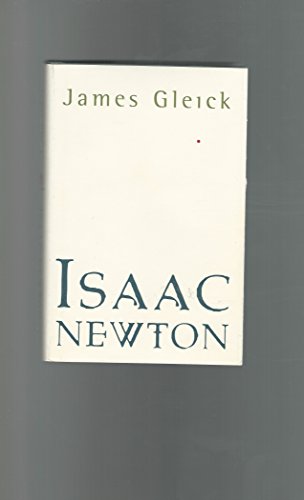
In this biography, James Gleick moves between a comprehensive historical portrait and a dramatic focus on Newton's significant letters and unpublished notebooks to illuminate the real importance of his work in physics, in optics, and in calculus. He makes us see the old intuitive, alchemical universe out of which Newton's mathematics first arose and shows us how Newton's ideas have altered all forms of understanding from history to philosophy. And he gives us an account of the conflicting impulses that pulled at this man's heart: his quiet longings, his rage, his secrecy, the extraordinary subtleties of personality that were mirrored in the invisible forces he first identified as the building blocks of science. More than biography, more than history, more than science, Isaac Newton tells us how, through the mind of one man, we have come to know our place in the cosmos.
Die Inhaltsangabe kann sich auf eine andere Ausgabe dieses Titels beziehen.
Über die Autorin bzw. den Autor
James Gleick is an author, reporter, and essayist. His writing on science and technology–including Chaos, Genius, Faster, and What Just Happened–has been translated into thirty languages. He lives in New York.
From the Trade Paperback edition.
Aus dem Klappentext
James Gleick has long been fascinated by the making of science how ideas order visible appearances, how equations can give meaning to molecular and stellar phenomena, how theories can transform what we see. In Chaos, he chronicled the emergence of a new way of looking at dynamic systems; in Genius, he portrayed the wondrous dimensions of Richard Feynman s mind. Now, in Isaac Newton, he gives us the story of the scientist who, above all others, embodied humanity s quest to unveil the hidden forces that constitute the physical world.
In this original, sweeping, and intimate biography, Gleick moves between a comprehensive historical portrait and a dramatic focus on Newton s significant letters and unpublished notebooks to illuminate the real importance of his work in physics, in optics, and in calculus. He makes us see the old intuitive, alchemical universe out of which Newton s mathematics first arose and shows us how Newton s ideas have altered all forms of understanding from history to philosophy. And he gives us a moving account of the conflicting impulses that pulled at this man s heart: his quiet longings, his rage, his secrecy, the extraordinary subtleties of a personality that were mirrored in the invisible forces he first identified as the building blocks of science. More than biography, more than history, more than science, Isaac Newton tells us how, through the mind of one man, we have come to know our place in the cosmos.
Auszug. © Genehmigter Nachdruck. Alle Rechte vorbehalten.
Chapter 1
What Imployment Is He Fit For?
Medieval, in some disrepair, the Woolsthorpe farmhouse nestled into a hill near the River Witham. With its short front door and shuttered windows, its working kitchen, and its bare floors of ash and linden laid on reeds, it had belonged to Newton's forebears for just twenty years. In back stood apple trees. Sheep grazed for acres around.
Isaac was born in a small room at the top of the stairs. By the terms of feudal law this house was a manor and the fatherless boy was its lord, with seigniorial authority over a handful of tenant farmers in nearby cottages. He could not trace his ancestry back past his grandfather, Robert, who lay buried in the churchyard nearly a mile to the east. Still, the boy expected to live managing the farm in the place of the father he had never known. His mother, Hannah Ayscough, had come from gentlefolk. Her brother, the Reverend William Ayscough, studied at Cambridge University on his way to joining the Anglican clergy; now he occupied a village rectory two miles away. When Isaac was three years old and his widowed mother near thirty, she accepted a marriage offer from another nearby rector, Barnabas Smith, a wealthy man twice her age. Smith wanted a wife, not a stepson; under the negotiated terms of their marriage Hannah abandoned Isaac in the Woolsthorpe house, leaving him to his grandmother's care.
War flared in the countryside all through his youth. The decade-long Great Rebellion began in the year of his birth: Parliamentarians fighting Royalists, Puritans recoiling from the idolatry they saw in the Church of England. Motley, mercenary armies skirmished throughout the Midlands. Pikemen and musketeers sometimes passed through the fields near Woolsthorpe. Bands of men plundered farms for supplies. England was at war with itself and also, increasingly, aware of itself-its nationhood, its specialness. Divided as it was, convulsed over ecclesiastical forms and beliefs, the nation carried out a true revolution. The triumphant Puritans rejected absolutism and denied the divine right of the monarchy. In 1649, soon after Isaac turned six, Charles Stuart, the king, was beheaded at the wall of his palace.
This rustic country covered a thousandth of the world's landmass, cut off from the main continent since the warming of the planet and the melting of polar ice 13,000 years before. Plundering, waterborne tribes had settled on its coasts in waves and diffused into its downs and valleys, where they aggregated in villages. What they knew or believed about nature depended in part on the uses of technology. They had learned to employ the power of water and wind to crush, grind, and polish. The furnace, the forge, and the mill had taken their place in an economy that thereby grew more specialized and hierarchical. People in England, as in many human communities, made metal-kettles of copper and brass, rods and nails of iron. They made glass. These crafts and materials were prerequisites now to a great leap in knowledge. Other prerequisites were lenses, paper and ink, mechanical clocks, numeric systems capable of denoting indefinitely small fractions, and postal services spanning hundreds of miles.
By the time of Newton's birth, one great city had formed, with about 400,000 people; no other town was even a tenth as large. England was still a country of villages and farms, its seasons ordered by the Christian calendar and the rhythms of agriculture: lambing and calving, haymaking and harvest. Years of harvest failure had brought widespread starvation. Roving laborers and vagrants made up much of the population. But a class of artisans and merchants was coming into its own: traders, shopkeepers, apothecaries, glaziers, carpenters, and surveyors, all developing a practical, mechanical view of knowledge. They used numbers and made tools. The nucleus of a manufacturing economy was taking shape.
When Isaac was old enough, he walked to the village dame school, where he learned to read and studied the Bible and chanted arithmetic tables. He was small for his age, lonely and abandoned. Sometimes he wished his stepfather dead, and his mother, too: in a rage he threatened to burn their house down over them. Sometimes he wished himself dead and knew the wish for a sin. On bright days sunlight crept along the wall. Darkness as well as light seemed to fall from the window- or was it from the eye? No one knew. The sun projected slant edges, a dynamic echo of the window frame in light and shadow, sometimes sharp and sometimes blurred, expressing a three-dimensional geometry of intersecting planes. The particulars were hard to visualize, though the sun was the most regular of heavenly objects, the one whose cycles already defined the measures of time. Isaac scratched crude geometric figures, circles with arcs inscribed, and hammered wooden pegs into the walls and the ground to measure time exactly, to the nearest quarter-hour. He cut sun-dials into stone and charted the shadows cast by their gnomons. This meant seeing time as akin to space, duration as length, the length of an arc. He measured small distances with strings and made a translation between inches and minutes of an hour. He had to revise this translation methodically as the seasons changed. Across the day the sun rose and fell; across the year its position in the sky shifted slightly against the fixed stars and traced a slowly twisting figure eight, a figure invisible except to the mind's eye. Isaac grew conscious of this pattern long before he understood it as the product of two oddities, the earth's elliptical orbit and a tilt in its axis.
At Woolsthorpe anyone who cared to know the hour consulted Isaac's dials. "O God! Methinks it were a happy life," said Shakespeare's Henry VI, "to carve out dials quaintly, point by point, thereby to see the minutes how they run." Sun-dials-shadow-clocks-still told most people the time, though at some churches the hour could be read from mechanical clocks. At night the stars turned in the blue vault of the sky; the moon waxed and waned and traced its own path, much like the sun's, yet not exactly-these great globes, ruling the seasons, lighting the day and night, connected as if by invisible cords. Sun-dials embodied practical knowledge that had been refined over millennia. With cruder sun-dials, the hours were unequal and varied with the seasons. Better versions achieved precision and encouraged an altered sense of time itself: not just as a recurring cycle, or a mystical quality influencing events, but as duration, measurable, a dimension. Still, no one could perfect or even understand sun-dials until all the shifting pieces of a puzzle had been assembled: the shadows, the rhythms, the orbits of planets, the special geometry of the ellipse, the attraction of matter by matter. It was all one problem.
When Isaac was ten, in 1653, Barnabas Smith died, and Hannah returned to Woolsthorpe, bringing three new children with her. She sent Isaac off to school, eight miles up the Great North Road, to Grantham, a market town of a few hundred families-now a garrison town, too. Grantham had two inns, a church, a guild hall, an apothecary, and two mills for grinding corn and malt. Eight miles was too far to walk each day; Isaac boarded with the apothecary, William Clarke, on High Street. The boy slept in the garret and left signs of his presence, carving his name into the boards and drawing in charcoal on the walls: birds and beasts, men and ships, and pure abstract circles and triangles.
At the Kings School, one room, with strict Puritan discipline, Henry Stokes, schoolmaster, taught eighty boys Latin, theology, and some Greek and Hebrew. In most English schools that would have been all, but Stokes added some practical arithmetic for his prospective farmers: mostly about measurement of areas and shapes, algorithms for surveying,...
„Über diesen Titel“ kann sich auf eine andere Ausgabe dieses Titels beziehen.
Suchergebnisse für Isaac Newton

Beispielbild für diese ISBN
Isaac Newton
Anbieter: Wonder Book, Frederick, MD, USA
Verkäuferbewertung 5 von 5 Sternen

Zustand: Good. Good condition. Acceptable dust jacket. A copy that has been read but remains intact. May contain markings such as bookplates, stamps, limited notes and highlighting, or a few light stains. Artikel-Nr. T14A-06218
Gebraucht kaufen
EUR 6,41
Versand gratis
Versand innerhalb von USA
Versand innerhalb von USA
Anzahl: 1 verfügbar
Beispielbild für diese ISBN
Isaac Newton : Die Biografie
Verlag:
Knopf Doubleday Publishing Group, 2003
ISBN 10: 0375422331
ISBN 13: 9780375422331
Gebraucht
Hardcover
Anbieter: Better World Books, Mishawaka, IN, USA
Verkäuferbewertung 5 von 5 Sternen
Zustand: Good. Former library copy. Pages intact with minimal writing/highlighting. The binding may be loose and creased. Dust jackets/supplements are not included. Includes library markings. Stock photo provided. Product includes identifying sticker. Better World Books: Buy Books. Do Good. Artikel-Nr. GRP102406054
Gebraucht kaufen
EUR 6,55
Versand gratis
Versand innerhalb von USA
Versand innerhalb von USA
Anzahl: 2 verfügbar
Beispielbild für diese ISBN
Isaac Newton : Die Biografie
Verlag:
Knopf Doubleday Publishing Group, 2003
ISBN 10: 0375422331
ISBN 13: 9780375422331
Gebraucht
Hardcover
Anbieter: Better World Books, Mishawaka, IN, USA
Verkäuferbewertung 5 von 5 Sternen
Zustand: Good. Pages intact with minimal writing/highlighting. The binding may be loose and creased. Dust jackets/supplements are not included. Stock photo provided. Product includes identifying sticker. Better World Books: Buy Books. Do Good. Artikel-Nr. 4109947-6
Gebraucht kaufen
EUR 6,55
Versand gratis
Versand innerhalb von USA
Versand innerhalb von USA
Anzahl: 3 verfügbar
Beispielbild für diese ISBN
Isaac Newton
Anbieter: ThriftBooks-Phoenix, Phoenix, AZ, USA
Verkäuferbewertung 5 von 5 Sternen
Hardcover. Zustand: Good. No Jacket. Pages can have notes/highlighting. Spine may show signs of wear. ~ ThriftBooks: Read More, Spend Less. Artikel-Nr. G0375422331I3N00
Gebraucht kaufen
EUR 6,84
Versand gratis
Versand innerhalb von USA
Versand innerhalb von USA
Anzahl: 2 verfügbar
Beispielbild für diese ISBN
Isaac Newton
Anbieter: ThriftBooks-Phoenix, Phoenix, AZ, USA
Verkäuferbewertung 5 von 5 Sternen
Hardcover. Zustand: Good. No Jacket. Former library book; Pages can have notes/highlighting. Spine may show signs of wear. ~ ThriftBooks: Read More, Spend Less. Artikel-Nr. G0375422331I3N10
Gebraucht kaufen
EUR 6,84
Versand gratis
Versand innerhalb von USA
Versand innerhalb von USA
Anzahl: 1 verfügbar
Beispielbild für diese ISBN
Isaac Newton
Anbieter: ThriftBooks-Reno, Reno, NV, USA
Verkäuferbewertung 5 von 5 Sternen
Hardcover. Zustand: Good. No Jacket. Former library book; Pages can have notes/highlighting. Spine may show signs of wear. ~ ThriftBooks: Read More, Spend Less. Artikel-Nr. G0375422331I3N10
Gebraucht kaufen
EUR 6,84
Versand gratis
Versand innerhalb von USA
Versand innerhalb von USA
Anzahl: 1 verfügbar
Beispielbild für diese ISBN
Isaac Newton
Anbieter: ThriftBooks-Reno, Reno, NV, USA
Verkäuferbewertung 5 von 5 Sternen
Hardcover. Zustand: Good. No Jacket. Pages can have notes/highlighting. Spine may show signs of wear. ~ ThriftBooks: Read More, Spend Less. Artikel-Nr. G0375422331I3N00
Gebraucht kaufen
EUR 6,84
Versand gratis
Versand innerhalb von USA
Versand innerhalb von USA
Anzahl: 3 verfügbar
Beispielbild für diese ISBN
Isaac Newton
Anbieter: ThriftBooks-Phoenix, Phoenix, AZ, USA
Verkäuferbewertung 5 von 5 Sternen
Hardcover. Zustand: Good. No Jacket. Missing dust jacket; Pages can have notes/highlighting. Spine may show signs of wear. ~ ThriftBooks: Read More, Spend Less. Artikel-Nr. G0375422331I3N01
Gebraucht kaufen
EUR 6,84
Versand gratis
Versand innerhalb von USA
Versand innerhalb von USA
Anzahl: 2 verfügbar
Beispielbild für diese ISBN
Isaac Newton
Anbieter: ThriftBooks-Reno, Reno, NV, USA
Verkäuferbewertung 5 von 5 Sternen
Hardcover. Zustand: Fair. No Jacket. Readable copy. Pages may have considerable notes/highlighting. ~ ThriftBooks: Read More, Spend Less. Artikel-Nr. G0375422331I5N00
Gebraucht kaufen
EUR 6,84
Versand gratis
Versand innerhalb von USA
Versand innerhalb von USA
Anzahl: 1 verfügbar
Beispielbild für diese ISBN
Isaac Newton
Anbieter: ThriftBooks-Dallas, Dallas, TX, USA
Verkäuferbewertung 5 von 5 Sternen
Hardcover. Zustand: Good. No Jacket. Former library book; Pages can have notes/highlighting. Spine may show signs of wear. ~ ThriftBooks: Read More, Spend Less. Artikel-Nr. G0375422331I3N10
Gebraucht kaufen
EUR 6,92
Versand gratis
Versand innerhalb von USA
Versand innerhalb von USA
Anzahl: 1 verfügbar