
Verwandte Artikel zu From the Briarpatch File: On Context, Procedure, and...
Inhaltsangabe
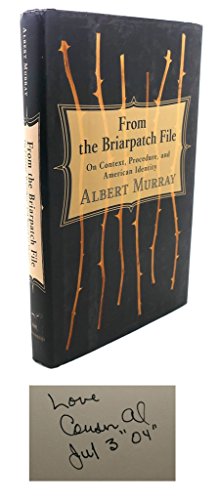
The renowned novelist, essayist, poet, and literary and social critic presents a collection of scholarly and provocative essays, reviews, and interviews that examine contemporary America, including his own beginnings as a writer, the accomplishments of Duke Ellington and William Faulkner, the responsibilites of the black educated elite, and the near-tragic, near-comic aura of the blues.
Die Inhaltsangabe kann sich auf eine andere Ausgabe dieses Titels beziehen.
Über die Autorin bzw. den Autor
Albert Murray was born in Nokomis, Alabama, in 1916. He was educated at Tuskegee Institute, where he later taught literature and directed the college theater. He is the author of many works of fiction and nonfiction, including <i>The Seven League Boots</i>, <i>The Blue Devils of Nada</i>, and <i>The Spyglass Tree</i>. He lives in New York City.
Aus dem Klappentext
In <i>From the Briarpatch File</i>―a gathering of erudite, provocative, and iconoclastic essays, reviews, and interviews―Albert Murray approaches contemporary America through its artistic expressions of itself and through the inventiveness of his own thinking and experience. He writes about New York in the 1920s and about the beginnings of his career as a writer. He gives us profound assessments of the achievements of Duke Ellington and William Faulkner. He outlines the responsibilities of the black educated elite and discusses the near-tragic, near-comic essence of the blues. His subject is no less than the life of America today; the clarity and the singularity of his vision, thought, and language are no less than stunning.
Auszug. © Genehmigter Nachdruck. Alle Rechte vorbehalten.
Part 1- The Briarpatch
One - Antagonistic Cooperation in Alabama
In the remarks I made on April 16, 1988, at the University of Alabama in Tuscaloosa, where I was a participant in a symposium on "The American South: Distinctiveness and Its Limitations," I began by stating that as a writer of fiction which I hoped would be read as serious literary statement of universal appeal above all else, my primary concern was not with recording, reporting, or documenting sociopolitical data as such about the South.
But then I went on to point out that the universally appealing in art, which is to say aesthetic statement, is always achieved through the extension, elaboration, and refinement of the local details and idiomatic particulars that impinge most intimately on one's everyday existence. So the point was not that I was not at all concerned with writing about the South, but rather that I have always been more interested in ultimate metaphors about the South than in social science surveys about it. Because whereas sociopolitical reports in effect give circumstances which amount to predicament all of the advantages over incentive and ambition, the metaphor may be employed as a pragmatic device that functions as our most basic equipment for living, by which of course I mean self-fulfillment.
The metaphor represents how we feel about whatever facts and figures are used to describe or define the concrete circumstances of our existence wherever we are. And how we feel adds up to our outlook or horizon of aspiration, which is the source of our incentive or lack of incentive.
In brief, how I felt about the socioeconomic and political circumstances in the Alabama in which I grew up during the 1920s and the 1930s added up to me thinking of myself as having to be as the ever nimble and ever resourceful mythological Alabama jackrabbit in the no less actual than mythological Alabama briarpatch. Thus I have never thought of myself as a victim or a villain. I was always, but always, the fairy tale hero who would marry the fairy tale princess.
All of which is also why I've written so much about the blues (and about jazz, which is the fully orchestrated blues statement). To me, blues music has never been the misery music that the ever so benevolent social-science-survey-oriented do-gooders and uplifters of the downtrodden seem to think it is. To me it has always been good-time music, music that inspires you to stomp away low-down blue feelings and stomp in an atmosphere of earthy well-being and affirmation and celebration of the sheer fact of existence.
Yes, the ever so blue lyrics are indeed about problems, troubles, disappointment, defeat, loss, and unhappiness. But the music, with its locomotive beat and onomatopoeia, not only counterstates and counteracts the complaint that life itself is such a low-down dirty shame, it also goes on to transform the atmosphere (of the juke joint, honky-tonk, or even the rent party) from that of a purification ritual to a fertility ritual! A juke joint, honky-tonk, or any blues dive is a good-time place, and I've never seen, heard, or heard of a blues musician who was not primarily interested in making the good times roll.
Anyway, to me blues music is an aesthetic device of confrontation and improvisation, an existential device or vehicle for coping with the ever-changing fortunes of human existence, in a word entropy, the tendency of everything to become formless. Which is also to say that such music is a device for confronting and acknowledging the harsh fact that the human situation (the human situation as such) is always awesome and all too often awful. The blues lyric never lets you forget that.
And yet the blues statement is neither a matter of commiseration nor of protestation as such. According to Kenneth Burke's book Attitudes Toward History, aesthetic statement falls into one or the other of two rhetorical frames of reference. On the one hand, there is a frame of rejection within which the basic statement is that life should not be a matter of tribulation. Hence the plaint, the complaint, the protestation, the grotesque, the burlesque, the satire, the caricature, the elegy, and so on. But on the other hand there is the frame of acceptance of the obvious fact that life is always a struggle against destructive forces and elements whether seen or unseen. Thus the aesthetic statement takes the form of the ode, the hymn of praise, the epic, the tragedy (of noble defeat), the comedy (of insightful resolution), the melodrama (of resolution through effective engineering); and then there is farce, which is where I place the blues and jazz because such music presents life as a matter of perpetual readjustment and improvisation.
Such is the context within which I place my blues-derived literary statement. When Scooter, the protagonist of Train Whistle Guitar, The Spyglass Tree, and The Seven League Boots, says "My name is Jack the Rabbit because I was bred and born and brought up in the briarpatch," he is speaking in terms of the idiomatic particulars of a brownskin boy from Alabama, but his actions should add up to the anecdotes that represent the basic ancestral American outlook on what life is all about.
As a frame of acceptance the blues as literary statement also functions in terms of the dynamics of antagonistic cooperation! In a blues composition or anecdote, a key structural device is the break, a cessation of the established rhythm and temp which jazz musicians regard and respond to not as a detrimental or trauma-inducing disruption not unlike the abrupt intrusion of the villain or some other personification of disaster, but rather as an opportunity to exercise their personal best.
What makes the Alabama jackrabbit so nimble, so resilient, so elegantly resourceful? The briarpatch!
Two - Context and Definition
At Mobile County Training School on the outskirts of Mobile, Alabama, where I was a high school junior in the spring of 1934, you had to compose, memorize, and deliver an essay in the annual juniors' oratorical contest, a major event of the commencement season, of greater importance and only slightly less popular than the annual junior-senior prom. It was an occasion when next year's seniors not only showed their promise but also began their competition for college scholarship grants, without which during those stark days of the Depression many of the most promising among us would not have been able to go to college.
It was while collecting materials in preparation for my oration that I came across a poem by one Langston Hughes. It was in an anthology of writings from the so-called Harlem Renaissance entitled The New Negro, edited by Alain Locke. The poem was called "Youth," and not only did I memorize it and use it as the outchorus for my statement, I also appropriated the title of Alain Locke's anthology as the theme and title of my presentation.
Well, Langston's poem didn't win the juniors' oratorical contest for me. But along with Locke's theme it did lead the sponsors to choose me as the lead-off speaker, which meant that faculty support for my college scholarship grant status was already very strong indeed.
I can't say that Langston Hughes or anybody else from the so-called Harlem Renaissance as such inspired me to be a writer. Once I got to college and became involved with literature as existential equipment for living rather than as academic exercises and ceremonial-recitation fluff stuff, nothing in The New Negro struck me as being in the same league as such world-class twentieth-century writers as James Joyce, Thomas Mann, Marcel Proust, André Malraux, Ernest Hemingway, William Faulkner, T. S. Eliot, W. B. Yeats, and Ezra Pound, among others. Which is to say there was nothing from my...
„Über diesen Titel“ kann sich auf eine andere Ausgabe dieses Titels beziehen.
Suchergebnisse für From the Briarpatch File: On Context, Procedure, and...

Beispielbild für diese ISBN
From the Briarpatch File : On Context, Procedure and American Identity
Verlag:
Knopf Doubleday Publishing Group, 2001
ISBN 10: 0375421424
ISBN 13: 9780375421426
Gebraucht
Hardcover
Erstausgabe
Anbieter: Better World Books, Mishawaka, IN, USA
Verkäuferbewertung 5 von 5 Sternen

Zustand: Good. 1st. Pages intact with minimal writing/highlighting. The binding may be loose and creased. Dust jackets/supplements are not included. Stock photo provided. Product includes identifying sticker. Better World Books: Buy Books. Do Good. Artikel-Nr. 5063674-6
Gebraucht kaufen
EUR 6,04
Versand gratis
Versand innerhalb von USA
Versand innerhalb von USA
Anzahl: 1 verfügbar
Beispielbild für diese ISBN
From the Briarpatch File : On Context, Procedure and American Identity
Verlag:
Knopf Doubleday Publishing Group, 2001
ISBN 10: 0375421424
ISBN 13: 9780375421426
Gebraucht
Hardcover
Erstausgabe
Anbieter: Better World Books: West, Reno, NV, USA
Verkäuferbewertung 5 von 5 Sternen
Zustand: Good. 1st. Former library copy. Pages intact with minimal writing/highlighting. The binding may be loose and creased. Dust jackets/supplements are not included. Includes library markings. Stock photo provided. Product includes identifying sticker. Better World Books: Buy Books. Do Good. Artikel-Nr. 470469-6
Gebraucht kaufen
EUR 6,04
Versand gratis
Versand innerhalb von USA
Versand innerhalb von USA
Anzahl: 1 verfügbar
Beispielbild für diese ISBN
From the Briarpatch File : On Context, Procedure and American Identity
Verlag:
Knopf Doubleday Publishing Group, 2001
ISBN 10: 0375421424
ISBN 13: 9780375421426
Gebraucht
Hardcover
Erstausgabe
Anbieter: Better World Books, Mishawaka, IN, USA
Verkäuferbewertung 5 von 5 Sternen
Zustand: Good. 1st. Former library copy. Pages intact with minimal writing/highlighting. The binding may be loose and creased. Dust jackets/supplements are not included. Includes library markings. Stock photo provided. Product includes identifying sticker. Better World Books: Buy Books. Do Good. Artikel-Nr. 470469-6
Gebraucht kaufen
EUR 6,04
Versand gratis
Versand innerhalb von USA
Versand innerhalb von USA
Anzahl: 1 verfügbar
Beispielbild für diese ISBN
From the Briarpatch File: On Context, Procedure, and American Identity
Anbieter: ThriftBooks-Phoenix, Phoenix, AZ, USA
Verkäuferbewertung 5 von 5 Sternen
Hardcover. Zustand: Very Good. No Jacket. May have limited writing in cover pages. Pages are unmarked. ~ ThriftBooks: Read More, Spend Less. Artikel-Nr. G0375421424I4N00
Gebraucht kaufen
EUR 6,27
Versand gratis
Versand innerhalb von USA
Versand innerhalb von USA
Anzahl: 1 verfügbar
Beispielbild für diese ISBN
From the Briarpatch File: On Context, Procedure, and American Identity
Anbieter: ThriftBooks-Dallas, Dallas, TX, USA
Verkäuferbewertung 5 von 5 Sternen
Hardcover. Zustand: Very Good. No Jacket. May have limited writing in cover pages. Pages are unmarked. ~ ThriftBooks: Read More, Spend Less. Artikel-Nr. G0375421424I4N00
Gebraucht kaufen
EUR 6,27
Versand gratis
Versand innerhalb von USA
Versand innerhalb von USA
Anzahl: 1 verfügbar
Beispielbild für diese ISBN
From the Briarpatch File: On Context, Procedure, and American Identity
Anbieter: Wonder Book, Frederick, MD, USA
Verkäuferbewertung 5 von 5 Sternen
Zustand: Very Good. Very Good condition. Very Good dust jacket. A copy that may have a few cosmetic defects. May also contain light spine creasing or a few markings such as an owner's name, short gifter's inscription or light stamp. Artikel-Nr. B12A-03565
Gebraucht kaufen
EUR 6,27
Versand gratis
Versand innerhalb von USA
Versand innerhalb von USA
Anzahl: 1 verfügbar
Beispielbild für diese ISBN
From the Briarpatch File: On Context, Procedure, and American Identity
Anbieter: Magers and Quinn Booksellers, Minneapolis, MN, USA
Verkäuferbewertung 5 von 5 Sternen
Hardcover. Zustand: Very Good. May have light to moderate shelf wear and/or a remainder mark. Complete. Clean pages. Artikel-Nr. 1283346
Gebraucht kaufen
EUR 5,82
EUR 3,48 Versand
Versand innerhalb von USA
Versand innerhalb von USA
Anzahl: 1 verfügbar
Beispielbild für diese ISBN
From the Briarpatch File; On Context, Procedure, and American Identity (A Fine First Edition)
Verlag:
Pantheon (New York), 2001
ISBN 10: 0375421424
ISBN 13: 9780375421426
Gebraucht
Hardcover
Erstausgabe
Anbieter: Dan Pope Books, West Hartford, CT, USA
Verkäuferbewertung 5 von 5 Sternen
Hardcover. Zustand: Fine. Zustand des Schutzumschlags: Fine. 1st Edition. New York: Pantheon Books (2001). First edition. First printing. Hardcover. Fine/Fine. A clean, tight copy. Comes with mylar dust jacket cover. Shipped in well-padded box. Smoke-free shop. Defect-free. LITERATURE, M. SALE. Artikel-Nr. LW-680
Gebraucht kaufen
EUR 11,22
EUR 3,92 Versand
Versand innerhalb von USA
Versand innerhalb von USA
Anzahl: 1 verfügbar
Beispielbild für diese ISBN
From the Briarpatch File: On Context, Procedure, and American Identity
Anbieter: Powell's Bookstores Chicago, ABAA, Chicago, IL, USA
Verkäuferbewertung 5 von 5 Sternen
Hardcover. Zustand: Used-Very Good. 1st. Cloth, dj. Slight shelf wear. Artikel-Nr. 1857690
Gebraucht kaufen
EUR 9,43
EUR 6,54 Versand
Versand innerhalb von USA
Versand innerhalb von USA
Anzahl: 1 verfügbar
Foto des Verkäufers
FROM THE BRIARPATCH FILE
Verlag:
Pantheon, New York, 2001
ISBN 10: 0375421424
ISBN 13: 9780375421426
Gebraucht
Hardcover
Erstausgabe
Anbieter: Andre Strong Bookseller, Blue Hill, ME, USA
Verkäuferbewertung 5 von 5 Sternen
Hardcover. Zustand: Near Fine. Zustand des Schutzumschlags: very good +. First edition. 5 x in. Paper boards. Condition is NEAR FINE ; mibor wear, else like new. DJ is VERY GOOD+ ; not clipped, a bit rubbed. Essays. Stax. Artikel-Nr. 33539
Gebraucht kaufen
EUR 13,46
EUR 6,10 Versand
Versand innerhalb von USA
Versand innerhalb von USA
Anzahl: 1 verfügbar