
Verwandte Artikel zu Legacy
Inhaltsangabe
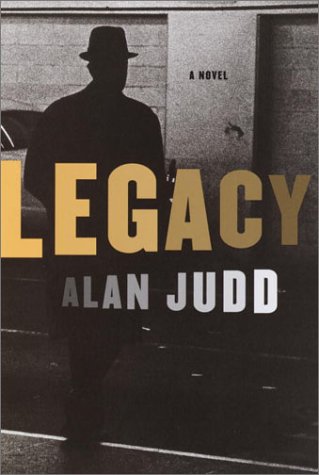
Training at MI6 during the height of the Cold War, Charles Thoroughgood learns that his father is suspected of having worked for the KGB, a situation that forces him to choose between his father and the code of the secret service. 25,000 first printing.
Die Inhaltsangabe kann sich auf eine andere Ausgabe dieses Titels beziehen.
Über die Autorin bzw. den Autor
Alan Judd began writing while in the Foreign Office. His biography of Ford Madox Ford won the Royal Society of Literature’s Heinemann Award. He recently published a biography of Mansfield Cumming, founder of Great Britain’s modern Secret Service. Judd writes regularly for the Daily Telegraph in London.
Aus dem Klappentext
dd, winner of the Guardian Fiction Prize for The Devil s Own Work and author of the acclaimed biography Ford Madox Ford--a mesmerizing tale from the golden age of espionage.
It is the mid-1970s, the height of the Cold War. Charles Thoroughgood, recently discharged from military service, begins, rather comically, his training at MI6. But on one of his first real assignments, the charming but inexpert spook learns from a former Cambridge classmate a secret that threatens to end his career just as it begins: Charles s deceased father, a decorated military hero, is suspected of having worked for the KGB. As Charles struggles to uncover the truth, ultimately forced to choose between honoring his father and the inexorable code of the Secret Service, he is drawn deeper and deeper into the vortex of the international intelligence machinery--far deeper than any veteran spy, much less a novice, could ever imagine.
Authentic and elegantly told, <
Auszug. © Genehmigter Nachdruck. Alle Rechte vorbehalten.
CHAPTER ONE
LONDON, MID-1970s
It was a warm summer when Charles Thoroughgood left the army and joined the Secret Service but politically the world was deep in the Cold War. He moved to London and rented a basement flat in Kensington with a view of sodden detritus in the well of the building and the housekeeper's kitchen. He suspected that, from behind her dirty net curtains, she spent days and nights in unprofitable surveillance of his own uncurtained window. "Slack Alice," Roger Donnington, his colleague and flatmate, had dubbed her. "Face that would stop a coal barge."
One autumn Monday, he got up after a restless night to a humid, muggy London. The flat's tiny bathroom had no window and the electricity was off. Shaving by candlelight was a slow operation because he had to keep moving the candle as he traversed each cheek, and it was difficult to get any light at all beneath the chin without risk of singeing. He had long owned an electric razor, a present from his mother, but it had never left its box. The idea of using it had always felt like a concession to something, perhaps a luxurious and corrupting modernity. It was irrelevant now, anyway, because he had used the battery for his radio. Calling an electrician to restore mains power had, so far, proved too great a concession for either him or Roger.
The milk and butter in the powerless fridge smelt rancid. Someone would have to throw them away, sometime. He made toast in the gas stove, covered it with Marmite and drank black tea. He tidied the bedclothes on his double mattress on the floor, put on his light suit and flicked a tie free of the clothes crammed on the hook on his bedroom door. Before leaving he knocked on Roger's door. Roger had his own mattress in the sitting room, with the television at its foot. Charles had got in late the night before, so had no idea whether Roger was alone or accompanied. There was no answer. He knocked again, louder. "Okay?" he called.
Roger's groan became a cough. "Okay."
It was not to be a normal day at the office, though few were at that time. He was glad of that: secret service seemed so far to provide the advantages of bureaucratic employment--security, purpose, companionship and, though he might not yet have admitted it to himself, the pleasing consciousness of service--without the monotony he assumed to go with office life. He wouldn't need his bike that day, so left it propped up against the bedroom wall.
The best features of the flat were the front door of the building and the curving staircase, both of a size and grandeur to give an impression of spaciousness and opulence within. It had been cheaply converted into flats during the 1950s and 1960s and already the additions seemed older and more worn than the house. The plaster was cracked, paintwork faded, doors warped and skirting boards had parted company with their walls. The door of Charles's flat was tucked beneath the bottom turn of the staircase, so that stepping from it into the entrance hall was literally to enter a bigger and brighter world.
Out on Queensgate, he turned left towards Hyde Park after a deliberate glance across the wide street to check that his car was undamaged. The rush-hour traffic was heavier than usual, perhaps in anticipation of further wildcat strikes on the Underground, and the delay in crossing the Cromwell Road gave him the pretext to look about as if seeking a quicker way. He did the same at Kensington Gore, then walked behind the Albert Memorial and into the park. He walked unhurriedly, trying to establish a regular but not purposeless pace.
He looked back around again before he crossed the Serpentine Road and took one of the footpaths to Marble Arch and Speakers Corner. Anyone following would have to keep well back, or ahead or to the side, but then close quickly before Charles entered the Marble Arch subway. Presumably they would have car as well as foot surveillance, and radio. A car team might become a foot team when they needed to close, but to do that the cars would have to loiter in the busy Park Lane or Bayswater Road, which was never easy.
Once in the subway and reasonably sure he was out of sight, he broke the rules by looking behind without an obvious reason. None of the figures in the park was hurrying. No puffy, sweaty man or woman suddenly appeared at the top of the steps. Perhaps they were waiting in Queensgate for Roger, if they were there at all. They might have a long wait.
In Oxford Street he made for C&A, where he bought two pairs of black socks. It was cooler in the store and he loitered a while among the suits, before taking a back street to Marylebone Station, walking slowly with his jacket over his arm. At the station he bought a day return to Beaconsfield. The newsagent had sold out of The Times because the printers had gone on strike during the night, leaving only the early editions available. There would be time to find one later. He settled for the previous week's Economist.
He knew the forty-minute journey. Whether or not they were following by car, they would have to put at least one watcher on the train with him. If there were any "they." He read until the approaching Chilterns countryside gave reason for glancing about the carriage. It was tempting to get off at one of the small stations before Beaconsfield to see who got off with him, but that was cinema stuff. The trick in evading surveillance, they were told, was not only to get away but to give the impression you weren't looking for surveillance because you were innocent of anything that would merit it. At Seer Green, the last halt before Beaconsfield, he glimpsed a Ford Escort in the car park with Russian diplomatic number plates. He saw it too late to get the number but was sure enough of its origin. They were supposed to report all such sightings.
At Beaconsfield a grizzled, grey-haired man wearing jeans and incongruously polished brown shoes got off with him. Charles walked unhurriedly up the station approach, pausing to look in a shop window at the top. The man crossed the road and became engrossed in an estate agent's window. Charles continued his walk, turning left towards Old Beaconsfield, with its stockbroker Tudor avenues, neo-Georgian mini-mansions and moguls' houses of the twenties and thirties, with large unseen gardens and new Jaguars and Rovers in swept gravel drives. The low cloud had thinned enough to permit weak sunshine.
He strode purposefully into Hughes's, the Mercedes dealership. The forecourt was lined with polished secondhand saloons described as "nearly new," with their distinctive vertical headlights and squared-off, no-nonsense styling. Beige seemed the most popular colour, followed by red. To one side was a trio of elegant sports models with their dished roofs and thick, rounded leather seats. Immediately outside the showroom was a luxurious new S class, gleaming silver and easily the biggest car there. Charles paused by it before entering the show-room and wandering with what he hoped was critical detachment among the new cars within.
A salesman sat smoking at a desk with a telephone, a notepad, a Mercedes brochure and a copy of Glass's Guide, the trade price list. He had rubbery features and crinkly dark hair. Charles watched through the window as Brown Shoes crossed the forecourt to the older saloons. His back was to the showroom but he could probably see it in the car windscreens. The salesman took two long pulls on his cigarette before stubbing it out and slipping Glass's Guide into his desk drawer. He rose and came over to Charles, his features now composed into a rubbery smile. "Can I help, sir?"
"I'm thinking of buying a car."
"Just what we like to hear, sir. Mercedes, I take it?"
"Could be."
"Anything...
„Über diesen Titel“ kann sich auf eine andere Ausgabe dieses Titels beziehen.
Suchergebnisse für Legacy

Beispielbild für diese ISBN
Legacy
Anbieter: ThriftBooks-Atlanta, AUSTELL, GA, USA
Verkäuferbewertung 5 von 5 Sternen

Hardcover. Zustand: Good. No Jacket. Pages can have notes/highlighting. Spine may show signs of wear. ~ ThriftBooks: Read More, Spend Less. Artikel-Nr. G0375414843I3N00
Gebraucht kaufen
EUR 8,44
Versand gratis
Versand innerhalb von USA
Versand innerhalb von USA
Anzahl: 1 verfügbar
Beispielbild für diese ISBN
Legacy
Anbieter: ThriftBooks-Atlanta, AUSTELL, GA, USA
Verkäuferbewertung 5 von 5 Sternen
Hardcover. Zustand: Good. No Jacket. Former library book; Pages can have notes/highlighting. Spine may show signs of wear. ~ ThriftBooks: Read More, Spend Less. Artikel-Nr. G0375414843I3N10
Gebraucht kaufen
EUR 8,44
Versand gratis
Versand innerhalb von USA
Versand innerhalb von USA
Anzahl: 1 verfügbar
Beispielbild für diese ISBN
Legacy
Anbieter: ThriftBooks-Dallas, Dallas, TX, USA
Verkäuferbewertung 5 von 5 Sternen
Hardcover. Zustand: Good. No Jacket. Pages can have notes/highlighting. Spine may show signs of wear. ~ ThriftBooks: Read More, Spend Less. Artikel-Nr. G0375414843I3N00
Gebraucht kaufen
EUR 8,44
Versand gratis
Versand innerhalb von USA
Versand innerhalb von USA
Anzahl: 1 verfügbar
Beispielbild für diese ISBN
Legacy
Verlag:
Knopf Doubleday Publishing Group, 2003
ISBN 10: 0375414843
ISBN 13: 9780375414848
Gebraucht
Hardcover
Erstausgabe
Anbieter: Better World Books, Mishawaka, IN, USA
Verkäuferbewertung 5 von 5 Sternen
Zustand: Good. 1st. Former library copy. Pages intact with minimal writing/highlighting. The binding may be loose and creased. Dust jackets/supplements are not included. Includes library markings. Stock photo provided. Product includes identifying sticker. Better World Books: Buy Books. Do Good. Artikel-Nr. 471197-6
Gebraucht kaufen
EUR 8,71
Versand gratis
Versand innerhalb von USA
Versand innerhalb von USA
Anzahl: 2 verfügbar
Beispielbild für diese ISBN
Legacy
Verlag:
Alfred A. Knopf Incorporated, New York, NY, U.S.A., 2003
ISBN 10: 0375414843
ISBN 13: 9780375414848
Gebraucht
Hardcover
Erstausgabe
Anbieter: A Good Read, LLC, San Antonio, TX, USA
Verkäuferbewertung 5 von 5 Sternen
Hardcover. Zustand: Very Good +. Zustand des Schutzumschlags: Very Good +. First American Edition. 8vo - over 7¾" - 9¾" Tall. Artikel-Nr. 012578
Gebraucht kaufen
EUR 7,29
EUR 4,67 Versand
Versand innerhalb von USA
Versand innerhalb von USA
Anzahl: 1 verfügbar
Foto des Verkäufers
Legacy
Anbieter: WeBuyBooks, Rossendale, LANCS, Vereinigtes Königreich
Verkäuferbewertung 5 von 5 Sternen
hardcover. Zustand: Good. Most items will be dispatched the same or the next working day. A copy that has been read but remains in clean condition. All of the pages are intact and the cover is intact and the spine may show signs of wear. The book may have minor markings which are not specifically mentioned. Ex library copy with usual stamps & stickers. Artikel-Nr. rev7110200189
Gebraucht kaufen
EUR 19,12
EUR 8,29 Versand
Versand von Vereinigtes Königreich nach USA
Versand von Vereinigtes Königreich nach USA
Anzahl: 1 verfügbar
Beispielbild für diese ISBN
Legacy
Anbieter: Sell Books, Elland, YORKS, Vereinigtes Königreich
Verkäuferbewertung 5 von 5 Sternen
hardcover. Zustand: Good. Our good condition books are generally good for reading but not for gifting or collecting. They could have imperfections such as creasing, fanning, inscriptions, margin notes, yellowing, staining on edge or cover or pages, bumps, scuffs, etc etc (sometimes multiple of these). It's a wide category that encompasses anything that isn't almost-new down to anything that is slightly better than poor. We would NOT recommend gifting Good books - these should be considered reading copies. Our books are dispatched from a Yorkshire former cotton mill. We list via barcode/ISBN so please note that the images are stock images and may not be the exact copy you receive, furthermore the details about edition and year might not be accurate as many publishers reuse the same ISBN for multiple editions and as we simply scan a barcode or enter an ISBN we do not check the validity of the edition data when listing. If you're looking for an exact edition please don't order (at least not without checking with us first, although we don't always have time to check). We aim to dispatch prompty, the service used will depend on order value and book size. We can ship to most countries, see our shipping policies. Payment is via Abe only. Artikel-Nr. SBAB-P-BCG00149-MIX-20230823-G
Gebraucht kaufen
EUR 19,70
EUR 13,53 Versand
Versand von Vereinigtes Königreich nach USA
Versand von Vereinigtes Königreich nach USA
Anzahl: 1 verfügbar
Beispielbild für diese ISBN
Legacy
Anbieter: SZ Global, Toronto, ON, Kanada
Verkäuferbewertung 5 von 5 Sternen
Hardcover. Zustand: New. From Alan Judd, winner of the Guardian Fiction Prize for The Devil?s Own Work and author of the acclaimed biography Ford Madox Ford--a mesmerizing tale from the golden age of espionage.It is the mid-1970s, the height of the Cold War. Charles Thoroughgood, recently discharged from military service, begins, rather comically, his training at MI6. But on one of his first real assignments, the charming but inexpert spook learns from a former Cambridge classmate a secret that threatens to end his career just as it begins: Charles?s deceased father, a decorated military hero, is suspected of having worked for the KGB. As Charles struggles to uncover the truth, ultimately forced to choose between honoring his father and the inexorable code of the Secret Service, he is drawn deeper and deeper into the vortex of the international intelligence machinery--far deeper than any veteran spy, much less a novice, could ever imagine.Authentic and elegantly told, Legacy is an utterly satisfying new take on a classic genre. Artikel-Nr. 9780375414848
Neu kaufen
EUR 53,15
EUR 34,00 Versand
Versand von Kanada nach USA
Versand von Kanada nach USA
Anzahl: 2 verfügbar