
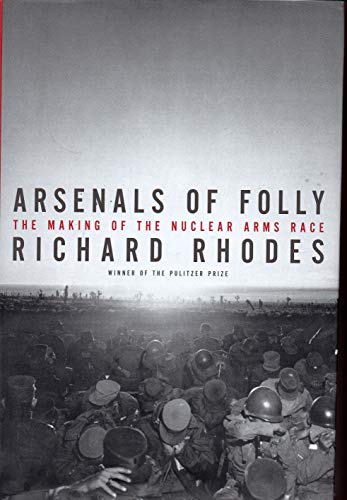
Inhaltsangabe
The Pulizer Prize-winning author of The Making of the Atomic Bomb narrates the story of the postwar superpower arms race that culminated in the Reagan-Gorbachev era when the U.S. and Soviet Union came all too close to nuclear war, chronicling the nuclear policies on both sides following World War II and their implications for global peace and security. 60,000 first printing.
Die Inhaltsangabe kann sich auf eine andere Ausgabe dieses Titels beziehen.
Über die Autorin bzw. den Autor
Richard Rhodes is the author or editor of twenty-two books, including novels, history, journalism, and letters. The Making of the Atomic Bomb won a Pulitzer Prize, a National Book Award, and a National Book Critics Circle Award. Dark Sun, about the development of the hydrogen bomb, was one of three finalists for a Pulitzer Prize in History. An affiliate of Stanford University’s Center for International Security and Cooperation, he lectures to college and professional audiences. He lives with his wife near Half Moon Bay, California.
Auszug. © Genehmigter Nachdruck. Alle Rechte vorbehalten.
Chapter One: To the Chernobyl Sarcophagus
On the Saturday morning in April 1986 when the alarms went off at the Institute for Nuclear Power Engineering of the Byelorussian Academy of Sciences, in a forest outside Minsk, the nuclear physicist Stanislav Shushkevich thought the institute's reactor was bleeding radiation. Its fuel assemblies, sealed inside aluminum cassettes at the bottom of a deep, stainless-steel tank full of distilled water, might have sprung a leak. Or something might have spilled in the institute's radiochemistry lab. Dosimeter operators began working their way methodically through the labs and offices and found radiation everywhere. It was in people's hair and clinging to their clothes. It registered two hundred times normal on the air filters. It was near danger levels at the front door.
The dosimetrists moved outside and discovered it there as well: on the sidewalk, on the grass, on the periwinkle crocuses pushing up through the dark litter of the forest floor. So the institute wasn't the source. An order over the public-address system warned everyone to stay indoors. Someone called the Lithuanian nuclear-power complex at Ignalina, one hundred miles northwest, and radiation was everywhere there too. Chernobyl, in the Ukraine, was farther away, two hundred miles southeast, where four big RBMK* thousand-megawatt reactors were lined up end to end in a building almost a mile long. Hundreds of people worked there, but the phones rang unanswered. Something was wrong at Chernobyl.
By afternoon, institute chemists had found radioactive iodine in the fallout, which confirmed that a reactor had exploded. For radioactive gas and smoke from Chernobyl to have reached Minsk, the explosion must have occurred sometime during the night. How much radioactivity had been released? How much more would follow? Why had no one warned them?
Shushkevich, fifty-two, a solid, ample man with a ruddy face and a high, domed forehead fringed with graying brown hair, was friendly and avuncular but shrewdly intelligent. He was vice-provost of the Byelorussian University in Minsk, a liberal humanist in the tradition of Andrey Sakharov. The Soviet Union's change of direction since the death of Konstantin Chernenko in March 1985, just thirteen months before, had filled him with hope. Chernenko, an emphysemic general secretary with the soul of a retired file clerk, had served as a placeholder between the reform-minded but ailing former KGB chief Yuri Andropov and his vigorous young heir apparent, Mikhail Gorbachev. At Chernenko's death his private safe had turned up no personal diary or other intimate record, only a large cache of money no one could account for. Good riddance, Shushkevich had thought: "I was the first at the university to put a portrait of Gorbachev on the wall."
The night of Chernenko's death, Raisa Maksimovna, Mikhail Gorbachev's wife and partner, pacing beside him in the garden of their country house near Moscow, heard him say resolutely, "We just can't go on like this." The next day, 11 March 1985, Gorbachev had been elected general secretary at a meeting of the Communist Party Central Committee. In his acceptance speech immediately after his election he had called for open government and accountability: "I emphasized the need for transparency (glasnost) in the work of Party, Soviet, state and public organizations," he wrote later. He had laid out in detail his other fundamental goal, perestroika—economic restructuring, salvaging the nearly moribund Soviet economy—at a Central Committee plenum the following month, stressing "the elimination of everything that interferes with development."
The huge Soviet military-industrial complex, which insinuated itself into every corner of the Soviet economy and consumed at least 40 percent of the state budget, headed his list for cutbacks, and in a letter delivered to President Ronald Reagan on 15 January 1986 he had broached a proposal without precedent across the four dangerous decades of the U.S.-Soviet nuclear-arms race: "A concrete program," as he described it during a press conference in Moscow later that day, ". . . for the complete liquidation of nuclear weapons throughout the world . . . before the end of the present century." Opening to such unprecedented initiative, 1986 had seemed a year of immense possibility. Now a disaster loomed, of consequences yet unknown, and radiation blew north from Chernobyl.
At 2:30 on Saturday afternoon someone finally called the institute to report an accident at Chernobyl. In the early hours after midnight, Chernobyl Reactor Number Four had run away in four seconds from 7 percent of maximum rated power to about one hundred times maximum rated power, an event called a prompt critical excursion that had flashed the reactor's thousands of gallons of circulating water to high-pressure steam. The graphite core of the massive concrete-encased reactor was an enclosed cylinder forty feet in diameter and twenty-three feet tall, set on end, with blocks of concrete and a water pool beneath it to absorb the fierce radiation its zirconium-clad uranium fuel elements produced, and a two-million-pound, disk-shaped upper biological shield of concrete blocks set over it like a lid to protect workers from radiation exposure. In the same spirit of bravado that had prompted the scientists at Los Alamos during the Second World War to nickname the atomic bomb they were building the "gadget," the men who operated the RBMKs called the upper biological shield the pyatachok, Russian for one of the smallest Soviet coins, the five-kopek piece.** When the water flashed to superheated steam and the reactor's steam pipes started exploding, an eyewitness reported later, the pyatachok "began to bubble and dance."
Then two explosions in the space of less than four seconds tore open the reactor and blew out the building. The reactor core was sealed within a metal tank filled with a mixture of helium and nitrogen to prevent the graphite moderator—four million pounds of pure carbon—from burning. The prompt critical excursion had heated the graphite red hot. The first steam explosion lifted the two-million-pound pyatachok. At the same time the steam burst down through the metal tank and penetrated the red-hot graphite. Steam combines ferociously with hot carbon to make carbon monoxide, liberating hydrogen; the second and more powerful explosion combined steam and exploding hydrogen gas, tilted up the pyatachok nearly vertical, shattered the upper half of the reactor core, and blew tons of its red-hot radioactive debris—a rubble of highly irradiated uranium-oxide fuel as well as radioactive graphite and zirconium—past the pyatachok, through the roof, and half a mile into the air.
It fell out by size. Big blocks of hot graphite landed on the roofs of Number Four's turbine hall and Reactor Number Three. To lower construction costs, the roofs had been covered with flammable asphalt; the hot graphite set them on fire. Blocks and smaller pieces of graphite landed on the grounds around the building and splashed hissing into the four-mile-long cooling pond that lay between the plant and the Pripyat River. The cooling pond was fed by and drained into the river, which drained in turn into the big reservoir downstream that stored the water supply of the city of Kiev, the Soviet Union's third-largest city, with a population of some 2.5 million people.
Graphite pieces and soot-like particles scattered across a stand of pines southeast of the complex; several weeks later, when the radiation had killed the trees and their chlorophyll had faded, people started calling the dead stand "the Red Forest." About half the total radioactive fission products jettisoned from the...
„Über diesen Titel“ kann sich auf eine andere Ausgabe dieses Titels beziehen.
Weitere beliebte Ausgaben desselben Titels

Suchergebnisse für Arsenals of Folly: The Making of the Nuclear Arms Race

Beispielbild für diese ISBN
Arsenals of Folly: The Making of the Nuclear Arms Race
Anbieter: World of Books (was SecondSale), Montgomery, IL, USA
Verkäuferbewertung 5 von 5 Sternen

Zustand: Very Good. Item in very good condition! Textbooks may not include supplemental items i.e. CDs, access codes etc. Artikel-Nr. 00104530798
Gebraucht kaufen
EUR 3,99
Versand gratis
Versand innerhalb von USA
Versand innerhalb von USA
Anzahl: 1 verfügbar
Beispielbild für diese ISBN
Arsenals of Folly: The Making of the Nuclear Arms Race
Anbieter: World of Books (was SecondSale), Montgomery, IL, USA
Verkäuferbewertung 5 von 5 Sternen
Zustand: Good. Item in good condition and has highlighting/writing on text. Used texts may not contain supplemental items such as CDs, info-trac etc. Artikel-Nr. 00105544478
Gebraucht kaufen
EUR 3,99
Versand gratis
Versand innerhalb von USA
Versand innerhalb von USA
Anzahl: 1 verfügbar
Beispielbild für diese ISBN
Arsenals of Folly: The Making of the Nuclear Arms Race
Anbieter: World of Books (was SecondSale), Montgomery, IL, USA
Verkäuferbewertung 5 von 5 Sternen
Zustand: Acceptable. Item in acceptable condition! Textbooks may not include supplemental items i.e. CDs, access codes etc. Artikel-Nr. 00089981746
Gebraucht kaufen
EUR 3,99
Versand gratis
Versand innerhalb von USA
Versand innerhalb von USA
Anzahl: 2 verfügbar
Beispielbild für diese ISBN
Arsenals of Folly: The Making of the Nuclear Arms Race
Anbieter: World of Books (was SecondSale), Montgomery, IL, USA
Verkäuferbewertung 5 von 5 Sternen
Zustand: Good. Item in good condition. Textbooks may not include supplemental items i.e. CDs, access codes etc. Artikel-Nr. 00106143422
Gebraucht kaufen
EUR 4,00
Versand gratis
Versand innerhalb von USA
Versand innerhalb von USA
Anzahl: 1 verfügbar
Beispielbild für diese ISBN
Arsenals of Folly: The Making of the Nuclear Arms Race
Anbieter: ThriftBooks-Atlanta, AUSTELL, GA, USA
Verkäuferbewertung 5 von 5 Sternen
Hardcover. Zustand: Good. No Jacket. Pages can have notes/highlighting. Spine may show signs of wear. ~ ThriftBooks: Read More, Spend Less. Artikel-Nr. G0375414134I3N00
Gebraucht kaufen
EUR 6,21
Versand gratis
Versand innerhalb von USA
Versand innerhalb von USA
Anzahl: 1 verfügbar
Beispielbild für diese ISBN
Arsenals of Folly: The Making of the Nuclear Arms Race
Anbieter: ThriftBooks-Atlanta, AUSTELL, GA, USA
Verkäuferbewertung 5 von 5 Sternen
Hardcover. Zustand: Good. No Jacket. Former library book; Pages can have notes/highlighting. Spine may show signs of wear. ~ ThriftBooks: Read More, Spend Less. Artikel-Nr. G0375414134I3N10
Gebraucht kaufen
EUR 6,21
Versand gratis
Versand innerhalb von USA
Versand innerhalb von USA
Anzahl: 1 verfügbar
Beispielbild für diese ISBN
Arsenals of Folly: The Making of the Nuclear Arms Race
Anbieter: ThriftBooks-Dallas, Dallas, TX, USA
Verkäuferbewertung 5 von 5 Sternen
Hardcover. Zustand: Good. No Jacket. Former library book; Pages can have notes/highlighting. Spine may show signs of wear. ~ ThriftBooks: Read More, Spend Less. Artikel-Nr. G0375414134I3N10
Gebraucht kaufen
EUR 6,21
Versand gratis
Versand innerhalb von USA
Versand innerhalb von USA
Anzahl: 1 verfügbar
Beispielbild für diese ISBN
Arsenals of Folly: The Making of the Nuclear Arms Race
Anbieter: ThriftBooks-Dallas, Dallas, TX, USA
Verkäuferbewertung 5 von 5 Sternen
Hardcover. Zustand: Very Good. No Jacket. Former library book; May have limited writing in cover pages. Pages are unmarked. ~ ThriftBooks: Read More, Spend Less. Artikel-Nr. G0375414134I4N10
Gebraucht kaufen
EUR 6,21
Versand gratis
Versand innerhalb von USA
Versand innerhalb von USA
Anzahl: 1 verfügbar
Beispielbild für diese ISBN
Arsenals of Folly: The Making of the Nuclear Arms Race
Anbieter: ThriftBooks-Reno, Reno, NV, USA
Verkäuferbewertung 5 von 5 Sternen
Hardcover. Zustand: Good. No Jacket. Former library book; Pages can have notes/highlighting. Spine may show signs of wear. ~ ThriftBooks: Read More, Spend Less. Artikel-Nr. G0375414134I3N10
Gebraucht kaufen
EUR 6,21
Versand gratis
Versand innerhalb von USA
Versand innerhalb von USA
Anzahl: 1 verfügbar
Beispielbild für diese ISBN
Arsenals of Folly: The Making of the Nuclear Arms Race
Anbieter: ThriftBooks-Phoenix, Phoenix, AZ, USA
Verkäuferbewertung 5 von 5 Sternen
Hardcover. Zustand: Good. No Jacket. Former library book; Pages can have notes/highlighting. Spine may show signs of wear. ~ ThriftBooks: Read More, Spend Less. Artikel-Nr. G0375414134I3N10
Gebraucht kaufen
EUR 6,21
Versand gratis
Versand innerhalb von USA
Versand innerhalb von USA
Anzahl: 1 verfügbar