
Verwandte Artikel zu Ball of Fire: The Tumultuous Life and Comic Art of...
Inhaltsangabe
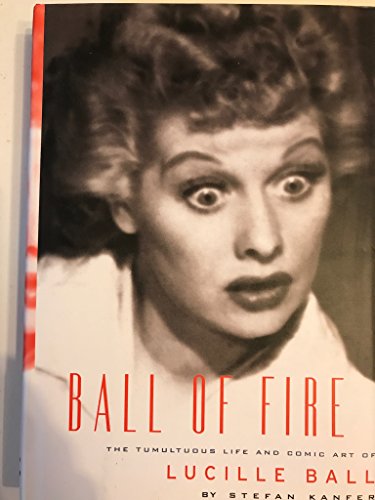
For more than fifty years Lucille Ball has been television's most recognizable and beloved face. As Lucy Ricardo she was the ultimate screwball housewife, getting herself into and out of scrapes with unmatched comic finesse. Indeed, she was so funny, and so central to the cultural landscape, that we often overlook Ball's role in shaping that turf: as producer of her own show and a cofounder of a major studio, she was a pioneer, rewriting the rules and forging new paths for women in the boardroom and on the sound stage. In Ball of Fire, Stefan Kanfer goes beyond the icon to examine the difficult life and enduring work of the most influential woman in modern American comedy.
Kanfer traces the arc of her career from its unlikely beginnings in a lonely and desolate childhood in upstate New York. There she discovered that making people laugh could ease the pains of a fragmented family life. But she was more than amusing. She was also beautiful, and when Lucy's adolescent attempts to crack Broadway ended in failure, she became a runway model and on a fluke, journeyed out to California to be an extra in one film. That led to another, and another, and another bottom-of-the-bill movie, until she became, in her own words, "The Queen of the B's". Ball of Fire tracks Lucy's pursuit of the superstardom that eluded her on the big screen and follows the actress through a series of disappointing affairs and sorrows until she meets a Cuban conga drummer six years her junior, and falls headlong in love with Desi Arnaz. Working with her husband, Lucille Ball becomes a different kind of comic artist in a program called I Love Lucy, the show that is still running in more than eighty countries around the globe.
Taking us through the development of television both as technology and cultural phenomenon, Kanfer chronicles the difficult birth of the sitcom that changed the world. He details the early executive meetings, the rocky first productions, the shaky first weeks and the unpredicted triumph. We see all of Lucy's behind-the-scenes battles for creative control of the show; her surprising confrontation with the House Un-American Activities Committee when it was discovered that she had once registered to vote as a Communist; her groundbreaking on-air pregnancy; and a series of in-depth analyses of the classic scenes and Chaplinesque slapstick that guarantee her a permanent place in the pantheon of American comedy.
Finally, we see the aftermath of her hard-won fame: the turbulent marriage and painful split from Desi, the man she never stopped loving; her second marriage; and her sad last years out of the limelight and away from the applause.
This is the first biography to examine the legendary Lucille Ball in all her many dimensions: her personal struggles and the torments that forged a comic genius; and, at last, her posthumous influence on television comedy, on feminist scholars and cultural critics, and on the public at large. Ball of Fire is the definitive biography Lucy fans have been waiting for.
Die Inhaltsangabe kann sich auf eine andere Ausgabe dieses Titels beziehen.
Über die Autorin bzw. den Autor
Stefan Kanfer's books include <b>The Eighth Sin</b>, <b>A Summer World</b>,<b>The Last Empire</b>,<b> Serious Business</b>,<b> </b>and <b>Groucho</b> . He was a writer and editor at <i>Time</i> for more than twenty years. A Literary Lion of the New York Public Library and recipient of numerous writing awards, Kanfer is currently in the Distinguished Writer program at Southampton College, Long Island University. He lives in New York and on Cape Cod.<br><br>Stefan Kanfer's <b>Groucho</b>:<b> The Life and Times of Julius Henry Marx</b> and <b>The Essential Groucho</b>:<b> Writings by, for, and about Groucho Marx</b> are available in Vintage paperback.
Auszug. © Genehmigter Nachdruck. Alle Rechte vorbehalten.
Chapter One
A little world out of nothing
Few intimations of Lucille Ball's character and career can be found on her family tree. Hers is a classic instance of the comic talent that surfaces without genetic antecedent. There have been, of course, many such "sports" in show business, performers who sprang from generations of laborers or small-time entrepreneurs. But most often these comedians and clowns were first-generation Americans, breaking out from the poverty, illiteracy, and prejudice that still afflicted their parents. Moreover, the great majority of them came from the streets of New York City, where demonic energy was the only résumé they needed, and where opportunity lay all around them-from larceny and murder to medicine, law, and entertainment.
Lucille had little in common with the generation that was to beget laughter in vaudeville, in the legitimate theater, and on the sound stages of the 1930s. Compared to them she is a bloodline aristocrat. "My mother, Desirée Hunt," her account proudly states, "was of French-English descent, with a touch of Irish from her father's side that showed in her porcelain-fine English complexion and auburn hair." Lucille's father, Henry Durrell Ball, was descended from landed gentry in England; some of the family came to the New World as early as the seventeenth century. She was delighted to note that there was "some Ball blood in George Washington" since "his mother's maiden name was Mary Ball." If there were any deeper investigations of the Ball genealogy, Lucille did not record them. Actually, George Washington's relationship with his mother was one that grew increasingly unpleasant and embarrassing. Hardly had George left home when Mary began to complain publicly about her son's neglect. Rather than take pride in his early career, she used it as a lever to pry favors from him. During the French and Indian War, for example, he suffered terrible privations in the service of King George III. Mary displayed little interest in his ordeal; her letters demanded more butter and a new house servant. Irritation between parent and child remained until her death in 1789.
Evidently a number of Mary's descendants were working folk and farmers, scattered about the United States, with little in the way of wealth or prospects. For one of them, fate intervened in 1865, when oil was discovered in the appropriately named town of Pithole, Pennsylvania. Clinton Ball, Lucy's great-grandfather, had property in the vicinity, accepted the enormous bid of $750,000, and headed for the progressive, gaslit village of Fredonia, New York. There he built a large house and acquired an additional four hundred acres. Clinton must have found Protestant fundamentalism to his liking; he donated generous sums to local churches, but made certain that anyone who preached there hewed to his literal interpretation of the Bible. Unsurprisingly, he looked upon city life as licentious and went so far as to forbid any of his six children to dance.
Five of them obeyed; the sixth was an adventurer who wanted something more than received wisdom. Jasper Ball-"Jap," as he preferred to be called-married young and became a father soon afterward. He settled the family in Jamestown, New York, and began to invest his savings in the newfangled telephone business. When the hinterlands proved inhospitable to the invention he sought employment out west. The Securities Home Telephone Company of Missoula, Montana, hired him as manager, and for many years he shuttled between work and family, from the towns and villages of Montana to his home in upstate New York. In time Jap's admiring son Henry Durrell Ball ("Had" to family and friends) came to Missoula and signed on as a lineman for the phone company. In 1910 Had returned to Jamestown to visit his mother and sisters, and while he was there someone introduced him to the eighteen-year-old Desirée Evelyn Hunt, the daughter of a professional midwife and a man who had worked at a number of trades, including hotel management, mail delivery, and furniture construction. (She chose the Frenchified spelling; "Desire" was the name on her birth certificate.) The twenty-four-year-old Had qualified as an attractive older man. Several months later, on September 1, 1910, the two were married at the two-story gabled home of Frederick and Flora Belle Hunt. Some 140 guests witnessed the ceremony, conducted by the Reverend Charles D. Reed, pastor of the Calgary Baptist Church. It was the biggest social event of the season. Contemporary photographs show a pale, conventionally pretty young woman, and a husband so lean he appears to be two profiles in search of a face.
Laden with gifts of silver, linen, and furniture, the couple boarded a train and headed toward the sunset. They settled in the little town of Anaconda, Montana, about twenty-five miles from Butte. A couple of months later Desirée became pregnant. She expressed a desire to have the baby back home in Jamestown, where her mother could act as midwife. Had consented, and the couple went east in the summer of 1911. On August 6, Lucille Desirée was born.
Once Flora had pronounced her granddaughter fit for travel, the Balls returned to Montana-only to turn around and head back east. Securities Home Telephone had recently acquired the Michigan Telephone Company, and the company needed experienced linemen. The little family resettled in Wyandotte, outside Detroit, a town just far enough from the automobile industry to offer quiet tree-lined streets and clean air. Had regarded it as a fine place to raise a family, and pretty soon Desirée was pregnant again. Everything went well: Had was making five dollars a week, a good salary in those days, and the doctor said that Desirée was the ideal age and weight to bear a second child. As for little Lucille, she was an active, healthy youngster, fond of her mother and crazy about roughhousing with her father-she would scream with delight when he tossed her into the air and caught her inches from the floor.
All this was to change in the awful winter of 1915. In January, cases of typhoid fever were reported in the Detroit area. Public health officials warned citizens to boil their water and to stay away from unpasteurized dairy products. Desirée scrupulously followed their instructions. Had went along for a while, but in early January he treated himself to a dish of ice cream. A week later he began to suffer from sleeplessness, then intestinal problems, and finally he developed a fever of 104 degrees accompanied by delirium. Physicians made a grim diagnosis and nailed a sign to the Balls' front door: keep out-health authorities. Neighbors shut their windows and drew the curtains; there was no vaccine at the time. The family doctor could do little beyond making Had comfortable and preparing Desirée for the end.
Distraught and overburdened, she kept Lucille out of the sickroom and in the fresh air for hours at a time. To ease her mind she tied one end of a rope around the child's waist, the other end to a steel runner on the backyard clothesline. As long as she heard the metal squeal, Desirée knew that her little daughter was running like a trolley from the back of the yard to the front. Whenever the noise stopped for longer than a few minutes she ran outside to see if Lucille had slipped the knot. The three-and-a-half-year-old never did escape, but on at least one occasion she tried. After an ominous silence Desirée found her batting her eyes and negotiating with a milkman: "Mister, help me. I got caught up in this silly clothesline. Can you help me out?"
Had died on February 28, 1915. He was twenty-eight years old. Lucille retained only fleeting memories of that day, all of them traumatic. A picture fell from the wall; a bird...
„Über diesen Titel“ kann sich auf eine andere Ausgabe dieses Titels beziehen.
Suchergebnisse für Ball of Fire: The Tumultuous Life and Comic Art of...

Beispielbild für diese ISBN
Ball of Fire The Tumultuous Li
Anbieter: World of Books (was SecondSale), Montgomery, IL, USA
Verkäuferbewertung 5 von 5 Sternen

Zustand: Good. Item in good condition. Textbooks may not include supplemental items i.e. CDs, access codes etc. Artikel-Nr. 00089023710
Gebraucht kaufen
EUR 4,72
Versand gratis
Versand innerhalb von USA
Versand innerhalb von USA
Anzahl: 3 verfügbar
Beispielbild für diese ISBN
Ball of Fire The Tumultuous Li
Anbieter: World of Books (was SecondSale), Montgomery, IL, USA
Verkäuferbewertung 5 von 5 Sternen
Zustand: Very Good. Item in very good condition! Textbooks may not include supplemental items i.e. CDs, access codes etc. Artikel-Nr. 00107022057
Gebraucht kaufen
EUR 4,72
Versand gratis
Versand innerhalb von USA
Versand innerhalb von USA
Anzahl: 1 verfügbar
Beispielbild für diese ISBN
Ball of Fire The Tumultuous Li
Anbieter: World of Books (was SecondSale), Montgomery, IL, USA
Verkäuferbewertung 5 von 5 Sternen
Zustand: Acceptable. Item in acceptable condition! Textbooks may not include supplemental items i.e. CDs, access codes etc. Artikel-Nr. 00087940427
Gebraucht kaufen
EUR 4,72
Versand gratis
Versand innerhalb von USA
Versand innerhalb von USA
Anzahl: 2 verfügbar
Beispielbild für diese ISBN
Ball of Fire: The Tumultuous Life and Comic Art of Lucille Ball
Anbieter: ThriftBooks-Phoenix, Phoenix, AZ, USA
Verkäuferbewertung 5 von 5 Sternen
Hardcover. Zustand: Very Good. No Jacket. Former library book; May have limited writing in cover pages. Pages are unmarked. ~ ThriftBooks: Read More, Spend Less. Artikel-Nr. G0375413154I4N10
Gebraucht kaufen
EUR 5,84
Versand gratis
Versand innerhalb von USA
Versand innerhalb von USA
Anzahl: 1 verfügbar
Beispielbild für diese ISBN
Ball of Fire: The Tumultuous Life and Comic Art of Lucille Ball
Anbieter: ThriftBooks-Phoenix, Phoenix, AZ, USA
Verkäuferbewertung 5 von 5 Sternen
Hardcover. Zustand: Very Good. No Jacket. Missing dust jacket; May have limited writing in cover pages. Pages are unmarked. ~ ThriftBooks: Read More, Spend Less. Artikel-Nr. G0375413154I4N01
Gebraucht kaufen
EUR 5,84
Versand gratis
Versand innerhalb von USA
Versand innerhalb von USA
Anzahl: 1 verfügbar
Beispielbild für diese ISBN
Ball of Fire: The Tumultuous Life and Comic Art of Lucille Ball
Anbieter: ThriftBooks-Reno, Reno, NV, USA
Verkäuferbewertung 5 von 5 Sternen
Hardcover. Zustand: Good. No Jacket. Former library book; Pages can have notes/highlighting. Spine may show signs of wear. ~ ThriftBooks: Read More, Spend Less. Artikel-Nr. G0375413154I3N10
Gebraucht kaufen
EUR 5,84
Versand gratis
Versand innerhalb von USA
Versand innerhalb von USA
Anzahl: 1 verfügbar
Beispielbild für diese ISBN
Ball of Fire: The Tumultuous Life and Comic Art of Lucille Ball
Anbieter: ThriftBooks-Dallas, Dallas, TX, USA
Verkäuferbewertung 5 von 5 Sternen
Hardcover. Zustand: Good. No Jacket. Missing dust jacket; Pages can have notes/highlighting. Spine may show signs of wear. ~ ThriftBooks: Read More, Spend Less. Artikel-Nr. G0375413154I3N01
Gebraucht kaufen
EUR 5,85
Versand gratis
Versand innerhalb von USA
Versand innerhalb von USA
Anzahl: 1 verfügbar
Beispielbild für diese ISBN
Ball of Fire: The Tumultuous Life and Comic Art of Lucille Ball
Anbieter: ThriftBooks-Atlanta, AUSTELL, GA, USA
Verkäuferbewertung 5 von 5 Sternen
Hardcover. Zustand: Good. No Jacket. Former library book; Pages can have notes/highlighting. Spine may show signs of wear. ~ ThriftBooks: Read More, Spend Less. Artikel-Nr. G0375413154I3N10
Gebraucht kaufen
EUR 5,85
Versand gratis
Versand innerhalb von USA
Versand innerhalb von USA
Anzahl: 1 verfügbar
Beispielbild für diese ISBN
Ball of Fire: The Tumultuous Life and Comic Art of Lucille Ball
Anbieter: ThriftBooks-Dallas, Dallas, TX, USA
Verkäuferbewertung 5 von 5 Sternen
Hardcover. Zustand: Fair. No Jacket. Missing dust jacket; Readable copy. Pages may have considerable notes/highlighting. ~ ThriftBooks: Read More, Spend Less. Artikel-Nr. G0375413154I5N01
Gebraucht kaufen
EUR 5,85
Versand gratis
Versand innerhalb von USA
Versand innerhalb von USA
Anzahl: 1 verfügbar
Beispielbild für diese ISBN
Ball of Fire: The Tumultuous Life and Comic Art of Lucille Ball
Anbieter: ThriftBooks-Dallas, Dallas, TX, USA
Verkäuferbewertung 5 von 5 Sternen
Hardcover. Zustand: Very Good. No Jacket. Former library book; May have limited writing in cover pages. Pages are unmarked. ~ ThriftBooks: Read More, Spend Less. Artikel-Nr. G0375413154I4N10
Gebraucht kaufen
EUR 5,85
Versand gratis
Versand innerhalb von USA
Versand innerhalb von USA
Anzahl: 1 verfügbar