
Verwandte Artikel zu Changing Stages: A View of British and American Theatre...
Inhaltsangabe
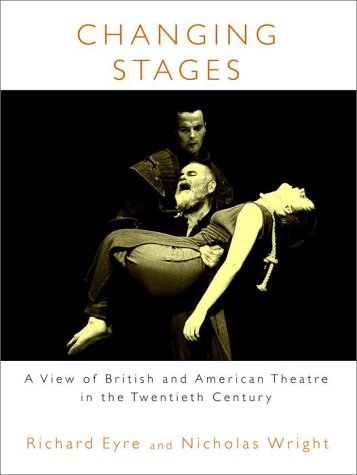
The companion volume to a six-part PBS television series, a tour of the British and American stage covers the gamut, from Pygmalion to Who's Afraid of Virginia Woolf and Copenhagen, in a richly illustrated volume that chronicles the history of twentieth-century theater on both sides of the Atlantic. 30,000 first printing.
Die Inhaltsangabe kann sich auf eine andere Ausgabe dieses Titels beziehen.
Über die Autorin bzw. den Autor
Richard Eyre, the celebrated director of numerous classic and new plays, was for ten years the artistic director of the Royal National Theatre. The winner of many awards, including a Tony and a Peabody, he received the Laurence Olivier Award for Outstanding Achievement in 1997 and was knighted the same year. He lives in London.
Nicholas Wright is the author of the plays Mrs. Klein and Cressida, among many others. He was the first director of the Royal Court's Theatre Upstairs and an associate director of the Royal National Theatre from 1984 to 1998. A native of South Africa, he lives in London.
Auszug. © Genehmigter Nachdruck. Alle Rechte vorbehalten.
Excerpt from chapter 6:
America Dreaming
"In the United States there is more space where nobody is than where anybody is. This is what makes America what it is." -- Gertrude Stein
1.
There's a Picture Post photograph taken in 1945: two sailors and two girls are standing in the fountains of Trafalgar Square, trousers rolled up to their thighs, water above their knees. One girl has her arms wrapped round the two men, a half-knotted tie lying between her breasts on her Lana Turner jumper, and a sailor's hat cocked at a rakish angle on her dark hair; she looks straight at the camera, mocking the photographer. The other, blonde and demure, floats her hands away from her body like a dancer, neither encouraging nor rejecting the sailor's hand spread over the side of her stomach. They are tired, drunk, young, and guileless.
It is dawn, V-E day, after a night when plump women in aprons made of Union Hacks danced with pinstriped civil servants, strangers kissed, the young princesses Elizabeth and Margaret mingled with the crown outside Buckingham Palace, searchlights danced on the night sky, bonfires blazed in the streets, and for a moment the nation held its breath before putting its weary back into rebuilding a nearly bankrupt country, crippled by war.
Britain at the time was profoundly insular, undemocratic and riven by class division. The country was divided between those who were content to let it continue, and those who were keen for change. A poll of all voters was asked if people wanted Labor to govern along existing lines, only more efficiently, or to introduce sweeping new changes. 56 per cent made the second assumption. A Labor government was voted in with the hope of a New Jerusalem. The wonder is that it changed so little for so long.
In the six years of war, millions of British men left home for the first time in their lives, and had their eyes opened by experience and education, millions of women went to work, millions of both sexes occupued the magic heartland of the movies, and were seduced by the vision of the Promised Land. Hundreds of thousands of American soldiers grafted their world onto Britain -- their own newspapers, magazines, films, music, even their radio station: 'They so often seemed t treat Britain as an occupied country rather than as an ally," said a contemporary U.S. journalist. They were better paid than the British, better dressed, and however vainly the old guard may have hoped to export cricket and soccer to the U.S., the traffic was all one-way -- the waltz gave way to the foxtrot, Pinewood to Hollywood, and the received pronunciation of the BBC graduated to the Mid-Atlantic.
The American presence -- and the 'special relationship' -- started to saturate British life politically, economically, and culturally, invoking unease about our lack of democracym unsatistifed desire for consumer goods, and restlessness and insecurity about our own culture. We became willingly, enthusiastically, and comprehensively colonized. 'The immense popularity of American movies abroad demonstrates that Europe is the unfinished negative of which America is the proof,' said the novelist Mary McCarthy., Generation after generation has lost its soul to American films, novels,comics, rock and roll, or TV, from I Love Lucy and Bilko, to Friends and ER.
Now when you walk down a street, you pass a McDonald's, a Burger King, a Nachos, a Baskin-Robbins, a Kentucky Fried Chicken, a Planet Hollywood, Tower Records, Warner Cinemas, jeans, t-shirts, baseball caps, loafers, hightop sneakers that proclaim Gap, Nike, Coke, Levi's, Calvin Klein, Ralph Lauren, Donna Karan, Tommy Hilfiger. You choose between a Bud and a Beck's in a pub called the Sunset Strip where you watch a Superbowl game on the TV, agree to a ballpark figure for your deal, take a rain check on a movie, slap high-fives, and find yourself in the centre of any large city in Britain -- the unofficial 51st state of the Union. . .
The British theater of the 1930s, '40s, and early '50s -- whatever the charms, skill and sunbusts of dissent -- was drained of vigor, etiolated, bound up by class, public puritanism, hypocrisy, self-censorship and state censorship. The injection of the plays of Arthur Miller and Tennessee Williams and of American musicals into the repertoire of the British theater emancipated it: the ailing patient sat up and walked.
In 1950, at a time when British theatre was toying with a poetic drama, there was real poetry on the American stage or, to be exact, the poetry of reality: plays about life lived on the streets of Brooklyn and New Orleans by working-class people floundering on the edges of gentility, and resonating with metaphors of the American Dream and the American Nightmare -- aspiration and desperation.
Death of a Salesman in 1949 and A Streetcar Named Desire in 1947 were not freak products engineered by gifted writers out of nowhere. They emerged from soil that had been tilled for two generations by commercial producers and by philanthropists and - for a short time - state subsidy, from organizations like the Provincetown Playhouse, the Mercury Theater and the Group Theater, and from a succession of writers, directors, and actors who not only believed in the power and importance of the theater but that, above all, it should engage with real life.
And Broadway, far from being oppressicely risky for producers of plays and prohibitively expensive for their audiences, was -- in Arthur Miller's eyes -- a benign and supportive world:
"The only theatre available to a playwright in the later '40s was Broadway. That theatre had only one single audience -- catering to very different levels of age, culture, education and intellectual sophisitication. One result of this mix was the ideal, if fragmentary, an emotional rather than an intellectual experience. A play basically of heart with its ulterioir moral gesture indicated with action rather than rhetoric . In fact it was a Shakespearian ideal, a theatre for anyone with an understanding of English and perhaps some common sense."
The same criteria underwrote the musicals of the time, musicals of real intelligence, wit, allure, and imagination - West Side Story, Gyspy, Guys and Dolls, and Carousel -- which entertained without patronising the audience -- giving the best to them, beleiving the best of them.
This was indeed a golden age, but sadly withoin fifteen years -- by the mid 1960s -- it had been dissolved in the face of rising costs and box-office tyranny, while the British theater, inspired by American example and fuelled by its state subsidy, grew from strength to strength.
2.
Broadway became 'The Great White Way' when it was illuminated by electric light in the last decade of the nineteenth century. It stretched over nearly twenty blocks and included a rash of new hotels and a string of fifty-odd theaters. In the 1900-1901 season there were seventy plays or musicals being produced on Broadway. In the decades that followed that number quadrupled. In addition, there were seven vaudeville houses and six burlesque theaters presenting their shows to a population of just over three-and-a-half million inhabitants. The American theater of the first twenty years of the century was not entirely devoid of any play of any content but you had to hunt hard to find a play that was more than anodyne family entertainment. Plus ca change...
In those New York theatres you could have seen several of George M. Cohan's well-machined mixtures of cockiness, aggressive optimism, patriotism, and sentimentality, like Little Johnny Jones (which featured the song "I'm a Yankee Doodle Dandy") or George Washington Jr. (hit song: "You're a Grand Old Flag"). Or musical comedies with books by P. G....
„Über diesen Titel“ kann sich auf eine andere Ausgabe dieses Titels beziehen.
Suchergebnisse für Changing Stages: A View of British and American Theatre...

Beispielbild für diese ISBN
Changing Stages: A View of British and American Theatre in the Twentieth Century
Anbieter: ThriftBooks-Atlanta, AUSTELL, GA, USA
Verkäuferbewertung 5 von 5 Sternen

Hardcover. Zustand: Good. No Jacket. Pages can have notes/highlighting. Spine may show signs of wear. ~ ThriftBooks: Read More, Spend Less. Artikel-Nr. G0375412034I3N00
Gebraucht kaufen
EUR 6,32
Versand gratis
Versand innerhalb von USA
Versand innerhalb von USA
Anzahl: 1 verfügbar
Beispielbild für diese ISBN
Changing Stages: A View of British and American Theatre in the Twentieth Century
Anbieter: BooksRun, Philadelphia, PA, USA
Verkäuferbewertung 5 von 5 Sternen
Hardcover. Zustand: Fair. The item might be beaten up but readable. May contain markings or highlighting, as well as stains, bent corners, or any other major defect, but the text is not obscured in any way. Artikel-Nr. 0375412034-7-1-13
Gebraucht kaufen
EUR 7,37
Versand gratis
Versand innerhalb von USA
Versand innerhalb von USA
Anzahl: 1 verfügbar
Beispielbild für diese ISBN
Changing Stages : A View of British and American Theatre in the Twentieth Century
Verlag:
Knopf Doubleday Publishing Group, 2001
ISBN 10: 0375412034
ISBN 13: 9780375412035
Gebraucht
Hardcover
Anbieter: Better World Books, Mishawaka, IN, USA
Verkäuferbewertung 5 von 5 Sternen
Zustand: Good. Pages intact with minimal writing/highlighting. The binding may be loose and creased. Dust jackets/supplements are not included. Stock photo provided. Product includes identifying sticker. Better World Books: Buy Books. Do Good. Artikel-Nr. GRP95566098
Gebraucht kaufen
EUR 8,20
Versand gratis
Versand innerhalb von USA
Versand innerhalb von USA
Anzahl: 1 verfügbar
Beispielbild für diese ISBN
Changing Stages : A View of British and American Theatre in the Twentieth Century
Verlag:
Knopf Doubleday Publishing Group, 2001
ISBN 10: 0375412034
ISBN 13: 9780375412035
Gebraucht
Hardcover
Anbieter: Better World Books, Mishawaka, IN, USA
Verkäuferbewertung 5 von 5 Sternen
Zustand: Good. Former library copy. Pages intact with minimal writing/highlighting. The binding may be loose and creased. Dust jackets/supplements are not included. Includes library markings. Stock photo provided. Product includes identifying sticker. Better World Books: Buy Books. Do Good. Artikel-Nr. 470947-6
Gebraucht kaufen
EUR 8,20
Versand gratis
Versand innerhalb von USA
Versand innerhalb von USA
Anzahl: 1 verfügbar
Beispielbild für diese ISBN
Changing Stages: A View of British and American Theatre in the Twentieth Century
Anbieter: AwesomeBooks, Wallingford, Vereinigtes Königreich
Verkäuferbewertung 5 von 5 Sternen
Hardcover. Zustand: Very Good. Changing Stages: A View of British and American Theatre in the Twentieth Century This book is in very good condition and will be shipped within 24 hours of ordering. The cover may have some limited signs of wear but the pages are clean, intact and the spine remains undamaged. This book has clearly been well maintained and looked after thus far. Money back guarantee if you are not satisfied. See all our books here, order more than 1 book and get discounted shipping. Artikel-Nr. 7719-9780375412035
Gebraucht kaufen
EUR 3,56
EUR 4,89 Versand
Versand von Vereinigtes Königreich nach USA
Versand von Vereinigtes Königreich nach USA
Anzahl: 2 verfügbar
Beispielbild für diese ISBN
Changing Stages: A View of British and American Theatre in the Twentieth Century
Anbieter: Wonder Book, Frederick, MD, USA
Verkäuferbewertung 5 von 5 Sternen
Zustand: Very Good. Very Good condition. Good dust jacket. A copy that may have a few cosmetic defects. May also contain light spine creasing or a few markings such as an owner's name, short gifter's inscription or light stamp. NOT AVAILABLE FOR SHIPMENT OUTSIDE OF THE UNITED STATES. Artikel-Nr. A08M-00661
Gebraucht kaufen
EUR 9,06
Versand gratis
Versand innerhalb von USA
Versand innerhalb von USA
Anzahl: 1 verfügbar
Beispielbild für diese ISBN
Changing Stages (First American Edition)
Verlag:
Alfred A. Knopf, New York, 2001
ISBN 10: 0375412034
ISBN 13: 9780375412035
Gebraucht
Hardcover
Erstausgabe
Anbieter: Dan Pope Books, West Hartford, CT, USA
Verkäuferbewertung 5 von 5 Sternen
Hardcover. Zustand: Fine. Zustand des Schutzumschlags: Fine. 1st Edition. First American edition. 1st printing. Hardbound. Very Fine/Very Fine. But for coffee stain on side edge. A tight unread new copy which I just spilled my coffee on! (Argh.) Smoke-free, comes with mylar wrapper. SALE. Artikel-Nr. 05-2013-86
Gebraucht kaufen
EUR 6,89
EUR 4,01 Versand
Versand innerhalb von USA
Versand innerhalb von USA
Anzahl: 1 verfügbar
Beispielbild für diese ISBN
CHANGING STAGES: A View of British and American Theatre in the Twentieth Century
Anbieter: Dan Pope Books, West Hartford, CT, USA
Verkäuferbewertung 5 von 5 Sternen
Hardcover. Zustand: As New. Zustand des Schutzumschlags: As New. 1st Edition. New York: Alfred A. Knopf [2001]. First American edition. First printing. Hardbound. Fine/Fine, but for red remainder dot top edge. A tight unread copy protected in acid-free mylar wrap. Tiny bump top corners. Artikel-Nr. jm026
Gebraucht kaufen
EUR 9,19
EUR 4,01 Versand
Versand innerhalb von USA
Versand innerhalb von USA
Anzahl: 1 verfügbar
Beispielbild für diese ISBN
Changing Stages: A View of British and American Theatre in the Twentieth Century
Anbieter: Bahamut Media, Reading, Vereinigtes Königreich
Verkäuferbewertung 4 von 5 Sternen

Hardcover. Zustand: Very Good. This book is in very good condition and will be shipped within 24 hours of ordering. The cover may have some limited signs of wear but the pages are clean, intact and the spine remains undamaged. This book has clearly been well maintained and looked after thus far. Money back guarantee if you are not satisfied. See all our books here, order more than 1 book and get discounted shipping. Artikel-Nr. 6545-9780375412035
Gebraucht kaufen
EUR 5,88
EUR 8,28 Versand
Versand von Vereinigtes Königreich nach USA
Versand von Vereinigtes Königreich nach USA
Anzahl: 2 verfügbar
Beispielbild für diese ISBN
Changing Stages: A View of British and American Theatre in the Twentieth Century
Verlag:
Alfred A. Knopf, United States, New York, NY, 2001
ISBN 10: 0375412034
ISBN 13: 9780375412035
Gebraucht
Paperback
Anbieter: WorldofBooks, Goring-By-Sea, WS, Vereinigtes Königreich
Verkäuferbewertung 5 von 5 Sternen
Paperback. Zustand: Very Good. The book has been read, but is in excellent condition. Pages are intact and not marred by notes or highlighting. The spine remains undamaged. Artikel-Nr. GOR003784554
Gebraucht kaufen
EUR 8,24
EUR 6,65 Versand
Versand von Vereinigtes Königreich nach USA
Versand von Vereinigtes Königreich nach USA
Anzahl: 3 verfügbar