Inhaltsangabe
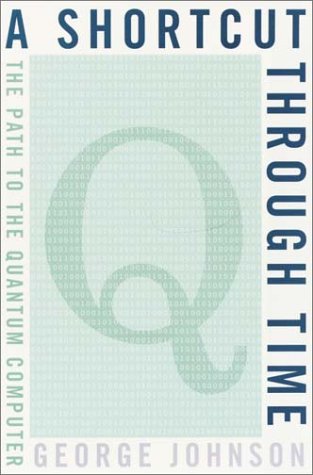
The author of Strange Beauty and Fire int he Mind combines the latest advances in mathematics and physics with ground-breaking computer science to examine the possibility for the development of the quantum computer, a breakthrough that could allow a shortcut through time. 30,000 first printing.
Die Inhaltsangabe kann sich auf eine andere Ausgabe dieses Titels beziehen.
Über die Autorin bzw. den Autor
George Johnson is a science writer for the New York Times. He is a recipient of the Science Journalism Award from the American Association for the Advancement of Science and was a finalist for the distinguished Rhone-Poulenc Prize. This is his fifth book. He lives with his wife in Santa Fe, New Mexico.
Aus dem Klappentext
ok to prepare us for the next big perhaps the biggest breakthrough in the short history of the cyberworld: the development of the quantum computer.
The newest Pentium chip driving personal computers packs 40 million electronic switches onto a piece of silicon the size of a thumbnail. It is dramatically smaller and more powerful than anything that has come before it. If this incredible shrinking act continues, the logical culmination is a computer in which each switch is composed of a single atom. And at that point the miraculous the actualization of quantum mechanics becomes real. If atoms can be harnessed, society will be transformed: problems that could take forever to be solved on the supercomputers available today would be dispatched with ease. Quantum computing promises nothing less astonishing than a shortcut through time.
In this book, the award-winning New York Times science writer George Johnson first takes us back to the original
Auszug. © Genehmigter Nachdruck. Alle Rechte vorbehalten.
Chapter 1
"Simple Electric Brain Machines and How to Make Them"
I don't know where I first saw the advertisement for the Geniac Electric Brain construction kit, but I knew I had to have one for Christmas. It was the early 1960s, and like a lot of science-crazed kids I was obsessed with the wonderfully outrageous idea of "thinking machines." I devoured the picture stories in Life magazine and the Saturday Evening Post about the electronic behemoths manufactured by companies like International Business Machines, Univac, and Remington Rand. The spinning tape drives and banks of blinking lights were as exciting to me as the idea of space travel. Two of my favorite books were Tom Swift and His Giant Robot and Danny Dunn and the Homework Machine-testaments to the eerie fantasy of automating human thought. One day, flipping through one of my favorite magazines-probably Boys' Life or Popular Science-I stumbled upon an unbelievably tantalizing ad.
"Can you think faster than this Machine?"
Below the provocative headline was a picture of the Geniac with its sloping panel bedecked with six large dials and a row of ten bulbs. Who knew what kind of mysterious circuitry was hidden inside?
"GENIAC, the first electrical brain construction kit, is equipped to play tic-tac-toe, cipher and decipher codes, convert from binary to decimal, reason in syllogisms, as well as add, subtract, multiply and divide. . . . You create from over 400 specially designed and manufactured components a machine that solves problems faster than you can express them." Such was the promise of the Oliver Garfield Co., 126 Lexington Avenue, New York 16, N.Y. (This was before zip codes replaced the old numbered postal zones.) To a boy growing up in Albuquerque, the location of this modern Frankenstein laboratory seemed promisingly exotic and far away.
"Send for your GENIAC kit now. Only $19.95. . . . We guarantee that if you do not want to keep GENIAC after two weeks you can return it for full refund plus shipping costs."
There was nothing to lose. I began my lobbying effort, making it clear to my parents that receiving a Geniac was all that mattered to me. Then I waited, my brain charged with the kind of high-voltage anticipation that can only accumulate in someone still in the first decade of life.
Christmas morning I sat on the floor anxiously opening presents, keeping my eye out for one large enough to hold the pieces of an electronic computer. Finally a likely box emerged from behind the tree. I tore off the wrapping.
Decades later I still remember the disappointment I felt as I explored the contents of the cardboard package. The title of the instruction manual was intriguing enough: "Simple Electric Brain Machines and How to Make Them." But how was anyone to carry out such an ambitious project with the meager, humdrum parts that had been supplied?
Digging through the pile, I was crestfallen to find that the bulk of the kit consisted of some decidedly low-tech pieces of particle board called Masonite: a big square one and six smaller round disks, each drilled with concentric patterns of little holes. This was complemented by an assortment of hardware you might find in a kitchen junk drawer or a toolbox in the garage: ten flashlight bulbs and sockets, a battery and battery clamp, a spool of insulated wire, several dozen nuts, bolts, and washers, a bunch of small brass-plated staples (referred to in the typewritten instructions as "jumpers"), and the tools for assembling this detritus into what would supposedly function as a digital computer-a hexagonal wrench for gripping bolts (a "spintite") and a screwdriver.
Finally there was a simple on-off switch, described rather melodramatically in the manual: "This is the switch that enables you to put suspense and drama into your machine; for you set everything the way it should be, then talk about it and explain it, and finally when you have your listener all keyed up and ready, you (or he) throw the switch . . ."
I'd been had. There were no vacuum tubes, no transistors, or capacitors, or resistors-the colorful components I'd found from eviscerating dead radios and TV sets. All I'd gotten for Christmas was a handy-dandy kit for stringing together mindlessly simple circuits of switches and bulbs. The nuts and bolts were to be placed in various holes on the square wooden panel and connected one to the other by wires running underneath. The little metal jumpers were to be inserted into holes in the Masonite disks, the ends bent over to keep them in place. When the disks were attached to the panel, with more bolts and washers, they could be turned to and fro so that the jumpers touched the heads of the bolts, forming connections that caused the lightbulbs to flash on and off. It was all just switches-simple enough for a child to understand.
Reluctantly I opened the manual, published, disconcertingly, in 1955, and saw that it contained the familiar explanations of the wonders of electricity. ("You can think of a battery as a pump, which is able to push electrons, or little marbles of electricity, away from the plus end of the battery and towards the minus end of the battery . . . A flow of electrons is an electric current.")
The instructions went on to show how to assemble circuits and switches into various question-answering machines.
1.Whom do you prefer: (a) Marilyn Monroe? or
(b) Liberace?
2.How would you put a thread in a small hole: (a) wet it? or (b) tap it?
3.Would you rather spend a day: (a) shopping on Fifth Avenue? or (b) hunting in the woods?
Depending on how you answered these and three other questions (rotating the six circular switches so that they pointed to A or B), the current in the wiring would flow to one of two bulbs, M or F. The result was called a "Masculine-Feminine Testing Machine."
Never mind the musty Eisenhower-era philosophy. Scientifically, the whole thing seemed obvious and dumb. Just changing the paper labels would turn the machine into a tester for, say, whether you were a Jock or a Brain (the 1960s version of "nerd"): "Would you rather spend a rainy afternoon: (a) building a crystal radio? or (b) working out in the gym?" The meaning was all in the eye of the beholder.
As I paged through the manual, other projects appeared slightly more interesting. The switches could be wired to make machines that added numbers. Turn dial A to indicate the first number, turn dial B to indicate the second, and if the copper paths behind the panel had been correctly platted, the lightbulb that came on would be the very one labeled with the proper answer. (And if you made a mistake and didn't feel like redoing the wires, you could just move around the tags.)
Rig the machine another way and you could subtract or multiply. Wire up the "Reasoning Machine" described on page 25 of the guide and turning switch A to indicate "All fighter pilots are bomber pilots" and switch B to "No bomber pilots are jet pilots" would light the bulb for "No fighter pilots are jet pilots." QED. A syllogism (and a reminder that something can be logical but not true).
It was all terribly anticlimactic. Only years later would I realize that an utterly profound idea was slowly insinuating itself into my head: a computer is indeed just a box with a bunch of switches. The Geniac was "semiautomatic," as the manual put it: You had to turn the dials by hand to light the lights. And to "reprogram" the machine, you had to unscrew nuts with the "spintite" and shift the wires around. But suppose that some of the bulbs were replaced with little motors. When activated by the proper combination of settings, the...
„Über diesen Titel“ kann sich auf eine andere Ausgabe dieses Titels beziehen.
Weitere beliebte Ausgaben desselben Titels

Suchergebnisse für A Shortcut Through Time: The Path to a Quantum Computer

Foto des Verkäufers
A Shortcut Through Time: The Path to the Quantum Computer
Anbieter: Dream Books Co., Denver, CO, USA
Verkäuferbewertung 5 von 5 Sternen

Zustand: very_good. Pages are clean with no markings. May show minor signs of wear or cosmetic defects marks, cuts, bends, or scuffs on the cover, spine, pages, or dust jacket. May have remainder marks on edges. Artikel-Nr. DBV.0375411933.VG
Gebraucht kaufen
EUR 6,54
Versand gratis
Versand innerhalb von USA
Versand innerhalb von USA
Anzahl: 1 verfügbar
Beispielbild für diese ISBN
A Shortcut Through Time : The Path to the Quantum Computer
Verlag:
Knopf Doubleday Publishing Group, 2003
ISBN 10: 0375411933
ISBN 13: 9780375411939
Gebraucht
Hardcover
Anbieter: Better World Books, Mishawaka, IN, USA
Verkäuferbewertung 5 von 5 Sternen
Zustand: Very Good. Second Edition. Used book that is in excellent condition. May show signs of wear or have minor defects. Artikel-Nr. 3222959-6
Gebraucht kaufen
EUR 6,57
Versand gratis
Versand innerhalb von USA
Versand innerhalb von USA
Anzahl: 1 verfügbar
Beispielbild für diese ISBN
A Shortcut Through Time : The Path to the Quantum Computer
Verlag:
Knopf Doubleday Publishing Group, 2003
ISBN 10: 0375411933
ISBN 13: 9780375411939
Gebraucht
Hardcover
Anbieter: Better World Books, Mishawaka, IN, USA
Verkäuferbewertung 5 von 5 Sternen
Zustand: Very Good. Second Edition. Former library book; may include library markings. Used book that is in excellent condition. May show signs of wear or have minor defects. Artikel-Nr. GRP102345449
Gebraucht kaufen
EUR 6,57
Versand gratis
Versand innerhalb von USA
Versand innerhalb von USA
Anzahl: 1 verfügbar
Beispielbild für diese ISBN
A Shortcut Through Time: The Path to the Quantum Computer
Anbieter: ThriftBooks-Dallas, Dallas, TX, USA
Verkäuferbewertung 5 von 5 Sternen
Hardcover. Zustand: As New. No Jacket. Pages are clean and are not marred by notes or folds of any kind. ~ ThriftBooks: Read More, Spend Less. Artikel-Nr. G0375411933I2N00
Gebraucht kaufen
EUR 6,87
Versand gratis
Versand innerhalb von USA
Versand innerhalb von USA
Anzahl: 1 verfügbar
Beispielbild für diese ISBN
A Shortcut Through Time: The Path to the Quantum Computer
Anbieter: My Dead Aunt's Books, Hyattsville, MD, USA
Verkäuferbewertung 5 von 5 Sternen
Hardcover. Zustand: As New. First Edition. Stated first ed., deckle edges; 204 p., immaculate and unmarked; photos and ill.; bindign firm; boards pristine. Unclipped, no more wear than in. Artikel-Nr. 033794
Gebraucht kaufen
EUR 5,63
EUR 4,26 shipping
Versand innerhalb von USA
Versand innerhalb von USA
Anzahl: 1 verfügbar
Beispielbild für diese ISBN
A Shortcut Through Time: The Path to the Quantum Computer
Anbieter: Powell's Bookstores Chicago, ABAA, Chicago, IL, USA
Verkäuferbewertung 5 von 5 Sternen
Zustand: Used - Very Good. 2003. Hardcover. Cloth, d.j. Some shelf-wear. Else clean copy. Very Good. Artikel-Nr. SON000034785
Gebraucht kaufen
EUR 6,42
EUR 3,84 shipping
Versand innerhalb von USA
Versand innerhalb von USA
Anzahl: 1 verfügbar
Beispielbild für diese ISBN
A Shortcut Through Time: The Path to a Quantum Computer
Anbieter: WorldofBooks, Goring-By-Sea, WS, Vereinigtes Königreich
Verkäuferbewertung 5 von 5 Sternen
Paperback. Zustand: Very Good. The book has been read, but is in excellent condition. Pages are intact and not marred by notes or highlighting. The spine remains undamaged. Artikel-Nr. GOR005599745
Gebraucht kaufen
EUR 3,93
EUR 6,40 shipping
Versand von Vereinigtes Königreich nach USA
Versand von Vereinigtes Königreich nach USA
Anzahl: 3 verfügbar
Foto des Verkäufers
A Shortcut Through Time: The Path to the Quantum Computer
Anbieter: ThriftBooksVintage, Tukwila, WA, USA
Verkäuferbewertung 5 von 5 Sternen
Hardcover. Zustand: Good. Zustand des Schutzumschlags: Good. First Edition. Dust jacket in good condition. First edition. Shelf and handling wear to cover and binding, with general signs of previous use. Secure packaging for safe delivery. Artikel-Nr. 736099752
Gebraucht kaufen
EUR 18,47
Versand gratis
Versand innerhalb von USA
Versand innerhalb von USA
Anzahl: 1 verfügbar
Foto des Verkäufers
A Shortcut Through Time: The Path to the Quantum Computer
Anbieter: Samson Books, Trenton, ON, Kanada
Verkäuferbewertung 4 von 5 Sternen

Hardcover. Zustand: Very Good. Zustand des Schutzumschlags: Good. 2nd Edition. Some edgewear to jacket, and rubbing wear to spine. Artikel-Nr. 20010610
Gebraucht kaufen
EUR 6,06
EUR 12,42 shipping
Versand von Kanada nach USA
Versand von Kanada nach USA
Anzahl: 1 verfügbar
Foto des Verkäufers
A Shortcut Through Time: The Path to the Quantum Computer
Verlag:
Alfred A. Knopf, 2003
ISBN 10: 0375411933
ISBN 13: 9780375411939
Gebraucht
Hardcover
Erstausgabe
Anbieter: Southampton Books, Sag Harbor, NY, USA
Verkäuferbewertung 5 von 5 Sternen
Hardcover. Zustand: Like New. First Edition. First Edition, First Printing. Not price-clipped. Published by Alfred A. Knopf, 2003. Octavo. Hardcover. Book is like new with a straight spine and sharp corners. Dust jacket is like new with very light edgewear.100% positive feedback. 30 day money back guarantee. NEXT DAY SHIPPING! Excellent customer service. Please email with any questions. All books packed carefully and ship with free delivery confirmation/tracking. All books come with free bookmarks. Ships from Sag Harbor, New York. Artikel-Nr. 360691
Gebraucht kaufen
EUR 17,59
EUR 3,41 shipping
Versand innerhalb von USA
Versand innerhalb von USA
Anzahl: 1 verfügbar