
Flashman and the Tiger: And Other Extracts from the Flashman Papers - Hardcover
Buch 11 von 12: Flashman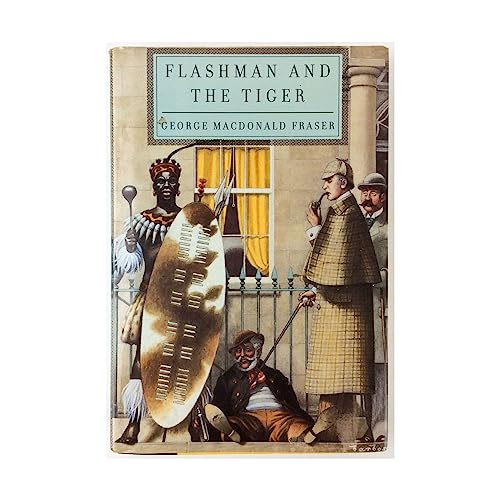
Inhaltsangabe
A new installment of the Flashman Papers continues the adventures and exploits of Victorian soldier, soundrel, and anti-hero Sir Harry Flashman as he becomes embroiled with the attempted assassination of Emperor Franz Joseph, the Prince of Wales and the Tranby Croft gambling scandal, and the fallout from Rorke's Drift. 25,000 first printing.
Die Inhaltsangabe kann sich auf eine andere Ausgabe dieses Titels beziehen.
Über die Autorin bzw. den Autor
George MacDonald Fraser was born in England and schooled in Scotland, served in a Highland regiment in India, Africa, and the Middle East, and now lives on the Isle of Man. In addition to ten previous volumes of The Flashman Papers and several other novels, Fraser has written screenplays, most notably for Richard Lester's The Three Musketeers and The Four Musketeers, and for the James Bond film Octopussy.
Aus dem Klappentext
le and appallingly appealing Flashy is back, in a long-awaited new installment of The Flashman Papers.
When the memoirs of Sir Harry Flashman, the notorious Victorian soldier and scoundrel, first came to light thirty years ago, it was finally revealed what had become of the infamous bully who had darkened Tom Brown's school days. Now, three new episodes in the career of this eminently disreputable adventurer place us at the center of pivotal historical events--the attempted assassination of Emperor Franz Josef in the 1880s, the Prince of Wales's involvement in the Tranby Croft gambling scandal, and the military disaster at Rorke's Drift in South Africa--as the aging but agile Flashy is pitted against one of the greatest villains of his day. Thrown into contact with assorted grand royalty and even grander tarts, he must test his wits against political heavyweights, including Bismarck, as he becomes eyewitness to the uncensored truth about two of the greatest heroes of his time
Auszug. © Genehmigter Nachdruck. Alle Rechte vorbehalten.
Chapter One
You don't know Blowitz, probably never heard of him even, which is your good luck, although I dare say if you'd met him you'd have thought him harmless enough. I did, to my cost. Not that I bear him a grudge, much, for he was a jolly little teetotum, bursting with good intentions, and you may say it wasn't his fault that they paved my road to Hell -- which lay at the bottom of a salt-mine, and it's only by the grace of God that I ain't there yet, entombed in everlasting rock. Damnable places, and not at all what you might imagine. Not a grain of salt to be seen, for one thing.
Mind you, when I say 'twasn't Blowitz's fault, I'm giving the little blighter the benefit of the doubt, a thing I seldom do. But I liked him, you see, in spite of his being a journalist. Tricky villains, especially if they work for The Times. He was their correspondent in Paris thirty years ago, and doubtless a government agent -- show me the Times man who wasn't, from Delane to the printer's devils -- but whether he absolutely knew what he was about, or was merely trying to do old Flashy a couple of good turns, I ain't sure. It was certainly his blasted pictures that led me astray: photographs of two lovely women, laid before my unsuspecting middle-aged eyes, one in '78, t'other in '83, and between 'em they landed me in the strangest pickle of my misspent life. Not the worst, perhaps, but bad enough, and deuced odd. I don't think I understand the infernal business yet, not altogether.
It had its compensations along the way, though, among them the highest decoration France can bestow, the gratitude of two Crowned Heads (one of 'em an out-and-out stunner, much good may it do me), the chance to serve Otto Bismarck a bad turn, and the favours of that delightful little spanker, Mamselle Caprice, to say nothing of the enchanting iceberg Princess Kralta. No . . . I can't think too much ill of little Blowitz at the end of the day.
He was reckoned the smartest newsman of the time, better than Billy Russell even, for while Billy was the complete hand at dramatic description, thin red streaks and all, and the more disastrous the better, Blowitz was a human ferret with his plump little claw on every pulse from Lisbon to the Kremlin; he knew everyone, and everyone knew him -- and trusted him. That was the great thing: kings and chancellors confided in him, empresses and grand duchesses whispered him their secrets, prime ministers and ambassadors sought his advice, and while he was up to every smoky dodge in his hunt for news, he never broke a pledge or betrayed a confidence -- or so everyone said, Blowitz loudest of all. I guess his appearance helped, for he was nothing like the job at all, being a five-foot butterball with a beaming baby face behind a mighty moustache, innocent blue eyes, bald head, and frightful whiskers a foot long, chattering nineteen to the dozen (in several languages), gushing gallantly at the womenfolk, nosing up to the elbows of the men like a deferential gun dog, chuckling at every joke, first with all the gossip (so long as it didn't matter), a prime favourite at every Paris party and reception -- and never missing a word or a look or a gesture, all of it grist to his astounding memory; let him hear a speech or read a paper and he could repeat it, pat, every word, like Macaulay.
Aye, and when the great crises came, and all Europe was agog for news of the latest treaty or rumour of war or collapsing ministry, it was to the Times' Paris telegrams they looked, for Blowitz was a past master at what the Yankee scribblers call "the scoop." At the famous Congress of Berlin (of which more anon), when the doors were locked for secret session, Bismarck looked under the table, and when D'Israeli asked him what was up, Bismarck said he wanted to be sure Blowitz wasn't there. A great compliment, you may say -- and if you don't, Blowitz did, frequently.
It was through Billy Russell, who you may know was also a Times man and an old chum from India and the Crimea, that I met this tubby prodigy at the time of the Franco-Prussian farce in '70, and we'd taken to each other straight off. At least, Blowitz had taken to me, as folk often do, God help 'em, and I didn't mind him; he was a comic little card, and amused me with his Froggy bounce (though he was a Bohemian in fact), and tall tales about how he'd scuppered the Commune uprising in Marseilles in '71 by leaping from rooftop to rooftop to telegraph some vital news or other to Paris while the Communards raged helpless below, and saved some fascinating Balkan queen and her beautiful daughter from shame and ruin at the hands of a vengeful monarch, and been kidnapped when he was six and fallen in love with a flashing-eyed gypsy infant with a locket round her neck -- sounded deuced like The Bohemian Girl to me, but he swore it was gospel, and part of his "Destiny," which was a great bee in his bonnet.
"You ask, what if I had slipped from those Marseilles roofs, and been dashed to pieces on the cruel cobbles, or torn asunder by those ensanguined terrorists?" cries he, swigging champagne and waving a pudgy finger. "What, you say, if that vengeful monarch's agents had entrapped me -- moi, Blowitz? What if the gypsy kidnappers had taken another road, and so eluded pursuit? Ah, you ask yourself these things, cher 'Arree -- "
"I don't do anything o' the sort, you know."
"But you do, of a certainty!" cries he. "I see it in your eye, the burning question! You consider, you speculate, you! What, you wonder, would have become of Blowitz? Or of France? Or the Times, by example?" He inflated, looking solemn. "Or Europe?"
"Search me, old Blowhard," says I rescuing the bottle. "All I ask is whether you got to grips with that fascinating Balkan bint and her beauteous daughter, and if so, did you tackle 'em in tandem or one after t'other?" But he was too flown with his fat-headed philosophy to listen.
"I did not slip, me -- I could not! I foiled the vengeful monarch's ruffians -- it was inevitable! My gypsy abductors took the road determined by Fate!" He was quite rosy with triumph. "Le destin, my old one -- destiny is immutable. We are like the planets, our courses preordained. Some of us," he admitted, "are comets, vanishing and reappearing, like the geniuses of the past. Thus Moses is reflected in Confucius, Caesar in Napoleon, Attila in Peter the Great, Jeanne d'Arc in . . . in . . ."
"Florence Nightingale. Or does it have to be a Frog? Well, then, Madame du Barry -- "
"Jeanne d'Arc is yet to reappear, perhaps. But you are not serious, my boy. You doubt my reason. Oh, yes, you do! But I tell you, everything moves by a fixed law, and those of us who would master our destinies -- " he tapped a fat finger on my knee " -- we learn to divine the intentions of the Supreme Will which directs us."
"Ye don't say. One jump ahead of the Almighty. Who are you reincarnating, by the way -- Baron Munchausen?"
He sat back chortling, twirling his moustache. "Oh, 'Arree, 'Arree, you are incorrigible! Well, I shall submit no more to your scepticism méprisant, your dérision Anglaise. You laugh, when I tell you that in our moment of first meeting, I knew that our fates were bound together. 'Regard this man,' I thought. 'He is part of your destiny.' It is so, we are bound, I, Blowitz, in whom Tacitus lives again, and you . . . ah, but of whom shall I say you are a reflection? Murat, perhaps? Your own Prince Rupert? Some great beau sabreur, surely?" He twinkled at me. "Or would it please you if I named the Chevalier de Seignalt?"
"Who's he...
„Über diesen Titel“ kann sich auf eine andere Ausgabe dieses Titels beziehen.
Weitere beliebte Ausgaben desselben Titels

Suchergebnisse für Flashman and the Tiger: And Other Extracts from the...

Beispielbild für diese ISBN
Flashman and the Tiger
Anbieter: World of Books (was SecondSale), Montgomery, IL, USA
Verkäuferbewertung 5 von 5 Sternen

Zustand: Good. Item in good condition. Textbooks may not include supplemental items i.e. CDs, access codes etc. Artikel-Nr. 00095110658
Gebraucht kaufen
EUR 5,06
Versand gratis
Versand innerhalb von USA
Versand innerhalb von USA
Anzahl: 1 verfügbar
Foto des Verkäufers
Flashman and the Tiger
Anbieter: Dream Books Co., Denver, CO, USA
Verkäuferbewertung 5 von 5 Sternen
Zustand: very_good. Pages are clean with no markings. May show minor signs of wear or cosmetic defects marks, cuts, bends, or scuffs on the cover, spine, pages, or dust jacket. May have remainder marks on edges. Artikel-Nr. DBV.0375410244.VG
Gebraucht kaufen
EUR 5,07
Versand gratis
Versand innerhalb von USA
Versand innerhalb von USA
Anzahl: 1 verfügbar
Beispielbild für diese ISBN
Flashman and the Tiger
Anbieter: BooksRun, Philadelphia, PA, USA
Verkäuferbewertung 5 von 5 Sternen
Hardcover. Zustand: Very Good. With dust jacket. It's a well-cared-for item that has seen limited use. The item may show minor signs of wear. All the text is legible, with all pages included. It may have slight markings and/or highlighting. Artikel-Nr. 0375410244-11-6-29
Gebraucht kaufen
EUR 6,02
Versand gratis
Versand innerhalb von USA
Versand innerhalb von USA
Anzahl: 1 verfügbar
Beispielbild für diese ISBN
Flashman and the Tiger
Anbieter: Wonder Book, Frederick, MD, USA
Verkäuferbewertung 5 von 5 Sternen
Zustand: Good. Good condition. Good dust jacket. A copy that has been read but remains intact. May contain markings such as bookplates, stamps, limited notes and highlighting, or a few light stains. Artikel-Nr. B19L-00542
Gebraucht kaufen
EUR 6,74
Versand gratis
Versand innerhalb von USA
Versand innerhalb von USA
Anzahl: 1 verfügbar
Beispielbild für diese ISBN
Flashman and the Tiger
Anbieter: Wonder Book, Frederick, MD, USA
Verkäuferbewertung 5 von 5 Sternen
Zustand: Very Good. Very Good condition. Very Good dust jacket. A copy that may have a few cosmetic defects. May also contain light spine creasing or a few markings such as an owner's name, short gifter's inscription or light stamp. Artikel-Nr. O13B-03919
Gebraucht kaufen
EUR 6,74
Versand gratis
Versand innerhalb von USA
Versand innerhalb von USA
Anzahl: 2 verfügbar
Beispielbild für diese ISBN
Flashman and the Tiger
Anbieter: Wonder Book, Frederick, MD, USA
Verkäuferbewertung 5 von 5 Sternen
Zustand: As New. Like New condition. Very Good dust jacket. A near perfect copy that may have very minor cosmetic defects. Artikel-Nr. T09A-03996
Gebraucht kaufen
EUR 6,74
Versand gratis
Versand innerhalb von USA
Versand innerhalb von USA
Anzahl: 1 verfügbar
Beispielbild für diese ISBN
Flashman and the Tiger
Anbieter: ThriftBooks-Atlanta, AUSTELL, GA, USA
Verkäuferbewertung 5 von 5 Sternen
Hardcover. Zustand: Good. No Jacket. Former library book; Pages can have notes/highlighting. Spine may show signs of wear. ~ ThriftBooks: Read More, Spend Less. Artikel-Nr. G0375410244I3N10
Gebraucht kaufen
EUR 7,09
Versand gratis
Versand innerhalb von USA
Versand innerhalb von USA
Anzahl: 1 verfügbar
Beispielbild für diese ISBN
Flashman and the Tiger
Anbieter: ThriftBooks-Phoenix, Phoenix, AZ, USA
Verkäuferbewertung 5 von 5 Sternen
Hardcover. Zustand: Good. No Jacket. Pages can have notes/highlighting. Spine may show signs of wear. ~ ThriftBooks: Read More, Spend Less. Artikel-Nr. G0375410244I3N00
Gebraucht kaufen
EUR 7,09
Versand gratis
Versand innerhalb von USA
Versand innerhalb von USA
Anzahl: 1 verfügbar
Beispielbild für diese ISBN
Flashman and the Tiger
Anbieter: ThriftBooks-Atlanta, AUSTELL, GA, USA
Verkäuferbewertung 5 von 5 Sternen
Hardcover. Zustand: Good. No Jacket. Pages can have notes/highlighting. Spine may show signs of wear. ~ ThriftBooks: Read More, Spend Less. Artikel-Nr. G0375410244I3N00
Gebraucht kaufen
EUR 7,09
Versand gratis
Versand innerhalb von USA
Versand innerhalb von USA
Anzahl: 1 verfügbar
Beispielbild für diese ISBN
FLASHMAN AND THE TIGER : AND OTHER EXTRA
Anbieter: Magers and Quinn Booksellers, Minneapolis, MN, USA
Verkäuferbewertung 5 von 5 Sternen
hardcover. Zustand: Very Good. May have light to moderate shelf wear and/or a remainder mark. Complete. Clean pages. Artikel-Nr. 610975
Gebraucht kaufen
EUR 5,84
EUR 3,49 Versand
Versand innerhalb von USA
Versand innerhalb von USA
Anzahl: 1 verfügbar