
Verwandte Artikel zu A Gate at the Stairs
Inhaltsangabe
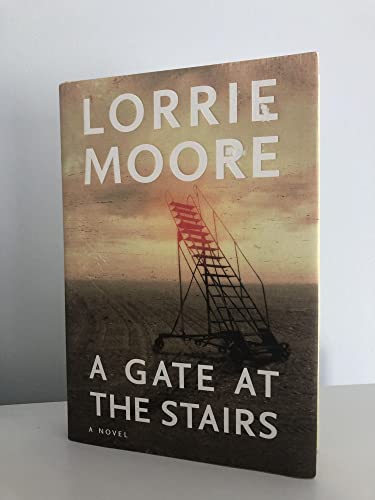
A latest work by the PEN/Malamud-winning author of Who Will Run the Frog Hospital? is set on a small midwestern farm just after the September 11 attacks and finds a twenty-year-old woman coming of age amid such challenges as racism, the War on Terror, and cruelty in the name of love.
Die Inhaltsangabe kann sich auf eine andere Ausgabe dieses Titels beziehen.
Über die Autorin bzw. den Autor
Lorrie Moore is the author of the story collections Birds of America, Like Life, and Self-Help and the novels Who Will Run the Frog Hospital? and Anagrams. Her work has won honors from the Lannan Foundation and the American Academy of Arts and Letters, as well as the Irish Times International Prize for Fiction, the Rea Award for the Short Story, and the PEN/Malamud Award. She is a professor of English at the University of Wisconsin in Madison.
Auszug. © Genehmigter Nachdruck. Alle Rechte vorbehalten.
I
The cold came late that fall and the songbirds were caught off guard. By the time the snow and wind began in earnest, too many had been suckered into staying, and instead of flying south, instead of already having flown south, they were huddled in people’s yards, their feathers puffed for some modicum of warmth. I was looking for a job. I was a student and needed babysitting work, and so I would walk from interview to interview in these attractive but wintry neighborhoods, the eerie multitudes of robins pecking at the frozen ground, dun-gray and stricken—though what bird in the best of circumstances does not look a little stricken—until at last, late in my search, at the end of a week, startlingly, the birds had disappeared. I did not want to think about what had happened to them. Or rather, that is an expression—of politeness, a false promise of delicacy—for in fact I wondered about them all the time: imagining them dead, in stunning heaps in some killing cornfield outside of town, or dropped from the sky in twos and threes for miles down along the Illinois state line.
I was looking in December for work that would begin at the start of the January term. I’d finished my exams and was answering ads from the student job board, ones for “childcare provider.” I liked children—I did!—or rather, I liked them OK. They were sometimes interesting. I admired their stamina and candor. And I was good with them in that I could make funny faces at the babies and with the older children teach them card tricks and speak in the theatrically sarcastic tones that disarmed and en?thralled them. But I was not especially skilled at minding children for long spells; I grew bored, perhaps like my own mother. After I spent too much time playing their games, my mind grew peckish and longed to lose itself in some book I had in my backpack. I was ever hopeful of early bedtimes and long naps.
I had come from Dellacrosse Central, from a small farm on the old Perryville Road, to this university town of Troy, “the Athens of the Midwest,” as if from a cave, like the priest-child of a Colombian tribe I’d read of in Cultural Anthropology, a boy made mystical by being kept in the dark for the bulk of his childhood and allowed only stories—no experience—of the outside world. Once brought out into light, he would be in a perpetual, holy condition of bedazzlement and wonder; no story would ever have been equal to the thing itself. And so it was with me. Nothing had really prepared me. Not the college piggy bank in the dining room, the savings bonds from my grandparents, or the used set of World Book encyclopedias with their beautiful color charts of international wheat production and photographs of presidential birthplaces. The flat green world of my parents’ hogless, horseless farm—its dullness, its flies, its quiet ripped open daily by the fumes and whining of machinery—twisted away and left me with a brilliant city life of books and films and witty friends. Someone had turned on the lights. Someone had led me out of the cave—of Perryville Road. My brain was on fire with Chaucer, Sylvia Plath, Simone de Beauvoir. Twice a week a young professor named Thad, dressed in jeans and a tie, stood before a lecture hall of stunned farm kids like me and spoke thrillingly of Henry James’s masturbation of the comma. I was riveted. I had never before seen a man wear jeans with a tie.
The ancient cave, of course, had produced a mystic; my childhood had produced only me.
In the corridors students argued over Bach, Beck, Balkanization, bacterial warfare. Kids said things to me like “You’re from the country. Is it true that if you eat a bear’s liver you’ll die?” They asked, “Ever know someone who did you-know-what with a cow?” Or “Is it an actual fact that pigs won’t eat bananas?” What I did know was that a goat will not really consume a tin can: a goat just liked to lick the paste on the label. But no one ever asked me that.
From our perspective that semester, the events of September—we did not yet call them 9/11—seemed both near and far. Marching poli-sci majors chanted on the quads and the pedestrian malls, “The chickens have come home to roost! The chickens have come home to roost!” When I could contemplate them at all—the chickens, the roosting—it was as if in a craning crowd, through glass, the way I knew (from Art History) people stared at the Mona Lisa in the Louvre: La Gioconda! its very name like a snake, its sly, tight smile encased at a distance but studied for portentous flickers. It was, like September itself, a cat’s mouth full of canaries. My roommate, Murph—a nose-pierced, hinky-toothed blonde from Dubuque, who used black soap and black dental floss and whose quick opinions were impressively harsh (she pronounced Dubuque “Du-ba-cue”) and who once terrified her English teachers by saying the character she admired most in all of literature was Dick Hickock in In Cold Blood—had met her boyfriend on September tenth and when she woke up at his place, she’d phoned me, in horror and happiness, the television blaring. “I know, I know,” she said, her voice shrugging into the phone. “It was a terrible price to pay for love, but it had to be done.”
I raised my voice to a mock shout. “You sick slut! People were killed. All you think about is your own pleasure.” Then we fell into a kind of hysteria—frightened, guilty, hopeless laughter I have never actually witnessed in women over thirty.
“Well,” I sighed, realizing I might not be seeing her all that much from then on in, “I hope there’s just hanky—no panky.”
“Nah,” she said. “With panky there’s always tears, and it ruins the hanky.” I would miss her.
Though the movie theaters closed for two nights, and for a week even our yoga teacher put up an American flag and sat in front of it, in a lotus position, eyes closed, saying, “Let us now breathe deeply in honor of our great country” (I looked around frantically, never getting the breathing right), mostly our conversations slid back shockingly, resiliently, to other topics: backup singers for Aretha Franklin, or which Korean-owned restaurant had the best Chinese food. Before I’d come to Troy, I had never had Chinese food. But now, two blocks from my apartment, next to a shoe repair shop, was a place called the Peking Café where I went as often as I could for the Buddha’s Delight. At the cash register small boxes of broken fortune cookies were sold at discount. “Only cookie broken,” promised the sign, “not fortune.” I vowed to buy a box one day to see what guidance—obscure or mystical or mercenary but Confucian!—might be had in bulk. Meanwhile, I collected them singly, one per every cookie that came at the end atop my check, briskly, efficiently, before I’d even finished eating. Perhaps I ate too slowly. I’d grown up on Friday fish fries and green beans in butter (for years, my mother had told me, mar- garine, considered a foreign food, could be purchased only across state lines, at “oleo” stands hastily erected along the highway—park here for parkay read the signs—just past the Illinois governor’s welcome billboard, farmers muttering that only Jews bought there). And so now these odd Chinese vegetables—fungal and gnomic in their brown sauce—had the power for me of an adventure or a rite, a statement to be savored. Back in Dellacrosse the dining was divided into “Casual,” which meant you ate it standing up or took it...
„Über diesen Titel“ kann sich auf eine andere Ausgabe dieses Titels beziehen.
Suchergebnisse für A Gate at the Stairs

Beispielbild für diese ISBN
A Gate at the Stairs
Anbieter: World of Books (was SecondSale), Montgomery, IL, USA
Verkäuferbewertung 5 von 5 Sternen

Hardback. Zustand: Good. In her best-selling story collection, Birds of America ( it] will stand by itself as one of our funniest, most telling anatomies of human love and vulnerability -James McManus, front page of The New York Times Book Review), Lorrie Moore wrote about the disconnect between men and women, about the precariousness of women on the edge, and about loneliness and loss.Now, in her dazzling new novel-her first in more than a decade-Moore turns her eye on the anxiety and disconnection of post-9/11 America, on the insidiousness of racism, the blind-sidedness of war, and the recklessness thrust on others in the name of love.As the United States begins gearing up for war in the Middle East, twenty-year-old Tassie Keltjin, the Midwesterndaughter of a gentleman hill farmer-his Keltjin potatoes are justifiably famous-has come to a university town as a college student, her brain on fire with Chaucer, Sylvia Plath, Simone de Beauvoir.Between semesters, she takes a job as a part-time nanny.The family she works for seems both mysterious and glamorous to her, and although Tassie had once found children boring, she comes to care for, and to protect, their newly adopted little girl as her own.As the year unfolds and she is drawn deeper into each of these lives, her own life back home becomes ever more alien to her: her parents are frailer; her brother, aimless and lost in high school, contemplates joining the military. Tassie finds herself becoming more and more the stranger she felt herself to be, and as life and love unravel dramatically, even shockingly, she is forever changed.This long-awaited new novel by one of the most heralded writers of the past two decades is lyrical, funny, moving, and devastating; Lorrie Moore's most ambitious book to date-textured, beguiling, and wise. Artikel-Nr. 00055635699
Gebraucht kaufen
EUR 3,82
Versand gratis
Versand innerhalb von USA
Versand innerhalb von USA
Anzahl: 14 verfügbar
Beispielbild für diese ISBN
A Gate at the Stairs
Anbieter: World of Books (was SecondSale), Montgomery, IL, USA
Verkäuferbewertung 5 von 5 Sternen
Hardback. Zustand: Fair. In her best-selling story collection, Birds of America ( it] will stand by itself as one of our funniest, most telling anatomies of human love and vulnerability -James McManus, front page of The New York Times Book Review), Lorrie Moore wrote about the disconnect between men and women, about the precariousness of women on the edge, and about loneliness and loss.Now, in her dazzling new novel-her first in more than a decade-Moore turns her eye on the anxiety and disconnection of post-9/11 America, on the insidiousness of racism, the blind-sidedness of war, and the recklessness thrust on others in the name of love.As the United States begins gearing up for war in the Middle East, twenty-year-old Tassie Keltjin, the Midwesterndaughter of a gentleman hill farmer-his Keltjin potatoes are justifiably famous-has come to a university town as a college student, her brain on fire with Chaucer, Sylvia Plath, Simone de Beauvoir.Between semesters, she takes a job as a part-time nanny.The family she works for seems both mysterious and glamorous to her, and although Tassie had once found children boring, she comes to care for, and to protect, their newly adopted little girl as her own.As the year unfolds and she is drawn deeper into each of these lives, her own life back home becomes ever more alien to her: her parents are frailer; her brother, aimless and lost in high school, contemplates joining the military. Tassie finds herself becoming more and more the stranger she felt herself to be, and as life and love unravel dramatically, even shockingly, she is forever changed.This long-awaited new novel by one of the most heralded writers of the past two decades is lyrical, funny, moving, and devastating; Lorrie Moore's most ambitious book to date-textured, beguiling, and wise. Artikel-Nr. 00057068185
Gebraucht kaufen
EUR 3,82
Versand gratis
Versand innerhalb von USA
Versand innerhalb von USA
Anzahl: 3 verfügbar
Beispielbild für diese ISBN
A Gate at the Stairs
Verlag:
Knopf (edition First Edition), 2009
ISBN 10: 0375409289
ISBN 13: 9780375409288
Gebraucht
Hardcover
Erstausgabe
Anbieter: BooksRun, Philadelphia, PA, USA
Verkäuferbewertung 5 von 5 Sternen
Hardcover. Zustand: Very Good. First Edition. With dust jacket. It's a well-cared-for item that has seen limited use. The item may show minor signs of wear. All the text is legible, with all pages included. It may have slight markings and/or highlighting. Artikel-Nr. 0375409289-8-18-29
Gebraucht kaufen
EUR 5,49
Versand gratis
Versand innerhalb von USA
Versand innerhalb von USA
Anzahl: 1 verfügbar
Beispielbild für diese ISBN
A Gate at the Stairs
Verlag:
Knopf (edition First Edition), 2009
ISBN 10: 0375409289
ISBN 13: 9780375409288
Gebraucht
Hardcover
Erstausgabe
Anbieter: BooksRun, Philadelphia, PA, USA
Verkäuferbewertung 5 von 5 Sternen
Hardcover. Zustand: Very Good. First Edition. It's a well-cared-for item that has seen limited use. The item may show minor signs of wear. All the text is legible, with all pages included. It may have slight markings and/or highlighting. Artikel-Nr. 0375409289-11-1
Gebraucht kaufen
EUR 5,84
Versand gratis
Versand innerhalb von USA
Versand innerhalb von USA
Anzahl: 1 verfügbar
Beispielbild für diese ISBN
A Gate at the Stairs
Verlag:
Knopf Doubleday Publishing Group, 2009
ISBN 10: 0375409289
ISBN 13: 9780375409288
Gebraucht
Hardcover
Erstausgabe
Anbieter: Better World Books, Mishawaka, IN, USA
Verkäuferbewertung 5 von 5 Sternen
Zustand: Good. 1St Edition. Pages intact with minimal writing/highlighting. The binding may be loose and creased. Dust jackets/supplements are not included. Stock photo provided. Product includes identifying sticker. Better World Books: Buy Books. Do Good. Artikel-Nr. 3222206-75
Gebraucht kaufen
EUR 6,33
Versand gratis
Versand innerhalb von USA
Versand innerhalb von USA
Anzahl: 2 verfügbar
Beispielbild für diese ISBN
A Gate at the Stairs
Verlag:
Knopf Doubleday Publishing Group, 2009
ISBN 10: 0375409289
ISBN 13: 9780375409288
Gebraucht
Hardcover
Erstausgabe
Anbieter: Better World Books, Mishawaka, IN, USA
Verkäuferbewertung 5 von 5 Sternen
Zustand: Good. 1St Edition. Former library copy. Pages intact with minimal writing/highlighting. The binding may be loose and creased. Dust jackets/supplements are not included. Includes library markings. Stock photo provided. Product includes identifying sticker. Better World Books: Buy Books. Do Good. Artikel-Nr. GRP27507605
Gebraucht kaufen
EUR 6,33
Versand gratis
Versand innerhalb von USA
Versand innerhalb von USA
Anzahl: 2 verfügbar
Beispielbild für diese ISBN
A Gate at the Stairs
Anbieter: Wonder Book, Frederick, MD, USA
Verkäuferbewertung 5 von 5 Sternen
Zustand: Very Good. Very Good condition. Good dust jacket. A copy that may have a few cosmetic defects. May also contain light spine creasing or a few markings such as an owner's name, short gifter's inscription or light stamp. Artikel-Nr. M03J-02334
Gebraucht kaufen
EUR 6,40
Versand gratis
Versand innerhalb von USA
Versand innerhalb von USA
Anzahl: 1 verfügbar
Beispielbild für diese ISBN
A Gate at the Stairs
Anbieter: Wonder Book, Frederick, MD, USA
Verkäuferbewertung 5 von 5 Sternen
Zustand: Very Good. Very Good condition. Very Good dust jacket. A copy that may have a few cosmetic defects. May also contain light spine creasing or a few markings such as an owner's name, short gifter's inscription or light stamp. Artikel-Nr. V12B-05089
Gebraucht kaufen
EUR 6,40
Versand gratis
Versand innerhalb von USA
Versand innerhalb von USA
Anzahl: 1 verfügbar
Beispielbild für diese ISBN
A Gate at the Stairs
Anbieter: ThriftBooks-Phoenix, Phoenix, AZ, USA
Verkäuferbewertung 5 von 5 Sternen
Hardcover. Zustand: As New. No Jacket. Pages are clean and are not marred by notes or folds of any kind. ~ ThriftBooks: Read More, Spend Less. Artikel-Nr. G0375409289I2N00
Gebraucht kaufen
EUR 6,50
Versand gratis
Versand innerhalb von USA
Versand innerhalb von USA
Anzahl: 1 verfügbar
Beispielbild für diese ISBN
A Gate at the Stairs
Anbieter: ThriftBooks-Dallas, Dallas, TX, USA
Verkäuferbewertung 5 von 5 Sternen
Hardcover. Zustand: As New. No Jacket. Pages are clean and are not marred by notes or folds of any kind. ~ ThriftBooks: Read More, Spend Less. Artikel-Nr. G0375409289I2N00
Gebraucht kaufen
EUR 6,50
Versand gratis
Versand innerhalb von USA
Versand innerhalb von USA
Anzahl: 1 verfügbar