
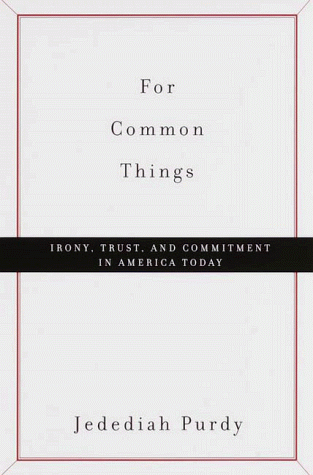
Verwandte Artikel zu For Common Things: Irony, Trust, and Commitment in...
Inhaltsangabe
Calling for a rewewed commitment to and faith in American political and civic life, a blueprint for a sound society assesses the satisfaction of social and political reengagement as it examines such topics as the breakdown of the political process and the ethical and legal complexities of technological development. 35,000 first printing. Tour.
Die Inhaltsangabe kann sich auf eine andere Ausgabe dieses Titels beziehen.
Über die Autorin bzw. den Autor
Jedediah Purdy was born and raised on a hillside farm in Chloe, West Virginia. Home-educated, he later attended Phillips Exeter Academy, then returned to West Virginia after graduating and spent a year working in environmental politics, dividing his time between public policy and community work. Purdy attended college at Harvard, and since finishing his degree has concentrated on writing essays on culture and politics. He is currently studying law, environment, and values at Yale.
Aus dem Klappentext
impressive, this is a twenty-four-year-old writer's ringing and heartfelt plea for renewed commitment to--and faith in--American civic and political life.<br><br>Given the cynicism rampant in America today, Jedediah Purdy's endeavor may seem quixotic. But he persuasively argues the necessity and satisfactions of social and political reengagement and of renewed attention to the "common things" we all have a stake in: the environment, education, culture, law, and government. Drawing on a wide range of sources--from Thoreau to Seinfeld--he contemplates such questions as the use of irony in popular culture, the breakdown of our political processes, and the moral and legal dilemmas posed by technological advances. In these and other discussions, he lures us away from disbelief and detachment toward a sincere devotion to the healing and betterment of society.<br><br>Homeschooled in rural West Virginia, Purdy went on to study at Harvard; this dual experience fuels his lucid and often un
Auszug. © Genehmigter Nachdruck. Alle Rechte vorbehalten.
This book is a response to an ironic time. Irony has become our marker of worldliness and maturity. The ironic individual practices a style of speech and behavior that avoids all appearance of naivete -- of naive devotion, belief, or hope. He subtly protests the inadequacy of the things he says, the gestures he makes, the acts he performs. By the inflection of his voice, the expression of his face, and the motion of his body, he signals that he is aware of all the ways he may be thought silly or jejune, and that he might even think so himself. His wariness becomes a mistrust of language itself. He disowns his own words.
In answer to all that, this book is a plea for the value of declaring hopes that we know to be fragile. It is an argument that those hopes are no less necessary for their fragility, and that permitting ourselves to neglect them is both reckless and impoverishing. My purpose in writing is to take our inhibition seriously, and to ask what would be required to overcome it, to speak earnestly of uncertain hopes.
To do so requires understanding today's ironic manner. There is something fearful in this irony. It is a fear of betrayal, disappointment, and humiliation, and a suspicion that believing, hoping, or caring too much will open us to these. Irony is a way of refusing to rely on such treacherous things. However, there is also something perceptive about irony, and sometimes we must wonder whether the ironist is right. The ironist expresses a perception that the world has grown old, flat, and sterile, and that we are rightly weary of it. There is nothing to delight, move, inspire, or horrify us. Nothing will ever surprise us. Everything we encounter is a remake, a re-release, a ripoff, or a rerun. We know it all before we see it, because we have seen it all already.
What has so exhausted the world for us? For one, we are all exquisitely self-aware. Around us, commercials mock the very idea of commercials, situation comedies make being a sitcom their running joke, and image consultants detail the techniques of designing and marketing a personality as a product. We can have no intimate moment, no private words of affection, empathy, or rebuke that we have not seen pronounced on a thirty-foot screen before an audience of hundreds. We cannot speak of atonement or apology without knowing how those words have been put to cynical, almost morally pornographic use by politicians. Even in solitary encounters with nature, bicycling on a country road or hiking on a mountain path, we reluctant ironists realize that our pleasure in these places has been anticipated by a thousand L. L. Bean catalogues, Ansel Adams calendars, and advertisements promising a portion of the rugged or bucolic life. So we sense an unreal quality in our words and even in our thoughts. They are superficial, they belong to other people and other purposes; they are not ours, and it may be that nothing is properly ours. It is this awareness, and the wish not to rest the weight of our hopes on someone else's stage set, that the ironic attitude expresses.
Irony is a response to something else as well. In roughly the past twenty-five years, politics has gone dead to the imagination. It has ceased being the site of moral and historical drama. It has come to seem petty, tedious, and parochial.
This change would signify less if politics had mattered less than it has in recent decades. However, for more than two hundred years, politics has been among the great sources of inspiration and purpose, giving shape to many lives. From the radical period of the French Revolution onward there has stood the promise that politics can change the human predicament in elemental ways. Politics, on this promise, could erase all the foolish, cruel, maddening accretions of history and replace them with fair and humane arrangements where for the first time people would live as free as they are born. For both the revolutionaries whose ambitions convulsed the world and the crusading reformers of Britain and America, politics was the fulcrum on which women and men could move the lever of history. They needed only a firm place to stand to take up Archimedes' old boast and move the world.
This extraordinary promise attracted the people with the greatest capacity and need for hope, the ones with the keenest sensitivity to suffering and cruelty and the strongest impulse to work against them. Politics was the means by which those who were most keenly aware of what should be could turn that moral truth into historical reality. Politics in effect took over the role of religion for many people in both this century and the last. It gave purpose to individual lives. Its aim of remaking the world carried the promise of redemption, both of whole societies and of the long labors of the individuals who worked to change them. Politics was the way to service, to heroism, and to sainthood.
Because its ambitions ran so far and so deep, politics posed questions that were inescapable for serious people. The questions of what sort of country to live in, what kind of men and women to be, how to work, and sometimes even how to love were all ones that politics promised -- or threatened -- to resolve. The German author Thomas Mann expressed a widely shared perception, which was sometimes reluctant and sometimes enthusiastic, when he wrote, "In our time, the question of man's destiny presents itself in political terms." Not acknowledging that truth meant avoiding the leading drama of the time.
All of that is now so thoroughly gone that it is difficult even to recall. If it is difficult to speak earnestly of personal matters, to speak earnestly about public issues seems perverse: not only naive, but wrongly or confusedly motivated. Politics is now presumed to be the realm of dishonest speech and bad motives. Moreover, it is accepted that everyone sees through the speech, that the motives are as transparent as the new clothes of the fabled emperor. Public life takes on a quality of unbelievable ritual incredulously performed, like the ceremonies of an aged and failing faith, conducted with the old litanies because no others are available and because rote speech is indifferent to its content anyway.
Our private wariness and the public failure of politics are among the sources of our ironic attitude. Understanding them, describing and diagnosing irony, is one of the things that I attempt to do in this book, and is the concern of the first two chapters. The rest of the book is an attempt to express a hope that seems to me too important to let go unacknowledged. I do not believe that, even where it is strongest, irony has convinced us that nothing is real, true, or ours. We believe, when we let ourselves, that there are things we can trust, people we can care for, words we can say in earnest. Irony makes us wary and abashed in our belief. We do not want the things in which we trust to be debunked, belittled, torn down, and we are not sure that they will be safe in the harsh light of a reflexively skeptical time. Nor can we stand the thought that they might be trivialized, brought into someone's ad campaign, movie dialogue, or self-help phrase. So we keep our best hopes safe in the dark of our own unexpressed sentiments and half-forbidden thoughts.
I believe that there is too much at stake in the reality of these thoughts to keep them hidden. They matter too much for us to say of them, by our behavior, that we have outgrown them or never believed them at all. So far as they are true, they are not fragile unless we neglect them. The only way to test their truth, and the best way to sustain them, is to bring them into the world, to think through them, and to act on them.
For me, writing about these things requires writing about West Virginia. I was born and raised there, on a small hillside farm in the steep, ragged foothills of the Appalachian...
„Über diesen Titel“ kann sich auf eine andere Ausgabe dieses Titels beziehen.
Suchergebnisse für For Common Things: Irony, Trust, and Commitment in...

Beispielbild für diese ISBN
For Common Things Irony Trust
Anbieter: World of Books (was SecondSale), Montgomery, IL, USA
Verkäuferbewertung 5 von 5 Sternen

Zustand: Good. Item in good condition. Textbooks may not include supplemental items i.e. CDs, access codes etc. Artikel-Nr. 00093966866
Gebraucht kaufen
EUR 3,44
Versand gratis
Versand innerhalb von USA
Versand innerhalb von USA
Anzahl: 5 verfügbar
Beispielbild für diese ISBN
For Common Things Irony Trust
Anbieter: World of Books (was SecondSale), Montgomery, IL, USA
Verkäuferbewertung 5 von 5 Sternen
Zustand: Very Good. Item in very good condition! Textbooks may not include supplemental items i.e. CDs, access codes etc. Artikel-Nr. 00095499671
Gebraucht kaufen
EUR 3,44
Versand gratis
Versand innerhalb von USA
Versand innerhalb von USA
Anzahl: 3 verfügbar
Beispielbild für diese ISBN
For Common Things Irony Trust
Anbieter: World of Books (was SecondSale), Montgomery, IL, USA
Verkäuferbewertung 5 von 5 Sternen
Zustand: Acceptable. Item in acceptable condition! Textbooks may not include supplemental items i.e. CDs, access codes etc. Artikel-Nr. 00096566426
Gebraucht kaufen
EUR 3,44
Versand gratis
Versand innerhalb von USA
Versand innerhalb von USA
Anzahl: 1 verfügbar
Beispielbild für diese ISBN
For Common Things: Irony, Trust, and Commitment in America Today
Anbieter: BooksRun, Philadelphia, PA, USA
Verkäuferbewertung 5 von 5 Sternen
Hardcover. Zustand: Fair. 1. With dust jacket. The item might be beaten up but readable. May contain markings or highlighting, as well as stains, bent corners, or any other major defect, but the text is not obscured in any way. Artikel-Nr. 0375407081-7-1-29
Gebraucht kaufen
EUR 4,62
Versand gratis
Versand innerhalb von USA
Versand innerhalb von USA
Anzahl: 1 verfügbar
Beispielbild für diese ISBN
For Common Things: Irony, Trust, and Commitment in America Today
Anbieter: BooksRun, Philadelphia, PA, USA
Verkäuferbewertung 5 von 5 Sternen
Hardcover. Zustand: Very Good. 1. With dust jacket. It's a well-cared-for item that has seen limited use. The item may show minor signs of wear. All the text is legible, with all pages included. It may have slight markings and/or highlighting. Artikel-Nr. 0375407081-11-1-29
Gebraucht kaufen
EUR 4,72
Versand gratis
Versand innerhalb von USA
Versand innerhalb von USA
Anzahl: 1 verfügbar
Beispielbild für diese ISBN
For Common Things: Irony, Trust, and Commitment in America Today
Anbieter: ThriftBooks-Dallas, Dallas, TX, USA
Verkäuferbewertung 5 von 5 Sternen
Hardcover. Zustand: Very Good. No Jacket. May have limited writing in cover pages. Pages are unmarked. ~ ThriftBooks: Read More, Spend Less. Artikel-Nr. G0375407081I4N00
Gebraucht kaufen
EUR 5,84
Versand gratis
Versand innerhalb von USA
Versand innerhalb von USA
Anzahl: 1 verfügbar
Beispielbild für diese ISBN
For Common Things: Irony, Trust, and Commitment in America Today
Anbieter: ThriftBooks-Dallas, Dallas, TX, USA
Verkäuferbewertung 5 von 5 Sternen
Hardcover. Zustand: Very Good. No Jacket. Missing dust jacket; May have limited writing in cover pages. Pages are unmarked. ~ ThriftBooks: Read More, Spend Less. Artikel-Nr. G0375407081I4N01
Gebraucht kaufen
EUR 5,84
Versand gratis
Versand innerhalb von USA
Versand innerhalb von USA
Anzahl: 1 verfügbar
Beispielbild für diese ISBN
For Common Things: Irony, Trust, and Commitment in America Today
Anbieter: ThriftBooks-Atlanta, AUSTELL, GA, USA
Verkäuferbewertung 5 von 5 Sternen
Hardcover. Zustand: Very Good. No Jacket. May have limited writing in cover pages. Pages are unmarked. ~ ThriftBooks: Read More, Spend Less. Artikel-Nr. G0375407081I4N00
Gebraucht kaufen
EUR 5,84
Versand gratis
Versand innerhalb von USA
Versand innerhalb von USA
Anzahl: 1 verfügbar
Beispielbild für diese ISBN
For Common Things: Irony, Trust, and Commitment in America Today
Anbieter: ThriftBooks-Reno, Reno, NV, USA
Verkäuferbewertung 5 von 5 Sternen
Hardcover. Zustand: Very Good. No Jacket. May have limited writing in cover pages. Pages are unmarked. ~ ThriftBooks: Read More, Spend Less. Artikel-Nr. G0375407081I4N00
Gebraucht kaufen
EUR 5,84
Versand gratis
Versand innerhalb von USA
Versand innerhalb von USA
Anzahl: 1 verfügbar
Beispielbild für diese ISBN
For Common Things: Irony, Trust, and Commitment in America Today
Anbieter: Wonder Book, Frederick, MD, USA
Verkäuferbewertung 5 von 5 Sternen
Zustand: Very Good. Very Good condition. Good dust jacket. A copy that may have a few cosmetic defects. May also contain light spine creasing or a few markings such as an owner's name, short gifter's inscription or light stamp. Artikel-Nr. K13A-02010
Gebraucht kaufen
EUR 6,19
Versand gratis
Versand innerhalb von USA
Versand innerhalb von USA
Anzahl: 3 verfügbar