
Verwandte Artikel zu After the War
Inhaltsangabe
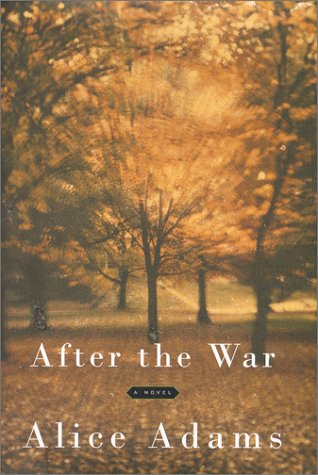
Picking up where A Southern Exposure ended, this final novel by the acclaimed late author describes life in the small Southern town of Pinehill during World War II, as Harry Baird takes off for London to aid the war effort, daughter Abigail heads off to college, and Cynthia finds her life complicated by loneliness, the local racism and anti-Semitism, and a growing fear of Communism. 20,000 first printing.
Die Inhaltsangabe kann sich auf eine andere Ausgabe dieses Titels beziehen.
Über die Autorin bzw. den Autor
Alice Adams was born in Virginia and graduated from Radcliffe College. She was the recipient of an Award in Literature from the American Academy and Institute of Arts and Letters, and received grants from the National Endowment for the Arts and the Guggenheim Foundation. She lived in San Francisco until her death in 1999.
Aus dem Klappentext
is considered to be one of the major American writers of the last thirty years. Her stories appeared in The New Yorker from 1969 and 1995, as well as in twenty-two O. Henry Awards collections and several volumes of Best American Short Stories. After the War is her eleventh and final novel--the brilliant coda to a brilliant career.
After the War begins where her acclaimed novel A Southern Exposure ended: in the small Southern town of Pinehill during World War II. With all the insight and grace that have marked her writing, she brings us close to Cynthia and Harry Baird, transplanted Yankees who moved south from Connecticut during the Depression to find a simpler world for themselves and their daughter, Abigail. But life in Pinehill has become more difficult since the beginning of the war: with Harry off in London to do his share, Cynthia finds her life complicated not only by her own loneliness but also by a growing awarenes
Auszug. © Genehmigter Nachdruck. Alle Rechte vorbehalten.
Chapter One
By mid-August, in the third summer of the Second World War, heavy and relentless heat had yellowed all the grass and almost all the flowers in the little college town of Pinehill, in the middle South. Cynthia Baird, an actively unfaithful Navy wife, contemplated the limp petals that lay beneath what had been a beautiful display of roses, massed blossoms of gold to pink to white -- although she was not thinking of roses, nor actually of the war, but rather of her lover, Derek McFall, the famous war correspondent. Derek, who was tall and blond and not in love with her, not at all. Cynthia thought too of her husband, Harry -- Captain Harry Baird, USN, now in London -- but less often than she thought of Derek; Harry and wartime London, as well as the war itself, were vague to Cynthia, as they were to most of the rest of that town. People there were more aware of the state of Cynthia's lawn and her flowers, of their own lawns and flowers, than of the terrible but distant war. If they had known about Derek and Cynthia, they would have given that some thought, and much talk, but so far they did not.
In the town's view Cynthia was still a transplanted Yankee, from Connecticut; over five years now but her Yankee ways and those of Harry were still remarked on, in Pinehill. And the trouble with the lawn and the flowers was that the Bairds were hardly there in Pinehill anymore, since Harry went up
to Washington to work for the Navy, and then was sent off to London. They actually lived in Washington -- Georgetown, of course; there was a rumor about Cynthia going to law school in Georgetown, but she gave that up, of course, when Harry went to London. Abigail, their daughter, came down to Pinehill more often than they did during the Georgetown days, but she did not do any gardening chores; she came to stay with her friend Melanctha Byrd, and they both went out with a lot of boys. Abigail had always been independent -- "a regular Yankee child, always does pretty much what she wants to, always has."
But now Cynthia lived mostly in Pinehill, and it was too bad that the garden looked so pathetic, especially today: Cynthia was having an important party that she said was for Abigail, and for Melanctha too. The girls were both going up North to college in just a few weeks, Abigail to Swarthmore, a Quaker place that had boys as well, and Melanctha to Radcliffe, the girls' part of Harvard.
What gardening got done at the Bairds' house these days was done by Odessa, the maid. Odessa actually lived at the Bairds', sort of, in the out back -- "real nice of Cynthia to take her in like that, but sort of Yankified, wouldn't you say?" In any case, Odessa had enough to do just keeping the house in shape, not to mention certain problems of her own: a wandering husband, Horace (too bad: Horace was a wonderful gardener, just terrific with flowers, but he'd been off somewhere all summer); a daughter in trouble at the defense plant -- Nellie, Odessa's only child, and no one knew just what kind of trouble, but they had their own ideas.
But the garden was nobody's fault, not Abigail's or Odessa's, but probably the Lord's. Or the war's, like everything else.
Odessa's husband, Horace, was actually in the Navy, in the Pacific Ocean. He was overage but he looked young, and he'd lied about his age, and Odessa saw no point in telling anyone (no one white) where he was, and she never had, not even Miz Baird, who had treated her good. But she sorely missed him, and all she got were little notes sometimes that Horace got some man there with him to write. She didn't even know just where he was, but sometimes on the radio she heard these Japanese-sounding names, Okinawa, Hirohito, and talk about boats and battles, and she was scared, just plumb dumb scared, and not a single thing she could do about it, and not a person to tell. And then Nellie: some white folks' crazy talk about a union over to the plant, which would end up getting her fired, Odessa knew. Some crazy students from over to Hilton. Every time the phone rings in the house, which is not too often these days with them all off somewheres, Odessa was mortally afraid of terrible news: Horace, or Nellie, or even Mr. Baird, off in the Navy too, though not with the same uniform at all that Horace wears.
Cynthia was not looking forward to her party. For one thing, it was planned as a by-the-pool party, and she might not hear the phone from the pool, and Derek might call; all day she has had a strong sense of the imminence of Derek. Odessa will be up at the house to answer some of the time, but there's all the food to bring out, and more glasses and fresh ice -- always something. Odessa could all too easily not hear the phone. Really smart of me, Cynthia thinks, to be waiting like a sixteen-year-old for a phone call --congratulations, dumbbell -- and a phone call from a man who doesn't even love you, he says. She frowns and tries to concentrate on what's to be done.
Sliced cold ham, a notch up from the usual cold fried chicken, and a cold green rice salad, two notches up from potato salad. Odessa's beaten biscuits, locally famous, and Odessa's fresh peach ice cream. Divine.
A nice lunch, the problem being that she doesn't really care for any of the guests -- except of course for the two girls of honor, her own dearest Abigail, who actually has been a considerable pain in the butt, of late, and dear Melanctha Byrd, who at times looks so unnervingly like Russ, and who seems unhappy, poor child. And no wonder, with those great big breasts almost weighing her down -- just like her mother, poor SallyJane. Does Melanctha drink too? Well, probably not yet. But she'll always have trouble buying clothes.
Cynthia herself, a former Vassar Daisy Chain girl, is tall and thin, is made for clothes -- as salesladies have often told her. And Abigail, an inch less tall and a tiny bit heavier than her mother, could wear almost anything if she cared to, but she does not; she does not give a fig about clothes, she wears any old thing and gets by with it because she is so young, and pretty, really (if she'd only do something about her hair).
But the person Cynthia surely does not want to see, who always makes her uncomfortable, is James Russell Lowell Byrd, father of Melanctha. Russ, who was once a famous poet and a playwright, now just writes screenplays, sometimes -- he was the true reason that Cynthia and Harry moved to Pinehill in the first place: Cynthia wanted to meet the poet, she loved his words. And a few years later it had happened, they had had the affair that she had always had in mind. Which had been terrific, in its way, but all that is left of it now is social embarrassment. Discomfort at seeing each other. Russ must feel it too, she is sure, along with guilt; it happened so soon after the death of SallyJane, his wife, mother of Melanctha -- poor SallyJane with the overlarge bosom, who drank too much and then died of the shock treatment they gave her for depression. Now Russ is married to Deirdre, who used to be the most beautiful girl in town, and who had a little boy with Russ before they were married, and now has a little baby girl, unaccountably named SallyJane. Cynthia sighs, and she thinks for the thousandth time, I will never understand the Southern mind, not in any way.
Cynthia does not want to see Russ, nor her supposed best friend, Dolly Bigelow (Dolly is just too idiotic, some of the time) -- nor Jimmy Hightower, another "dear friend," a former Oklahoma oilman who with Russ's help wrote one best-seller. The person she would actually like to see is Esther, Jimmy's wife, who is in New York now doing something with Jewish refugees.
She was glad, Cynthia was, that none of the grown-ups have chosen to wear their bathing suits. They're mostly too old and too fat, a lot of them. Dolly Bigelow is...
„Über diesen Titel“ kann sich auf eine andere Ausgabe dieses Titels beziehen.
Suchergebnisse für After the War

Beispielbild für diese ISBN
After the War
Anbieter: World of Books (was SecondSale), Montgomery, IL, USA
Verkäuferbewertung 5 von 5 Sternen

Zustand: Good. Item in good condition. Textbooks may not include supplemental items i.e. CDs, access codes etc. Artikel-Nr. 00089285512
Gebraucht kaufen
EUR 6,35
Versand gratis
Versand innerhalb von USA
Versand innerhalb von USA
Anzahl: 1 verfügbar
Beispielbild für diese ISBN
After the War
Anbieter: World of Books (was SecondSale), Montgomery, IL, USA
Verkäuferbewertung 5 von 5 Sternen
Zustand: Very Good. Item in very good condition! Textbooks may not include supplemental items i.e. CDs, access codes etc. Artikel-Nr. 00075427826
Gebraucht kaufen
EUR 6,35
Versand gratis
Versand innerhalb von USA
Versand innerhalb von USA
Anzahl: 1 verfügbar
Beispielbild für diese ISBN
After the War
Anbieter: World of Books (was SecondSale), Montgomery, IL, USA
Verkäuferbewertung 5 von 5 Sternen
Zustand: Acceptable. Item in acceptable condition! Textbooks may not include supplemental items i.e. CDs, access codes etc. Artikel-Nr. 00107960865
Gebraucht kaufen
EUR 6,35
Versand gratis
Versand innerhalb von USA
Versand innerhalb von USA
Anzahl: 1 verfügbar
Beispielbild für diese ISBN
After the War
Verlag:
Knopf Doubleday Publishing Group, 2000
ISBN 10: 0375406832
ISBN 13: 9780375406836
Gebraucht
Hardcover
Erstausgabe
Anbieter: Better World Books, Mishawaka, IN, USA
Verkäuferbewertung 5 von 5 Sternen
Zustand: Very Good. 1st. Former library copy. Pages intact with possible writing/highlighting. Binding strong with minor wear. Dust jackets/supplements may not be included. Includes library markings. Stock photo provided. Product includes identifying sticker. Better World Books: Buy Books. Do Good. Artikel-Nr. 14635768-75
Gebraucht kaufen
EUR 6,36
Versand gratis
Versand innerhalb von USA
Versand innerhalb von USA
Anzahl: 2 verfügbar
Beispielbild für diese ISBN
After the War
Anbieter: Wonder Book, Frederick, MD, USA
Verkäuferbewertung 5 von 5 Sternen
Zustand: As New. Like New condition. Like New dust jacket. A near perfect copy that may have very minor cosmetic defects. Artikel-Nr. B01A-03484
Gebraucht kaufen
EUR 6,43
Versand gratis
Versand innerhalb von USA
Versand innerhalb von USA
Anzahl: 1 verfügbar
Beispielbild für diese ISBN
After the War
Anbieter: ThriftBooks-Atlanta, AUSTELL, GA, USA
Verkäuferbewertung 5 von 5 Sternen
Hardcover. Zustand: Fair. No Jacket. Readable copy. Pages may have considerable notes/highlighting. ~ ThriftBooks: Read More, Spend Less. Artikel-Nr. G0375406832I5N00
Gebraucht kaufen
EUR 7,32
Versand gratis
Versand innerhalb von USA
Versand innerhalb von USA
Anzahl: 1 verfügbar
Beispielbild für diese ISBN
After the War
Verlag:
Knopf Doubleday Publishing Group, 2000
ISBN 10: 0375406832
ISBN 13: 9780375406836
Gebraucht
Hardcover
Erstausgabe
Anbieter: Better World Books Ltd, Dunfermline, Vereinigtes Königreich
Verkäuferbewertung 5 von 5 Sternen
Zustand: Good. 1st. Pages intact with minimal writing/highlighting. The binding may be loose and creased. Dust jackets/supplements are not included. Stock photo provided. Product includes identifying sticker. Better World Books: Buy Books. Do Good. Artikel-Nr. 38342954-6
Gebraucht kaufen
EUR 7,31
EUR 5,90 Versand
Versand von Vereinigtes Königreich nach USA
Versand von Vereinigtes Königreich nach USA
Anzahl: 1 verfügbar
Foto des Verkäufers
After the War
Verlag:
Alfred A. Knopf, New York, 2000
ISBN 10: 0375406832
ISBN 13: 9780375406836
Gebraucht
Hardcover
Anbieter: The Haunted Bookshop, LLC, Iowa City, IA, USA
Verkäuferbewertung 5 von 5 Sternen
Hardcover. Zustand: Very Good. Zustand des Schutzumschlags: Very Good. Third Printing. Artikel-Nr. 00081426
Gebraucht kaufen
EUR 9,20
EUR 4,91 Versand
Versand innerhalb von USA
Versand innerhalb von USA
Anzahl: 1 verfügbar
Beispielbild für diese ISBN
After the War
Anbieter: Wonder Book, Frederick, MD, USA
Verkäuferbewertung 5 von 5 Sternen
Zustand: Very Good. First edition copy. . Very Good dust jacket. In protective mylar cover. Artikel-Nr. P13OS-00253
Gebraucht kaufen
EUR 20,65
Versand gratis
Versand innerhalb von USA
Versand innerhalb von USA
Anzahl: 1 verfügbar
Foto des Verkäufers
The Last Lovely City
Verlag:
Alfred A. Knopf, New York, 1999
ISBN 10: 0375406832
ISBN 13: 9780375406836
Gebraucht
Hardcover
Erstausgabe
Anbieter: Between the Covers-Rare Books, Inc. ABAA, Gloucester City, NJ, USA
Verkäuferbewertung 5 von 5 Sternen
Hardcover. Zustand: Fine. Zustand des Schutzumschlags: Fine. First edition. Fine in a fine dust jacket. Advance Review copy, with publishers slip laid in. Artikel-Nr. 567066
Gebraucht kaufen
EUR 18,39
EUR 4,91 Versand
Versand innerhalb von USA
Versand innerhalb von USA
Anzahl: 1 verfügbar