
Verwandte Artikel zu The Popes Against the Jews: The Vatican's Role...
Inhaltsangabe
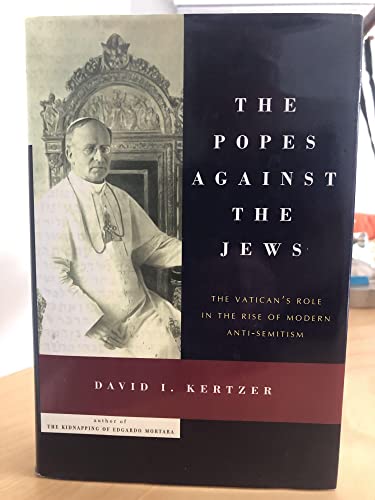
Drawing on preciously hidden Vatican sources and archival materials, a provovative historical study traces the evolution of anti-Semitism in the Catholic Church from the French Revolution to World War II and assesses the Church's role in promoting and deseminating a centuries-long demonization of the Jews throughout Europe that led to the Holocaust. 50,000 first printing.
Die Inhaltsangabe kann sich auf eine andere Ausgabe dieses Titels beziehen.
Über die Autorin bzw. den Autor
Kertzerwas born in 1948 in New York City. He is Paul Dupee, Jr. University Professor of Social Science and a professor of anthropology and Italian studies at Brown University. He is the author of The Kidnapping of Edgardo Mortara, which was a finalist for the National Book Award. He has twice been awarded, in 1985 and 1990, the Marraro Prize from the Society for Italian Historical Studies for the best work on Italian history. He and his wife, Susan, live in Providence.
Aus dem Klappentext
king historical study based on documents previously locked in the Vatican s secret archives: The Popes Against the Jews graphically shows how the Catholic Church helped make the Holocaust possible.
Pope John Paul II, as part of his effort to improve Catholic-Jewish relations, has himself called for a clear-eyed historical investigation into any possible link be-tween the Church and the Holocaust. An important sign of his commitment was the recent decision to allow the distinguished historian David I. Kertzer, a specialist in Italian history, to be one of the first scholars given access to long-sealed Vatican archives.
The result is a book filled with shocking revelations. It traces the Vatican s role in the development of modern anti-Semitism from the nineteenth century up to the outbreak of the Second World War. Kertzer shows why all the recent attention given to Pope Pius XII s failure to publicly protest the slaughter of Europe s Jews in the war mi
Auszug. © Genehmigter Nachdruck. Alle Rechte vorbehalten.
Introduction
Edward Cardinal Cassidy, Australian head of the Vatican's Commission for Religious Relations with the Jews, called in reporters to announce the long-awaited results of his investigation. It was March 16, 1998--eleven years after Pope John Paul II had asked the Commission to determine what responsibility, if any, the Church bore for the slaughter of millions of European Jews during World War II. For the Church, a more explosive subject could hardly be imagined. It had been thirty-five years since Rolf Hochhuth's play The Deputy had first raised the charge of papal complicity in the Holocaust, triggering Catholic outrage worldwide. Yet the suggestion that the Vatican bore any responsibility for what had happened to the Jews continued to grate on Catholic sensibilities. And so nervousness mixed with curiosity as the report was finally released to a public sharply divided between those worried that it might criticize the Church, and those who feared it would not.
Heightening the drama and underlining the significance of the event, the Pope himself wrote an introduction to the report. John Paul II hailed the Commission document--"We Remember: A Reflection on the Shoah"--as an important part of Church preparations for the upcoming millennial celebrations. To properly observe the jubilee, the Pope wrote, the Church's sons and daughters must purify their hearts by examining the responsibility they bore for sins committed in the past. He voiced the hope that by providing an accurate account of past evils, the Commission report would help ensure that such horrors as the Holocaust would never be repeated. The report's preamble echoed this theme, not only stressing the Pope's commitment to repentance for past sins, but also linking the proper understanding of the past to the building of a brighter future.
At the heart of the problem, as the Vatican commissioners recognized, was the fact that the Holocaust had taken place "in countries of long-standing Christian civilization." Might there be some link, they asked, between the destruction of Europe's Jews and "the attitudes down the centuries of Christians toward the Jews"?
Those who feared that the report might criticize past popes or past Church actions were soon relieved to learn that the Commission's answer to this question was a resounding "no." True, the report admitted, Jews had for centuries been discriminated against and used as scapegoats, and, regrettably, certain misguided interpretations of Christian teachings had on occasion nurtured such behavior. But all this regarded an older history, one largely overcome by the beginning of the 1800s.
In the Commission's view, the nineteenth century was the key period for understanding the roots of the Holocaust and, in particular, the reasons why the Church bore no responsibility for it. It was in that turbulent century that new intellectual and political currents associated with extreme nationalism emerged. Amid the economic and social upheavals of the time, people started to accuse Jews of exercising a disproportionate influence. "There thus began to spread," the Commission members argued, "an anti-Judaism that was essentially more sociological and political than religious." This new form of antagonism to the Jews was further shaped by racial theories that first appeared in the latter part of the nineteenth century and reached their terrible apotheosis in the Nazis' glorification of a superior Aryan race. Far from supporting these racist ideologies, the Vatican commissioners asserted, the Church had always condemned them.
And so, according to the report, a crucial distinction must be made. What arose in the late nineteenth century, and sprouted like a poisonous weed in the twentieth, was "anti-Semitism, based on theories contrary to the constant teaching of the Church." This they contrasted with "anti-Judaism," long-standing attitudes of mistrust and hostility of which "Christians also have been guilty," but which, in the Vatican report, had nothing to do with the hatred of the Jews that led to the Holocaust.
When I read the news story of the Vatican press conference, and later read the text of the Commission report, I knew that there was something terribly wrong with the history that the Vatican was recounting. It is a history that many wished had happened, but it is not what actually happened. It is the latter story, sometimes dramatic, sometimes hard to believe, often sad, that I try to tell in the pages that follow.
Just how little this history is known was driven home to me by reader reactions to my recent book The Kidnapping of Edgardo Mortara. The book tells of a six-year-old Jewish boy in Bologna, Italy, who, in 1858, was taken from his family on orders of the local inquisitor. Having been secretly baptized by a servant--or so it was claimed--the boy, the inquisitor argued, was now Catholic and could not remain in a Jewish household.
"You mean there was still an Inquisition in 1858?" readers asked. "I thought the Inquisition was back in the 1500s or 1600s." I also kept hearing--especially from non-Jewish readers--how amazing it was for them to learn that forcing Jews to wear yellow badges and keeping them locked in ghettoes were not inventions of the Nazis in the twentieth century, but a policy that the popes had championed for hundreds of years.
Although various histories of the fraught relations between the Roman Catholic Church and the Jews have been published, most focus on a more remote past. Others examine Church doctrine, engage in biblical exegesis, or analyze various other texts, and so do not capture the actual struggle between the Church and the Jews. Someone, I thought, needed to write a book about the Church and the Jews in modern times, one that would use original archival documents--many never before examined--to tell a story that has remained in important ways unknown.
This last point is worth emphasizing, because while recent scholar- ship--especially in Italy--has brought to light important new information about the Vatican and the Jews, much has remained buried in the archives. In this light, Cardinal Ratzinger's announcement in 1998 that, for the first time, the archives of the Holy Office of the Inquisition were being opened to scholars, offered a once-in-a-lifetime opportunity. Sources never before seen by scholars were now available, offering the tantalizing prospect of new insights into Church history. This book rests heavily on these newly available documents from the Inquisition archives, as well as from other Vatican archives that have become open to researchers in recent years. Together with evidence that has been reported in the specialized scholarly literature--mainly in Italy and France--over the past few years these new sources shed light on a history that until now has remained hidden.
Back in early 1998, news of the impending release of the Vatican report on the Holocaust had brought hope that the Church itself might help rectify the ignorance that surrounded the history of the Church's dealing with the Jews. Pope John Paul II had done much to foster an ecumenical spirit and warmer relations between the Catholic Church and the Jews, and he had called on the Commission to be fearless in confronting the truths of the past. The Commission did not take its task lightly, studying the question for over a decade before formulating its conclusions. Surely, thirty-six years after the Second Vatican Council opened, the time had come for the Church to face up to its own uncomfortable past.
The report's key passage on the rise of modern anti-Semitism explains:
By the end of the eighteenth century and the beginning of the nineteenth century, Jews generally had achieved an equal standing with other...
„Über diesen Titel“ kann sich auf eine andere Ausgabe dieses Titels beziehen.
Suchergebnisse für The Popes Against the Jews: The Vatican's Role...

Beispielbild für diese ISBN
The Popes Against the Jews: The Vatican's Role in the Rise of Modern Anti-Semitism
Anbieter: ThriftBooks-Dallas, Dallas, TX, USA
Verkäuferbewertung 5 von 5 Sternen

Hardcover. Zustand: Good. No Jacket. Pages can have notes/highlighting. Spine may show signs of wear. ~ ThriftBooks: Read More, Spend Less. Artikel-Nr. G0375406239I3N00
Gebraucht kaufen
EUR 5,93
Versand gratis
Versand innerhalb von USA
Versand innerhalb von USA
Anzahl: 1 verfügbar
Beispielbild für diese ISBN
The Popes Against the Jews: The Vatican's Role in the Rise of Modern Anti-Semitism
Anbieter: ThriftBooks-Atlanta, AUSTELL, GA, USA
Verkäuferbewertung 5 von 5 Sternen
Hardcover. Zustand: Fair. No Jacket. Missing dust jacket; Readable copy. Pages may have considerable notes/highlighting. ~ ThriftBooks: Read More, Spend Less. Artikel-Nr. G0375406239I5N01
Gebraucht kaufen
EUR 5,93
Versand gratis
Versand innerhalb von USA
Versand innerhalb von USA
Anzahl: 1 verfügbar
Beispielbild für diese ISBN
The Popes Against the Jews: The Vatican's Role in the Rise of Modern Anti-Semitism
Anbieter: ThriftBooks-Dallas, Dallas, TX, USA
Verkäuferbewertung 5 von 5 Sternen
Hardcover. Zustand: Good. No Jacket. Former library book; Pages can have notes/highlighting. Spine may show signs of wear. ~ ThriftBooks: Read More, Spend Less. Artikel-Nr. G0375406239I3N10
Gebraucht kaufen
EUR 5,93
Versand gratis
Versand innerhalb von USA
Versand innerhalb von USA
Anzahl: 1 verfügbar
Beispielbild für diese ISBN
The Popes Against the Jews: The Vatican's Role in the Rise of Modern Anti-Semitism
Anbieter: ThriftBooks-Atlanta, AUSTELL, GA, USA
Verkäuferbewertung 5 von 5 Sternen
Hardcover. Zustand: Good. No Jacket. Missing dust jacket; Pages can have notes/highlighting. Spine may show signs of wear. ~ ThriftBooks: Read More, Spend Less. Artikel-Nr. G0375406239I3N01
Gebraucht kaufen
EUR 5,93
Versand gratis
Versand innerhalb von USA
Versand innerhalb von USA
Anzahl: 1 verfügbar
Beispielbild für diese ISBN
The Popes Against the Jews: The Vatican's Role in the Rise of Modern Anti-Semitism
Verlag:
Knopf (edition First Edition), 2001
ISBN 10: 0375406239
ISBN 13: 9780375406232
Gebraucht
Hardcover
Erstausgabe
Anbieter: BooksRun, Philadelphia, PA, USA
Verkäuferbewertung 5 von 5 Sternen
Hardcover. Zustand: Fair. First Edition. With dust jacket. The item might be beaten up but readable. May contain markings or highlighting, as well as stains, bent corners, or any other major defect, but the text is not obscured in any way. Ex-Library. Artikel-Nr. 0375406239-7-1-12_29
Gebraucht kaufen
EUR 6,20
Versand gratis
Versand innerhalb von USA
Versand innerhalb von USA
Anzahl: 1 verfügbar
Beispielbild für diese ISBN
The Popes Against the Jews: The Vatican's Role in the Rise of Modern Anti-Semitism
Anbieter: Wonder Book, Frederick, MD, USA
Verkäuferbewertung 5 von 5 Sternen
Zustand: Very Good. Very Good condition. Very Good dust jacket. A copy that may have a few cosmetic defects. May also contain light spine creasing or a few markings such as an owner's name, short gifter's inscription or light stamp. Artikel-Nr. F01F-03977
Gebraucht kaufen
EUR 6,35
Versand gratis
Versand innerhalb von USA
Versand innerhalb von USA
Anzahl: 2 verfügbar
Beispielbild für diese ISBN
The Popes Against the Jews : The Vatican's Role in the Rise of Modern Anti-Semitism
Verlag:
Knopf Doubleday Publishing Group, 2001
ISBN 10: 0375406239
ISBN 13: 9780375406232
Gebraucht
Hardcover
Anbieter: Better World Books, Mishawaka, IN, USA
Verkäuferbewertung 5 von 5 Sternen
Zustand: Good. Pages intact with minimal writing/highlighting. The binding may be loose and creased. Dust jackets/supplements are not included. Stock photo provided. Product includes identifying sticker. Better World Books: Buy Books. Do Good. Artikel-Nr. 3940521-6
Gebraucht kaufen
EUR 6,43
Versand gratis
Versand innerhalb von USA
Versand innerhalb von USA
Anzahl: 3 verfügbar
Beispielbild für diese ISBN
The Popes Against the Jews : The Vatican's Role in the Rise of Modern Anti-Semitism
Verlag:
Knopf Doubleday Publishing Group, 2001
ISBN 10: 0375406239
ISBN 13: 9780375406232
Gebraucht
Hardcover
Anbieter: Better World Books, Mishawaka, IN, USA
Verkäuferbewertung 5 von 5 Sternen
Zustand: Good. Former library copy. Pages intact with minimal writing/highlighting. The binding may be loose and creased. Dust jackets/supplements are not included. Includes library markings. Stock photo provided. Product includes identifying sticker. Better World Books: Buy Books. Do Good. Artikel-Nr. 3222793-6
Gebraucht kaufen
EUR 6,43
Versand gratis
Versand innerhalb von USA
Versand innerhalb von USA
Anzahl: 3 verfügbar
Beispielbild für diese ISBN
The Popes Against The Jews - The Vatican's Role In The Rise Of Modern Anti-semitism
Anbieter: Books From California, Simi Valley, CA, USA
Verkäuferbewertung 4 von 5 Sternen

Paperback. Zustand: Good. Artikel-Nr. mon0003264427
Gebraucht kaufen
EUR 3,62
EUR 4,40 Versand
Versand innerhalb von USA
Versand innerhalb von USA
Anzahl: 1 verfügbar
Beispielbild für diese ISBN
The Popes Against The Jews - The Vatican's Role In The Rise Of Modern Anti-semitism
Anbieter: Books From California, Simi Valley, CA, USA
Verkäuferbewertung 4 von 5 Sternen
Paperback. Zustand: Very Good. Minimal wear and handling. Artikel-Nr. mon0002989183
Gebraucht kaufen
EUR 3,62
EUR 4,40 Versand
Versand innerhalb von USA
Versand innerhalb von USA
Anzahl: 1 verfügbar