
Verwandte Artikel zu Exuberance: The Passion for Life
Inhaltsangabe
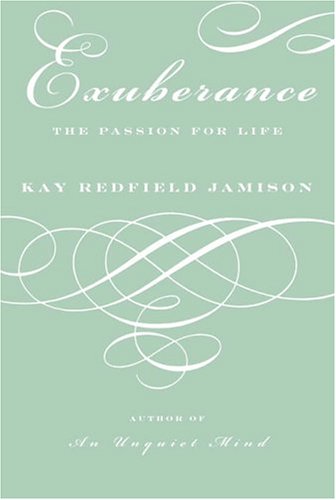
An international expert in the field of mood disorders and best-selling author of An Unquiet Mind explores the role of exuberance in humankind's most important creative and scientific accomplishments, discussing the nature of exuberance and its relationship to intellectual curiosity, creativity, risk-taking, and survival.
Die Inhaltsangabe kann sich auf eine andere Ausgabe dieses Titels beziehen.
Über die Autorinnen und Autoren
Kay Redfield Jamison is Professor of Psychiatry at the Johns Hopkins University School of Medicine as well as Honorary Professor of English at the University of St. Andrews in Scotland. She is the author of the national best sellers An Unquiet Mind: A Memoir of Moods and Madness, Night Falls Fast: Understanding Suicide, and Touched with Fire: Manic-Depressive Illness and the Artistic Temperament. She is coauthor of the standard medical text on manic-depressive illness and author or coauthor of more than one hundred scientific papers about mood disorders, creativity, and psychopharmacology. Dr. Jamison, the recipient of numerous national and international scientific awards, was distinguished lecturer at Harvard University in 2002 and the Litchfield lecturer at the University of Oxford in 2003. She is a John P. and Catherine T. MacArthur Fellow.
Kay Redfield Jamison is Professor of Psychiatry at the Johns Hopkins University School of Medicine as well as Honorary Professor of English at the University of St. Andrews in Scotland.
Aus dem Klappentext
The author of the bestselling An Unquiet Mind and internationally renowned authority on mood disorders now gives us something wonderfully different: an exploration of exuberance and how it fuels our most important creative and scientific achievements.
John Muir s lifelong passion to save America s wild places, Wilson Bentley s legendary obsession to record for posterity the beauty of individual snowflakes, the boundless scientific curiosity behind Watson and Crick s discovery of DNA, sea lions that surf and porcupines that dance Kay Redfield Jamison shows how these and many more examples both human and animal define the nature of exuberance, and how this exuberance relates to intellectual searching, risk-taking, creativity, and survival itself. She examines the hereditary predisposition to exuberance; the role of the brain chemical dopamine; the connection between positive moods and psychological resilience; and the differences between exuberance and mania. She delves into some of the phenomena of exuberance the contagiousness of laughter, the giddiness of new love, the intoxicating effects of music and of religious ecstasy while also addressing the dangerous desire to simulate exuberance by using drugs or alcohol. In a fascinating and intimate coda to the rest of the book, renowned scientists, writers, and politicians share their thoughts on the forms and role of exuberance in their own lives.
Original, inspiring, authoritative, Exuberance brims with the very energy and passion that it celebrates.
Auszug. © Genehmigter Nachdruck. Alle Rechte vorbehalten.
Chapter One
"Incapable of Being Indifferent"
It is a curious request to make of God. Shield your joyous ones, asks the Anglican prayer: Shield your joyous ones. God more usually is asked to watch over those who are ill or in despair, as indeed the rest of the prayer makes clear. "Watch now those who weep this day," it goes. "Rest your weary ones; soothe your suffering ones." The joyous tend to be left to their own devices, the exuberant even more so.
Perhaps this is just as well. Those inclined toward exuberance have enjoyed the benign neglect of my field. Psychologists, for reasons of clinical necessity or vagaries of temperament, have chosen to dissect and catalogue the morbid emotions-depression, anger, anxiety-and to leave largely unexamined the more vital, positive ones. Not unlike God, if only in this one regard, my colleagues and I have tended more to those in the darkness than to those in the light. We have given sorrow many words, but a passion for life few.
Yet it is the infectious energies of exuberance that proclaim and disperse much of what is marvelous in life. Exuberance carries us places we would not otherwise go-across the savannah, to the moon, into the imagination-and if we ourselves are not so exuberant we will, caught up in the contagious joy of those who are,
be inclined collectively to go yonder. By its pleasures, exuberance lures us from our common places and quieter moods; and-after the victory, the harvest, the discovery of a new idea or an unfamiliar place-it gives ascendant reason to venture forth all over again. Delight is its own reward, adventure its own pleasure.
Exuberance is an abounding, ebullient, effervescent emotion. It is kinetic and unrestrained, joyful, irrepressible. It is not happiness, although they share a border. It is instead, at its core, a more restless, billowing state. Certainly it is no lulling sense of contentment: exuberance leaps, bubbles, and overflows, propels its energy through troop and tribe. It spreads upward and outward, like pollen toted by dancing bees, and in this carrying ideas are moved and actions taken. Yet exuberance and joy are fragile matter. Bubbles burst; a wince of disapproval can cut dead a whistle or abort a cartwheel. The exuberant move above the horizon, exposed and vulnerable.
Exuberance keeps occasional company with grief, though grief may command the greater mention. Blake's belief that "Under every grief & pine/Runs a joy with silken twine" is a received theme in folklore. Our greatest joys and sorrows ripen on the same vine, says the American proverb. Danger and delight grow on one stalk, maintains the English one. Intense emotions inhabit a correspondent territory: joy may be our wings and sorrow our spurs, but the boundaries between the moods are open. Wings and high moods are shivery things; the joyous do indeed need shielding.
Exuberance is a vital emotion; it demands not only defense but exposure, for despair far more than joy has found sympathy with poets and scholars. Joy lacks the gravitas that suffering so effortlessly commands. Joy without reflection is evanescent; without counterweight, it has no weight at all. Or so one would think.
Yet joy is essential to our existence. Exuberance, joy's more energetic relation, occupies an ancient region of our mammalian selves, and one to which we owe in no small measure our survival and triumphs. It is a material part of our pursuits-love, games, hunting and war, exploration-and it is a vibrant force to signal victory, proclaim a time to quicken, to draw together, to exult, to celebrate. Exuberance is ancient, material, and profound. "The Greeks understood the mysterious power of the hidden side of things," wrote Louis Pasteur. "They bequeathed to us one of the most beautiful words in our language-the word 'enthusiasm'-en theos-a god within. The grandeur of human actions is measured by the inspiration from which they spring. Happy is he who bears a god within, and who obeys it."
Like many essential human traits, exuberance is teeming in some and not to be caught sight of in others. For a few, exuberance is in the blood, an irrepressible life force. It may ebb and flow, but the underlying capacity for joy is as much a part of the person as having green eyes or a long waist. For them, as the psalm promises, a full joy cometh in the morning. Not so for most others. Exuberance is a more occasional thing, something to be experienced only at splendid moments of love or attainment, or known in youth but lost with time. The nonexuberant lack fizz and risibility: they need to be lifted up on the enthusiasm of others; roused by dance or drug; impelled by music. They do not kindle of their own accord.
Variation in temperament is necessary. Exuberance, indiscriminately apportioned, is anarchical. If all were effervescent, the world would be an exhausting and chaotic place, driven to incoherence by competing enthusiasms or becalmed by indifference to the day-to-day requirements of life. Our species, like most, is well served by a diversity of temperaments, a variety of energies and moods. Exuberance is a fermenting, pushing-upward-and-forward force, but sometimes fixity is critical to survival. The joyous, and the not so, need one another in order to survive.
I believe that exuberance is incomparably more important than we acknowledge. If, as it has been claimed, enthusiasm finds the opportunities and energy makes the most of them, a mood of mind that yokes the two is formidable indeed. Exuberant people take in the world and act upon it differently than those who are less lively and less energetically engaged. They hold their ideas with passion and delight, and they act upon them with dispatch. Their love of life and of adventure is palpable. Exuberance is a peculiarly pleasurable state, and in that pleasure is power.
"Why should man want to fly at all?" asked Charles Lindbergh. "People often ask these questions. But what civilization was not founded on adventure, and how long could one exist without it? Some answer the attainment of knowledge. Some say wealth, or power, is sufficient cause. I believe the risks I take are justified by the sheer love of the life I lead." Man's exuberant spirit of adventure, Lindbergh argued elsewhere, is beyond his power to control. "Our earliest records," he said, "tell of biting the apple and baiting the dragon, regardless of hardship or of danger, and from this inner drive, perhaps, progress and civilization developed. We moved from land to sea, to air, to space, era on era, our aspirations rising."
Psychologists, who in recent years have taken up the study of positive emotions, find that joy widens one's view of the world and expands imaginative thought. It activates. It makes both physical and intellectual exploration more likely, and it provides reward for problems solved or risks taken. Through its positive energies, it heals as well. One joy, the Chinese believe, scatters a hundred griefs, and certainly it can be an antidote to fatigue and discouragement. Into those set back by failure, joy transfuses hope.
Exuberance is also, at its quick, contagious. As it spreads pell-mell throughout a group, exuberance excites, it delights, and it dispels tension. It alerts the group to change and possibility. Ted Turner, who would know, believes a leader is someone with the ability to "create infectious enthusiasm." This is a defining quality of great teachers, statesmen, and adventurers. Put to good use, infectious enthusiasm is a wonderful thing; used badly, it is calamitous.
Mostly, exuberance is a bounty and a blessing. It has its dangers, and we shall examine them in depth, but it is, all told, an amazing thing. Amazing and, on occasion, transfiguring. This...
„Über diesen Titel“ kann sich auf eine andere Ausgabe dieses Titels beziehen.
Suchergebnisse für Exuberance: The Passion for Life

Beispielbild für diese ISBN
Exuberance: The Passion for Life
Anbieter: World of Books (was SecondSale), Montgomery, IL, USA
Verkäuferbewertung 5 von 5 Sternen

Zustand: Good. Item in good condition and has highlighting/writing on text. Used texts may not contain supplemental items such as CDs, info-trac etc. Artikel-Nr. 00106088674
Gebraucht kaufen
EUR 3,73
Versand gratis
Versand innerhalb von USA
Versand innerhalb von USA
Anzahl: 1 verfügbar
Beispielbild für diese ISBN
Exuberance: The Passion for Life
Anbieter: World of Books (was SecondSale), Montgomery, IL, USA
Verkäuferbewertung 5 von 5 Sternen
Zustand: Good. Item in good condition. Textbooks may not include supplemental items i.e. CDs, access codes etc. Artikel-Nr. 00094618561
Gebraucht kaufen
EUR 3,75
Versand gratis
Versand innerhalb von USA
Versand innerhalb von USA
Anzahl: 7 verfügbar
Beispielbild für diese ISBN
Exuberance: The Passion for Life
Anbieter: World of Books (was SecondSale), Montgomery, IL, USA
Verkäuferbewertung 5 von 5 Sternen
Zustand: Very Good. Item in very good condition! Textbooks may not include supplemental items i.e. CDs, access codes etc. Artikel-Nr. 00104689430
Gebraucht kaufen
EUR 3,75
Versand gratis
Versand innerhalb von USA
Versand innerhalb von USA
Anzahl: 2 verfügbar
Beispielbild für diese ISBN
Exuberance: The Passion for Life
Anbieter: World of Books (was SecondSale), Montgomery, IL, USA
Verkäuferbewertung 5 von 5 Sternen
Zustand: Acceptable. Item in good condition. Textbooks may not include supplemental items i.e. CDs, access codes etc. Artikel-Nr. 00065012799
Gebraucht kaufen
EUR 3,75
Versand gratis
Versand innerhalb von USA
Versand innerhalb von USA
Anzahl: 1 verfügbar
Beispielbild für diese ISBN
Exuberance: The Passion for Life
Verlag:
Knopf (edition First Edition), 2004
ISBN 10: 037540144X
ISBN 13: 9780375401442
Gebraucht
Hardcover
Erstausgabe
Anbieter: BooksRun, Philadelphia, PA, USA
Verkäuferbewertung 5 von 5 Sternen
Hardcover. Zustand: Very Good. First Edition. With dust jacket. It's a well-cared-for item that has seen limited use. The item may show minor signs of wear. All the text is legible, with all pages included. It may have slight markings and/or highlighting. Artikel-Nr. 037540144X-11-1-29
Gebraucht kaufen
EUR 4,72
Versand gratis
Versand innerhalb von USA
Versand innerhalb von USA
Anzahl: 1 verfügbar
Beispielbild für diese ISBN
Exuberance: The Passion for Life
Verlag:
Knopf (edition First Edition), 2004
ISBN 10: 037540144X
ISBN 13: 9780375401442
Gebraucht
Hardcover
Erstausgabe
Anbieter: BooksRun, Philadelphia, PA, USA
Verkäuferbewertung 5 von 5 Sternen
Hardcover. Zustand: Fair. First Edition. With dust jacket. The item might be beaten up but readable. May contain markings or highlighting, as well as stains, bent corners, or any other major defect, but the text is not obscured in any way. Artikel-Nr. 037540144X-7-1-29
Gebraucht kaufen
EUR 5,30
Versand gratis
Versand innerhalb von USA
Versand innerhalb von USA
Anzahl: 1 verfügbar
Beispielbild für diese ISBN
Exuberance: The Passion for Life
Anbieter: ThriftBooks-Atlanta, AUSTELL, GA, USA
Verkäuferbewertung 5 von 5 Sternen
Hardcover. Zustand: Good. No Jacket. Pages can have notes/highlighting. Spine may show signs of wear. ~ ThriftBooks: Read More, Spend Less. Artikel-Nr. G037540144XI3N00
Gebraucht kaufen
EUR 5,88
Versand gratis
Versand innerhalb von USA
Versand innerhalb von USA
Anzahl: 1 verfügbar
Beispielbild für diese ISBN
Exuberance: The Passion for Life
Anbieter: ThriftBooks-Atlanta, AUSTELL, GA, USA
Verkäuferbewertung 5 von 5 Sternen
Hardcover. Zustand: Very Good. No Jacket. May have limited writing in cover pages. Pages are unmarked. ~ ThriftBooks: Read More, Spend Less. Artikel-Nr. G037540144XI4N00
Gebraucht kaufen
EUR 5,88
Versand gratis
Versand innerhalb von USA
Versand innerhalb von USA
Anzahl: 1 verfügbar
Beispielbild für diese ISBN
Exuberance : The Passion for Life
Verlag:
Knopf Doubleday Publishing Group, 2004
ISBN 10: 037540144X
ISBN 13: 9780375401442
Gebraucht
Hardcover
Erstausgabe
Anbieter: Better World Books, Mishawaka, IN, USA
Verkäuferbewertung 5 von 5 Sternen
Zustand: Very Good. 1st Edition. Former library copy. Pages intact with possible writing/highlighting. Binding strong with minor wear. Dust jackets/supplements may not be included. Includes library markings. Stock photo provided. Product includes identifying sticker. Better World Books: Buy Books. Do Good. Artikel-Nr. GRP94276094
Gebraucht kaufen
EUR 6,20
Versand gratis
Versand innerhalb von USA
Versand innerhalb von USA
Anzahl: 1 verfügbar
Beispielbild für diese ISBN
Exuberance : The Passion for Life
Verlag:
Knopf Doubleday Publishing Group, 2004
ISBN 10: 037540144X
ISBN 13: 9780375401442
Gebraucht
Hardcover
Erstausgabe
Anbieter: Better World Books, Mishawaka, IN, USA
Verkäuferbewertung 5 von 5 Sternen
Zustand: Good. 1st Edition. Former library copy. Pages intact with minimal writing/highlighting. The binding may be loose and creased. Dust jackets/supplements are not included. Includes library markings. Stock photo provided. Product includes identifying sticker. Better World Books: Buy Books. Do Good. Artikel-Nr. GRP21204515
Gebraucht kaufen
EUR 6,20
Versand gratis
Versand innerhalb von USA
Versand innerhalb von USA
Anzahl: 1 verfügbar